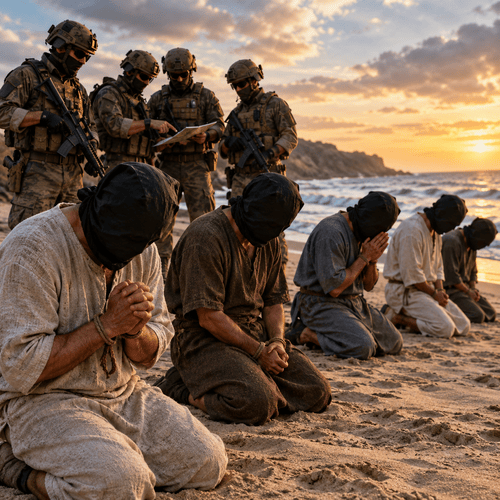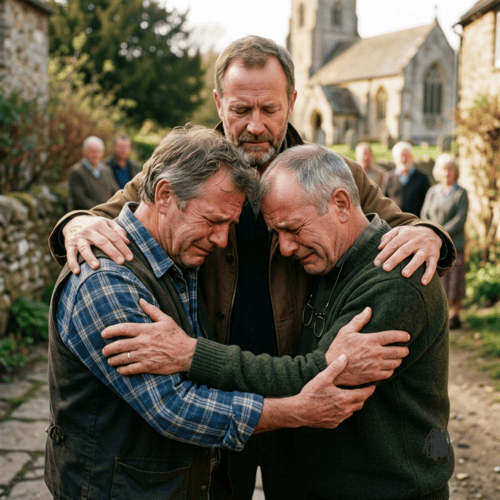
‘Peacemaker’ was an emperor’s title. Rome celebrated it on its coins.
The empire had built its peace the usual way—by killing everyone who objected and then congratulating itself on the quiet. Tacitus later captured the irony in the words he put into the mouth of a British leader: “They make a wasteland and call it peace.”
Jesus took that word and gave it to a crowd of ordinary Galileans—people with no army, no political power, and no ability to force peace on anyone. And then comes the striking part: the very next beatitude says they will be persecuted.
That matters. Whatever Jesus meant by “Blessed are the peacemakers,” it can’t mean simply creating peace by having enough power to impose it. The persecution that follows is part of the meaning.
Two Kinds of Peace
The Latin pax and the Hebrew shalom aren’t the same idea. The gap between them explains most of what this beatitude is doing.
Roman peace was the absence of resistance. It was a real achievement of a kind—roads were safe, trade moved, the frontier held—but it was produced by force and maintained by the credible threat of more. Nothing was reconciled. Opposition was simply removed.
Shalom runs the other way. It’s not primarily the absence of anything but the presence of something: wholeness, right relationship, things functioning as they were meant to. When a Hebrew asked after the shalom of a person’s flocks or family, he means roughly, “Is everything as it should be?” Peace in this sense can’t be imposed, because it consists of relationships being right rather than resistance being suppressed.
Scripture is severe about the difference. Jeremiah’s complaint against the false prophets of his day wasn’t that they were pessimists but that they were reassurers: they healed the wound of God’s people lightly, saying peace, peace, when there was no peace (Jeremiah 6:14). That’s an indictment of professional peacekeeping. The prophets weren’t lying about facts so much as declaring a settlement that hadn’t yet happened.
Jesus is blessing people who make the second kind. This is why the beatitude is so much more demanding than it sounds. Producing quiet is a matter of power. Producing shalom is a matter of cost. And the difference runs through everything that follows.
The Only Other Time This Word Appears
The Greek noun for ‘reconciler’ Matthew uses here—eirēnopoioi—occurs nowhere else in the New Testament. Its verb form appears exactly once, and where it appears is the most useful commentary available on this verse.
Paul writes God was pleased through Christ to reconcile all things to Himself, “making peace by the blood of His cross” (Colossians 1:20). That’s the word. The single other use of this vocabulary in the New Testament describes what God did at Calvary.
The choice of vocabulary is itself worth noticing. Greek had ordinary ways of saying reconciler, mediator or arbitrator, and Matthew used none of them. He used a compound word associated in the surrounding culture with rulers who ended wars. The New Testament then reserves its only other use for the cross.
This settles the definition more firmly than any word study could. Peacemaking, in the New Testament’s own usage, isn’t the management of tension or the smoothing of atmospheres. It’s the costly work of reconciling parties who were genuinely estranged, achieved by someone absorbing the cost personally rather than distributing it between them.
James supplies the agricultural version of the same idea: a harvest of righteousness is sown in peace by those who make peace (James 3:18). Sowing is the relevant image. It’s slow, it’s done in conditions that give no immediate return, and the person doing it won’t see the result in the same season. Most real peacemaking has that shape, which is why it’s so much less satisfying than winning an argument and so much more durable.
Paul develops the same picture elsewhere. Christ is described as our peace, having broken down the dividing wall of hostility and killed the hostility in Himself (Ephesians 2:14–16). Note where the hostility goes. It’s not negotiated down or split fairly. It’s absorbed by the one making the peace, and it dies in Him.
THE DEFINITION THE NEW TESTAMENT SUPPLIES
The only other use of this word group for ‘peacemaker’ describes God “making peace by the blood of His cross”. Peacemaking is reconciliation paid for by the one who makes it.
Peacemaking Isn’t Peacekeeping
The two are routinely confused. One of them is far cheaper than the other.
Two Responses to Conflict
| Aspect | PEACEKEEPING | PEACEMAKING |
|---|---|---|
| Aim | Restore quiet | Restore relationship |
| Method | Avoid, defer, smooth over | Name the wrong, absorb cost, pursue reconciliation |
| Truth | Managed, often suppressed | Required, however awkward |
| Cost | Borne by whoever is easiest to silence | Borne by the peacemaker |
| Result | Surface calm, unresolved grievance | Genuine repair, or an honest impasse |
The last row is worth sitting with. Peacemaking doesn’t guarantee resolution. It guarantees only that whatever remains is honest, which is a considerably better outcome than a truce built on things nobody’s allowed to mention.
But Didn’t Jesus Say He Came to Bring a Sword?
5 chapters after blessing the peacemakers, the same Gospel records Jesus saying this: “Do not think that I have come to bring peace to the earth. I have not come to bring peace, but a sword” (Matthew 10:34). He goes on to describe families divided by allegiance to Him.
The resolution lies in distinguishing what’s being reconciled from what’s being divided. Peace with God is offered to everyone and produces, wherever it’s received, a real division from everyone who rejects it. That division isn’t the peacemaker’s project; it’s the predictable consequence of a claim that can’t be held loosely. A person who declines to say anything that might divide hasn’t achieved peace. He has achieved silence, which the Roman authorities also achieved and which Jesus didn’t commend.
There’s a further distinction worth drawing here. Jesus divided people by telling the truth about Himself; He didn’t divide them by being needlessly abrasive, and the New Testament repeatedly asks believers to distinguish between offence caused by the message and offence caused by the messenger. A great deal of conflict that Christians describe as unavoidable turns out, on inspection, to belong to the second category. The sword in Matthew 10 isn’t a licence for a combative temperament.
Paul builds the same realism into his instruction. The qualifiers repay attention: “If possible, so far as it depends on you, live peaceably with all” (Romans 12:18). Two limits in one sentence. It isn’t always possible, and it doesn’t always depend on us. Scripture never asks believers to secure an outcome that requires another person’s cooperation. It asks them to do everything on their own side of the line.
Matthew’s Order of Operations
Matthew is unusually practical about this. Peacemaking in his Gospel isn’t a disposition but a procedure. And it has a sequence.
The initiative belongs to whoever becomes aware of the breach. “If you are at the altar and remember that your brother has something against you, the instruction is to leave the gift and go (Matthew 5:23–24). Note the direction: it’s not that we have something against him but that he has something against us. The obligation falls on the person who has caused offence, and it interrupts worship to do so.
That instruction is more radical than it first appears. Ordinary conflict resolution places the burden on the injured party to raise the matter; Jesus places it on the person who caused the offence, and requires him to act on the strength of a recollection rather than a complaint. He’s not waiting to be approached. He remembers, mid-worship, that someone has a grievance, and he goes. A congregation in which that instruction were widely obeyed would have very few long-running disputes, because most of them survive on the assumption the other party should come first.
The second move is that the conversation starts small. “If your brother sins against you, go and tell him his fault, between the two of you alone” (Matthew 18:15). Private first, then widening only as necessary. Most failed peacemaking in churches fails at exactly this point—when the process begins with a third party.
The third move is that the process widens only as far as it must. Matthew 18 goes on to describe involving one or two others, and then the congregation, but each stage is a reluctant escalation rather than a natural next step. The design assumes most breaches should be settled at the smallest scale that can settle them, and that every additional person drawn in makes retreat harder for whoever needs to retreat.
Behind both is an order that runs vertically before it runs horizontally. Peace with God comes first—justified by faith, we have peace with God through our Lord Jesus Christ (Romans 5:1)—and horizontal peacemaking follows as a derivative activity. Paul describes believers as having received a ministry of reconciliation and as serving as ambassadors (2 Corinthians 5:18–20). This is precisely the language of someone acting on behalf of a peace they didn’t negotiate.
Why ‘Sons of God’ and Not Something Else
Every other beatitude promises a possession or a change of condition: the kingdom, comfort, an inheritance, satisfaction, mercy, the sight of God. This one promises a name.
The phrase draws on a Semitic idiom in which ‘son of’ designates character rather than mere parentage. Jesus nicknamed James and John Sons of Thunder. The early church called Joseph of Cyprus Barnabas, son of encouragement. Paul writes of the sons of disobedience. In each case the construction identifies someone by the quality that characterises them.
So the promise isn’t that peacemakers earn adoption. Sonship in the New Testament is given, not achieved, and this beatitude sits in a list that has spent four verses establishing its subjects have nothing to trade. The promise is recognition: they shall be called sons of God because the resemblance will be unmistakable.
There’s also a quiet comfort in the passive construction. They shall be called—by someone else. Peacemakers are notoriously bad at assessing their own work, partly because the job leaves them bruised by both parties and partly because success in it is often invisible for years. The verse doesn’t ask them to award themselves the title. It says the recognition will come, but it doesn’t say when.
That’s a striking thing to attach to this particular activity. Of all the things God does, reconciling estranged parties at His own expense is the one Jesus identifies as the family trait—the behaviour that most reliably identifies whose child someone is.
What Peacemaking Actually Costs
The beatitude that follows blesses those persecuted for righteousness’ sake. The proximity isn’t decorative. Peacemakers are attacked, and usually from both directions at once.
- It costs our neutrality. Real reconciliation requires establishing what actually happened, which means someone will be found more in the wrong than the other. Refusing to reach that judgement isn’t impartiality; it’s a decision to leave the injury in place.
- It costs our standing with both sides. Each party wants an ally, and a peacemaker declines to be one. The predictable result is that both come to regard us as insufficiently loyal, which is precisely what happened to the person who wrote the definition into the New Testament.
- It costs comfort. Peacekeeping can be done from a distance and by email. Peacemaking requires the difficult conversation, held in person, more than once, usually with someone who doesn’t want to have it.
- It costs the satisfaction of being right. A person who enters a conflict primarily to have his own account of it vindicated isn’t making peace. He’s prosecuting a case with a conciliatory tone.
- It costs certainty of outcome. The work can be done properly and still fail, because reconciliation requires two. Dietrich Bonhoeffer wrote about the peacemaker’s willingness to bear what others will not, and bearing it is the commitment—not succeeding at it.
Where This Goes Wrong
Two failures dominate. Both are common enough to have produced their own vocabulary in church life, and both are easier to spot in other people than in oneself.
The first is appeasement dressed as peacemaking. A church or family suppresses conflict, discourages anyone from raising it, and calls the resulting quiet “unity.” The cost is always paid by the same person—the one easiest to silence, which usually means the person with the least power. When the underlying wrong is abuse or exploitation, this isn’t merely ineffective; it’s a second injury. And dressing it up in the language of Matthew 5:9 makes it worse.
The second is confrontation mistaken for courage. Naming a wrong is a necessary part of peacemaking, but it isn’t a substitute for it. A person who only ever does the naming has taken the easier half of the job. As John Stott observed, peacemaking is constructive rather than merely corrective: it aims at a restored relationship, not a settled score.
Both failures share a hidden feature: they’re cheaper than the alternative. Appeasement costs the appeaser little because the bill is handed to someone else. Confrontation costs less than it appears because being publicly right brings its own reward. Peacemaking has no such hidden subsidy. That may explain why it’s so much rarer than either.
The test is the direction of travel. Both the confronter and the appeaser can point to a principle. Only the peacemaker is trying to get the two parties back into the same room—and is prepared to pay the price of getting them there.
Blessed Are the Peacemakers: The Family Resemblance
It’s worth ending where the beatitude began, with the coinage. Rome wasn’t lying when it called itself a peacemaker; it had genuinely ended a great many wars. The objection Jesus raises isn’t that imperial peace was fraudulent but that it was the wrong kind—quiet purchased by the elimination of everyone who disagreed.
Rome could produce order and call it peace. Anyone with sufficient power can. What no amount of power can produce is shalom, because reconciliation isn’t something we can do to people—only something we can pay for on their behalf.
That’s why this beatitude promises a name rather than a possession. Peacemakers are recognised, not rewarded. When someone stands between 2 estranged parties, refuses to take a side, tells the truth to both and absorbs the cost of doing it, he’s doing in miniature what God did at the cross.
It will also, reliably, get him hurt. Jesus said so in the next breath.
Blessed are the peacemakers. Not the quiet-keepers, not the conflict-avoiders, and not the people who win the argument. The ones who paid.
Tough Questions, Honest Answers
What’s the difference between peacemaking and peacekeeping?
Peacekeeping aims at quiet; peacemaking aims at a restored relationship. The first can be achieved by avoidance, deferral and discouraging anyone from raising the subject, and its cost is usually paid by whoever has least power to object. The second requires establishing what actually happened, which is uncomfortable, and it requires someone to absorb cost rather than distribute it. Peacekeeping produces surface calm over an unresolved grievance. Peacemaking produces either genuine repair or an honest impasse, and the second of those is still better than a truce nobody is allowed to discuss.
Didn’t Jesus say He came to bring a sword rather than peace?
He did, in Matthew 10:34, and the two sayings are compatible once you separate what is being reconciled from what is being divided. Peace with God is offered to everyone and produces a genuine division from those who reject it; that division follows from the nature of the claim rather than from any failure of tact. What Jesus never commends is the avoidance of all conflict. Silence is not peace, and the empire of His day had already demonstrated how much quiet can be produced without any reconciliation at all.
Does peacemaking mean I should never confront anyone?
The opposite. Matthew’s own instructions require confrontation as a component: go and tell him his fault, between the two of you alone (Matthew 18:15). What the beatitude rules out is confrontation as an end in itself. Naming a wrong is the necessary first half of the job, and a person who only ever does that half has taken the more enjoyable one. The distinguishing question is whether you are trying to get two parties back into the same room or trying to establish that you were right.
Why “sons of God” rather than “children of God”?
The underlying phrase reflects a Semitic idiom where son of designates character rather than descent—as in Sons of Thunder, son of encouragement, sons of disobedience. It identifies people by the quality that characterises them. Translations rendering it children are conveying inclusiveness accurately enough, but they slightly obscure the point, which is about recognisable family likeness rather than family membership. The promise is not that peacemakers become God’s children by peacemaking, but that peacemaking is the trait by which His children get recognised.
Does this apply to public and political conflict or only to personal relationships?
Both, though the personal is where Scripture concentrates its instructions and where most people’s actual peacemaking happens. The principles carry across: truth first, cost borne rather than distributed, the aim being a restored relationship rather than a won argument. What does not carry across is the assumption that a Christian position on a public dispute will be the moderate one. Peacemaking is not the same as splitting the difference, and there are conflicts where the reconciling move is not located halfway between the parties.
What if the other person refuses to reconcile?
Then you have done what was asked. Paul builds this directly into his instruction with two qualifiers—if possible, and so far as it depends on you (Romans 12:18). Reconciliation requires two parties and cannot be secured unilaterally, which means the commitment is to the attempt rather than the outcome. A believer who has told the truth, sought the meeting, absorbed what he could and been refused has not failed at this beatitude. He has run into its stated limit.
Is it peacemaking to stay neutral between two sides?
Not usually, and in some cases neutrality is the opposite of peacemaking. Reconciliation requires establishing what happened, which frequently means concluding that one party is substantially more in the wrong. Declining to reach that conclusion leaves the injury in place and asks the injured person to carry it quietly. This matters most where there is a genuine imbalance of power—abuse, exploitation, bullying—because there the appearance of even-handedness functions as support for whoever already holds the advantage. Impartiality about facts is a virtue. Neutrality about wrongdoing is not.
Related Reads
- The 9 Beatitudes Meaning: The 9 Marks of Those Jesus Calls Blessed
- Blessed Are the Poor in Spirit: Meaning of Matthew 5:3
- Matthew 5:4: What ‘Blessed Are Those Who Mourn’ Truly Means
- Blessed Are the Meek: Meaning of Matthew 5:5
- ‘Hunger and Thirst for Righteousness’: What Matthew 5:6 Means
- Matthew 5:7: What Does ‘Blessed Are the Merciful’ Mean?
- ‘Blessed Are the Pure in Heart’: Meaning of Matthew 5:8
- Matthew 5:10: What Does ‘Blessed Are Those Who Are Persecuted’ Mean?
- ‘Blessed Are You When People Revile You’: What Does Jesus Mean?
- What Do We Do When We Can’t Forgive Someone?