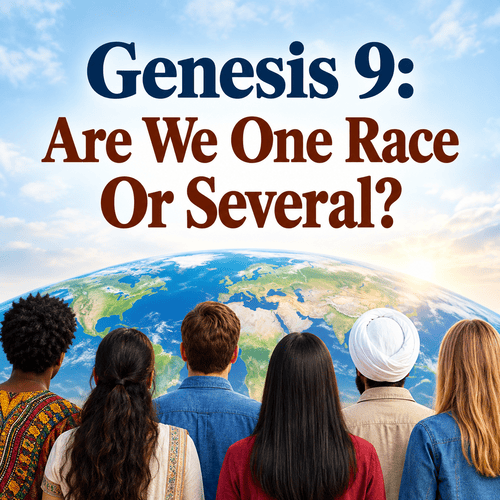
For more than a 1000 years, people used 1 short Bible story to claim that God cursed black Africans. Slave traders repeated it. Preachers taught it. Some still share it online.
There’s just one problem. The Bible never says it.
The story is in Genesis 9. Noah drinks too much wine and lies uncovered in his tent. His son Ham sees him and tells his brothers. When Noah wakes up, he speaks a curse. Many people call this ‘the curse of Ham’.
But read the chapter slowly and you’ll find 3 surprises. Ham isn’t the one cursed. Skin colour is never mentioned. And just a few verses earlier, God says every human being is made in His image (Genesis 9:6).
Let’s trace where the curse of Ham myth came from, and why the gospel itself needs one human race.
THE SHORT ANSWER
No. Genesis 9 doesn’t teach separate races. Noah’s curse falls on Canaan, not Ham. The Canaanites lived in the land later called Israel, not in Africa. The curse came true when Israel took that land. The Bible teaches one human race, all descended from Adam and from Noah (Genesis 9:19; Acts 17:26).
How the Curse of Ham Myth Grew
This idea didn’t begin with Moses. It grew slowly, over many centuries.
Timeline: From Genesis to the Internet
- 1400s BC: Moses writes Genesis for Israel. The curse names Canaan, Israel’s neighbour.
- Early centuries AD: Scholar David M Goldenberg found no link between Noah’s curse and black skin in early Jewish and Christian writings.
- From the 600s AD: In the Near East, black Africans became linked with slavery. Only then, Goldenberg shows, did writers clearly tie the curse to dark skin.
- 1500s–1800s: The Atlantic slave trade grows. Europeans and Americans borrow the idea to defend it.
- 1700s: European scientists begin sorting humanity into ‘races’ by skin colour and body shape.
- 1800s: American preachers use Genesis 9 to defend slavery. Historian Stephen R Haynes has shown how often they returned to ‘Noah’s curse’.
- 1900s: The same thinking supports segregation in America and apartheid in South Africa.
- 2000s: Kinism—the modern teaching that God wants races to live, worship and marry separately—spreads online, using the same verses in new clothes.
NOTICE THE ORDER
The idea came first. Then people went looking for Bible verses to support it. This is eisegesis: reading your own ideas into the text. Faithful reading does the opposite—exegesis: drawing the meaning out of the text.
What Genesis 9:18–29 Actually Says
First, let’s read what Noah actually said.
When Noah awoke from his wine and knew what his youngest son had done to him, he said, “Cursed be Canaan; a servant of servants shall he be to his brothers.” He also said, “Blessed be the LORD, the God of Shem; and let Canaan be his servant. May God enlarge Japheth, and let him dwell in the tents of Shem, and let Canaan be his servant.”
Genesis 9:24–27 (ESV)
Five Facts from the Text
- Canaan is cursed, not Ham. Canaan is named in all 3 verses of the curse. Ham’s name doesn’t appear in it at all. In fact, God had already blessed Ham: ‘And God blessed Noah and his sons’ (Genesis 9:1).
- Noah speaks as a prophet. John Calvin, the 16th-century pastor of Geneva, pointed out Noah couldn’t know Canaan’s future ‘by human means’. Instead, Calvin wrote, ‘the Spirit directed his tongue’.
- The Canaanites did not live in Africa. Genesis 10:15–19 lists Canaan’s descendants: Sidon, the Hittites, the Jebusites, the Amorites and others. Their land stretched from Sidon, in modern Lebanon, down to Gaza.
- Ham’s African sons weren’t cursed. Ham had 4 sons: Cush, Egypt, Put and Canaan (Genesis 10:6). Cush refers to the dark-skinned peoples south of Egypt (Jeremiah 13:23). Yet Cush received no curse. Neither did Egypt or Put.
- The curse came true in Israel’s history. Moses wrote Genesis for Israel as they prepared to enter Canaan. God warned them, ‘you shall not do as they do in the land of Canaan’ (Leviticus 18:3). Later, some Canaanites became Israel’s servants (Joshua 9:23; 1 Kings 9:20–21).
O Palmer Robertson, an Old Testament scholar who taught for years in Malawi and Uganda, concluded plainly the people under this curse weren’t black or African. Cambridge scholar Derek Kidner went further. Anyone who thinks Ham’s peoples are doomed to be inferior, he said, has ‘misread the Old Testament as well as the New’.
Canaanites and Israelites also spoke closely related languages. Isaiah even calls Hebrew ‘the language of Canaan’ (Isaiah 19:18). A curse on Canaan simply can’t be a curse about skin colour.
Is the Curse Passed Down for Ever?
No. God says, ‘The son shall not suffer for the iniquity of the father’ (Ezekiel 18:20). Canaanites who turned to God found mercy. Rahab, a Canaanite woman, joined Israel and became an ancestor of Jesus (Matthew 1:5). Centuries later, Jesus said to a Canaanite mother, ‘O woman, great is your faith!’ (Matthew 15:28).
What Was Ham’s Sin?
Bible teachers disagree. Some believe Ham mocked his father. Others think ‘saw the nakedness’ points to sexual sin, as similar words do in Leviticus 18. Either way, Ham dishonoured his father—and our case does not depend on settling this.
Myth or Bible? Checking Five Common Claims
| THE CLAIM | WHAT THE BIBLE ACTUALLY SAYS | READ IT YOURSELF |
|---|---|---|
| ‘God cursed Ham.’ | Noah cursed Canaan, one of Ham’s four sons. | Genesis 9:25–27 |
| ‘The curse made skin black.’ | The passage never mentions skin or colour. | Genesis 9:18–29 |
| ‘Africans are under the curse.’ | Canaan’s people lived in Canaan, not Africa. | Genesis 10:15–19 |
| ‘The curse lasts for ever.’ | Canaanites such as Rahab found mercy and joined Jesus’ family line. | Joshua 6:25; Matthew 1:5 |
| ‘Noah’s sons began separate races.’ | The whole earth was filled from one family. | Genesis 9:19; 10:32 |
Genesis 10: Nations, Not Races
Genesis 10 is often called the Table of Nations. It’s a family tree showing how the families of Noah’s 3 sons spread out and became the peoples of the ancient world.
Moses groups people ‘by their clans, their languages, their lands, and their nations’ (Genesis 10:20). That’s 4 labels:
- Clans: family lines.
- Languages: how people speak.
- Lands: where people live.
- Nations: people groups with their own rulers.
Now notice what’s missing. There’s no mention of skin colour, hair or face shape. Genesis groups people by family, speech and place—never by appearance.
Noah’s 3 Sons: Why the ‘3 Races’ Idea Doesn’t Fit
| SON OF NOAH | SOME DESCENDANTS (GENESIS 10) | WHERE THEY LIVED | WHY THIS BREAKS ‘RACE’ THINKING |
|---|---|---|---|
| Shem | Elam, Asshur (Assyria), Aram, Eber (the Hebrews) | Iran, Iraq, Syria, Israel | The Elamites spoke a language unlike Hebrew, yet they are listed under Shem. |
| Ham | Cush, Egypt, Canaan, the Philistines, Nimrod | Africa, Israel, Lebanon, Iraq | Nimrod, from Ham’s line, built Babel and Nineveh in Mesopotamia (10:8–11). |
| Japheth | Javan (Greeks), Madai (Medes), Gomer | Greece, Turkey, Iran | The Medes lived beside the Elamites, yet came from a different son. |
Also notice: the names Sheba and Havilah appear in both Ham’s line (10:7) and Shem’s line (10:28–29). Family lines overlapped.
If Genesis taught 3 colour-based races, this list would make no sense. It shows instead every nation belongs to one extended family. Even Dutch theologian Herman Bavinck, writing over a century ago, noted the lines between so-called races are so hard to draw that they cause endless arguments.
Babel and Acts 17:26: Providence, Not Prescription
2 words will help us here. Providence means God’s wise control over everything that happens in history. Prescription means a command telling us what we must do. Kinism’s biggest mistake is confusing the 2.
What Happened at Babel
After the flood, God told Noah’s family to ‘fill the earth’ (Genesis 9:1). Instead, people gathered in one place to build a tower and make a name for themselves. So God confused their language and ‘dispersed them over the face of all the earth’ (Genesis 11:9). The split into many languages was God’s judgement on pride, not his original design.
Think of a broken leg in a plaster cast. The cast is wise and good, but it is not the goal. The goal is a healed leg. Likewise, the scattering at Babel was God’s wise response to sin, but the goal was always a healed human family. At Pentecost, people from many nations heard the gospel, ‘each of us in his own native language’ (Acts 2:8). The healing had begun.
What Paul Meant in Athens
And he made from one man every nation of mankind to live on all the face of the earth, having determined allotted periods and the boundaries of their dwelling place, that they should seek God, and perhaps feel their way toward him and find him.
Acts 17:26–27 (ESV)
Paul spoke in Athens, a city proud of its ancient roots. Every nation, he said, comes ‘from one man’. Yes, God sets ‘boundaries’, but notice the purpose—‘that they should seek God’. Paul was describing God’s providence. He was not making a law against moving to another land or marrying across a border.
Israel itself was never a ‘pure’ bloodline. A ‘mixed multitude’ left Egypt with them (Exodus 12:38). Rahab the Canaanite and Uriah the Hittite were counted among God’s people.
Kinism’s Favourite Verses—and What They Really Mean
| VERSE | WHAT KINISTS CLAIM | WHAT THE VERSE ACTUALLY TEACHES |
|---|---|---|
| Genesis 11:7–9 | God wants the races kept apart for ever. | God judged human pride by confusing languages. At Pentecost he began to reverse it (Acts 2:8–11). |
| Deuteronomy 32:8 | God fixed borders for each race to protect. | God gave nations their lands in history. The verse says nothing about skin colour, marriage or church membership. |
| Acts 17:26 | God set racial boundaries we must defend. | God made every nation ‘from one man’ and guides history so that people will seek him. |
KINISM IN ONE SENTENCE
Kinism takes something God allowed in history and turns it into a rule for all time. In 2019, one North American denomination with Dutch roots officially called kinism ‘a grievous deviation from sound doctrine, a heresy’. A heresy is a teaching so wrong that it attacks the heart of the Christian faith.
Why the Gospel Needs 1 Human Race
This isn’t only about kindness. The gospel itself depends on one human race. Follow the chain:
- 1 head: Adam was our ‘federal head’. He represented all people, like a team captain whose choices affect the whole team. ‘Sin came into the world through one man’ (Romans 5:12).
- 1 fall: The Westminster Confession of Faith, a statement of Bible teaching from the 1640s, calls Adam and Eve ‘the root of all mankind’ (6.3). All of us share their guilt and broken nature.
- 1 Saviour: To rescue us, Jesus ‘had to be made like his brothers in every respect’ (Hebrews 2:17). If some people didn’t come from Adam, Jesus wouldn’t share their nature and couldn’t stand in their place.
- 1 church: The Heidelberg Catechism (1563) says Christ gathers his church ‘out of the whole human race’ (Question 54). The Canons of Dort (1619) say he redeems people ‘out of every people, tribe, nation, and language’ (Head 2, Article 8).
WHAT RESTS ON 1 HUMAN RACE?
Herman Bavinck called the unity of the human race ‘the presupposition of religion and morality’. In simple words, it’s the foundation: original sin, the cross, the worldwide church and love of neighbour all stand on it.
Genesis 9 makes the same point before the curse is ever spoken: ‘for God made man in his own image’ (Genesis 9:6). Calvin drew a searching lesson from this verse: ‘no one can be injurious to his brother without wounding God himself.’ To despise anyone is to insult the God whose image they carry.
The New Testament does speak of one special ‘race’, but it has nothing to do with skin. Peter tells believers from many backgrounds, ‘you are a chosen race’ (1 Peter 2:9). In God’s eyes, the real dividing line runs between those still in Adam and those united to Christ.
When the Church Got It Wrong
We must be honest. Some Bible-believing Christians—including some who loved the historic confessions—used these passages to defend terrible sins.
- In the American South: Many preachers used ‘Noah’s curse’ to defend slavery and, later, segregation.
- In South Africa: White church leaders used Babel and Acts 17:26 to support apartheid, a system that kept races apart by law.
- Online today: Kinism repeats the same arguments, often dressed in the language of old confessions.
Yet the church also repented—admitted the wrong and turned around. In 1982, a worldwide alliance of Presbyterian and similar churches declared the theological defence of apartheid a heresy. In 1984, the North American denomination that later condemned kinism did the same.
THE LESSON FOR US
Sound doctrine on paper is not enough. We must let Scripture correct our culture, rather than use Scripture to protect our culture.
From Babel to the Lamb’s Multitude
Genesis 9–11 doesn’t end in division. After Babel, God calls Abraham and promises, ‘in you all the families of the earth shall be blessed’ (Genesis 12:3). The Hebrew word for ‘families’ here is the same word translated ‘clans’ in Genesis 10. God’s answer to a scattered world is a blessed world.
Noah’s prophecy agrees: Japheth will ‘dwell in the tents of Shem’ (Genesis 9:27). Calvin saw here the Gentiles (non-Jewish nations) joining God’s people through the gospel. God, he wrote, ‘has confirmed a fraternal union between alienated parties’. Put simply, God makes brothers out of strangers.
And here’s the most surprising twist. Rahab the Canaanite became the great-great-grandmother of King David, and so an ancestor of Jesus. Robertson draws the stunning conclusion: ‘From the cursed line of Canaan comes the promised Saviour.’ Jesus then became ‘a curse for us’ (Galatians 3:13), so that Abraham’s blessing could reach every nation.
After this I looked, and behold, a great multitude that no one could number, from every nation, from all tribes and peoples and languages, standing before the throne and before the Lamb.
Revelation 7:9 (ESV)
So, does Genesis 9 teach separate races? No. It teaches 1 human family made in God’s image, a curse on Canaan fulfilled in Israel’s history, and a coming Saviour who breaks down ‘the dividing wall of hostility’ (Ephesians 2:14).
The deepest divide in our world isn’t between skin colours. It’s between those still far from God and those brought near by the blood of Christ. That invitation is open to every nation.
Tough Questions, Honest Answers
What colour were Adam and Eve?
The Bible doesn’t tell us. It does tell us Eve was ‘the mother of all living’ (Genesis 3:20), so every skin tone on earth came from this one couple. Many creation scientists believe Adam and Eve were probably a middle brown, carrying genes for both lighter and darker skin. God built rich variety into the first 2 people from the very beginning. The colours we see today aren’t different kinds of humans, but the unfolding of that original design.
How did different skin colours appear if we all come from Noah?
Everyone has the same main skin pigment, called melanin. The only difference is how much of it our bodies make. Noah’s family carried genes for a range of skin tones. After Babel, small groups moved apart and married within their own group, so certain traits became common in certain places within a few generations. This fits a young earth and a recent, shared origin. It also explains why all humans share about 99.9% of their DNA—skin colour is a very small surface difference within one family.
Is the mark of Cain the same as the curse of Ham?
No. They’re 2 separate stories, and people often confuse them. The mark of Cain comes from Genesis 4, long before the flood. God put it on Cain ‘lest any who found him should attack him’ (Genesis 4:15), so it was a sign of protection, not punishment. The Bible never says it was a skin colour or that it passed to Cain’s children. And after the flood, the whole earth was filled from Noah’s three sons (Genesis 9:19), so no race today can be ‘Cain’s people’.
Does the Bible forbid interracial marriage?
No. When God told Israel not to marry certain nations, he gave the reason: ‘for they would turn away your sons from following me, to serve other gods’ (Deuteronomy 7:4). The problem was false worship, not ancestry or skin. Moses married a Cushite woman, and God judged Miriam when she and Aaron spoke against Moses (Numbers 12:1, 10). Ruth, a Moabite, married Boaz and became King David’s great-grandmother. The New Testament rule is that believers marry ‘only in the Lord’ (1 Corinthians 7:39).
Why did the Mormon Church link Ham to its priesthood ban?
Early leaders of the Church of Jesus Christ of Latter-day Saints taught that black people carried a curse passed down from Cain and Ham. For this reason, black men of African descent could not be ordained to its priesthood until 1978. In 2013, the church published an essay rejecting the idea that black skin is a sign of God’s curse. That change is welcome, but it exposes the deeper problem: human traditions and extra ‘scriptures’ were placed above the Bible. Genesis, read carefully, never supported such a ban.
What ethnicity was Jesus?
Jesus was a Jewish man, born in Bethlehem and raised in Nazareth. He came from the tribe of Judah and the family of David (Matthew 1:1; Hebrews 7:14). He would have looked like other Middle Eastern Jews of his day, not like the pale figure of many European paintings. His family tree also includes non-Israelite women, such as Rahab the Canaanite and Ruth the Moabite (Matthew 1:5). Jesus belongs to one nation by birth, yet he is the Saviour of people from every nation.
Does the Bible support slavery?
The Bible never supports the kind of slavery found in the Atlantic slave trade. That trade was built on kidnapping, and God’s law said, ‘Whoever steals a man and sells him, and anyone found in possession of him, shall be put to death’ (Exodus 21:16). Paul lists ‘enslavers’ among the lawless (1 Timothy 1:10). Servitude in ancient Israel was mostly a way to pay off debt, and God’s law set limits and protections around it. The gospel also planted seeds of freedom: Paul asked Philemon to receive his runaway servant Onesimus ‘as a beloved brother’ (Philemon 16).
Related Reads
- The Racial Diversity Question: Does the Bible Have Answers?
- Interracial Marriages: Does God Frown On Them?
- Can Modern Genetics Trace the Human Race Back to Noah?
- The One Man Mystery in Acts 17:26: Is It Adam Or Noah?
- Historicity of Adam & Eve: The New Testament’s Validation
- Navigating Critical Race Theory: How Should Christians Respond?
- Exegesis vs Eisegesis: What Do the Two Terms Really Mean?