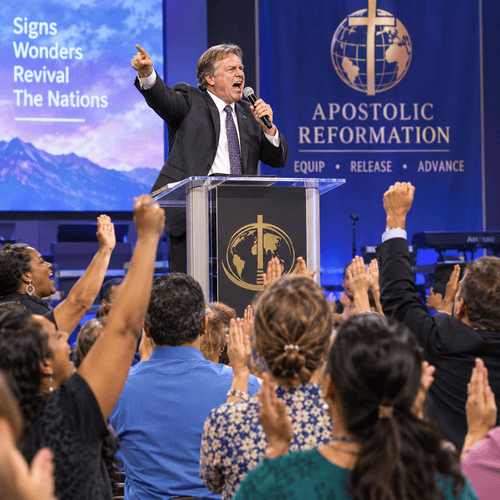
Imagine a man walks onto the stage IN church. He says, ‘I am an apostle. God speaks to me directly. Follow me, and together we will take over the nations for Jesus.’
Would we follow him?
Millions of Christians already do. From America to India, and from Nigeria to Brazil, people call their leaders ‘Apostle’ and ‘Prophet’. They expect fresh words from heaven and talk about taking ‘dominion’—control—over the world. Many have never heard the name of the movement behind these ideas: the New Apostolic Reformation, or NAR.
So here’s our question: is it biblical?
To answer it, we shall sit with one short passage written by a real apostle—Simon Peter. He wrote it to ordinary Christians who were suffering. In four verses, Peter answers almost every big claim the NAR makes.
OUR KEY PASSAGE: 1 PETER 1:6–9 (ESV)
In this you rejoice, though now for a little while, if necessary, you have been grieved by various trials, so that the tested genuineness of your faith—more precious than gold that perishes though it is tested by fire—may be found to result in praise and glory and honour at the revelation of Jesus Christ. Though you have not seen him, you love him. Though you do not now see him, you believe in him and rejoice with joy that is inexpressible and filled with glory, obtaining the outcome of your faith, the salvation of your souls.
Keep these words close. We will keep coming back to them.
What Is the New Apostolic Reformation?
The NAR is not a denomination (a family of churches with one name and shared rules, like Baptists). It is a loose network of independent churches joined by shared beliefs.
Its central belief is that God has brought back the offices of apostle and prophet. An office is a position of authority, like elder or pastor. NAR leaders teach that today’s apostles and prophets have authority to lead the church and even change nations.
The name comes from C Peter Wagner, a church-growth teacher at Fuller Theological Seminary in California. He claimed the movement was as big as the Protestant Reformation. But Martin Luther took the church back to the Bible. As we will see, the NAR takes it beyond the Bible.
Timeline: Where Did the NAR Come From?
- 1948—The Latter Rain: A revival in North Battleford, Canada, teaches that God is restoring apostles and prophets.
- 1949—An early warning: The Assemblies of God, a large Pentecostal denomination, rejects this teaching.
- 1980s—The ‘Kansas City Prophets’: Mike Bickle, Paul Cain and Bob Jones make ‘prophetic ministry’ popular.
- 1990s—A name is born: C. Peter Wagner starts using the name ‘New Apostolic Reformation’.
- 2000s—Apostles and ‘mountains’: Wagner gathers a coalition of apostles; Lance Wallnau and Johnny Enlow spread the ‘Seven Mountain Mandate’.
- 2016—After Wagner: Wagner dies; leaders such as Bill Johnson of Bethel Church and Ché Ahn carry the ideas forward.
- 2020s—Into the spotlight: Failed election prophecies and news coverage make the NAR known worldwide.
Some leaders say the NAR ‘does not exist’. But Wagner named and organised it. Anyway, labels matter less than teaching.
What Does the NAR Teach?
Not every NAR church holds every point, but these six show up often.
6 key NAR teachings in plain words
| NAR teaching | What it means | Why it matters |
|---|---|---|
| Apostles and prophets today | God has given the church new apostles and prophets with authority like Peter and Paul. | Churches must submit to them, or lose their ‘apostolic covering’ (spiritual protection). |
| New revelation | Apostles and prophets receive fresh messages from God that the church must follow. | It quietly puts their words beside the Bible. |
| Seven Mountain Mandate | Christians must take control of seven areas: religion, family, government, education, media, arts and business. | Winning power becomes the church’s main task. |
| Strategic-level spiritual warfare | Powerful demons, called ‘territorial spirits’, rule cities and nations. Believers must find, name and ‘bind’ them. | Prayer turns into commands aimed at demons. |
| A miracle-working army | A final generation of believers will do greater miracles than the apostles did. | Christians are taught to chase signs. |
| Jesus as our miracle model | Jesus did miracles as a Spirit-filled man, not as God, so we can do the same. Healing is always God’s will. | It shrinks our view of Jesus and crushes the sick who are not healed. |
Some of this sounds exciting. But excitement is not the test. Truth is.
Is the NAR Biblical? Seven Tests from 1 Peter 1:6–9
Peter is the perfect witness. He walked with Jesus, saw Him risen and was sent out by Him. If anyone knows what an apostle is, Peter does.
One note first. Christians disagree about whether gifts like prophecy and healing continue today. Cessationists believe they ended with the apostles; continuationists believe they continue. Our case does not hang on that debate. Even continuationists such as Wayne Grudem teach that prophecy today can be mistaken, must be tested and cannot rule the church. The NAR fails their test as well as ours.
Test 1: ‘Grieved by Various Trials’—Glory Now or Glory Later?
Peter’s readers were suffering ‘for a little while’ (1:6). He did not tell them to take over the government of Rome. He told them to expect ‘the fiery trial’ (4:12) and to wait for glory ‘at the revelation of Jesus Christ’ (1:7).
This cuts across the Seven Mountain Mandate (a form of dominion theology), which says the church must take control of society before Jesus returns. But Jesus already has ‘all authority in heaven and on earth’ (Matthew 28:18). Our task is to ‘make disciples’ (28:19). And He said plainly, ‘My kingdom is not of this world’ (John 18:36).
Christians should not hide from public life. The Dutch theologian Abraham Kuyper famously said, ‘There is not a square inch in the whole domain of our human existence over which Christ, who is Sovereign over all, does not cry: Mine!’ So we serve God as teachers, nurses and leaders. But serving in every area is very different from seizing control of it. Kuyper’s square inch already belongs to Christ.
There is an irony too. Seven Mountain teachers point to the ‘seven mountains’ of Revelation 17:9. But there the mountains are where the prostitute Babylon sits—worldly power set against God.
Test 2: ‘The Tested Genuineness of Your Faith’—Testing the Prophets
God tests our faith like gold in a fire (1:7), burning away what is fake. In the same way, we must test what claims to come from God: ‘test the spirits… for many false prophets have gone out into the world’ (1 John 4:1). Peter warned that ‘there will be false teachers among you’ (2 Peter 2:1).
The Old Testament rule was simple. If a prophet speaks in God’s name and it does not happen, ‘that is a word that the LORD has not spoken’ (Deuteronomy 18:22). In the New Testament, the church weighed every prophecy (1 Corinthians 14:29).
Before the 2020 American election, many well-known NAR prophets announced in God’s name that Donald Trump would win a second term. He did not. Some apologised; others did not. By either standard, such ‘prophets’ have no right to rule anyone.
Testing is not unloving. Jesus praised Ephesus for testing ‘those who call themselves apostles and are not’ (Revelation 2:2).
Test 3: ‘The Revelation of Jesus Christ’—Is the Bible Enough?
Revelation means ‘unveiling’. Notice what Peter tells us to wait for: not a new message about Jesus, but Jesus Himself, unveiled when He returns (1:7, 13).
Until then, we have the gospel ‘preached… by the Holy Spirit sent from heaven’ (1:12). This word ‘remains forever’ (1:25).
Peter goes further. He had stood with Jesus ‘on the holy mountain’ and seen His glory (2 Peter 1:16–18). Yet he says, ‘we have the prophetic word more fully confirmed’ (1:19). The written Word is surer than even his mountaintop vision.
This is the sufficiency of Scripture: the Bible gives us all we need to know God, be saved and live for Him (2 Timothy 3:16–17). It is ‘the faith that was once for all delivered to the saints’ (Jude 3).
THINK IT THROUGH
If an NAR prophecy adds something new that we must obey, it adds to the Bible. If it adds nothing new, we do not need it to govern the church. Either way, the claim to authority falls.
Test 4: ‘Though You Have Not Seen Him’—Are There Apostles Today?
Verse 8 says, ‘Though you have not seen him, you love him.’ Peter had seen Jesus. He was ‘a witness of the sufferings of Christ’ (5:1) and an eyewitness ‘of his majesty’ (2 Peter 1:16). His readers had not. They were true Christians, but not apostles. The dividing line is in the text.
An apostle of Christ had to be an eyewitness of the risen Lord (Acts 1:21–22), sent by Him personally (Galatians 1:1). Paul was the last: ‘Last of all… he appeared also to me’ (1 Corinthians 15:8).
The church is ‘built on the foundation of the apostles and prophets, Christ Jesus himself being the cornerstone’ (Ephesians 2:20). A foundation is laid once. New Testament scholar Richard Gaffin argues that because the apostles’ work was foundational, it was temporary. Even Sam Storms, a pastor who believes all gifts continue, holds that no one today has the authority of the Twelve and Paul.
Others, like Barnabas, are called ‘apostles’ in a looser sense. The Greek apostolos means ‘one who is sent’—sometimes simply a church messenger (Philippians 2:25). The NAR mixes up the two meanings.
Two kinds of ‘apostle’ in the Bible—and where NAR apostles fit
| QUESTION | APOSTLES OF CHRIST (THE 12 AND PAUL) | CHURCH MESSENGERS (E.G. EPAPHRODITUS) | NAR APOSTLES TODAY |
|---|---|---|---|
| Who sent them? | Jesus Himself | A local church | Themselves or other NAR leaders |
| Did they see the risen Jesus? | Yes, always | Not needed | No |
| Authority over the churches? | Yes, their teaching is Scripture | None | They claim it |
| Can the office continue? | No, the foundation is laid once | Yes, missionaries are still sent | Claimed, but without biblical basis |
Test 5: ‘You Believe in Him’—Faith, Not Sight or Signs
‘Though you do not now see him, you believe in him’ (1:8). Jesus told Thomas, ‘Blessed are those who have not seen and yet have believed’ (John 20:29).
The NAR often pushes believers to seek visions and signs. But Jesus warned that false prophets ‘will arise and perform signs and wonders, to lead astray, if possible, the elect’ (Mark 13:22).
Jesus’ miracles showed who He is, ‘so that you may believe that Jesus is the Christ, the Son of God’ (John 20:31). He ‘emptied himself, by taking the form of a servant’ (Philippians 2:7)—adding humanity, not laying aside deity. And faith does not guarantee healing now: ‘I left Trophimus, who was ill, at Miletus’ (2 Timothy 4:20).
Faith is also how we fight the devil.
Spiritual warfare: NAR methods compared with Peter’s teaching
| QUESTION | NAR TEACHING | PETER’S TEACHING (1 PETER 5:8–9) |
|---|---|---|
| Who is the enemy? | Ruling spirits over cities and nations | ‘Your adversary the devil’ |
| How do we fight? | Mapping, naming and binding spirits; ‘decreeing’ | ‘Resist him, firm in your faith’ |
| Where does victory come from? | Our commands and declarations | Christ, who ‘disarmed the rulers and authorities’ at the cross (Colossians 2:15) |
Test 6: ‘Joy That Is Inexpressible’—Real Joy or Spiritual Hype?
Peter’s readers had no visions and no apostles in town. Yet they rejoiced ‘with joy that is inexpressible and filled with glory’ (1:8).
John Piper calls this Christian Hedonism: our deepest joy and God’s glory belong together. His summary: ‘God is most glorified in us when we are most satisfied in him.’ Satisfied in Him, not in experiences about Him.
The NAR often offers another joy: the rush of a packed meeting or the next ‘move of God’. It fades, so people keep chasing it. JI Packer called the Spirit’s work a ‘floodlight ministry’. A floodlight does not shine on itself; it lights up the building. The Spirit shines on Jesus. When a movement keeps pointing to its prophets and signs, the floodlight has been turned around.
Test 7: ‘The Salvation of Your Souls’—What Is the Church For?
Peter ends with the goal: ‘the salvation of your souls’ (1:9). God’s great work now is saving sinners, not building Christian control of nations.
Who leads God’s people meanwhile? Peter does not rule as an apostle. He writes ‘as a fellow elder’ (5:1), telling elders to shepherd, ‘not domineering over those in your charge’ (5:3). Over them stands ‘the chief Shepherd’ (5:4)—Jesus, the only Head of the church.
‘Apostolic covering’ turns this upside down, and has often opened the door to spiritual abuse.
Answering Common Objections
Here is how the Bible answers five common replies.
What NAR supporters say, and what the Bible says
| THEY SAY… | THE BIBLE ANSWERS… |
|---|---|
| ‘Ephesians 4:11–13 says apostles and prophets continue until the church is united.’ | Ephesians 2:20 already gave their job: laying the foundation, which is done once. |
| ‘You are quenching the Spirit’ (1 Thessalonians 5:19). | The very next verses say, ‘test everything’ (5:21). Testing obeys the Spirit. |
| ‘Joel 2 promised that our sons and daughters will prophesy.’ | Fulfilled at Pentecost, when the Spirit came on all believers (Acts 2:16–18). It says nothing about ruling apostles. |
| ‘Jesus promised we would do greater works’ (John 14:12). | Greater in reach, not in wonder: the gospel spreading to all nations after Jesus returned to the Father. |
| ‘Look at the fruit: people are healed and saved!’ | Some who did ‘mighty works’ in Jesus’ name were never His (Matthew 7:22–23). |
Red Flags: How to Spot NAR Teaching
7 WARNING SIGNS TO WATCH FOR
- Titles: Leaders call themselves ‘Apostle’ or ‘Prophet’.
- Covering: You hear that you must be ‘under’ or ‘aligned with’ an apostle.
- New truth: Teachers speak of ‘new revelation’, ‘present truth’ or ‘a new thing God is doing’.
- Decrees: Prayer focuses on ‘decreeing and declaring’ or binding spirits over cities.
- Dominion: There is talk of ‘taking the mountains’ or ruling society.
- No questions: Doubts are called rebellion or a ‘religious spirit’.
- No correction: Failed prophecies are excused, not repented of.
One red flag does not make a church NAR. Several together should send you to your Bible, like the Bereans (Acts 17:11).
How to Respond with Truth and Love
- Remember they’re often sincere: Many in NAR churches love Jesus, and not every charismatic church is NAR.
- Ask, do not attack: ‘How do we know this word is from God?’
- Open the Bible together: Read 1 Peter 1:6–9 slowly.
- Point to the better joy: The goal is not winning an argument but pointing to Christ.
So, should you follow the man who says he is an apostle? Peter, a real apostle, would say no—not because he feared the Spirit, but because he loved the Christ the Spirit points to.
We do not need new apostles. We have the old apostles’ words and a Saviour we have not seen but love. One day He will be revealed. Until then, that is enough—and it is joy inexpressible.
Tough Questions, Honest Answers
Is Bethel Church part of the New Apostolic Reformation?
Bethel Church in Redding, California, does not use the NAR label, and its senior leader Bill Johnson has questioned it. But Bethel openly teaches modern apostles and prophets, new revelation and the Seven Mountain idea. Researchers Holly Pivec and Douglas Geivett document this in detail in their book Reckless Christianity. So whatever name is used, Bethel’s teaching fits the NAR pattern closely, and it is one of the movement’s most influential centres worldwide.
Is it wrong to sing Bethel, Hillsong or Elevation worship songs?
Christians differ here. Start with the words: does the song say what the Bible says? Some songs from these groups are sound; others carry their teaching, such as chasing new ‘moves’ of God. Then think wider. Using a group’s songs can draw people towards its conferences, schools and leaders. Many churches choose to sing songs from sources they trust, so that worship and teaching point the same way.
Is the New Apostolic Reformation a cult?
In the strict sense, no. A cult usually denies core truths such as the Trinity or salvation by grace, and most NAR leaders say they hold these truths. But that does not make NAR teaching harmless. Adding new revelation, claiming apostolic authority and weakening the Bible’s final authority are serious errors. Many sincere believers sit in NAR churches; they need gentle, clear teaching, not name-calling.
Is the NAR the same as the prosperity gospel?
No, but they often overlap. The prosperity gospel teaches that God wants every believer to be rich and healthy, if they have enough faith. The NAR is mainly about authority: apostles, prophets and dominion. Many leaders teach both, and both share a ‘glory now’ mindset. Peter answers both with the same words: ‘for a little while… grieved by various trials’ (1 Peter 1:6).
Do gifts like prophecy and healing still happen today?
Faithful Christians disagree. Cessationists believe the miraculous gifts ended with the apostles, because their main purpose was to confirm the apostles’ message (Hebrews 2:3–4). Continuationists believe these gifts continue in a lesser, non-authoritative form. Both sides agree on what matters most here: God still heals in answer to prayer, Scripture is complete, and no modern ‘word’ can bind the church.
Is the NAR linked to Christian nationalism?
Some NAR leaders are deeply involved in politics, especially in the United States, and the Seven Mountain Mandate is often discussed alongside debates about Christian nationalism—the idea that a nation should be officially or culturally Christian by law. Christians may rightly vote, serve and speak in public life. The biblical problem is claiming apostolic authority for political goals, or making political victory the church’s mission.
I think my church is NAR. Should I leave?
First, pray and study. Compare what you hear with Scripture, perhaps using the red flags above. Then talk humbly with your pastor or elders. If leaders refuse correction, demand loyalty to an ‘apostle’ or treat questions as rebellion, it may be time to find a church that faithfully preaches the Bible. Leave quietly and graciously, and keep loving the friends you leave behind.
Related Reads
- Pastor-Led vs Elder-Led Churches: What’s the Difference?
- ‘Can’t God Raise Up Apostles Even Today?’: The Bible’s Answer
- What’s Wrong With Dominion Theology? A Biblical Critique
- Word of Faith Movement: What’s Desperately Wrong About It?
- The Prosperity Gospel’s Lies and the True Cost of Discipleship
- Africa Statement on the Prosperity Gospel: 14 Articles Explained
- 1 John 4:1: What Does ‘Test Every Spirit’ Mean?
- Is 1 Corinthians 14 Proof That Tongues and Prophecy Continue?
- Is Being ‘Slain in the Spirit’ Biblical?
- Is “Deliverance Ministry” Biblical or Dangerous? The New Exorcism Trend
- Standing Firm: A Biblical, Reformed View of Spiritual Warfare
- Is Apostolic Succession Biblical?
- Are Demonic Strongholds Real? How Do We Overcome Them?