The destruction of Tyre is one of the most quoted case studies in Bible prophecy, and for good reason. Long before it happened, the prophet Ezekiel described the fall of a city that looked utterly unconquerable. And he described it not in vague, mystical language but in hard, physical, checkable detail. The prediction could have been buried by the historical record. Instead, over the next 250 years, two of the ancient world’s greatest commanders did to Tyre almost exactly what Ezekiel said would be done. This is the story of how Ezekiel 26 was fulfilled, stone by stone.
Tyre: the city that seemed indestructible
To feel the force of Ezekiel’s words, we have to understand what Tyre was. This was no minor coastal town. Tyre was the commercial superpower of the eastern Mediterranean, a Phoenician trading empire whose merchant fleets reached from Spain to the Persian Gulf and whose purple dye and craftsmanship were prized across the ancient world. Its wealth was legendary; its sailors were unmatched.
What made Tyre genuinely formidable, though, was its peculiar geography. The city existed in two parts. There was the older settlement on the mainland coast, and there was the island fortress lying roughly 800 metres offshore, ringed by walls that in places rose to nearly 50 metres. Attackers could batter the mainland city all they liked, but the islanders simply withdrew across the water to a stronghold no land army could reach and no ordinary navy could storm. Tyre had outlasted siege after siege precisely because of this double identity. To predict its total and permanent destruction was, by any sober assessment, absurd.
Tyre also has a place in Israel’s own story. When Solomon built the temple, it was Hiram, king of Tyre, who supplied the cedar, the timber and the skilled craftsmen (1 Kings 5). The two kingdoms traded as partners. Ezekiel was not pronouncing doom on a faceless foreign power, but on a famous and seemingly invincible neighbour.
Ezekiel’s prophecy: specific, bold, and verifiable
Ezekiel delivered his oracle against Tyre around 586 BC, early in a prophetic ministry that ran from 593 to 571 BC—while the city still stood at the height of its power. Strip away the poetry of Ezekiel 26:3–14 and six specific, falsifiable claims remain:
- Many nations, not one. “Thus says the Lord God: Behold, I am against you, O Tyre, and will bring up many nations against you, as the sea brings up its waves” (v.3). The picture points to successive attackers across time, not a single campaign.
- Walls and towers thrown down. “They shall destroy the walls of Tyre and break down her towers, and I will scrape her soil from her and make her a bare rock” (v.4). The fortifications that made Tyre proud would be broken.
- Scraped to bare rock. Even the city’s dust would be swept away until only the rock remained (vv.4, 14): “I will make you a bare rock. You shall be a place for the spreading of nets. You shall never be rebuilt.”
- Stones and timber cast into the sea. The rubble of the city would be thrown into the water—the strangest clause of all: “They will lay your stones and timber and soil in the midst of the waters” (v.12).
- A drying-ground for nets. The site would become a place where fishermen spread their nets: “She shall be in the midst of the sea a place for the spreading of nets” (v.5, cf. v.14).
- Never rebuilt. The city, once destroyed, would not rise to its former glory again (v.14).
One detail in the grammar matters enormously. In verses 7–11 the prophecy speaks of a single attacker—he—and names him: Nebuchadnezzar. But at verse 12 the pronoun suddenly shifts to they. It’s they who lay the stones and timber in the sea. Ezekiel didn’t predict that one man would do all the damage. He predicted a sequence—one named conqueror, then others—and that’s precisely what history went on to deliver.
Stage one: Nebuchadnezzar’s thirteen-year siege (585–572 BC)
The first conqueror arrived almost immediately, and Ezekiel had named him outright. Nebuchadnezzar, king of Babylon, laid siege to Tyre in a campaign that lasted thirteen punishing years, from around 585 to 572 BC. The mainland city fell. Its walls were broken, its towers thrown down, its houses ruined—exactly as verses 8–11 had said. But the island held. When the mainland became untenable, the Tyrians did what they’d always done: they fell back to their offshore fortress and took their wealth with them. Babylon was left holding a wrecked and emptied city.
And here Scripture records one of the most unexpected admissions in all of prophetic literature. Years later, Ezekiel returns to the subject (Ezekiel 29:17–20) and reports that Nebuchadnezzar’s army had laboured so hard against Tyre that every head was rubbed bald and every shoulder worn raw—yet he’d received no wages, no plunder, for all that effort. God therefore announces he will hand Egypt to Nebuchadnezzar as compensation. This is a remarkable thing for the text to concede. A forger writing after the events, trying to make Ezekiel look infallible, would simply have claimed total victory. Scripture does the opposite. It openly admits the first conqueror didn’t finish the job—which is exactly why the prophecy still had work left to do. The pronoun had already shifted to “they.” Someone else still had to lay the stones in the sea.
Stage two: Alexander the Great and the land bridge (332 BC)
For 250 years, the island city of Tyre stood, rebuilt and prosperous, and the unfulfilled clauses of Ezekiel 26 sat quietly on the page. Then, in 332 BC, Alexander the Great came south along the Phoenician coast during his war with Persia. Tyre refused to surrender, retreating as ever to its island and trusting the water to do what its walls could not. Alexander had no fleet worth the name and no patience for a long blockade. So he did something audacious.
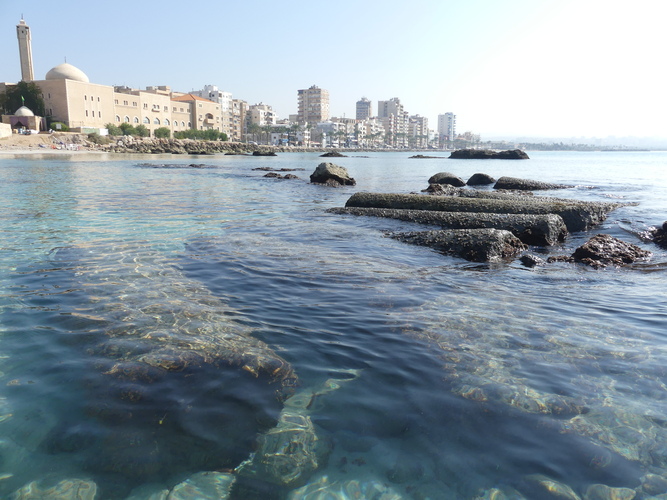
He ordered his engineers to build a causeway straight out across the 800 metres of sea—a solid land bridge from the shore to the island walls. And what did they build it from? They demolished the ruins of mainland Tyre and used the debris. The stones of the old city, its timber, even its soil, were scraped up and tipped into the water to make the mole. Read Ezekiel 26:12 again—they will lay your stones, your timber, and your dust in the midst of the waters—and then read the Greek historians Arrian and Quintus Curtius Rufus, who describe Macedonian soldiers pulling down the mainland and casting it into the sea. The prophecy and the military record describe the same act.
Alexander wasn’t trying to fulfil Ezekiel. He had almost certainly never heard of him. He was solving an engineering problem, and in solving it he completed a 250-year-old prophecy to the letter. The siege lasted seven months. When the island finally fell, the reprisal was savage: roughly 8,000 Tyrians killed, around 30,000 sold into slavery, the city razed. And the causeway never went away. Over the following centuries, sediment built up along both sides of it until the channel silted in completely. The island became a permanent peninsula joined to the mainland. Tyre, the island fortress that had defied empires, isn’t even an island any more—a geographical change we can still see today.
“Never to be rebuilt”: what happened to Tyre
This is the clause sceptics press hardest, and it deserves an honest, careful answer—because the honest answer is actually stronger than the slogan. The key is to distinguish two Tyres. There was mainland Tyre, the old continental city Nebuchadnezzar destroyed. And there was island Tyre, the offshore fortress that later became today’s peninsula.
Ezekiel’s “you will not be built any more” falls on the mainland city—the one scraped to bare rock and shovelled into the sea to build Alexander’s road. That city was never rebuilt. Its site has lain largely desolate ever since, and along that ancient shoreline fishermen genuinely do spread their nets to dry, just as Ezekiel 26:5 and 26:14 said they would. The geography itself was permanently rewritten: Alexander’s causeway turned an island into a headland and fixed the coastline in a shape it has held for more than two thousand years.
The honest caveat: there is a modern city on the old island site. It’s called Sur, it sits in southern Lebanon, and it’s a working town of well over 100,000 people. A careless apologist who claims “no one has ever lived at Tyre again” is simply wrong, and sceptics are right to point that out. But Ezekiel never said the rock would stay empty of all human life forever. He said the destroyed city would not be rebuilt as the city it had been—and ancient mainland Tyre, the proud Phoenician metropolis of Ezekiel’s day, has indeed never risen again. The prophecy is precise. It’s the popular paraphrase that overreaches.
What the archaeological evidence shows
None of this rests on the Bible’s say-so alone. The fall of Tyre is one of the better-documented episodes of ancient history, and the independent witnesses line up. The Jewish historian Flavius Josephus preserves the memory of Nebuchadnezzar’s thirteen-year siege, drawing on Tyrian annals. Greek historians Arrian and Quintus Curtius Rufus, citing Macedonian sources, both describe how Alexander’s causeway was built from the rubble of the old mainland city. Excavation layers at Tyre have exposed destruction debris consistent with the violent ends the texts describe. And the causeway Alexander threw across the strait still lies buried inside a broad isthmus of sediment that geologists can trace and date—a permanent reshaping of the coastline by a single act in 332 BC.
These aren’t Christian writers with a point to prove—they’re classical historians, and the geology and excavation layers corroborate them from another angle entirely. When the literary record, the archaeological record and the landscape itself all converge on one sequence, the case stops depending on faith alone and starts depending on evidence.
The probability argument: what are the odds?
The destruction of Tyre prophecy is one of the most-cited cases in all of evidential apologetics, precisely because it’s multi-stage, involves named conquerors, and turns on physically verifiable changes to the landscape. It helps to see the whole sequence in one place:
| When | What happened | Ezekiel’s clause met |
|---|---|---|
| c.586 BC | Ezekiel delivers his oracle against Tyre | Prediction made while Tyre stood at full strength |
| 585–572 BC | Nebuchadnezzar’s thirteen-year siege | Mainland city destroyed (26:7–11) |
| c.571 BC | Ezekiel 29 records that no spoil was taken | An honest caveat—the work is left unfinished |
| 332 BC | Alexander builds a causeway from the ruins | Stones, timber and dust cast into the sea (26:12) |
| After 332 BC | The causeway silts up over the centuries | The island becomes a permanent peninsula |
| Today | Mainland site lies desolate; nets dried on the rock | Never rebuilt; nets spread (26:5, 14) |
Ezekiel didn’t make one lucky guess; he committed himself to a chain of independent particulars—a first conqueror named outright, a multi-nation assault, rubble cast into the sea, a bare rock used by fishermen, a city never rebuilt to its former glory. A vague forecast might fluke one or two of these. The convergence of all of them—including the bizarre stones-in-the-sea clause that then waited 250 years for Alexander to carry it out—is exactly what coincidence handles so badly.
The obvious sceptical reply is that the prophecy was written after the fact. But this doesn’t survive contact with the evidence. Ezekiel’s pre-exilic, sixth-century composition is firmly established, and the book describes the island city as still standing and still defiant—which no post-Alexander forger would ever write. More decisive still, the clinching clause—the stones cast into the sea—wasn’t fulfilled until 332 BC, long after even the most sceptical dating of the book. The prophecy was on the record, in black and white, centuries before its strangest detail came true.
Tough Questions, Honest Answers
Did Ezekiel actually write this before Tyre’s fall?
Yes. Ezekiel is dated to the 6th century BC, and the oracle against Tyre belongs to roughly 586 BC. The internal evidence is decisive: the text treats Tyre as a thriving, defiant island power that has not yet been touched. No writer inventing the prophecy after Alexander’s conquest in 332 BC would describe the city that way, and the manuscript and canonical history of Ezekiel leaves no room for a late forgery slipped in after the events.
Why did Nebuchadnezzar not receive the spoils Ezekiel predicted?
Because the Tyrians evacuated their wealth to the island before the mainland fell. Nebuchadnezzar captured a ruined, emptied city and got no plunder for thirteen years of effort—and Ezekiel 29:17–20 says so plainly, with God granting him Egypt as compensation instead. Far from embarrassing the prophecy, this candour strengthens it. The “many nations” of verse 3 and the shift to “they” in verse 12 always implied one conqueror wouldn’t complete the work alone.
Doesn’t modern Tyre disprove the “never rebuilt” prophecy?
No, though it’s a fair challenge. The modern city of Sur sits on the old island, now a peninsula, and is very much alive. But Ezekiel’s “never rebuilt” clause attaches to mainland Tyre—the continental city destroyed by Nebuchadnezzar and quarried away by Alexander. That city has never been restored, and its site remains desolate. The prophecy is specific; only the loose popular version of it is vulnerable.
Were Alexander’s actions planned to fulfil the prophecy or just strategic warfare?
Purely strategic. Alexander built his causeway to crack an impregnable island fortress, not to vindicate a Hebrew prophet he had no interest in. And that is exactly what makes the fulfilment so compelling. When a conqueror unknowingly carries out the precise, peculiar action a prophet foretold two and a half centuries earlier—throwing a city’s stones into the sea—the absence of intent is the whole point. No one engineered the match. It simply happened.
Did any other prophet foretell Tyre’s fall?
Yes—Ezekiel was not working alone. Isaiah devoted an entire oracle to Tyre (Isaiah 23), Amos warned of fire on its walls (Amos 1:9–10), and Zechariah, writing after the exile but before Alexander, foretold that Tyre’s heaped-up silver would be cast down and the city itself “devoured by fire” (Zechariah 9:3–4)—which is precisely what happened when Alexander burned it in 332 BC. Several independent prophets, across different centuries, converged on the same doom.
Does Tyre appear anywhere in the New Testament?
It does. Jesus travelled into the region of Tyre and Sidon and healed the daughter of a Syrophoenician woman there (Mark 7:24–31). He also warned it would be “more bearable” for Tyre on the day of judgement than for the Galilean towns that had seen his miracles and still refused to repent (Matthew 11:21–22). And when Paul sailed home from his third journey, he found a community of disciples at Tyre and knelt to pray with them on the beach (Acts 21:3–7). None of this overturns Ezekiel: the New Testament settlement sat on the coast and the island, not on the desolate mainland site.
Is there any significance to the fact that Tyre’s name means “rock”?
There is, and it sharpens the prophecy. The name Tyre comes from a Semitic word meaning “rock”—a nod to the rocky island on which the fortress stood. So when Ezekiel announces that God will scrape the city down and make her a bare rock (Ezekiel 26:4 and 26:14), the wordplay cuts deep: the city called Rock would be stripped back to nothing but rock, swept clean of all the splendour built upon it. The pun wouldn’t have been lost on Ezekiel’s first hearers, and it underlines how total the humbling of the proud “Rock” of the Mediterranean would be.
Related Reads
- Is the Bible Historically Reliable? Here’s What the Evidence Shows
- Babylon Archaeology: How the Ruins Confirm Bible Accounts
- Hezekiah and Assyria: 7 Archaeological Discoveries Confirm Scripture
- The Ketef Hinnom Scrolls: The Oldest Biblical Text Ever Found
- What Do the Dead Sea Scrolls Prove? The Case for Bible Reliability
- Where Is Mount Sinai? Weighing the Candidates
- Nineveh Archaeology and the Bible: What the 2026 Digs Found