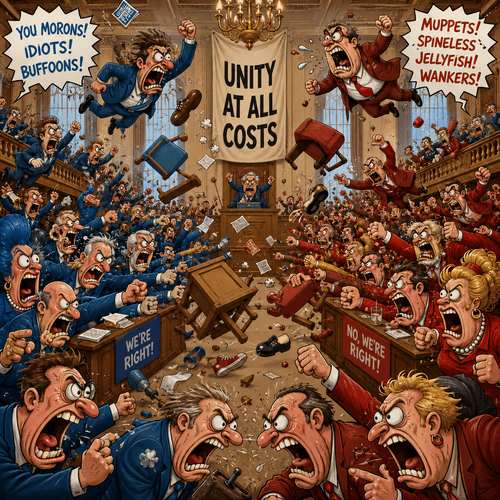
Few charges against Christianity are made more confidently than this one: “Look at the Crusades. Look at the denominational splits, the culture wars, the centuries of religious persecution. If Christianity is true, why has it generated so much conflict? And division?”
The charge, on careful examination, mistakes the disease for the cure. Bible doctrine isn’t the engine of human division—it’s the only power that can ever genuinely overcome it.
1. WE NEED TO BE PRECISE ABOUT THE CHARGE
Not all versions of this objection carry equal weight, and it matters which one we’re actually answering.
The strong version says doctrinal claims are inherently divisive—that the moment a community insists its beliefs are true and others are false, it plants the seeds of conflict. But notice the problem: this claim is itself a doctrinal assertion. The ideology of pluralism—the belief that all views are equally valid—makes very definite truth claims too, and its adherents are no less divisive. The strong claim defeats itself.
The moderate version of the charge is more careful: Christianity has historically produced more division than good, and its track record should make us suspicious of it. This version is historically testable, and when we test it honestly, the picture is far more complex than the objection assumes.
We shall address both versions. But the answers require us to go further than either—down to the level of human nature itself.
2. THE REAL SOURCE OF DIVISION: SIN, NOT DOCTRINE
The New Testament locates the root of human conflict with striking precision:
“What causes quarrels and what causes fights among you? Is it not this, that your passions are at war within you?”—James 4:1
The source of conflict, the apostle James tells us, isn’t theology. It’s disordered desire—pride, self-interest, and the will bent inward upon itself. This is what the Reformed tradition calls total depravity: not that human beings are as bad as they could possibly be, but that sin has affected every part of who we are, including our capacity to live peaceably with one another.
If this diagnosis is correct, we would expect to find division wherever fallen human beings gather—with or without religion. And isn’t that exactly what we find?
Political parties fracture into bitter factions. Academic institutions divide over ideology. Revolutionary movements consume their own members in purges. The French Revolution, launched in the name of liberty and fraternity, produced the Terror. Marxist regimes, explicitly atheistic and doctrinally opposed to religion, generated some of the most systematic violence in human history. People don’t need doctrine to divide. They’ll divide over anything. The problem isn’t theology—the problem is the human heart.
This matters for how we understand doctrine itself. A doctrine isn’t a tribal preference or a community identity badge. It’s a truth-claim about reality.
When truth contradicts error, there will be tension. But that tension isn’t divisiveness—it’s simply what reality looks like when it meets falsehood. You cannot eliminate this tension by going silent on doctrine. You only ensure error goes unchallenged.
The Council of Nicaea in AD 325 is often cited as doctrine causing division. But consider what was at stake: the question was whether the Son of God is fully divine, or a lesser being created by God. If Christ isn’t fully God, He cannot bridge the infinite gap between a holy God and sinful humanity—and the gospel collapses. The precise formula hammered out at Nicaea wasn’t ecclesiastical nit-picking. It was the defence of a gospel capable of saving.
3. WHAT HISTORY ACTUALLY SHOWS
We must not flinch from the hard history. The Wars of Religion, the Inquisition, the misuse of Christian language to justify slavery and colonialism—these are real, and a serious apologist does not wave them away.
But several critical distinctions must be drawn.
First, political power and doctrinal conviction aren’t the same thing. Most “religious” wars were political or ethnic conflicts in which religious language was pressed into service. The Thirty Years’ War was as much about Habsburg imperial ambition as it was about theology.
Second, we must measure against the right baseline. The question isn’t “Has Christianity ever produced conflict?”—of course it has. The question is: compared to what? The secular utopian projects of the 20th century—Stalinism, Maoism, the Khmer Rouge—killed between 100 and 200 million people in pursuit of ideologically pure societies. These were explicitly godless movements. The secular alternative doesn’t deliver peace.
Third, doctrine provides the very framework for distinguishing legitimate disagreement from sinful division. The Reformation recovered a vital principle—”In necessary things unity, in doubtful things liberty, in all things charity.” Not all doctrines carry equal weight. On matters that are necessary—the person of Christ, justification by faith alone, the authority of Scripture—the church must hold the line together. On matters that are genuinely uncertain or secondary—certain details of church governance, eschatological timelines, worship style—Christians must grant one another room to disagree without fracturing fellowship. And over all of it, charity must govern.
Consider this: William Wilberforce’s campaign to abolish the British slave trade was inseparable from his Reformed evangelical convictions. The doctrine that every human being bears the image of God (Genesis 1:26–27)—and Paul’s declaration that in Christ “there is neither slave nor free” (Galatians 3:28) was the theological dynamite that dismantled slavery. Doctrine was the engine of justice, not its enemy.
4. DOCTRINE IS THE ONLY REAL GROUND OF UNITY
The objection assumes unity is the natural human condition and that doctrine disrupts it. But this gets the logic backwards.
The Bible’s account of history begins not with unity disrupted by theology, but with sin disrupting the unity God created. Genesis 3 introduces fracture between humanity and God. By Genesis 11, the fracture has spread to all human community—Babel, the scattering of nations, the confusion of languages. Division is the default setting of fallen humanity. People don’t need religion to fragment. They simply need to be fallen.
Against this background, the gospel is a unification project. Paul describes Christ’s atoning work in remarkable terms (Ephesians 2:14–15).
The reconciliation the gospel achieves is first vertical—sinners are reconciled to a holy God—and then horizontal: the most divided communities of the ancient world, Jews and Gentiles, are brought into “one new humanity.” Every word in that passage carries doctrinal freight.
Even hostile observers of the early church marvelled at this. The Roman emperor Julian the Apostate despised Christianity, yet he acknowledged the solidarity it produced across the sharpest divisions of the ancient world: slave and free, Roman and barbarian, Jew and Greek. No other ancient system achieved this. Not Stoic cosmopolitanism, which remained an elite intellectual programme. Not the Roman imperial cult, which enforced unity by violence. Not Judaism, which was ethnically bounded.
Today, the global church gathers weekly across every continent, in virtually every language, in conditions of both prosperity and persecution, around the same Lord’s Table. It’s the most ethnically, nationally, and socioeconomically diverse institution in human history—not despite its doctrinal convictions, but because of them.
That’s the fruit of doctrine, not its enemy.
CONCLUSION: TURN THE QUESTION AROUND
At this point, it’s fair to ask the critic a question in return: What’s your alternative, and has it worked? The secular project of building human unity without God has a track record—and it’s far from encouraging. The most ambitious attempts at godless fraternity in the 20th century produced not unity but terror, because they had no answer to the problem James identified: the disordered, self-serving passions of the human heart.
The church’s failures—real and numerous—aren’t a refutation of the gospel. They’re exactly what the gospel predicts. The Reformers spoke of believers as being simultaneously justified yet sinful. The church is composed of people who’re being renewed but aren’t yet perfected. The wonder is not that she has sometimes divided and failed. The wonder is that she has not collapsed—and that she continues to hold together, across every barrier of race, nation, class, and language, those who confess one Lord, one faith and one baptism.
That isn’t a picture of a doctrine that divides. It’s a picture of a gospel that saves—and offers the world something no secular programme ever has: genuine reconciliation, grounded not in human goodwill, but in the grace of God.
The critics have it backwards. Bible doctrine isn’t what divides humanity. It’s what calls us home—to reconciliation. Both with God and each other.
TOUGH QUESTIONS, HONEST ANSWERS
The Apostle John repeatedly warns against false teaching and forbids fellowship with those who deny Christ (2 John 10, 11). Isn’t he actively promoting division rather than unity?
John’s fierce stand against false teaching isn’t a contradiction of Christian unity—it’s the defence of it. The unity John cares about isn’t a broad, doctrinally empty togetherness; it’s the unity of those who abide in the truth of who Christ is. And John understood that a community which tolerates the denial of Christ’s person hasn’t preserved unity—it has simply lost the gospel. His warning in 2 John is directed at a specific and devastating error: the denial that the Son of God had truly come in the flesh, which struck at the very heart of the incarnation and atonement. Far from promoting division, John is guarding the only foundation on which genuine Christian fellowship can stand—because a unity purchased by silence about Christ is no Christian unity at all.
Didn’t Jesus say “blessed are the peacemakers”?
Doesn’t that mean Christians should prioritise unity over doctrine? Jesus also said He came to bring “not peace but a sword” (Matthew 10:34)—meaning the inevitable conflict between truth and falsehood, not a call to violence. More tellingly, His great prayer for unity in John 17 is explicitly grounded in knowing the Father and the Son truly—which is irreducibly a matter of doctrine. True peacemaking isn’t the same as truth-suppressing. A peace that can only be maintained by leaving error unchallenged isn’t Christian peace—it’s mere conflict avoidance.
What about the thousands of Christian denominations? Doesn’t that prove doctrine divides more than it unites?
The often-cited figure of “30,000 denominations” is deeply misleading—it counts every independent congregation, including cultural and linguistic variations, as a separate theological split. The cause of most genuine Protestant divisions isn’t too much doctrine but the inconsistent application of a crucial principle: distinguishing primary matters that are essential to the gospel from secondary matters where Christians should grant one another liberty. Meanwhile, evangelical Christianity across denominations exhibits remarkable unity on every continent around the ecumenical creeds and the great Reformation convictions—grace alone, faith alone, Christ alone. That shared confession is entirely doctrinal, and it is far more significant than the divisions it transcends.
Christianity was used to justify slavery and colonialism. Doesn’t that prove doctrine has been destructive to human community?
This objection proves too much —Enlightenment rationalism, the tradition most associated with liberation from religion, furnished the intellectual scaffolding for scientific racism and eugenics. The real question is not whether a worldview has been misused, but whether the misuse is consistent with its own principles. For Christianity it manifestly is not. The strongest and earliest abolitionists—Wilberforce, John Newton, the Clapham Sect—drew their arguments directly and explicitly from Scripture, grounding the case for abolition in the imago Dei (the God-given dignity of every human being) and Paul’s declaration that in Christ “there is neither slave nor free.” When Bible doctrine was applied consistently, it dismantled the very injustice that had been committed in its name.
Aren’t religious differences the root cause of most wars throughout history?
Careful historical analysis consistently shows most conflicts attributed to “religion” are better understood as political, ethnic, or economic conflicts in which religious sentiment and language were pressed into service. The Thirty Years’ War, for example, was as much about Habsburg imperial ambition and the European balance of power as it was about theology. Furthermore, the explicitly secular utopian projects of the 20th century—Stalinism, Maoism, the Khmer Rouge—killed between 100 and 200 million people without any theology involved. If doctrine were truly the primary driver of human violence, we’d expect godless societies to be markedly more peaceful. And history gives us no reason to believe that.
If Christian doctrine is unifying, why has the church itself been so riven by conflict throughout its history?
The church is composed entirely of sinners who’re being renewed but aren’t yet perfected. As the Reformers described believers, we’re simultaneously justified yet sinful. The doctrine of sin doesn’t promise Christians will be immune to pride, faction, and self-interest; it predicts exactly the opposite, and the church’s history confirms the prediction. What’s remarkable isn’t that the church has sometimes divided and failed, but that it has endured for 2000 years across every culture, language, and continent—holding together the most diverse community in human history around a shared confession of one Lord, one faith, one baptism. That resilience isn’t despite the doctrine; it’s because of it.
If doctrine really unites, why does the church seem so divided on social and political issues today?
The church’s divisions over social and political questions often reflect the pressures of surrounding culture more than genuine theological disagreement. Christians on every side frequently import their politics into their reading of Scripture rather than deriving their politics from it. This is precisely the failure that a serious doctrinal commitment is designed to prevent: the church is called to rally around what Scripture clearly teaches, and to hold everything else with open hands and charitable disagreement. Where the church is most divided today, the diagnosis is usually not too much Bible doctrine—it’s too little of it, replaced by ideological allegiances that have more to do with cable news than with the confession of faith. The remedy isn’t less doctrine but a more disciplined, more prayerful, more cross-shaped return to it.
OUR RELATED POSTS