
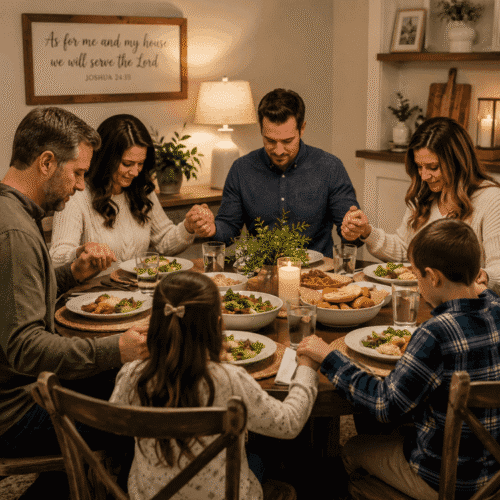
We’ve thought about it. The neighbour we keep meaning to have over. The new family in church who always stands alone after service. The colleague who mentioned, almost in passing, she doesn’t really know anyone in the city yet.
We meant to do something about it. But the week got busy. The house isn’t quite ready. Maybe next month, when things settle down… However, what if our quiet hesitation is costing us far more than a missed dinner? What if hospitality is a direct overflow of what Christ has done for us—and when we neglect it, we lose something we cannot quite recover by any other means?
HOSPITALITY IS A COMMAND, NOT A GIFT
The first thing to settle is this: biblical hospitality isn’t a spiritual gift reserved for extroverts with open-plan kitchens. The Greek word in Romans 12:13 is philoxenia—love for the stranger. It sits in the same list as weeping with those who weep, and clinging to what is good. It isn’t a niche ministry for the naturally gregarious. It’s never qualified with “if you feel ready” or “when your home is large enough.”
The Bible simply commands it—warmly, repeatedly, and without apology (1 Peter 4:9; Hebrews 13:2; 1 Timothy 3:2; Titus 1:8; Leviticus 19:33,34; Isaiah 58:7; Matthew 25:35; 3 John 1:5-8).
But the why matters enormously. Because hospitality, rightly understood, doesn’t begin with us at all.
GOD IS THE ORIGINAL HOST
The deepest foundation for hospitality is the character of God himself. Creation is a hospitable act—God making space, preparing a home, filling it with light and life and beauty, and placing creatures within it. Eden isn’t just a garden; it’s a welcome.
But the centrepiece of divine hospitality is the Incarnation. Jesus Christ left the eternal feast of the Trinity to enter our world as a stranger—born in a barn because there was no room (Luke 2:7), a man with nowhere to lay His head (Luke 9:58). He who was the eternal Host became a guest, a sojourner, the outsider. And the Cross is the ultimate act of welcome: absorbing our hostility (Romans 5:10), making peace, so that those who were once strangers and aliens (Ephesians 2:12) could be brought near and called home.
The gospel is, at heart, an invitation to a feast. Every dinner table we set is a faint, imperfect, glorious echo of the Marriage Supper of the Lamb. We cannot separate hospitality from the gospel. One flows irresistibly from the other.
THE OPEN HOME: ENTERTAINING VS. HOSPITALITY
Rosaria Butterfield, in her searching book The Gospel Comes with a House Key, draws a distinction that stops most of us cold.
Entertaining is about the host’s image. It’s curated, conditional, and essentially a performance—the right guests, the right occasion, the right meal. It waits until everything is ready, because what’s really on display is us.
Hospitality, on the other hand, is about the guest’s need. It is outward-facing, sacrificial, and often unglamorous. It doesn’t require a clean house, a fine meal, or a convenient evening. It requires only a willingness to make someone else feel they matter.
Butterfield and her husband practised what she calls “big-table Christianity”—a literal open table, feeding neighbours, strangers, international students, the lonely, the questioning, all together, not as an extraordinary event but as an ordinary Tuesday. Her central claim is quietly radical: the Christian home isn’t a castle for self-protection. It’s a stewardship, given by God, to be held open for others.
The table is a theological statement. Who sits at ours?
WHAT ACTUALLY GETS IN THE WAY
If hospitality is this important, why do so few of us practise it? Because something—usually several things—has taken its place. Scripture has a name for these things: idols.
- Comfort. We love our evenings. Our routines. Our carefully guarded peace. Hospitality is inherently disruptive. The guest who arrives when you are tired, the conversation that runs two hours longer than planned — these feel like interruptions to the ministry. They are the ministry.
- Reputation. We wait until the house is presentable, the meal impressive, the timing right. But this is entertaining disguised as hospitality. Biblical welcome opens the door with the dishes in the sink. The person at our doorstep doesn’t need our best crockery. They need to know they’re wanted.
- Reciprocity. Jesus is strikingly direct: invite the poor, the crippled, the lame, the blind—those who cannot repay you (Luke 14:12–14). If we only welcome those likely to return the favour, we’re doing social networking. Not Kingdom work.
- Safety. The stranger is risky. The neighbour with complicated views, the person who asks hard questions, the one whose life looks nothing like ours—welcoming them costs something. But Hebrews 13:2 reminds us some who opened their doors to strangers were, without knowing it, hosting angels. We don’t know who is standing at the door.
- Busyness. Perhaps the most socially respectable idol of all. We’re genuinely busy—and yet the Puritans, who took Scripture seriously, believed the home was the primary context for Christian discipleship, not a supplement to it. Our calendars tell the truth about what we actually believe.
WHAT WE’RE TRULY MISSING
Here’s what a closed home costs us—not in guilt, but in honest loss.
We miss the person who needed exactly what we had to offer, and found it nowhere. We miss the conversation that would have stretched our faith and softened our assumptions. We miss the slow, beautiful work of a stranger becoming a friend, and a friend coming to faith. We miss modelling for our children that the world does not revolve around family comfort alone—that other image-bearers have dignity and deserve a seat. We miss the strange joy that comes only on the other side of inconvenience.
And we miss the rehearsal. Every meal shared in welcome is a foretaste of the feast that has no end. Each time we open our homes, however imperfectly, we’re staging a small, provisional preview of the Kingdom—where the last are first, where the stranger is welcome, where the table always has room.
HOW TO ACTUALLY GROW
Growth in hospitality follows the same pattern as all Christian growth: it is Spirit-worked, through ordinary means, sustained over time. Here’s where we start.
Let’s start small. One intentional meal per week with someone outside our inner circle. The practice forms the habit, and the habit slowly forms the heart.
Let’s lower our standards for execution, not for love. Toast and tea and a listening presence is hospitality. The dinner party we never host is not.
Let’s pray for a specific person or family by name. Let’s ask God to lay someone on our heart—the new church member, the international student, the widow, the sceptic. Hospitality often begins not with an open door, but with a name.
Let the Lord’s Table teach us. Receiving Christ’s hospitality in Communion, week after week, is the liturgical school of welcoming others. We cannot be genuinely formed at the Lord’s Table and remain, without contradiction, a closed-home Christian.
THE ONLY CREDENTIAL WE NEED
Let’s return, for a moment, to that hesitation at the start. The messy house. The full calendar. The sense of not being quite ready.
None of it disqualifies us. The only credential hospitality requires is this: we were once the stranger, and we were welcomed at infinite cost. The God of the universe set a table for us when we were still an enemy. He opened a door we could not open ourselves. He made us guests before we even knew we needed a home.
That’s the gospel. And we who’ve truly received it have every reason to pass it on—and no good excuse not to.
“Do not neglect to show hospitality to strangers, for thereby some have entertained angels unawares.”—Hebrews 13:2
Open the door. Someone’s waiting on the other side.
OUR STRONGEST EXCUSES, GRACEFUL ANSWERS
“My home isn’t big enough to host people.” Hospitality has never required square footage—it requires willingness. The early church met in cramped homes, around modest tables, and turned the ancient world upside down. What we’re really offering isn’t a room; it’s our presence, our attention, and the signal that someone is worth our time. The person who needs welcome rarely notices our square footage; they notice whether we noticed them.
- “I’m too busy—I genuinely don’t have the time for it.” Busyness is the most socially acceptable reason to remain closed, which is precisely why it deserves the most scrutiny. The question isn’t whether our calendar is full—most faithful Christians’ calendars are—but what our calendar reveals about our priorities. Hospitality rarely demands a grand occasion; it often asks only for a meal we were already making, extended to one more person. What we lose in busyness isn’t just a dinner—it’s the slow, irreplaceable work of a stranger becoming a neighbour, and a neighbour coming to faith.
- “I’m an introvert—entertaining people drains me completely.” This is one of the most honest objections, and it deserves a genuinely honest answer: hospitality will cost us something, and for introverts, that cost is real. But the biblical call isn’t to entertain—that performance-driven, image-conscious exercise that exhausts everyone—it’s philoxenia, love for the stranger, which can be as quiet as a one-on-one cup of tea and a unhurried conversation. Many of the most gifted practitioners of hospitality are introverts, precisely because they listen well and make people feel genuinely seen. And heard. The drain is real; so is the grace that replenishes it.
“I have young children—my home is chaos right now.” The season of young children is demanding, and no one should minimise that honestly. But a home full of noise, mess, and small people isn’t a disqualification for hospitality—it may, in fact, be one of its most powerful forms. Guests who enter a home where children are being raised with warmth, laughter, and grace often encounter something they’ve not seen before and quietly long for. Our chaotic, imperfect, generous home may be the most compelling thing some people ever witness.
- “I wouldn’t know what to talk about—it feels awkward.” The fear of awkwardness keeps more doors closed than almost anything else, yet most people are so hungry for genuine conversation they’ll travel miles to get to a welcoming home. We don’t need to be sparkling conversationalists; we need to ask good questions and then actually listen to the answers—a rarer gift than wit or eloquence. The awkward silences we dread are usually just the sound of trust being slowly built. What we lose by avoiding them is the deeper friendship that only comes after we’ve pushed through the surface together.
- “I’m single—and I’m honestly not sure hospitality is really for me.” Hospitality has never belonged exclusively to married couples with dining rooms and matching crockery—it belongs to anyone who has been welcomed by Christ. Some of the most transformative tables in church history were kept by single people who had precisely the freedom that family life rarely allows: unhurried time, undivided attention, and a home that could be genuinely open without the negotiation that coupledom requires. What we may see as a limitation is, in the hands of God, a particular gift.
“I love the idea of an open home—but my spouse isn’t on board.” This is one of the most honest tensions in Christian marriage. Hospitality that’s unilaterally imposed on an unwilling spouse isn’t Kingdom generosity—it could become a source of resentment. The better path is patient, prayerful, and small: begin with one low-stakes invitation—over tea, perhaps, rather than over dinner. Make it as easy as possible for your spouse, and let the experience speak before the theology does. What often moves a reluctant spouse isn’t a compelling argument but a compelling evening—one where the cost turned out to be less than feared and the joy turned out to be more.
At the same time, it’s worth asking together what specifically feels threatening about the open home. Is it the loss of privacy? The effort and cost? A sense of inadequacy? Named honestly, most of these fears are far more workable than they appear. Pray for your spouse and for a shared vision—because hospitality flourishes best not as one person’s passion is tolerated by another, but as a joint act of grace that a household offers together.
OUR RELATED POSTS
- The Christian Open Home: The Aquila-Priscilla Model
- The Christian Open Home: FAQs on Why It’s a Ministry Worth Considering