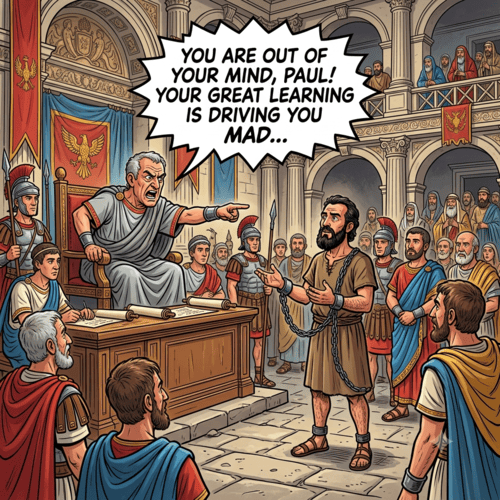
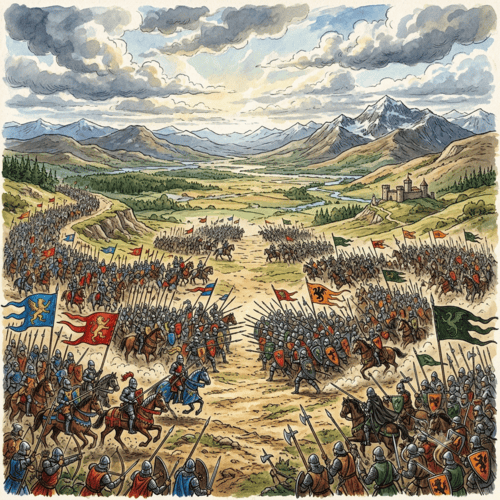
It’s a common objection we hear against faith: “Just look at history. The Crusades, the Inquisition, endless holy wars. Religion has caused more bloodshed than anything else. The world would be far more peaceful without it.”
It sounds obvious. And because it feels obvious, it’s rarely questioned. But some of the things that feel most obvious turn out, when we look at them carefully, to be untrue—and this is one of them.
Let’s put the claim to the test. Let’s look at what the historical evidence actually shows, and then dig down to the real root of human violence—a root that goes far deeper than religion, and that only the Christian faith both explains and cures.
Where the claim comes from
The idea that “religion causes most wars” was made popular by a group of writers often called the New Atheists—a movement of authors who argued forcefully that belief in God is harmful. The three best known are Richard Dawkins, Sam Harris and Christopher Hitchens. Hitchens even gave his book the subtitle “How Religion Poisons Everything.” Their argument, put simply, runs like this:
- Faith makes people certain. When someone believes God is on their side, they will not back down or compromise.
- Faith raises the stakes. A war stops being a mere fight over land and becomes a holy cause worth killing and dying for.
- Therefore religion is uniquely dangerous —and, they conclude, the chief cause of war.
It’s easy to see why this feels convincing. A handful of examples—the Crusades, a suicide bomber, a sectarian riot—are vivid, memorable and endlessly repeated in the news and online. Vivid pictures shape our sense of what’s normal, even when they are the exception rather than the rule. So the claim spreads not because someone has counted the wars, but because the images stick in the mind.
It’s a serious argument. So let’s begin where the objection is weakest: the actual facts.
What the numbers actually say
The most thorough catalogue of wars ever assembled is the three-volume Encyclopedia of Wars by Charles Phillips and Alan Axelrod. They recorded 1,763 wars across the whole of human history. Of these, how many were religious?
| THE HISTORICAL RECORD | FIGURE |
|---|---|
| All wars in recorded history | 1,763 |
| Wars involving religion | 123 |
| Share that were religious | about 7% |
A second major reference work, the Encyclopedia of War edited by Gordon Martel, reached almost the same figure—around 6%.
Now, a word of honesty: this 7% figure is useful, but it’s not a magic proof. The authors didn’t set out to settle this debate, and deciding exactly which wars count as “religious” isn’t a tidy science. So we shouldn’t swing to the opposite extreme and pretend religion has caused almost no wars at all.
The point is more modest—and more powerful. The person who claims religion causes most wars carries the burden of proof, and the evidence simply isn’t there. The great engines of war throughout history have been land, money, power, tribe and empire, far more than the pulpit.
Think of the biggest wars we can name. The First and Second World Wars—by far the deadliest conflicts in history—weren’t fought over doctrine but over territory, nationalism and political power. The wars of Napoleon, the conquests of Alexander the Great and Genghis Khan, the Roman campaigns, the American Civil War: none of these were religious wars. When we look past the few famous examples and survey the whole sweep of history, the pattern is unmistakable. Faith is rarely the driver.
What even counts as “religion”?
There’s a deeper problem hiding inside the objection, and scholar William Cavanaugh has exposed it clearly in his book The Myth of Religious Violence. It begins with a simple question: what exactly is “religion”?
We tend to imagine “religion” is one clear thing, sitting in a neat box, separate from “ordinary” life such as politics and money. But that division is surprisingly modern and surprisingly slippery. Consider these belief systems:
- Nationalism —the belief that my nation is supreme and must be served above all.
- Communism —an atheist system that promised a paradise on earth.
- Political ideologies of every kind —that ask for total loyalty, even sacrifice.
Each of these can inspire absolute devotion. Each has led millions to kill and to die. Yet we conveniently label them “secular”—meaning non-religious—and leave them out, while blaming “religion” for violence. The line is quietly drawn to give us the answer we already wanted.
Here’s one way to see the trick. Two men march into battle willing to die. One shouts the name of his god; the other shouts the name of his nation. We instinctively call the first “religious violence” and the second “patriotism” or “politics.” But both are acting out of a deep, unquestioning devotion to something they treat as sacred. The label we attach depends on which loyalties our culture happens to approve of, not on any real difference in the act.
Cavanaugh’s conclusion is sharp: there’s no neat, timeless thing called “religion” that we can lift out of human life and blame for war. Devotion, loyalty and the willingness to kill for a cause are human traits—not specifically religious ones.
The bloodiest century was the least religious
Here’s a test. If religion were truly the engine of war, the least religious period in history ought to have been the most peaceful. The exact opposite is true.
The 20th century was the most secular century humanity had ever seen—and by a wide margin the most murderous. The greatest slaughters were carried out not by churches but by governments that were officially atheist.
| Regime | Leader | Estimated deaths |
|---|---|---|
| Soviet Union | Joseph Stalin | tens of millions |
| China | Mao Zedong | tens of millions |
| Cambodia | Pol Pot | around a quarter of the whole population |
These governments weren’t merely non-religious. They were actively hostile to religion, and they killed on a scale no holy war has ever approached.
It’s worth pausing on why these regimes turned out as they did. Each promised to sweep away the old order—including faith—and to build a perfect society by human effort alone. But a system that recognises no authority higher than the state, and no law higher than its own vision of progress, has no reason to spare anyone who stands in the way. The results were the gulag, the famine and the killing field.
We must be careful and fair here. We’re not claiming “atheism causes murder” as a mirror-image of the objection—that would be the same lazy mistake in reverse. The point is simply this: take religion away, and the killing doesn’t stop. Something far deeper is at work.
So where do wars really come from?
If religion is not the true source of war, what is? Here the Bible offers an answer that’s more honest—and more uncomfortable—than anything the New Atheists propose. The objection assumes we human beings are basically peaceful, and that religion is the poison poured into us from outside. The Bible says the poison is already inside.
Listen to how James, the brother of Jesus, traces every conflict back to its true source:
What causes quarrels and what causes fights among you? Is it not this, that your passions are at war within you? You desire and do not have, so you murder. (James 4:1–2)
Notice what he blames. Not doctrine. Not the church. Not “religion.” He blames desire—the craving to have what we don’t have. War begins in the human heart long before it ever reaches a battlefield.
The Bible teaches every human being is affected by sin—not only in some outward actions, but in the deepest springs of the heart. This is why the very first murder in the Bible, Cain killing his brother Abel (Genesis 4), happened inside a single family, long before any organised religion or army existed. The problem was never “out there” in a system. It was “in here,” in the heart.
Prophet Jeremiah put it just as bluntly. When he searched for the source of humanity’s troubles, he didn’t point outward to institutions or systems. He pointed inward:
The heart is deceitful above all things, and desperately sick; who can understand it? (Jeremiah 17:9)
This is the honest diagnosis, and it applies to everyone without exception. It doesn’t divide the world neatly into peaceful people and violent people, or good “us” and dangerous “them.” It says the same capacity for greed, pride, envy and cruelty runs through every human heart—religious and non-religious, ancient and modern, yours and mine. That’s an uncomfortable truth, but it’s a far more honest one than blaming a single group or a single institution.
This explains something the objection cannot. Why does removing religion never remove war? Because we haven’t touched the real cause. We’ve simply moved the same sinful heart into a new uniform, under a new flag, chanting a new slogan. The reformers who wanted to abolish God in the name of a better world didn’t end violence—they industrialised it.
A better diagnosis
Religion isn’t the disease. It’s one of a thousand things a sick heart can seize, twist and abuse. Remove religion, and the disease simply finds another host—a nation, a party, a grievance, a flag.
But what about the Crusades and holy wars?
We must not dodge the hardest question. What about the wars that really were fought in God’s name—the Crusades, the Inquisition, the wars that tore Europe apart? Are these not a stain on the Christian faith? Two honest things must be said.
First, we do not excuse them. When people calling themselves Christians took up the sword to force their faith on others, or to seize land and power under a holy banner, they were wrong. We name it plainly as sin—and, in truth, such wars were often as much about territory, money and royal ambition as about belief.
Second, and this is crucial: a movement must be judged by its founder and its teaching, not only by its worst followers. And here the Christian faith stands on remarkable ground. When one of Jesus’ own disciples drew a sword to defend Him, Jesus rebuked him:
Put your sword back into its place. For all who take the sword will perish by the sword. (Matthew 26:52)
Jesus told the Roman governor plainly:
My kingdom is not of this world. (John 18:36)
He never once commanded His followers to spread the good news by force. So when the church has picked up the sword to advance the faith, it has betrayed its Master—not obeyed Him.
“But the God of the Old Testament commanded wars!”
That’s a fair charge. The battles God commanded in the Old Testament were a unique act of judgement upon specific nations at a specific point in history—not a general pattern for God’s people to copy in every age. They were never handed to the church as a licence for holy war, and the New Testament never authorises Christians to take up arms to spread the faith.
The one who came to end the violence
Here’s the final turn. The New Atheists picture religion as something that adds violence to the world. But look closely at the central figure of the Christian faith.
Jesus is called the Prince of Peace (Isaiah 9:6). He didn’t conquer His enemies by killing them—He conquered them by dying for them. At the very heart of Christianity we don’t find a warrior spilling the blood of his enemies, but a Saviour who lets His own blood be spilled to make peace.
His teaching pressed in the same direction. He told His followers to love their enemies, to bless those who curse them, and to turn the other cheek rather than answer blow with blow (Matthew 5:44). Whatever the failures of those who’ve claimed His name, no one can pretend this is a recipe for holy war. It’s the opposite—a call to break the cycle of revenge that keeps the world at war.
This is why, wherever the Christian message has truly taken root, it has tended to produce not armies but mercy—the first hospitals, the care of orphans and the poor, the movement to abolish slavery led by men such as William Wilberforce, and a great deal of modern humanitarian work. The fruit of the message, when it’s actually followed, is peace, not the sword.
And it points us to the only real cure for war. If the sickness lies in the human heart, no political system, no education programme, and no removal of religion can heal it. Only God can. And this is exactly what He promises:
I will give you a new heart, and a new spirit I will put within you. (Ezekiel 36:26)
So, is religion responsible for most wars?
The evidence says no. The history says no. And the deepest truth is this: the problem was never religion. The problem is the human heart—mine included.
The next time someone tells you religion is the great cause of war, you can answer gently but firmly. The numbers don’t support it. The definition of “religion” falls apart under pressure. The bloodiest century was the most secular. And the real culprit is one that no political revolution has ever managed to remove—the human heart itself.
The good news of the Christian faith is that it tells us the truth about the problem, and then offers the one remedy that actually works: a new heart, given freely by the God who made peace with us at the cost of His own Son. That’s not a religion that poisons everything. That’s a rescue.
Tough Questions, Honest Answers
Doesn’t the Bible itself contain violent commands from God?
It does record wars that God commanded in the Old Testament. But these were a bounded act of divine judgement on specific nations at a specific moment in redemptive history—never a standing pattern for God’s people to imitate. The New Testament gives the church no mandate to advance the faith by force. Jesus told Peter to put his sword away, and He conquered not by shedding others’ blood but by shedding His own.
What percentage of wars have actually been religious?
The three-volume Encyclopedia of Wars catalogued 1,763 wars and classed roughly 7% as religious; another major reference work reached about 6%. These figures are estimates rather than exact science, but they point clearly in one direction: the overwhelming majority of wars were driven by land, power, money and empire, not faith.
If religion doesn’t cause war, why does it appear in so many conflicts?
Because religion is deeply important to people, it often gets pulled into conflicts that are really about power, land or ethnicity—and used to rally support or justify what leaders already wanted to do. Religion frequently appears at the scene of the crime without being the cause of it. Strip it away and the underlying quarrels remain.
Weren’t the Crusades a Christian holy war?
They were fought under a religious banner, and we don’t excuse the violence done in Christ’s name. But they were also tangled up with land, trade, politics and royal ambition. More importantly, they contradict the plain teaching of Jesus, who forbade spreading His kingdom by the sword. The Crusaders departed from Christ; they didn’t follow Him.
Aren’t atheists more peaceful than religious people?
History doesn’t support that hope. The most secular century in human history—the 20th—was also the most murderous, with officially atheist regimes under Stalin, Mao and Pol Pot killing on a scale no religious war approached. The lesson isn’t that atheism causes murder, but that removing religion doesn’t remove the violence in the human heart.
Isn’t Islam clear evidence religion drives war?
Conflicts involving Islam are real, and it would be dishonest to wave them away. But the wider historical record still shows religion accounts for a small share of all wars. Each faith must be assessed on its own founder and teaching. For Christianity, the founder rejected the sword and died for His enemies—which is why we must never let the actions of any violent group stand in for the message of Jesus.
If sin is the real cause, does becoming a Christian make someone non-violent?
It begins a real change, though not an instant or perfect one. When God gives a person a new heart, the cravings that fuel conflict—envy, pride, the hunger to dominate—are gradually put to death. Christians aren’t sinless, but they’re being remade by the Prince of Peace, and are called to love even their enemies. The cure works from the inside out, over a lifetime.