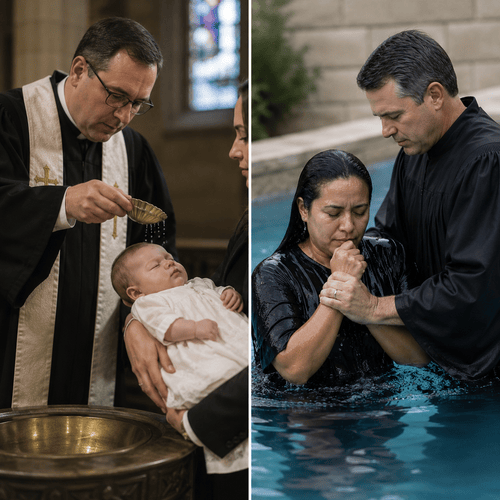
Few questions cause more friendly argument among Christians than this one. Some believers are lowered fully under the water. Some have water poured over the head. Others feel a few drops sprinkled on the forehead. Each group can point to a verse, and each can sound quite sure the others have got it wrong. So which is it? Is there one correct way to baptise, and are the rest mistakes?
The short answer of the historic Reformed churches may surprise you. All three ways are valid baptism. None is commanded to the exclusion of the others. But one way pictures the meaning of baptism most clearly. To see why, we need to slow down and take the question apart, because two different debates are usually tangled together here.
Two questions hidden inside one
Before we go further, notice people arguing about baptism are often arguing about two separate things at once:
- The mode question: how must the water be applied? Immersion (the whole body dipped under)? Pouring (water poured over the head, also called affusion)? Or sprinkling (a little water applied, also called aspersion)?
- The subject question: who should be baptised? Only those old enough to profess faith for themselves, or also the infant children of believers?
These are different axes. An adult can be sprinkled; an infant can be immersed. This article is only about the first question, the mode. So when we ask “is there a right way to baptise?”, we are asking two smaller questions: which ways are valid, and which way fits best?
A quick glossary
Immersion—the person is placed fully under the water and lifted out again.
Affusion (pouring)—water is poured over the head so it runs down the body.
Aspersion (sprinkling)—a small amount of water is sprinkled onto the person.
What does the word “baptise” actually mean?
The case for immersion often begins with the Greek word itself. Our English “baptise” comes from the Greek verb baptizō. In everyday Greek, this word can mean to dip or to plunge, and that’s quite true. If the word only ever meant “to plunge under”, the debate would be over. But words carry a range of meanings, and in the Bible baptizō and its close relatives are used more broadly, to mean “to wash”, “to wet”, or “to bring under a ceremonial cleansing”. Look at how Scripture actually uses the baptizō family:
| PASSAGE | WHAT IS DESCRIBED | WAS IT IMMERSION? |
|---|---|---|
| Mark 7:4 | Ritual “washing” of cups, pots and dining couches | No—a dining couch was not dipped |
| Luke 11:38 | A Pharisee is shocked Jesus did not “wash” before eating | No—this was ritual handwashing |
| Hebrews 9:10, 19–21 | Old Testament “various washings”; Moses sprinkles blood and water | No—the text says sprinkling |
| 1 Corinthians 10:2 | Israel “baptised into Moses in the cloud and in the sea” | No—Israel crossed on dry ground |
That last example is striking. Israel was said to be baptised, yet the people walked across on dry ground. It was the Egyptians who were plunged under the sea. If anything, Israel was covered by the cloud from above. The word alone, then, can’t settle the matter. It permits immersion, but it doesn’t command it.
The meaning decides the mode—and the meaning is “from above”
Reformed theology holds a simple principle about the sacraments: the sign should match the thing it signifies. Baptism is a sign of real things—of being joined to Christ, of being washed clean from sin, and of receiving the Holy Spirit. So we should ask: how does the Bible picture the Spirit coming to a person? The answer is remarkably consistent. The Spirit is poured out and clean water is sprinkled—always from above, never from below.
The Spirit and cleansing come down upon us
- Ezekiel 36:25–27—“I will sprinkle clean water on you, and you shall be clean … And I will put my Spirit within you.” The great promise of new-covenant cleansing is sprinkling.
- Joel 2:28–29; Acts 2:17, 33—at Pentecost the Spirit is poured out on all flesh.
- Titus 3:5–6—“the washing of regeneration … whom he poured out on us richly.”
- Isaiah 52:15—“so shall he sprinkle many nations.”
- Hebrews 10:22; 12:24; 1 Peter 1:2—hearts sprinkled clean, the sprinkled blood of Jesus.
Do you see the direction? Water applied from above—poured or sprinkled—mirrors the Spirit descending onto the believer. A person going down into water and rising again is a fine picture too, but it points the other way. This is the strongest positive argument for pouring and sprinkling, and notice it is a theological argument about meaning, not merely a word study. The mode that best pictures the gospel is the mode where the water comes down.
But what about being “buried with Christ”?
Here’s the immersionist’s best argument, and it deserves a fair hearing. Paul writes in Romans 6:3–4 we were “buried … with him by baptism into death”, and raised to “newness of life.” Colossians 2:12 says something similar. Surely, the argument runs, going under the water and coming up again acts out this burial and resurrection? It’s a powerful image. Three points show why it doesn’t make immersion necessary.
- The passage is about union, not choreography. Paul’s point is we’re joined to Christ by the Spirit in His death and resurrection. In the very same passage we’re also “crucified with Him” (Romans 6:6) and “planted together” with Him. Yet no one re-enacts a crucifixion or plants the candidate in soil to make baptism valid. The images teach union; they’re not stage directions for the water.
- First-century burial wasn’t “under and up”. Jewish bodies were laid on a rock shelf inside a tomb, with a stone rolled across the entrance—think of Jesus’ own tomb. Nobody was lowered down and covered over. So immersion doesn’t actually copy how they buried the dead.
- The main baptism picture in the New Testament is washing. Again and again baptism is linked to being cleansed: “wash away your sins” (Acts 22:16), “you were washed” (1 Corinthians 6:11), “having cleansed her by the washing of water” (Ephesians 5:26). And washing in the Bible is regularly done by pouring and sprinkling.
What the book of Acts shows us
When we watch actual baptisms happen in Acts, immersion is often difficult or unlikely, and water is usually brought to the people rather than the people taken to a river.
| ACCOUNT | WHAT HAPPENS | WHAT IT SUGGESTS |
|---|---|---|
| Acts 2:41 | 3,000 people baptised in Jerusalem in one day | Pouring is far more practical than 3,000 dippings |
| Acts 10:47 | “Can anyone withhold water…?” — water is fetched | Water brought to the people, indoors |
| Acts 16:33 | The jailer and his household baptised at midnight, in the house | No baptistery on hand at that hour |
| Acts 9:18 | Saul “rose and was baptised” in the house | Baptised on the spot, not at a river |
| Acts 8:38–39 | Philip and the eunuch “went down into” and “came up out of” the water | Permits immersion—but Philip was not immersed either |
That final case is the immersionist’s strongest story, and we should be honest about it. Yet notice both men went down into the water, and Philip plainly wasn’t dipped. The Greek phrases for going “into” and “out of” can equally describe stepping to the water’s edge and standing in it while water is applied. The scene allows immersion; it doesn’t require it.
What the earliest church did
We’re not the first to face this question. A very early Christian handbook called the Didache—written around the end of the 1st century or the start of the 2nd—gives step-by-step instructions for baptising. And it’s wonderfully down-to-earth.
The Didache on how to baptise (chapter 7)
Baptise in running (“living”) water if you can. If you have no running water, use other water. If you cannot do it in cold water, use warm. And if you have neither enough for immersion, then pour water on the head three times in the name of the Father, Son and Holy Spirit.
This matters enormously. The oldest surviving church manual we possess treats pouring as perfectly valid baptism when conditions require it. It never hints that a poured baptism is second-class or must be done again. The mode was simply never treated as the essence of the thing. Early Christian art from the catacombs points the same way, often showing a candidate standing in shallow water while water is poured over the head.
What the Reformers and confessions said
The Reformed tradition has been consistent and, importantly, honest. John Calvin freely admitted the word tends towards dipping and the early church often did immerse. But he concluded the mode “is of no importance”, and that churches should be left free according to their climate and circumstances. That intellectual honesty is worth keeping: we don’t need to deny immersion is ancient in order to deny it is required.
Later Reformed theologians such as John Murray, Charles Hodge and Benjamin Warfield carried the argument forward: because baptism signifies the Spirit applied from above, pouring and sprinkling aren’t merely allowed but especially fitting. The Westminster Confession of Faith then settled the matter for the confessional churches.
Westminster Confession of Faith 28.3
The Confession teaches that dipping the person into the water is not necessary, and that baptism is rightly administered by pouring or sprinkling water on the person.
The strongest case for immersion, fairly stated
It would be unfair to end without putting the other view at its best. A thoughtful Christian who prefers immersion can say:
- The default sense of baptizō really is “to dip”, so immersion is the natural reading.
- Romans 6 pairs baptism with burial and resurrection, which immersion acts out vividly.
- The Ethiopian eunuch account reads most naturally as an immersion.
- Even Calvin conceded immersion was the ancient practice.
- A full-body sign carries a striking symbolic force that a few drops cannot.
These are real points, and none of them should be waved away. The Reformed reply isn’t that immersion is wrong or invalid—it plainly is a valid baptism. The reply is simply that none of these points proves immersion is the only valid way, while the “Spirit poured out from above” imagery gives pouring and sprinkling the stronger claim to fitness.
So—is there a right way?
Now we can answer the question honestly, and the answer has two layers.
- If “right way” means “the only valid way”—then the question is a mistake. All three modes are true baptism. Scripture never binds us to one.
- If “right way” means “the fittest sign”—then there is a real answer: pouring or sprinkling, because water coming down upon us best pictures the Spirit poured out and the clean water sprinkled that the Bible promises.
This carries a gentle but important pastoral consequence. A believer who has been baptised by any mode, in the name of the Father, the Son and the Holy Spirit, has been truly baptised and shouldn’t be baptised again merely because of the mode. To demand a certain mode as the test of a valid baptism is to add a requirement that God’s Word never gives—and adding to Scripture is exactly the danger we should most want to avoid. The water, in the end, is a sign. What it points to—union with a crucified and risen Saviour, sins washed away, the Spirit poured out—is the treasure. Let us hold the sign with care, and the treasure with joy.
Tough Questions, Honest Answers
Does the Greek word “baptizō” mean I must be fully immersed?
Not on its own. The word can mean to dip, but in the Bible its family also means to wash or to cleanse ceremonially—including cases like washing cups or Moses sprinkling blood, where nothing was dipped under. The word permits immersion; it doesn’t command it.
Is a person baptised by sprinkling really baptised?
Yes. The historic Reformed churches, and the earliest church manual we possess (the Didache), treat pouring and sprinkling as fully valid baptism. The name of the Father, Son and Holy Spirit and the sign of water make it a true baptism, whatever the mode.
What about Romans 6 and being “buried” with Christ?
That passage teaches our union with Christ in His death and resurrection. It’s a picture of what happens spiritually, not a set of instructions about how much water to use. In the same passage we are “crucified” and “planted” with Christ too, yet no one acts those out physically.
Doesn’t the Ethiopian eunuch prove immersion (Acts 8)?
It allows immersion, but it doesn’t prove it’s required. Both Philip and the eunuch “went down into” the water, and Philip was not immersed. The phrasing fits stepping into the water and having it applied just as well as full dipping.
If someone was immersed, should they be baptised again by sprinkling?
No. Immersion is a valid baptism. Because mode is not the essence of baptism, there is no reason to repeat it. Re-baptising over a question of mode treats a matter of freedom as a matter of validity.
Why do Reformed churches prefer pouring or sprinkling?
Because the sign should match the thing signified. Scripture pictures the Spirit being poured out and clean water being sprinkled from above. Water applied from above therefore best captures the gospel meaning of baptism.
Should the mode of baptism divide churches?
It needn’t. Christians can hold their convictions sincerely while recognising one another’s baptisms as real. The mode is a matter on which believers may differ in peace, provided none unchurches the other over it.