You’re not David
Many of us grew up hearing David and Goliath told like this: be brave like David, and you’ll beat the giants in your life. But it misses the point of the story—and it misses Jesus.
In 1 Samuel 17, we’re not the young hero with the sling. We’re the frightened soldiers on the hillside. We can’t win. We’re crying for someone to fight for us.
That’s the message of the whole book. 1 Samuel gives Israel prophets, priests and kings. Some are good. Many are bad. None is good enough. This article shows how 1 Samuel points to Jesus as the true Prophet, the faithful Priest and the anointed King.
Jesus in the Old Testament — Book 9 of 39
This post is the ninth instalment in our series tracing Christ through every book of the Old Testament. See the full series index.
What’s 1 Samuel About?
1 Samuel tells how Israel moved from being led by judges to being ruled by kings, around 1100–1010 BC. In the Hebrew Bible, 1 and 2 Samuel were one book.
Timeline: The Story at a Glance
- Chapters 1–3: God gives childless Hannah a son, Samuel, who grows up serving at the tabernacle (God’s tent).
- Chapters 4–7: The Philistines capture the ark of the covenant (the sacred chest that showed God’s presence), then send it back.
- Chapters 8–15: Israel demands a king. God gives them Saul, who disobeys and is rejected.
- Chapters 16–17: Samuel anoints young David, who then defeats Goliath.
- Chapters 18–31: Saul hunts David. The book ends with Saul’s death.
Is It Right to Look for Jesus in 1 Samuel?
Do Christians just imagine Jesus everywhere? With 1 Samuel, we’re not guessing. The New Testament shows us the way.
- Jesus said the Prophets speak about Him. ‘Beginning with Moses and all the Prophets, he interpreted to them in all the Scriptures the things concerning himself’ (Luke 24:27). In the Hebrew Bible, Samuel belongs to ‘the Prophets’.
- Peter named Samuel. ‘All the prophets who have spoken, from Samuel and those who came after him, also proclaimed these days’ (Acts 3:24).
- Paul preached from Samuel to Jesus. Moving from Samuel to Saul to David, he said, ‘Of this man’s offspring God has brought to Israel a Saviour, Jesus’ (Acts 13:20–23).
- Jesus used 1 Samuel about Himself. He pointed to David eating the holy bread (1 Samuel 21), then said, ‘something greater than the temple is here’ (Matthew 12:3–6).
- Luke echoed 1 Samuel. Samuel grew ‘in stature and in favour with the LORD and also with man’ (1 Samuel 2:26). Luke describes the boy Jesus in almost the same words (Luke 2:52).
What Faithful Teachers Have Said
John Calvin, commenting on John 5:39, wrote ‘we ought to read the Scriptures with the express design of finding Christ in them’.
Charles Spurgeon said that from every text ‘there is a road to the metropolis of the Scriptures, that is Christ’.
Hannah’s Song: A King Before There Was a King
The book opens with Hannah, a childless woman in tears. God answers her prayer and gives her Samuel.
Then Hannah sings. God lifts up the poor and brings down the proud (2:7–8). He even rules over death: ‘The LORD kills and brings to life; he brings down to Sheol and raises up’ (2:6). Sheol means the place of the dead.
Her last line is the biggest surprise: ‘He will give strength to his king and exalt the horn of his anointed’ (2:10). A horn is a picture of strength. But Israel had no king yet! This is the first time the Bible calls a king God’s ‘anointed’—His messiah. From the start, this book is waiting for a king.
Hannah’s Song and the Songs in Luke 1
| THEME | HANNAH (1 SAMUEL 2) | MARY AND ZECHARIAH (LUKE 1) |
|---|---|---|
| Joy in God | ‘My heart exults in the LORD’ (2:1) | ‘My soul magnifies the Lord’ (1:46) |
| The proud brought low | ‘He brings low and he exalts’ (2:7) | ‘He has brought down the mighty from their thrones’ (1:52) |
| God’s strong King | ‘The horn of his anointed’ (2:10) | ‘A horn of salvation … in the house of his servant David’ (1:69) |
Luke wants us to hear Hannah’s song behind the songs of Mary and Zechariah. What Hannah hoped for, they saw arriving.
This is planned. Hannah’s song about God’s ‘anointed’ opens the story, and near the end of 2 Samuel, David praises God who ‘shows steadfast love to His anointed, to David and his offspring forever’ (2 Samuel 22:51). In the 5th century, Augustine of Hippo already read Hannah’s song as a prophecy of Christ.
The Faithful Priest Who’d Last Forever
Eli the priest had wicked sons who stole from God’s offerings (2:12–17). So God sent a warning—and a promise: ‘I will raise up for myself a faithful priest … and he shall go in and out before my anointed forever’ (2:35).
This came true in part when Zadok replaced Eli’s family (1 Kings 2:27, 35). But Zadok died. No human priest can serve ‘forever’. Jesus is ‘a merciful and faithful high priest’ (Hebrews 2:17), and ‘he continues forever’ (7:24). In 2:35, the priest and the anointed king are two people. In Jesus, they become one (Psalm 110:1–4).
Samuel: The Prophet Who Prayed for His People
When Samuel was a boy, ‘the word of the LORD was rare in those days’ (3:1). Then God called Samuel and began to speak through him (3:19–21).
Samuel spoke for God, offered sacrifices and led Israel as judge. When the Philistines attacked, ‘Samuel took a nursing lamb and offered it … And Samuel cried out to the LORD for Israel, and the LORD answered him’ (7:9). A lamb was offered, a leader prayed, and God saved His people. Scripture ranks Samuel with Moses as a great intercessor (Jeremiah 15:1).
SAMUEL POINTS BEYOND HIMSELF
- Samuel brought God’s word after silence. God has now ‘spoken to us by his Son’ (Hebrews 1:2).
- Samuel offered a lamb. Jesus is ‘the Lamb of God’ (John 1:29).
- Samuel prayed for Israel. Jesus ‘always lives to make intercession’ for His people (Hebrews 7:25).
- Samuel grew old, and his sons were corrupt (8:1–3). Jesus never fails.
The Ark in Enemy Land: When God Looks Defeated
Israel carried the ark into battle like a lucky charm—and lost. The Philistines captured it. A dying mother named her baby Ichabod, meaning ‘no glory’: ‘The glory has departed from Israel!’ (4:21).
It looked as if God had lost. The Philistines put the ark in the temple of their god Dagon. The next morning, ‘Dagon had fallen face downward on the ground before the ark of the LORD, and the head of Dagon and both his hands were lying cut off’ (5:4). Soon they sent the ark home.
God often wins when He looks weakest. At the cross, Jesus looked defeated. Yet there He ‘disarmed the rulers and authorities … by triumphing over them’ (Colossians 2:15).
‘Give Us a King’: The King Israel Rejected
The people told Samuel, ‘appoint for us a king to judge us like all the nations’ (8:5). Wanting a king was not wrong in itself. God had promised kings (Genesis 49:10; Deuteronomy 17:14–20). The problem was their heart. They wanted to be like everyone else, with a king they could see.
God said, ‘they have not rejected you, but they have rejected me from being king over them’ (8:7). A thousand years later, it happened again. When Pilate presented Jesus, the chief priests answered, ‘We have no king but Caesar’ (John 19:15).
Saul and David: Two Kings, Two Hearts
Saul looked like a king. He was tall and handsome (9:2). But he disobeyed God, and God rejected him (15:23).
So God sent Samuel to Bethlehem: ‘I have provided for myself a king’ (16:1). Samuel expected the tallest son. But ‘man looks on the outward appearance, but the LORD looks on the heart’ (16:7). God chose David, the youngest, a shepherd. When Samuel anointed him, ‘the Spirit of the LORD rushed upon David from that day forward’ (16:13). In the same way, God ‘anointed Jesus of Nazareth with the Holy Spirit and with power’ (Acts 10:38).
Saul, David and Jesus Compared
| QUESTION | SAUL | DAVID | JESUS |
|---|---|---|---|
| Who chose him? | The people (12:13) | God (16:1) | God the Father (Matthew 3:17) |
| How he looked | Tall and impressive | Overlooked youngest son | ‘No form or majesty’ (Isaiah 53:2) |
| The Holy Spirit | Left him (16:14) | Came upon him (16:13) | Given without measure (John 3:34) |
| Obedience | Disobeyed | Obeyed, but later fell | Obeyed perfectly (Hebrews 4:15) |
David and Goliath: Why You’re Not David
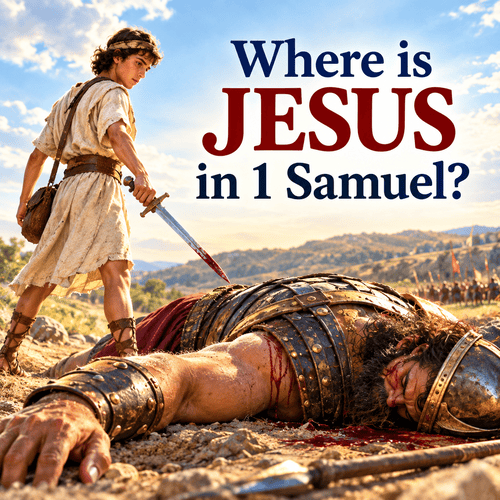
The giant Goliath offered Israel a special kind of fight: ‘If he is able to fight with me and kill me, then we will be your servants. But if I prevail … then you shall be our servants’ (17:9). This is called representative combat. One man fights for a whole nation. If he wins, they all win.
How did Israel respond? ‘They were dismayed and greatly afraid’ (17:11). No one would go. Then David arrived. He trusted God, because ‘the battle is the LORD’s’ (17:47). He struck the giant down and cut off his head with Goliath’s own sword (17:51).
Two Ways to Read David and Goliath
| QUESTION | THE ‘BE LIKE DAVID’ READING | THE BIBLE’S OWN FOCUS |
|---|---|---|
| Who am I in the story? | David | The frightened soldiers |
| What is the main lesson? | Be brave | Trust the champion who fights for you |
| Who gets the glory? | The brave person | God (17:46) |
| Where does it lead? | To myself | To Jesus |
Tim Keller often made this point: the story isn’t mainly about us becoming brave, but about a substitute who fights the battle we cannot fight. Dale Ralph Davis, in 1 Samuel: Looking on the Heart, draws our eyes to what David cared about most—God’s name, ‘that all the earth may know that there is a God in Israel’ (17:46).
Jesus is our greater Champion. We couldn’t defeat sin, death or the devil, so He fought alone. Like David, He used the enemy’s own weapon. He died ‘that through death he might destroy the one who has the power of death, that is, the devil’ (Hebrews 2:14). His victory counts for all His people (Romans 5:19), and the serpent’s head is crushed, just as God promised (Genesis 3:15).
The King in the Cave: Suffering Before Glory
David was anointed in chapter 16, but he did not take the throne until 2 Samuel 5. For years, he hid in caves while Saul hunted him. Jesus walked the same path: ‘Was it not necessary that the Christ should suffer these things and enter into his glory?’ (Luke 24:26).
- He refused a shortcut. Twice David could have killed Saul. He said, ‘The LORD forbid that I should do this thing to my lord, the LORD’s anointed’ (24:6). Jesus also refused Satan’s offer of the kingdoms without the cross (Matthew 4:8–10).
- He welcomed broken people. ‘Everyone who was in distress … in debt … bitter in soul, gathered to him’ (22:2). People said of Jesus, ‘This man receives sinners and eats with them’ (Luke 15:2).
- A go-between turned away anger. Abigail met the angry David and said, ‘On me alone, my lord, be the guilt’ (25:24). Jesus, our true mediator (go-between), actually carried our guilt (1 Peter 2:24).
- He shared the victory. David gave the same reward to those who fought and those who stayed behind (30:24). Christ won alone, yet shares His gifts with all His people (Ephesians 4:8).
Prophet, Priest and King: How It All Fits Together
The Westminster Shorter Catechism (Question 23) teaches that Christ, as our Redeemer, carries out ‘the offices of a prophet, of a priest, and of a king’. 1 Samuel shows all three roles—and shows every human version falling short.
The Three Roles: From 1 Samuel to Jesus
| ROLE | IN 1 SAMUEL | WHERE IT FELL SHORT | FULFILLED IN JESUS |
|---|---|---|---|
| Prophet | Samuel speaks God’s word (3:19–21) | Samuel died (25:1) | God’s final Word (Hebrews 1:1–2) |
| Priest | The promised faithful priest (2:35) | Eli’s sons were wicked (2:12) | Faithful High Priest forever (Hebrews 7:24–25) |
| King | David, the LORD’s anointed (16:13) | Saul disobeyed; David later sinned | Reigns forever (Luke 1:33) |
How Sure Can We Be?
Are all these links equally certain? No—and being honest makes our case stronger. Sidney Greidanus, in Preaching Christ from the Old Testament, shows several proper roads from an Old Testament text to Christ, including promise and fulfilment, typology and New Testament quotations. He warns against allegory, which invents hidden meanings. Typology is different: it starts with real history and follows patterns God built into it. Edmund Clowney taught the same care: first ask what a story meant to Israel, and only then trace it to Christ.
Three Levels of Certainty
| LEVEL | WHAT IT MEANS | EXAMPLES IN 1 SAMUEL |
|---|---|---|
| Clear | The New Testament quotes or applies the passage | Acts 3:24; 13:22; Matthew 12:3–6; Luke 1–2 |
| Strong | Word links in the text, plus a New Testament pattern | Hannah’s ‘anointed’ (2:10); the faithful priest (2:35); David’s anointing; Goliath |
| Illustrative | A true pattern that pictures Christ, but not a prediction | Dagon’s fall; Abigail; sharing the reward (30:24) |
Even without the illustrative level, the case stands.
Answering Common Objections
- ‘Samuel and David had faults, so they cannot picture Jesus.’ Types are meant to fall short. Each failure makes us long for someone better. Hebrews argues in exactly this way (Hebrews 7:23–25).
- ‘Hannah meant David, not Jesus.’ David is the first king in view. But centuries after David died, the prophets still promised a coming ‘David’ (Ezekiel 34:23–24). The ancient Jewish Aramaic paraphrase (the Targum) also reads 2:10 as speaking of the Messiah.
- ‘Christians invented this later.’ Jesus and His apostles read 1 Samuel this way first. Augustine followed them.
What This Means for Us
1 Samuel isn’t mainly a book of heroes for us to copy. It’s a record of human failures that make us hungry for a Saviour.
Like Israel, we often want a king we can see: a leader, a pastor, a parent. They all let us down. But there’s a King who will not fail. He is the Prophet who speaks God’s truth, the Priest who offered Himself as the Lamb and still prays for us, and the King who fought the giant we could never subdue.
So let’s stop trying to be David. Let’s trust the Son of David: ‘Come to me, all who labour and are heavy laden, and I will give you rest’ (Matthew 11:28).
Next, we shall see how 2 Samuel continues the story, as God promises David a King whose throne will last forever.
Tough Questions, Honest Answers
Did Samuel really come back from the dead at Endor?
In 1 Samuel 28, Saul visits a medium (someone who claims to speak with the dead) and asks her to bring up Samuel. Some older Protestant writers believed an evil spirit only pretended to be Samuel. But the text most naturally reads as the real Samuel: it calls him Samuel, the medium cries out in shock when she sees him (28:12), and his message soon comes true. If so, God allowed it as a one-time act of judgment, not because the medium had real power. The Bible still strictly forbids trying to contact the dead (Deuteronomy 18:10–12), and it says Saul died partly because he consulted a medium (1 Chronicles 10:13).
If God never changes His mind, why did He ‘regret’ making Saul king?
In 1 Samuel 15:11, God says, ‘I regret that I have made Saul king.’ Yet a few verses later, Samuel says God ‘is not a man, that he should have regret’ (15:29). The writer places these side by side on purpose, so he saw no contradiction. The first verse uses human language to show God’s real sorrow over Saul’s sin. The second teaches that God’s plans never change. God is never surprised; He grieves over sin while His eternal plan stays firm.
Why did God send a harmful spirit to trouble Saul?
1 Samuel 16:14 says ‘a harmful spirit from the LORD tormented him.’ This shows that God rules over everything, even evil spirits, which can do nothing without His permission (compare Job 1:12). It was an act of judgment. Saul had turned from God again and again, so God removed His Spirit and His protection. God is never the author of sin (James 1:13), and Saul remained fully responsible for his choices. The warning for us is serious: to keep rejecting God is to leave ourselves open to darker powers.
How could God command Saul to destroy the Amalekites?
This is one of the hardest passages in the Bible (1 Samuel 15:3). The Amalekites had attacked Israel’s weakest people, the tired stragglers, as they came out of Egypt (Deuteronomy 25:17–18), and they kept attacking Israel for generations. God waited several hundred years before bringing this judgment. Because God gives every life, He alone has the right to judge nations for their sin. This was a unique command for a unique moment in Israel’s history, not a pattern for anyone to follow today. It reminds us that God’s final judgment is real—and points us to the cross, where Jesus took God’s judgment for all who trust Him.
How tall was Goliath?
The traditional Hebrew text says Goliath was ‘six cubits and a span’ (17:4), which is nearly 3 metres. But a Dead Sea Scroll, the ancient Greek translation (the Septuagint) and the Jewish historian Josephus give ‘four cubits and a span’, about 2 metres. A cubit is the length from the elbow to the fingertip. Bible-believing scholars hold both views, because this is a question about how the text was copied, not about whether the Bible is true. Either way, Goliath was a giant, and his armour alone weighed about 57 kilograms (17:5). The message of the story does not depend on the exact number.
Why does Jesus mention Abiathar when 1 Samuel 21 names Ahimelech?
In Mark 2:26, Jesus says David ate the holy bread ‘in the time of Abiathar the high priest’. But 1 Samuel 21:1 names the priest as Ahimelech, Abiathar’s father. The Greek words Jesus used can mean ‘in the passage about Abiathar’, just as Mark 12:26 says ‘in the passage about the bush’ to point to a section of Exodus. Abiathar was also present at that time (22:20) and later became the better-known high priest, so his name was a natural label for that part of Scripture. This is not an error, but a normal way of referring to Bible passages in Jesus’ day.
Who wrote 1 Samuel?
The Bible doesn’t tell us who wrote 1 and 2 Samuel, which were one book in the Hebrew Bible. They were divided later when the book was translated into Greek, because the Greek text needed more scroll space. Samuel could not have written all of it, since his death is recorded in 1 Samuel 25:1. An old Jewish tradition says Samuel wrote the early part and the prophets Nathan and Gad completed it, and 1 Chronicles 29:29 mentions records kept by all three men. Whoever the human writers were, the ultimate author is the Holy Spirit, who ‘carried along’ the writers of Scripture (2 Peter 1:21).