What if the oldest story of suffering in the Bible is really about someone else?
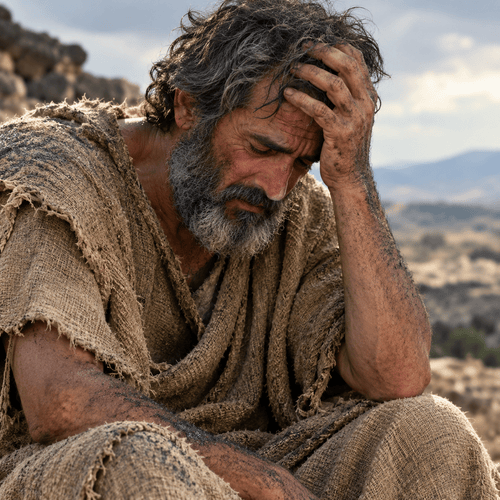
Job lost almost everything in 1 day—his wealth, his servants and all 10 of his children. Then he lost his health. His wife told him to curse God and die. His friends told him it was his own fault.
Then, sitting in the ashes and scraping his sores with broken pottery, Job said something that shouldn’t have been possible:
“For I know that my Redeemer lives, and at the last he will stand upon the earth.” (Job 19:25)
How could a man living long before Bethlehem speak like that? Who was this Redeemer?
This post is part of our series on Jesus in the Old Testament. Step by step, we shall show Job isn’t only about a suffering man. It’s about a longing for someone who could stand between a holy God and a hurting human being. The New Testament tells us his name.
Jesus in the Old Testament — Book 18 of 39
This post is the eighteenth instalment in our series tracing Christ through every book of the Old Testament. See the full series index.
How Can Jesus Be in a Book Written Before Moses?
Job probably lived around the time of Abraham, long before Moses. The book never mentions the law or Israel’s escape from Egypt. So is it fair to look for Jesus here?
Jesus Himself says yes. After rising from the dead, He “interpreted to them in all the Scriptures the things concerning himself” (Luke 24:27). He said “everything written about me in the Law of Moses and the Prophets and the Psalms must be fulfilled” (Luke 24:44). In the Hebrew Bible, “the Psalms” opened the section called the Writings—where Job belongs.
Peter adds the prophets searched carefully, “inquiring what person or time the Spirit of Christ in them was indicating when He predicted the sufferings of Christ and the subsequent glories” (1 Peter 1:11). God’s Spirit led His servants to say more than they fully understood. Job didn’t need to know the name “Jesus” for His words to point to Jesus.
The New Testament also treats Job as God’s word. Paul quotes Job 5:13 in 1 Corinthians 3:19, and James points to Job’s “steadfastness”—his refusal to give up (James 5:11).
How we find Jesus in Job: three honest tests we use in this post
| TEST | WHAT IT MEANS | EXAMPLE IN JOB |
|---|---|---|
| 1. The New Testament uses it | An apostle quotes the passage. | Job 5:13 quoted in 1 Corinthians 3:19 |
| 2. The text sets up a picture | A real person or event shows the “shape” of Christ. This is called a type. | Job, the blameless sufferer |
| 3. The book raises a longing only Christ meets | Job cries out for something only Christ supplies. | Job’s cry for a go-between |
We won’t turn small details, like the number of Job’s camels, into hidden codes. That guessing game is called allegory. We shall stay with what the text says.
Job’s Cry for a Mediator
Job’s deepest problem isn’t only his pain. God seems far away, and Job can’t reach Him. “But how can a man be in the right before God?” he asks (Job 9:2).
Job’s Hope Grows: A Timeline in 3 Steps
- Step 1, Job 9—a wish: “There’s no arbiter between us, who might lay his hand on us both” (Job 9:33). An arbiter is a go-between who puts one hand on each side to bring them together. Job sees no one.
- Step 2, Job 16—a conviction: “Even now, behold, my witness is in heaven, and He who testifies for me is on high” (Job 16:19). Now Job is sure someone in heaven will “argue the case of a man with God, as a son of man does with his neighbour” (Job 16:21).
- Step 3, Job 19—a certainty: “For I know that my Redeemer lives” (Job 19:25). The wish has become rock-solid confidence.
Notice “son of man” in Job 16:21. Here it simply means “a human being”, yet it became Jesus’ favourite name for himself. Job longed for someone truly human who could also plead in heaven.
The New Testament answers: “For there is one God, and there is one mediator between God and men, the man Christ Jesus” (1 Timothy 2:5). A mediator is exactly what Job called an arbiter. And Jesus keeps doing this work: “we have an advocate with the Father, Jesus Christ the righteous” (1 John 2:1). An advocate speaks for you in court. Job’s witness in heaven has a name.
“I Know That My Redeemer Lives”
Read Job’s most famous words slowly:
“For I know that my Redeemer lives, and at the last he will stand upon the earth. And after my skin has been thus destroyed, yet in my flesh I shall see God, whom I shall see for myself, and my eyes shall behold, and not another. My heart faints within me!” (Job 19:25–27)
KEY TERM: WHAT’S A “REDEEMER”?
The Hebrew word is go’el. In Israel, a go’el was your closest relative, whose duty was to rescue you.
- If you were sold as a slave: he paid to set you free.
- If you lost your family land: he bought it back for you.
- If someone killed you: he made sure justice was done.
Boaz, who rescued Ruth, is the best-known example. The key point: a go’el had to be family, sharing your flesh and blood.
3 things in Job’s words are astonishing:
- The Redeemer is alive: Job may die, but his Redeemer lives.
- Job expects a body: He will see God “in my flesh”, with real eyes, after death. That’s resurrection.
- The Redeemer is God: Job says his Redeemer will stand on the earth, and in the same breath says, “I shall see God.”
Here’s the puzzle. A go’el had to be a human relative, yet Job’s Redeemer is God. Job even seems to call on God to help him against God. How can one person be fully God and also our own flesh and blood?
The Old Testament never solves this puzzle. The New Testament does. “The Word became flesh and dwelt among us” (John 1:14). Jesus is God, and he became our brother—“he is not ashamed to call them brothers” (Hebrews 2:11). Only Jesus fits the job description Job wrote.
But Did Job Really Mean Jesus?
Some careful scholars say no. Daniel J Estes, an Old Testament professor, argues Job was probably not thinking of a final resurrection, because God revealed that truth much later.
- Job’s knowledge was not the limit: The Spirit of Christ spoke through Old Testament believers beyond what they understood (1 Peter 1:11). The question is not only “What did Job know?” but “What did God mean?”
- The words reach beyond this life: Job expected to die (Job 17:1), yet he would see God “after my skin has been thus destroyed”. His hope is beyond the grave.
- The earliest Christians read it this way: Clement of Rome, a church leader writing in the first century, used Job’s words as proof that our bodies will be raised.
Christopher Ash, an English pastor who has written a major commentary on Job, notes only one man has ever been truly blameless—Jesus Christ. So the book naturally leads beyond Job to him. Job’s words were a seed; in Jesus, the seed became a tree.
Elihu’s Ransom
Near the end, a young man named Elihu describes how a dying man might be rescued:
“If there be for him an angel, a mediator, one of the thousand, to declare to man what is right for him, and he is merciful to him, and says, ‘Deliver him from going down into the pit; I have found a ransom.’” (Job 33:23–24)
A ransom is a price paid to set someone free. The Hebrew word, kopher, is linked to “atonement”—covering sin so that God’s anger is turned away.
Elihu’s 3-part rescue plan and how Jesus fulfils each part
| PART OF THE RESCUE | WHAT ELIHU SAYS (JOB 33:23–24) | FULFILLED IN JESUS |
|---|---|---|
| A go-between | “a mediator” | “one mediator between God and men, the man Christ Jesus” (1 Timothy 2:5) |
| Rescue from death | “Deliver him from going down into the pit” | “Jesus who delivers us from the wrath to come” (1 Thessalonians 1:10) |
| A price paid | “I have found a ransom” | “to give his life as a ransom for many” (Mark 10:45) |
Elihu sketched the gospel. Only at the cross do we see who the mediator is and what the ransom cost—not silver or gold, “but with the precious blood of Christ” (1 Peter 1:19).
Job as a Picture of Christ—and Where the Picture Stops
Job is a type: a real person God designed to point forward to Christ, as a shadow shows the shape of the one casting it.
Job and Jesus compared: how Job’s life echoes Christ’s
| THEME | JOB | JESUS |
|---|---|---|
| A righteous life | “Blameless and upright” (Job 1:1), yet still a sinner | Tempted in every way, “yet without sin” (Hebrews 4:15) |
| Wrongly accused | His friends insist he must be guilty | Condemned by false witnesses (Mark 14:55–59) |
| Prays for enemies | Prays for the friends who hurt him (Job 42:8–10) | “Father, forgive them” (Luke 23:34) |
| Suffering, then glory | Given “twice as much as he had before” (Job 42:10) | Raised and “highly exalted” (Philippians 2:9) |
WHERE THE PICTURE STOPS
Job needed to repent; Jesus never did: Job ends by saying, “therefore I despise myself, and repent in dust and ashes” (Job 42:6).
Job’s suffering saved no one; Christ’s saves all his people:
Job is a signpost, not the destination. The shadow is real, but the one casting it is far greater.
John Calvin, the sixteenth-century pastor of Geneva, preached 159 sermons on Job. His repeated lesson: God is always just, even when we cannot see his reasons, so our right response is humble trust.
The Accuser Defeated
In chapters 1 and 2, the curtain opens on heaven. A figure called “the satan” arrives. The Hebrew word satan means “accuser”—like a prosecutor in court. He claims Job only loves God because God pays him well (Job 1:9–11). Two truths stand out:
- Satan works on a leash: God sets the limits: “Behold, all that he has is in your hand. Only against him do not stretch out your hand” (Job 1:12). Satan cannot go one step further than God allows.
- God turns evil into good: Satan meant to destroy Job’s faith. God used the same events to prove it real.
The cross follows the same pattern, only far greater. Wicked men worked to kill Jesus, yet Peter says Jesus was “delivered up according to the definite plan and foreknowledge of God” (Acts 2:23). And through that death, the accuser lost his case for ever: “the accuser of our brothers has been thrown down, who accuses them day and night before our God” (Revelation 12:10).
Wisdom and the Lord of the Storm
Where Wisdom Is Found
Job 28 is a poem about miners digging deep for silver and gold. People find treasure in the darkest places, but then comes the question: “But where shall wisdom be found? And where is the place of understanding?” (Job 28:12). No mine holds it. No money can buy it.
The New Testament answers with a person. Christ is “the power of God and the wisdom of God” (1 Corinthians 1:24), the one “in whom are hidden all the treasures of wisdom and knowledge” (Colossians 2:3). The treasure no miner could dig up has come to us in Jesus.
The God Who Walks on the Sea
Job describes God as the one who “trampled the waves of the sea” (Job 9:8). Then he adds, “Behold, he passes by me, and I see him not” (Job 9:11).
In Mark 6, the disciples are rowing in a storm, and Jesus “came to them, walking on the sea. He meant to pass by them” (Mark 6:48). In the Old Testament, God “passing by” is how he showed his glory to Moses (Exodus 33:22). Mark wants us to see who is really in that storm.
Later, speaking from a whirlwind, God asks who told the sea, “Thus far shall you come, and no farther” (Job 38:11). In Mark 4, Jesus calms a storm, and his frightened disciples ask, “Who then is this, that even the wind and the sea obey him?” (Mark 4:41). Job has already given the answer: only the Creator commands the sea. The voice from the whirlwind and the voice in the boat are the same voice.
Job, Suffering and the Cross
Job’s friends believed a simple rule: if you suffer, you must have sinned. Jesus’ disciples believed it too. Seeing a man born blind, they asked, “Rabbi, who sinned, this man or his parents, that he was born blind?” Jesus answered, “It was not that this man sinned, or his parents, but that the works of God might be displayed in him” (John 9:2–3).
Job breaks the friends’ rule. The cross smashes it: the only truly innocent man suffered more than anyone—not for his sin, but for ours.
Franz Delitzsch, a nineteenth-century German Old Testament scholar, saw this clearly. He wrote that “the Cross on Golgotha is the solution of the enigma of every cross.” An enigma is a riddle. Every painful riddle in our lives finds its final answer at the cross.
Derek Thomas, a Welsh-born pastor and theologian, notes something else. Job was never told about the scene in heaven. God did not give Job an explanation—he gave Job himself. The cross gives three things Job longed for:
- An answer to Job’s great question: “If a man dies, shall he live again?” (Job 14:14). The empty tomb says yes.
- A God who suffers with us: “For we do not have a high priest who is unable to sympathize with our weaknesses” (Hebrews 4:15). In Jesus, God came close enough to bleed.
- A face to see: Job ends by saying, “I had heard of you by the hearing of the ear, but now my eye sees you” (Job 42:5). We see God most clearly in Jesus: “Whoever has seen me has seen the Father” (John 14:9).
The Redeemer Job Longed to See
Job’s longings and Christ’s answers at a glance
| WHAT JOB LONGED FOR | WHERE IN JOB | HOW CHRIST ANSWERS IT |
|---|---|---|
| A go-between with God | Job 9:33 | One mediator (1 Timothy 2:5) |
| A witness in heaven | Job 16:19 | Our advocate (1 John 2:1) |
| A Redeemer who is family and God | Job 19:25–27 | The Word became flesh (John 1:14) |
| A ransom from death | Job 33:24 | A ransom for many (Mark 10:45) |
| Wisdom no one can buy | Job 28:12 | Wisdom’s treasures (Colossians 2:3) |
| The Lord who rules the sea | Job 9:8; 38:11 | Wind and sea obey him (Mark 4:41) |
| Life after death | Job 14:14 | Christ is risen (1 Corinthians 15:20) |
| To see God | Job 42:5 | Seeing Jesus, we see the Father (John 14:9) |
Job saw his Redeemer from far away. We see him from the other side of the empty tomb.
If you are suffering today, you may not know why. Job never found out why. But you can know who. Your Redeemer lives. He stood on this earth, died on a cross and rose from the grave—and one day your own eyes will see him.
Tough Questions, Honest Answers
Was Job a real person or just a story?
Job was a real man. God himself names Job alongside Noah and Daniel as real, righteous people (Ezekiel 14:14). James also points to Job’s endurance as a true example for Christians (James 5:11). The book begins like history, naming Job’s land (Uz) and his family. Much of it is written as poetry, but poetry can describe real events. We receive Job as true history because God’s word treats it that way.
Who wrote the book of Job, and when?
The Bible does not tell us who wrote Job. Some Jewish teachers suggested Moses, while others have suggested a writer in Solomon’s time or later, but no one knows for certain. The events seem to fit the age of Abraham: Job offers his own sacrifices, measures wealth in animals and lives 140 years after his trials. What matters most is not the human writer but the divine one. The Holy Spirit guided the writing, so every word is God’s word (2 Timothy 3:16).
Why did God allow Satan to test Job?
Satan claimed Job only loved God for his gifts: “Does Job fear God for no reason?” (Job 1:9). God allowed the test to show that true faith loves God for who he is, not only for what he gives. It also showed that the faith God gives his people cannot finally be destroyed. God had wise purposes that Job never learned, but they were good purposes. Scripture promises that God works all things together for good for those who love him (Romans 8:28). Our trials are never random either—they are in the hands of a wise and loving Father.
Why did Job get double everything except his children?
At the end, God gave Job twice as many sheep, camels, oxen and donkeys as before (compare Job 1:3 with Job 42:12). But Job received seven sons and three daughters—the same number as before, not double (Job 42:13). Many older Bible teachers noticed this and suggested a beautiful reason. Job’s animals were gone for ever, but his first ten children were not lost in the same way. If they belonged to God, they were still Job’s children, waiting beyond death. Counting both families, Job really did have twice as many children—a quiet echo of the hope he spoke of in Job 19.
Were Job’s friends wrong about everything?
Not everything. Much of what they said about God’s power and justice was true, and Paul even quotes Eliphaz in 1 Corinthians 3:19. Their mistake was using true ideas in the wrong way—they assumed Job’s suffering proved hidden sin. God told Eliphaz, “you have not spoken of me what is right, as my servant Job has” (Job 42:7). The lesson for us is serious: right beliefs used without love and wisdom can deeply wound hurting people.
Who or what is Leviathan in Job 41?
Leviathan is a huge, terrifying sea creature that no human can catch or control. Some think it describes a real animal, such as a crocodile or a great sea beast. Elsewhere the Bible also uses Leviathan as a picture of chaos and evil powers that oppose God (Psalm 74:14; Isaiah 27:1). Either way, God’s point to Job is clear: if you cannot tame Leviathan, how can you question the one who made it? Only God rules the monsters that frighten us, and one day he will destroy every evil power for good.
Is it wrong to complain to God as Job did?
No—as long as we bring our complaints to God and not away from him. Job said many raw and painful things, yet God said Job had spoken what is right, unlike his friends (Job 42:7). Honest crying out to God is called lament, and many of the Psalms are laments. Lament is actually an act of faith, because we keep talking to God even when life makes no sense. But when God answered, Job also learned to be humble: “I lay my hand on my mouth” (Job 40:4). So we may pour out our hearts to God freely, while trusting that he is wiser than we are.