Amos isn’t a gentle book. It opens with a lion’s roar and speaks of fire, locusts and exile. Christians often read it once and quietly move on. ‘Surely,’ they think, ‘Jesus isn’t here.’
But Jesus Himself says otherwise. After He rose from the dead, He walked with two sad disciples and explained the Old Testament to them:
And beginning with Moses and all the Prophets, he interpreted to them in all the Scriptures the things concerning himself. (Luke 24:27)
Amos is one of ‘the Prophets’. So we face a simple choice. Either Jesus was wrong about Amos, or we haven’t yet learned to see Him there.
Here are 7 clear signs of Christ is in this fierce little book.
Jesus in the Old Testament — Book 30 of 39
This post is the 30th instalment in our series tracing Christ through every book of the Old Testament. See the full series index.
Who Was Amos? A Quick Picture
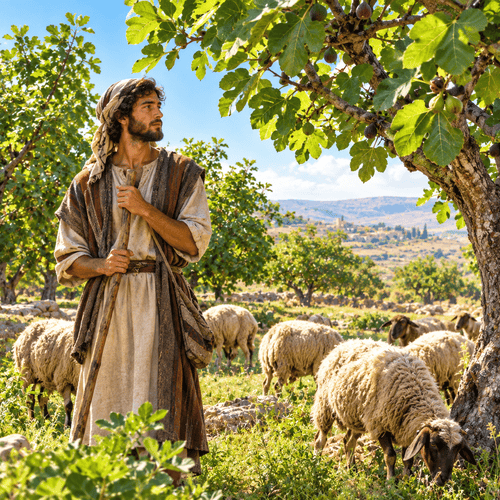
Amos wasn’t a professional preacher. He looked after animals and fig trees in Judah, the southern kingdom (Amos 7:14). Around 760 BC, God sent him north to Israel.
Israel was rich and religious, but the rich crushed the poor and worship was an empty show. Amos warned that judgement was coming. Within 40 years, Assyria destroyed Samaria, Israel’s capital.
KEY TERM: ‘THE DAY OF THE LORD’
In the Bible, ‘the Day of the LORD’ means the time when God steps into history to judge sin and rescue his people. Israel expected it to be a happy day for them. Amos shocked them: “Is not the day of the LORD darkness, and not light?” (Amos 5:20).
Keep this phrase in mind. It will matter later.
Why Look for Jesus in Amos at All?
Jesus said the Old Testament is about Him: ‘For if you believed Moses, you would believe me; for he wrote of me’ (John 5:46). The apostle Peter adds that ‘the Spirit of Christ’ was in the prophets ‘when he predicted the sufferings of Christ and the subsequent glories’ (1 Peter 1:11).
So we read Amos alongside the rest of the Bible. The Westminster Confession of Faith (1646) puts it simply: ‘The infallible rule of interpretation of Scripture is the Scripture itself’ (1.9).
Charles Spurgeon, the London preacher, repeated an old Welsh minister’s advice: just as every English village has a road to London, ‘so from every text of Scripture there is a road to the metropolis of the Scriptures, that is Christ.’
But we must travel those roads carefully. Sidney Greidanus, in Preaching Christ from the Old Testament, warns against inventing hidden meanings. .
KEY TERM: ‘TYPE’ AND ‘TYPOLOGY’
A type is a real person, event or thing in the Old Testament that God designed as a picture of something greater to come. The Passover lamb, for example, pictured Jesus (1 Corinthians 5:7).
How strong is the evidence? The evidences in this post are in 1 of 3 levels:
| LEVEL | WHAT IT MEANS | HOW SURE CAN WE BE? |
|---|---|---|
| 1. The apostles quote Amos | The New Testament quotes Amos about Jesus or his church. | Completely sure |
| 2. Strong patterns | A picture in Amos closely matches a major event in Jesus’s life. | Very sure, with reasons shown |
| 3. Echoes | A word or image in Amos reminds us of Jesus. | Helpful, but never used alone |
Level 1: The Apostles Quote Amos
Sign 1: David’s Fallen Tent Rebuilt (Amos 9:11–12)
After 9 chapters of warning, Amos ends with a surprise:
In that day I will raise up the booth of David that is fallen and repair its breaches, and raise up its ruins and rebuild it as in the days of old, that they may possess the remnant of Edom and all the nations who are called by my name. (Amos 9:11–12)
A ‘booth’ is a simple shelter made of branches—a hut. It’s a humble picture of David’s royal family. In 586 BC, Babylon removed the last king of David’s line. For centuries, the royal ‘tent’ lay flat. It looked dead.
Now jump to Acts 15. The early church faces a huge question: must non-Jewish believers become Jews to be saved? James, the leader of the Jerusalem church, quotes Amos:
“After this I will return, and I will rebuild the tent of David that has fallen; I will rebuild its ruins, and I will restore it, that the remnant of mankind may seek the Lord, and all the Gentiles who are called by my name.” (Acts 15:16–17)
James’s argument is simple: Gentiles (non-Jewish people) are turning to Jesus now, so God is rebuilding David’s tent now. How? Through Jesus, the Son of David. Peter had already explained that David ‘foresaw and spoke about the resurrection of the Christ’ (Acts 2:30–31).
When Jesus rose and ascended, David’s fallen tent stood up again—big enough to shelter every nation. If you are a non-Jewish believer in Chennai, Lagos or São Paulo, you are living proof that Amos 9 has come true.
WHAT SCHOLARS SAY
John Calvin, in his commentary on Amos, taught no earthly king could fully keep this promise. It points to Christ’s kingdom, which fills the whole world.
O Palmer Robertson, in The Israel of God, argues James didn’t push Amos 9 into a distant future. James saw it being fulfilled in the church of his own day.
Sign 2: The Rejected Prophet (Amos 5:25–27)
On trial in Acts 7, Stephen quotes Amos 5:25–27 (Acts 7:42–43). Amos had said Israel worshipped false gods even in the wilderness. They would not listen to God.
A priest named Amaziah even told Amos to go home and stop preaching (Amos 7:12–13). Stephen shows where this pattern ends:
Which of the prophets did your fathers not persecute? And they killed those who announced beforehand the coming of the Righteous One, whom you have now betrayed and murdered. (Acts 7:52)
Jesus is ‘the Righteous One’. He is the last and greatest Prophet. Rejecting Him was the peak of Israel’s long rebellion.
Notice one detail: Amos warned of exile ‘beyond Damascus’, but Stephen says ‘beyond Babylon’, widening the words to cover the whole story of exile. The lesson is serious: to reject Jesus is far worse than rejecting Amos.
Level 2: Strong Patterns That Point to the Cross
Sign 3: Darkness at Noon (Amos 8:9–10)
“And on that day,” declares the Lord GOD, “I will make the sun go down at noon and darken the earth in broad daylight… I will make it like the mourning for an only son and the end of it like a bitter day.” (Amos 8:9–10)
Now read what happened when Jesus died:
And when the sixth hour had come, there was darkness over the whole land until the ninth hour. (Mark 15:33)
The 6th hour is noon. At the very hour Amos described, darkness covered the land. And the grief would be ‘like the mourning for an only son’. Jesus is God’s ‘only Son’ (John 3:16). The prophet Zechariah also spoke of a day when people would ‘mourn for him, as one mourns for an only child’ (Zechariah 12:10).
Remember the Day of the LORD? Amos said it would be darkness, not light. At the cross, that darkness came—but it fell on the only innocent person who ever lived. Jesus took the judgement we deserved.
Irenaeus of Lyon, writing in the 2nd century, listed Amos 8:9 among the prophecies of Jesus’s death. The New Testament does not quote this verse directly. But noon darkness and mourning for an only son, side by side, are very hard to ignore.
Sign 4: A Famine of God’s Word (Amos 8:11–12)
“Behold, the days are coming,” declares the Lord GOD, “when I will send a famine on the land—not a famine of bread, nor a thirst for water, but of hearing the words of the LORD.” (Amos 8:11)
People would search for a word from God and find nothing (Amos 8:12). After Malachi, around 430 BC, no prophet spoke for about 400 years. The Jewish book of 1 Maccabees admits more than once there was no prophet in Israel.
Then the silence broke—not with another prophet, but with God’s own Son:
Long ago, at many times and in many ways, God spoke to our fathers by the prophets, but in these last days he has spoken to us by his Son. (Hebrews 1:1–2)
Jesus is ‘the Word’ who ‘became flesh and dwelt among us’ (John 1:14), and ‘the bread of life’ (John 6:35). Amos’s famine ended when the Bread from heaven arrived.
Sign 5: The Passover in Reverse (Amos 5:17; 7:8)
At the first Passover, God said, ‘when I see the blood, I will pass over you’ (Exodus 12:13). He judged Egypt but passed over His people.
Amos turns this upside down. God now tells Israel, ‘I will pass through your midst’ (Amos 5:17). And again, ‘I will never again pass by them’ (Amos 7:8). Israel had become like Egypt.
So how can anyone be spared? Only if a sacrifice dies in their place: ‘For Christ, our Passover lamb, has been sacrificed’ (1 Corinthians 5:7). Amos shows us the terrible problem. Jesus is the only answer.
Sign 6: The Intercessor Who Never Stops (Amos 7:1–9)
An intercessor is someone who prays to God on behalf of other people. God shows Amos two visions: locusts and a great fire. Both times Amos cries out, ‘O Lord GOD, please forgive! How can Jacob stand? He is so small!’ (Amos 7:2). God holds back (Amos 7:3, 6).
In the third vision, God holds a plumb line—a weighted string builders use to check that a wall is straight. Israel’s wall is crooked. This time Amos does not pray. Judgement is certain.
No one can pass God’s plumb line; our lives are crooked too. But Jesus is both the perfectly straight wall and the Intercessor who never falls silent:
Consequently, he is able to save to the uttermost those who draw near to God through him, since he always lives to make intercession for them. (Hebrews 7:25)
Amos prayed twice and then stopped. Jesus ‘always lives’ to pray for his people.
Sign 7: New Wine for a New World (Amos 9:13–15)
The last verses of Amos are full of joy:
“Behold, the days are coming,” declares the LORD, “when the plowman shall overtake the reaper and the treader of grapes him who sows the seed; the mountains shall drip sweet wine, and all the hills shall flow with it.” (Amos 9:13)
It’s a picture of a world made new.
At a wedding in Cana, Jesus’s first miracle turned water into the best wine, and the host was told, ‘you have kept the good wine until now’ (John 2:10). John calls this a ‘sign’ (John 2:11). It announced that Amos’s new age had begun. When Jesus returns, the whole creation will share that harvest (Revelation 21:1–5).
The book that began with a lion’s roar ends with a harvest party. That is the shape of the gospel.
Level 3: More Echoes of Christ in Amos
Smaller links show the whole book leaning towards Jesus.
Echoes of Christ in Amos
| WHAT AMOS SAYS | HOW IT REMINDS US OF JESUS |
|---|---|
| ‘The LORD roars from Zion’ (1:2) | Jesus is ‘the Lion of the tribe of Judah’ (Revelation 5:5). |
| ‘They sell the righteous for silver’ (2:6) | Jesus, ‘the Righteous One’, was sold for thirty pieces of silver (Matthew 26:15; Acts 3:14). |
| ‘Prepare to meet your God’ (4:12) | We meet God face to face in Jesus, as Saviour or as Judge (John 14:9; Acts 17:31). |
| ‘Seek me and live’ (5:4) | Jesus says, ‘you refuse to come to me that you may have life’ (John 5:40). |
The Story Across Time
- 760 BC: Amos warns Israel and promises a rebuilt ‘booth of David’.
- 722 BC: Assyria destroys Samaria; Israel goes into exile.
- 586 BC: Babylon ends David’s line on the throne. The ‘booth’ has fallen.
- 430 BC onwards: Four centuries of prophetic silence.
- AD 30: Darkness at noon as Jesus dies; three days later, he rises.
- AD 49: James declares Amos 9 fulfilled as Gentiles believe.
- Still to come: Jesus returns, and the new creation overflows with ‘sweet wine’.
Answering the Hard Objections
‘You’re just reading Jesus into Amos.‘ We began with the apostles’ own quotations and labelled smaller echoes honestly. Jesus is not added to Amos; he is where Amos was heading. Geerhardus Vos, a pioneer of biblical theology, described God’s revelation as growing like a seed into a tree. Amos is one stage of that growth.
‘James changed the words of Amos.’ James’s words differ a little from our Hebrew Bibles because he quoted the Septuagint, the Greek Old Testament many Jews used. The difference comes from reading almost the same Hebrew letters two ways:
Amos 9:12 in Hebrew and in Greek
| HEBREW TEXT (OUR OLD TESTAMENT) | GREEK TEXT (QUOTED BY JAMES IN ACTS 15:17) |
|---|---|
| ‘that they may possess the remnant of Edom‘ | ‘that the remnant of mankind may seek the Lord’ |
| Edom (Israel’s old enemy) | adam (mankind): almost the same letters, different vowels |
| yirshu (‘they may possess’) | yidreshu (‘they may seek’): only one letter different |
Both readings point the same way. In Amos, Edom stands for all the nations. James, guided by the Spirit, drew out the true meaning.
‘Amos 9 is about a future Jewish kingdom, not the church.‘ But James used Amos 9 to settle a question about the church in his own day. His argument only works if the promise was already being kept. The rebuilt house of David is Jesus and his people—Jews and Gentiles together (Ephesians 2:14–22).
‘Amos is only about social justice.‘ Martin Luther King Jr famously quoted Amos: ‘But let justice roll down like waters, and righteousness like an ever-flowing stream’ (Amos 5:24). Amos’s concern for the poor is real (James 5:1–6). But Israel’s injustice grew from a broken relationship with God. Real justice flows from the throne of the true King. First Jesus makes us right with God; then He makes us people who do right.
What This Means for You Today
4 WAYS AMOS IMPACTS OUR LIVES
Amos compels us to:
Take sin seriously. God isn’t impressed by religion that ignores the poor and His word.
Look to the cross. The darkness of the Day of the LORD fell on Jesus, so that it will never fall on those who trust Him.
Welcome the nations. David’s rebuilt tent has room for every people.
Keep listening. A famine of God’s word is a terrible judgement. We’re to treasure the Bible in our hands.
The Lion Who Became the Lamb
Amos opens with a lion’s roar. That roar still frightens us, and it should. But in Revelation 5, John is told to look at ‘the Lion of the tribe of Judah’ (Revelation 5:5). When he turns, he sees ‘a Lamb standing, as though it had been slain’ (Revelation 5:6). The Lion who roars in judgement is also the Lamb who was judged in our place.
So Jesus was right. Amos is about Him. Read it again—and this time, listen for his voice.
Tough Questions, Honest Answers
What’s the main message of the book of Amos?
The main message of Amos is that God’s people cannot enjoy His blessings while ignoring His word and crushing the poor. Israel was wealthy and full of religious festivals, but God called their songs mere ‘noise’ (Amos 5:23). Amos warned being chosen by God brings greater responsibility, not less: ‘You only have I known of all the families of the earth; therefore I will punish you for all your iniquities’ (Amos 3:2). Yet the book doesn’t end in despair. God promises to rebuild David’s fallen house and to restore His people. In short, judgement is real, but God’s grace has the last word.
Who was Amos, and what does his name mean?
Amos came from Tekoa, a small town about ten kilometres south of Bethlehem in Judah. He was a herdsman and a grower of sycamore figs, not a trained prophet (Amos 7:14). His name probably comes from a Hebrew word meaning ‘to carry a load’, so it is often explained as ‘burden-bearer’. That fits his task well: he carried God’s heavy message to a proud nation. His ordinary background reminds us that God’s power, not human status, makes a messenger effective.
Is there evidence for the earthquake in Amos 1:1?
Yes. Amos dates his preaching ‘two years before the earthquake’ (Amos 1:1). That earthquake was so strong that people still remembered it about 240 years later (Zechariah 14:5). Archaeologists have found signs of a major earthquake around 760 BC at Hazor, where the excavator Yigael Yadin reported tilted walls and fallen buildings, and at several other sites in Israel. Some geologists, including Steven Austin, have estimated its strength at around magnitude 8. The Bible’s small historical details keep fitting what we find in the ground.
What does ‘for 3 transgressions and for 4’ mean?
This is a Hebrew way of speaking, also found in Proverbs 30. It means ‘sin upon sin, until the cup is full and overflowing’. A transgression is a deliberate crossing of God’s boundary—an act of rebellion. Amos uses the phrase eight times, first for Israel’s neighbours and finally for Judah and Israel (Amos 1–2). His listeners probably cheered as their enemies were condemned, then fell silent when the finger turned towards them. God’s patience is long, but it has a limit.
What does ‘Do two walk together, unless they have agreed to meet?’ mean?
People often use Amos 3:3 to talk about marriage or friendship. In context, however, it is the first of a series of cause-and-effect questions (Amos 3:3–8). A lion roars because it has found prey; a trap springs because something has touched it. In the same way, Amos is preaching because God has spoken: ‘The Lord GOD has spoken; who can but prophesy?’ (Amos 3:8). The verse can still teach wise lessons about agreement, but its first purpose is to defend Amos as God’s true messenger.
Does God cause disaster?
Amos asks, ‘Does disaster come to a city, unless the LORD has done it?’ (Amos 3:6). The Bible teaches that God rules over all things, including painful events, and nothing happens outside his control (Isaiah 45:7; Ephesians 1:11). This does not make God the author of sin; people remain responsible for the evil they choose. In Amos, disasters were warnings meant to call Israel back to God (Amos 4:6–11). For believers, this truth is a deep comfort: even in suffering, our lives are in the hands of a wise and good Father (Romans 8:28).
Who were the ‘cows of Bashan’ in Amos 4:1?
Bashan was a rich farming region east of the Jordan River, famous for its well-fed cattle. Amos used the name as a sharp picture of the wealthy women of Samaria, who lived in luxury while they ‘oppress the poor’ and ‘crush the needy’ (Amos 4:1). They demanded more drinks from their husbands while others went hungry. It is strong language, but it shows how seriously God takes comfortable selfishness. The warning still speaks to anyone who enjoys God’s gifts while ignoring people in need.