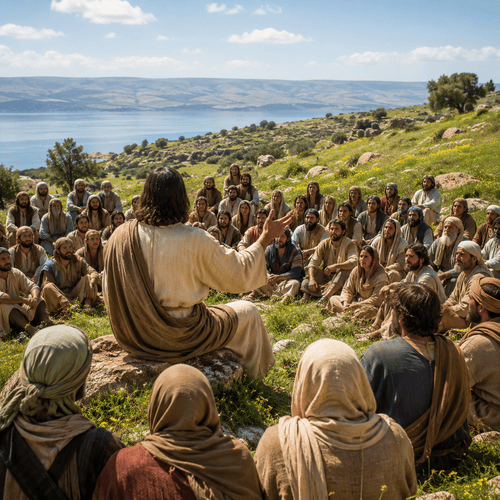
Open any of the 4 Gospels and read the words of Jesus. Within a few pages you’ll meet something that can shake us.
- A rich man asks him how to get eternal life. Jesus tells him to keep the commandments.
- He warns many who call Him “Lord” will be turned away on the last day.
- He describes a final judgement where people are separated by whether they fed the hungry and visited the prisoner.
- He says our goodness must be greater than that of the most religious men in the country.
Then you turn to the letters of Paul and read something that sounds like the opposite. “For by grace you have been saved through faith. And this is not your own doing; it is the gift of God, not a result of works, so that no one may boast” (Ephesians 2:8-9).
So which is it? Did Jesus preach works?
3 very different groups say yes. Sceptical scholars such as Bart Ehrman argue Jesus taught one message and Paul later invented another. Roman Catholic writers such as Trent Horn argue Jesus taught a final salvation that does depend on our works. And a small group of Protestant teachers goes the other way, saying the demanding sayings of Jesus can’t be about salvation at all, so they must be about extra rewards for keen disciples.
All three are wrong, and the reason isn’t complicated. Jesus preached works constantly. He never once preached works as the price of being accepted by God. This article walks through the hardest passages one at a time and shows why.
The One Distinction That Unlocks Everything
Almost all the confusion in this debate comes from missing a single distinction. Once we see it, the hard passages stop fighting each other.
The distinction is between the ground of our salvation and the evidence of it.
The ground is what our acceptance rests on. It’s the reason God declares a sinner “not guilty”. The Bible teaches this ground is entirely outside of us: it’s the perfect life and sacrificial death of Jesus Christ, received by faith alone. The Bible calls this declaration justification. It’s simply God’s legal verdict that a person who trusts in His Son can now stand before him.
The evidence is what shows this has really happened. A person who has been forgiven and given new life will start to live differently. Not perfectly, but really. Those changes are the fruit of salvation, never the root of it.
Think of an apple tree. The apples don’t make the tree an apple tree. They prove it is one. We’re right to be suspicious of a tree that has produced nothing for 40 years. But it be foolish of me to think tying apples onto a dead branch would change anything.
TWO WORDS TO KEEP IN MIND
GROUND—what our salvation rests on. Always and only the work of Christ, received by faith. Never our obedience.
EVIDENCE—what proves our salvation is real. Always includes obedience, because a changed heart produces a changed life.
Every hard saying of Jesus about works belongs under EVIDENCE, not under GROUND.
Test each one by asking: is He telling me how to become acceptable to God, or how to show that God has already changed me?
John Calvin summarised this in a phrase worth memorising: we’re saved by faith alone, but the faith that saves is never alone—it has works to show for it. Take away the changed life and we don’t get a simpler faith. We get a false one.
3 Reasons Jesus Preaches Works
When Jesus talks about obedience, He isn’t always doing the same thing. He uses the demands of God’s law in 3 distinct ways. And each has a different purpose. Sorting His sayings into these three groups solves most of the puzzle before we even reach the difficult verses.
| THE REASON | WHAT JESUS IS ACTUALLY DOING | WHERE YOU SEE IT |
|---|---|---|
| 1. The mirror (showing us our real condition) | He raises God’s standard so high no honest listener can imagine reaching it. The point isn’t to give us a ladder. It’s to make us give up on ladders, and to trust in the Spirit’s enabling. | Sermon on the Mount, especially Matthew 5:21-48, ending with “You therefore must be perfect, as your heavenly Father is perfect” |
| 2. The fruit (showing us what’s already inside) | He treats behaviour as a reliable signal of the heart. Good fruit reveals a good tree. Bad fruit reveals a bad one. Neither creates the tree. | Matthew 7:15-20; Matthew 12:33-35; Luke 6:43-45 |
| 3. The public proof (showing everyone else on the last day) | He describes a final judgement where lives are examined openly. The evidence is displayed before the whole world, but the verdict rests on whether a person belongs to him. | Matthew 25:31-46; Matthew 7:21-23 |
Jesus insists works are undeniably important for the Christian. But notice what He doesn’t tell us: that works are the payment for sin.
The Hardest Passages, One by One
Here are the nine sayings that people find most troubling, and the answer to each. Read them in order, because they build on one another.
1. “Unless your righteousness exceeds that of the scribes and Pharisees” (Matthew 5:20)
The scribes and Pharisees were the most careful religious keepers of the law in the country. They fasted, tithed, prayed and studied. If salvation could be earned, they were front runners. So Jesus seems to be setting a bar that’s simply out of reach.
That’s exactly the point. He isn’t asking for more of the same kind of righteousness. He’s asking for a different kind altogether. The Pharisees polished the outside. Jesus goes on for the next 30 verses to show God’s law reaches the heart: anger is murder, lust is adultery, and the standard is nothing less than the perfection of God Himself (Matthew 5:48).
And look at how the sermon opens. “Blessed are the poor in spirit, for theirs is the kingdom of heaven” (Matthew 5:3). Poor in spirit means spiritually bankrupt, with nothing—no works at all—to offer as payment for sin. That opening controls everything that follows.
2. “Not everyone who says to me, ‘Lord, Lord'” (Matthew 7:21-23)
This is the passage most often quoted to prove Jesus taught works. In fact it proves the opposite, and it does so devastatingly.
Look carefully at what the rejected people say in their defence. They plead their works. “Lord, Lord, did we not prophesy in your name, and cast out demons in your name, and do many mighty works in your name?” These aren’t lazy people. They have a spectacular CVs.
And Jesus answers, “I never knew you; depart from me, you workers of lawlessness.” Not “your works were too few”. Not “you needed a few more”. He says he never knew them. The relationship was never there. This is a warning against trusting our religious performance, and it was delivered to people whose performance was impressive.
3. The rich young ruler (Matthew 19:16-26; Mark 10:17-27)
The man asks, “Teacher, what good deed must I do to have eternal life?” Jesus replies, “If you would enter life, keep the commandments.”
On the surface this looks like works-salvation from the lips of Jesus Himself. Watch what He’s actually doing.
- He questions the man’s assumption first. “Why do you ask me about what is good? There’s only one who is good.” Before answering, Jesus asks whether the man understands goodness at all, or who He’s speaking to.
- He answers on the man’s own terms. The man wants a transaction, so Jesus hands him the price list. The fastest way to cure a wrong idea is often to let someone try it.
- He lists only the commandments about other people. Murder, adultery, theft, false witness, honouring parents, loving your neighbour. He leaves out the first and greatest commandment, about loving God above everything.
- Then he exposes the gap. “Go, sell what you possess and give to the poor.” This isn’t a general rule for everyone. It’s a scalpel aimed at this man’s particular idol. He walks away sorrowful, which proves he’d broken the very commandment Jesus didn’t mention.
And how does the account end? The disciples are stunned and ask, “Who then can be saved?” Jesus answers: “With man this is impossible, but with God all things are possible” (Matthew 19:26). That’s the conclusion of the whole episode, and it’s a flat denial that anyone gets in by keeping rules.
4. The sheep and the goats (Matthew 25:31-46)
At the final judgement people are divided by whether they fed the hungry, welcomed the stranger, clothed the naked and visited the prisoner. It reads like a list of entry requirements. Two details in the passage show it isn’t.
TWO DETAILS MOST READERS MISS
The sheep are astonished. They ask, “Lord, when did we see you hungry and feed you?” They weren’t keeping score. They had no idea they’d built up a record. That’s impossible if their works were a payment they’d been storing up. It’s exactly what you’d expect if the works flowed naturally from changed hearts.
The inheritance was prepared first. Jesus says, “Come, you who are blessed by my Father, inherit the kingdom prepared for you from the foundation of the world.” The kingdom was ready before the world began, long before a single meal was served. The works are then produced as evidence, not presented as an invoice.
Notice the word Jesus chooses: inherit. An inheritance comes through a relationship, never through wages. Children don’t invoice their father.
5. “This is the work of God, that you believe” (John 6:28-29)
This may be the single most decisive verse in the whole discussion, and it’s astonishing how rarely it shows up in this debate.
A crowd asks Jesus directly, “What must we do, to be doing the works of God?” It’s the exact question this article is about, asked of Jesus, in plain words, by people who wanted a list.
His answer: “This is the work of God, that you believe in Him whom He has sent.”
He takes their plural, “works”, and replaces it with a singular, “work”. Then He defines that one work as believing in Him. When Jesus was asked for the job description, He gave one item, and the item was faith. Everything else in the Gospels must be read in light of that answer, because here He isn’t telling a story or pressing a conscience. He’s defining terms.
6. The Pharisee and the tax collector (Luke 18:9-14)
Jesus tells of two men praying. One lists his achievements: he fasts twice a week and gives away a tenth of everything. The other will not even lift his eyes, and says, “God, be merciful to me, a sinner!”
Then comes the verdict: “I tell you, this man went down to his house justified, rather than the other.”
That word justified is the very word Paul builds his letters around. It’s on the lips of Jesus, in a parable, decades before Romans was written. The man with the impressive record goes home condemned. The man with no record at all, who brings nothing but a plea for mercy, goes home declared right with God. Anyone who says Paul invented salvation by faith alone hasn’t read Luke 18 carefully.
7. Nicodemus and the new birth (John 3:1-8)
Nicodemus was a religious leader and a serious man. Jesus does not give him a programme of improvement. He tells him he must be born again.
Consider what a birth is. Nobody contributes to their own. You don’t assist, cooperate or apply. Jesus sharpens it further: “The wind blows where it wishes… So it is with everyone who is born of the Spirit.” God gives the new life freely, and works follow afterwards. Obedience can never be the ground of salvation, because it’s downstream of a birth we didn’t perform.
8. “We are unworthy servants” (Luke 17:10)
Jesus describes a servant who works all day in the field and then serves dinner. Does the master thank him for doing what he was told? Jesus concludes: “So you also, when you have done all that you were commanded, say, ‘We are unworthy servants; we have only done what was our duty.'”
This closes the door on merit, which means earning a claim on God. Even flawless obedience would only ever be duty, never surplus credit. There is no bonus account to build up.
9. The thief on the cross (Luke 23:39-43)
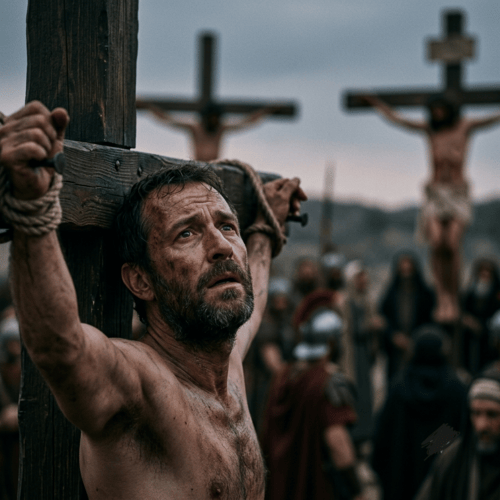
A convicted criminal, hours from death, nailed to a cross. He performs no good deeds, keeps no commandments, isn’t baptised, gives no money and joins no congregation. He simply says, “Jesus, remember me when you come into your kingdom.”
Jesus answers: “Truly, I say to you, today you will be with me in Paradise.”
This is the argument-ending case. If works were the ground of salvation, this man couldn’t be saved. Jesus says he is. Whatever else the demanding sayings mean, they cannot mean something this scene contradicts.
Why Jesus Sounds So Different from Paul
Even after all that, an honest reader still notices a difference in tone. Jesus commands. Paul comforts. The critical scholar Bart Ehrman has built a considerable following on the claim these are two different religions. Two straightforward facts explain the difference without any contradiction.
Difference 1: They were speaking to different sets of people
Jesus spent most of his ministry addressing confident religious insiders who genuinely believed they were keeping God’s law. Paul wrote mostly to young churches of former pagans who’d already believed and needed assurance.
Good preaching is always aimed. To the proud, we preach the law until they break. To the broken, we preach grace until they stand. Martin Luther made this the backbone of his preaching: the law wounds, the gospel heals, and giving a person the wrong one at the wrong moment does real damage. Jesus and Paul apply the same medicine to different patients.
Jewish scholar Geza Vermes, writing from outside the Christian faith entirely, noticed Jesus aimed his sharpest words at the religiously secure and his gentlest at the openly sinful. That pattern is hard to explain if He were simply handing out a rulebook.
Difference 2: They were standing at different points in the story
Paul wrote after the cross and resurrection, looking back at a finished work. Jesus preached before it, walking towards it. That alone accounts for much of the difference in vocabulary.
Some claim Jesus never preached the cross at all and only preached a kingdom of law-keeping. The Gospels say otherwise.
JESUS ON HIS OWN DEATH: A TIMELINE
Early in John’s account—He compares Himself to the bronze serpent lifted up in the desert so “whoever believes in him may have eternal life” (John 3:14-15).
Midway through His ministry—He begins openly predicting His death and resurrection, and repeats it at least 3 times (Mark 8:31; 9:31; 10:33-34).
On the road to Jerusalem—He states the purpose plainly: He came “to give His life as a ransom for many” (Mark 10:45). A ransom is a payment that buys someone out.
At the last supper—He hands over the cup as “my blood of the covenant, which is poured out for many for the forgiveness of sins” (Matthew 26:28).
After the resurrection—He rebukes the disciples for not seeing it: “Was it not necessary that the Christ should suffer these things and enter into His glory?” (Luke 24:26).
Jesus preached the cross. He preached it as a payment, for sins, in the place of others. The idea that Paul invented this cannot survive a careful reading of the gospels.
“Judged According to Works”—Evidence, Not Payment
This is by far the strongest objection perhaps. The Bible repeatedly says God judges people according to their works. If that’s true, is salvation not settled by works in the end after all?
This is the argument used by Alan Stanley in his study of works in the Gospels, and picked up by Roman Catholic apologists to defend a 2-stage system: you get in by grace, but you stay in by works.
The answer turns on a small phrase with a large meaning. Scripture says we’re judged according to works. It doesn’t say we’re justified on the basis of works. Those are different claims, and the difference is the difference between a witness and a payment.
| QUESTION | IF WORKS WERE THE BASIS | WHAT THE BIBLE ACTUALLY SHOWS |
|---|---|---|
| What do works do? | They buy the verdict. They’d have to be the payment God accepts. | They demonstrate the verdict. They’re the evidence that a person truly belongs to Christ. |
| Where do works come from? | From us, by our own strength, offered up to God. | From God, produced by His Spirit in a person he has already made new (Philippians 2:13). |
| How many are needed? | Enough. Which raises the terrifying question of how many is enough, with no answer. | Real ones. Not perfect, not measured, but genuine, because a living tree bears fruit. |
| What about the thief on the cross? | He is a problem with no solution. | He is no problem at all. He had faith and no time. The ground was faith in Christ, and it held. |
Think of a courtroom. The evidence presented doesn’t create the facts of the case; it displays them so justice is seen to be done. On the last day, God’s verdict on His people rests on Christ, and their lives are brought forward as public evidence they were truly His.
The old summary is exactly right: we’re not saved by works, but we’re not saved without them.
The Opposite Mistake: Grace Without Fruit
Having pushed hard against the idea that we earn salvation, we must now push just as hard the other way. There’s a second error, and it’s just as deadly.
Some teachers, anxious to protect free grace, argue the demanding sayings of Jesus are all about extra rewards rather than salvation. On this view a person can believe certain facts, live an entirely unchanged life, and still be safe. The name for this error is antinomianism, which simply means “against law”.
Jesus leaves no room for it. “Every tree that doesn’t bear good fruit is cut down and thrown into the fire” (Matthew 7:19). “Why do you call me ‘Lord, Lord,’ and not do what I tell you?” (Luke 6:46). His final instruction to his followers included “teaching them to observe all that I have commanded you” (Matthew 28:20).
Scottish minister Thomas Boston, writing during a long 18th-century controversy about grace and law, put the solution memorably. God’s law is no longer a covenant for the Christian, meaning it isn’t a contract we must fulfil to be accepted. It remains a rule, meaning it’s still the shape of the life God gives us. Not a way of earning, but a way of living.
Sinclair Ferguson, reflecting on that same controversy, makes a point worth sitting with: legalism and antinomianism aren’t really opposites. They’re twins. Both assume God’s law is a burden rather than the loving instruction of a Father. One tries to carry the burden and the other tries to drop it. The cure for both isn’t more rules or fewer rules, but a clearer view of God Himself.
The Answer: Joined to Christ
So why does obedience always follow real faith? No, not because we bolt it on out of duty, but because of what happens when a person is united to Jesus Christ.
When we trust Christ, we receive Him whole. Two gifts arrive together and they can’t be separated: a righteousness credited to us that we cannot earn, and a new heart that begins, slowly and imperfectly, to want what God wants. John Calvin compared them to heat and light from the sun. We can’t take the sunlight and refuse the warmth.
This is why the question “did Jesus preach works?” has a 2-part answer that isn’t a dodge.
No—He didn’t teach that our works make God accept us. He taught the opposite, repeatedly, sharply, and to the most religious people of His day.
Yes—He taught constantly that God changes those He saves, and the change shows. He refused to let anyone claim Him as Lord while ignoring everything He said.
The rich young man walked away sad because he was asked to give up the thing he loved most. The thief on the cross went to Paradise because he’d nothing left to give. Between the two men stands everything Jesus taught about works, and it points in one direction only: away from what we bring, and towards the one who brings everything.
Tough Questions, Honest Answers
Does Matthew 6:14-15 mean God will only forgive me if I forgive others first?
Jesus says, “For if you forgive others their trespasses, your heavenly Father will also forgive you, but if you do not forgive others their trespasses, neither will your Father forgive you.” This sounds like a straight trade, but it isn’t describing how we get forgiven in the first place.
Jesus is describing what a forgiven heart looks like. Someone who has truly grasped how much God has cancelled for them can’t then hold a small debt against a neighbour. Jesus makes this explicit in the parable of the unforgiving servant (Matthew 18:21-35), where the servant is condemned not for failing to earn mercy but for showing he never understood the mercy he received.
So a settled, deliberate refusal to forgive is a serious warning sign. It suggests the forgiveness of God has not actually landed. The order is always the same: God forgives us first, and forgiving others is the proof.
Jesus said “whoever believes and is baptised will be saved” (Mark 16:16). Is baptism a work we must do?
Baptism is the God-given sign of belonging to Christ, and no Christian should treat it as optional. But notice the second half of the same verse: “whoever does not believe will be condemned.” Jesus names unbelief as the thing that condemns, not the absence of baptism.
That is why the thief on the cross was not sent away to be baptised first. He was promised Paradise that same day.
Baptism is best understood as the outward mark of an inward reality, like a wedding ring. The ring does not create the marriage; it publicly declares it. A believer who refuses the sign has a real problem, but the sign itself never saves.
What about “the one who endures to the end will be saved” (Matthew 24:13)? Does that mean I could still lose everything?
This verse promises rather than threatens, though it certainly means to make us serious. Jesus is speaking about a time of severe pressure when many will fall away.
The point is that genuine faith lasts. It is not that we hold on to God tightly enough to keep ourselves saved; it is that God holds on to us. Jesus says of his sheep, “I give them eternal life, and they will never perish, and no one will snatch them out of my hand” (John 10:28).
Endurance is therefore the mark of real faith rather than the price of it. Those who fall away permanently show what they always were, which is why the apostle John writes that such people “went out from us, but they were not of us” (1 John 2:19).
The right response to this verse is not anxiety about your grip on God, but comfort in his grip on you, expressed by carrying on.
James 2:24 says a person is justified by works and not by faith alone. Does that contradict Jesus?
It does not, because James and Paul are answering different questions with the same words. Paul asks how a guilty sinner becomes right with God, and answers: by faith, apart from works. James asks how you can tell whether someone’s claimed faith is real, and answers: look at their life.
James makes this plain by his choice of example. He points to Abraham offering Isaac in Genesis 22, which happened many years after Genesis 15, where Abraham “believed the LORD, and he counted it to him as righteousness”. The believing came first. The obedience came decades later and proved it. James isn’t adding works to faith. He’s attacking a fake faith that is nothing more than agreeing with facts, which he says even the demons manage (James 2:19).
Why does Jesus say in Revelation that he repays each one according to their works (Revelation 2:23; 22:12)?
This is the same “according to” language as elsewhere in Scripture, and it carries the same meaning. Works are the evidence brought forward at the judgement, not the payment that secures the verdict.
Revelation itself makes this clear. Alongside the books of deeds stands another book, “the book of life” (Revelation 20:12-15), and it is that book which decides destiny. Those written in it belong to the Lamb who was slain.
It is also worth noticing that Revelation constantly describes the redeemed as those who were bought: “you were slain, and by your blood you ransomed people for God” (Revelation 5:9). People who have been purchased are not also paying.
Jesus told the rich young ruler to sell everything. Does every Christian have to do that?
No, and the Gospels show this by counter-example. Jesus did not tell Zacchaeus to sell everything, and Zacchaeus voluntarily gave away half (Luke 19:8). He did not tell Joseph of Arimathea, a rich man, to give up his wealth. Wealthy women supported his ministry out of their own means (Luke 8:3).
The command to the rich young ruler was personal surgery, not a general policy. Jesus identified the one thing the man loved more than God and asked for exactly that.
The principle behind it is universal even though the command is not. Every one of us has something that competes with God, and Jesus claims first place over it, whatever it happens to be for us. For that particular man, it was money.
What did Jesus mean by “strive to enter through the narrow door” (Luke 13:24)? Does striving not mean effort earns entry?
The Greek word behind “strive” is a strong one, related to the effort of an athlete in a contest. Jesus really is calling for urgency, not a casual shrug.
But look at what the effort is directed towards. He is not saying “work hard enough to deserve the door”. He is saying “get through the door, and do not assume you have time”. The rest of the passage warns people who expected to be admitted because of their background and connections. The Christian life involves genuine effort, and the New Testament never apologises for that. The difference is the direction of the effort. We don’t strive to be accepted; we strive because we’ve been accepted.