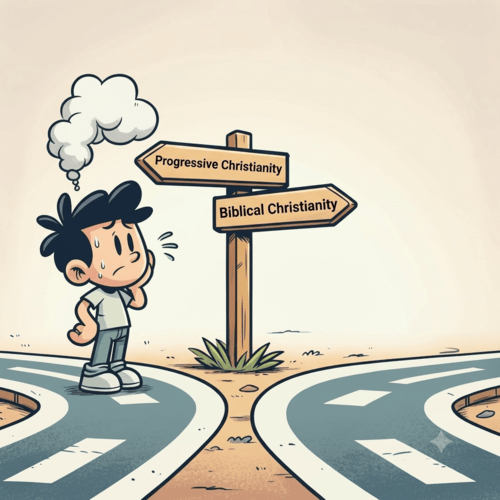
Meera grew up in a Bible-believing church in Bengaluru. When she moved to a new city for work, she found a friendly congregation near her flat. The music was good. The people were kind. The pastor spoke often about caring for the poor and welcoming outsiders, and Meera loved that.
But over the months, she noticed other things. Sin was rarely mentioned. The cross was described as an example of love, never as a payment. The Bible was called ‘a human book wrestling with God’. And one Easter Sunday the pastor said, ‘Whether or not the tomb was empty isn’t the point. Easter is about new beginnings.’
Meera had found her way into progressive Christianity. Many people today are in the same place, often without a name for it. So what is progressive Christianity? Where did it come from? And is it simply a gentler, more modern version of the Christian faith, or something else altogether?
THE SHORT ANSWER
Progressive Christianity is a movement that keeps Christian words and practices but reshapes Christian beliefs to fit modern values. It usually treats the Bible as a fallible human book, recasts sin and the cross, doubts or redefines the bodily resurrection, and rejects the claim that Jesus is the only way to God.
It raises some fair questions, but on the central truths of the gospel it parts company with the faith of the apostles. As J. Gresham Machen warned a century ago, a faith that changes these things is not a newer Christianity but a different religion.
KEY WORDS EXPLAINED
- Progressive Christianity: a broad movement, not a single church, that seeks to update Christian belief in the light of modern culture, especially on the Bible, the cross, hell and sexuality.
- Liberal theology: the older movement (from about 1800) that progressive Christianity grows out of. It placed human experience and reason above the authority of Scripture.
- Historic Christianity: the faith summed up in the Bible and confessed in the great creeds, such as the Apostles’ Creed and the Nicene Creed.
- Deconstruction: the personal process of questioning and taking apart the beliefs you were raised with. It can lead back to faith, out of faith, or into progressive Christianity.
What Is Progressive Christianity?
Progressive Christianity has no single founder, headquarters or creed. That is part of its appeal: it presents itself as open, humble and searching rather than fixed. Some progressive Christians are in mainline denominations. Others are in independent churches, online communities or no church at all.
Even so, a clear family likeness runs through the movement. Most progressive Christians share some or all of these beliefs:
- The Bible is a human book. It contains wisdom and real encounters with God, but also errors, prejudices and outdated views.
- Experience is the final judge. What feels loving, just or authentic decides what we keep from Scripture.
- The cross is an example, not a payment. The idea that Jesus bore God’s punishment for sin is often rejected as violent.
- Doubt is a virtue and certainty a vice. Questions are welcome; firm answers are suspect.
- Jesus is one way among many. Other religions are seen as equally valid paths to God.
- Sexual ethics must change. Biblical teaching on sex and marriage is treated as cultural, not binding.
- Justice is the heart of the gospel. The kingdom of God is mainly about making this world fairer.
Not every progressive believes all of these. Some hold on to the creeds while loosening their view of the Bible. Others go much further. But the direction of travel is the same: away from the authority of God’s Word and towards the authority of the modern self.
Where Did Progressive Christianity Come From?
Progressive Christianity isn’t new. It is the latest form of a movement that began more than 200 years ago.
Timeline: From Liberal Theology to Progressive Christianity
- 1799: German theologian Friedrich Schleiermacher publishes On Religion. He grounds faith in human feeling, ‘the feeling of absolute dependence’, rather than in God’s revealed Word.
- 1800s: ‘Higher criticism’ spreads from German universities, treating the Bible as an ordinary ancient book and doubting its miracles.
- 1907: Walter Rauschenbusch’s Christianity and the Social Crisis launches the ‘social gospel’, which shifts the focus from personal salvation to reforming society.
- 1922: New York preacher Harry Emerson Fosdick asks, ‘Shall the Fundamentalists Win?’ and argues the virgin birth and the second coming are not essential.
- 1923: J. Gresham Machen replies with Christianity and Liberalism.
- 1941: Rudolf Bultmann calls for the New Testament to be ‘demythologised’, stripped of miracles to find its ‘real’ message.
- 1985: The Jesus Seminar begins voting on the words of Jesus. (See The Jesus Seminar: Are Their Views Biblical?)
- 1998: Bishop John Shelby Spong publishes twelve theses calling for ‘a new reformation’.
- 2000s onwards: Writers such as Marcus Borg, Brian McLaren and Rob Bell bring these ideas to a wide church audience, and the name ‘progressive Christianity’ becomes common.
Marcus Borg is a good example of the link between scholars and churches. He was a fellow of the Jesus Seminar, and his popular books, such as The Heart of Christianity (2003), taught many church members that the Bible’s stories could be ‘true’ without having happened. In his view, Easter did not require an empty tomb.
Bishop Spong was even more direct. The sixth of his twelve theses said:
‘The view of the cross as the sacrifice for the sins of the world is a barbarian idea based on primitive concepts of God and must be dismissed.’
John Shelby Spong, Twelve Theses (1998)
Progressive and Historic Christianity Compared
The table below sets out the main differences. Not every progressive Christian holds every view in the middle column, but these are the views the movement typically promotes.
| Topic | Progressive Christianity often says | Historic Christianity confesses |
|---|---|---|
| The Bible | A human record of people’s experience of God, with errors | God’s own Word, breathed out by him and fully trustworthy (2 Timothy 3:16) |
| Jesus | A wise teacher and example of love; his divinity is often reinterpreted | The eternal Son of God made man, fully God and fully human (John 1:1, 14) |
| Sin | Mainly unjust systems and broken relationships | Rebellion against a holy God that makes us guilty before him (Romans 3:23) |
| The cross | An example of self-giving love, or a protest against violence | Christ bearing the penalty for our sins in our place (Isaiah 53:5; 1 Peter 2:24) |
| The resurrection | A powerful symbol of hope; the body may not have risen | A real, bodily rising on the third day (Luke 24:39; 1 Corinthians 15:4) |
| Salvation | Healing and wholeness, open to people of all faiths | Rescue from God’s judgement through faith in Christ alone (Acts 4:12) |
| Hell | Unloving and unbelievable; often denied | A real and just judgement taught by Jesus himself (Matthew 25:46) |
| Sex and marriage | Defined by love and consent; biblical limits are cultural | God’s design: one man and one woman for life (Matthew 19:4–6) |
The Good Questions Progressives Ask
It would be unfair, and unhelpful, to dismiss everything progressive Christians say. Many come to the movement because they saw real failures in the church: hypocrisy, harshness, a faith that talked about heaven and ignored the poor, or questions that were shouted down instead of answered.
Those are real problems, and the Bible condemns them too. God has always cared about justice: ‘He has told you, O man, what is good; and what does the LORD require of you but to do justice, and to love kindness, and to walk humbly with your God?’ (Micah 6:8). James says true religion includes caring for ‘orphans and widows in their affliction’ (James 1:27). And Scripture is full of honest questions, from Job to the Psalms to Habakkuk.
So the problem is not the questions. The problem is the answers. Progressive Christianity tends to solve the church’s failures by removing the very truths that make the church’s mission possible. Without a holy God, real sin and a real cross, there is no good news to bring to the poor at all.
Five Places Where Progressive Christianity Leaves the Faith
1. The Authority of Scripture
Jesus treated the Old Testament as the Word of God that ‘cannot be broken’ (John 10:35). He said that ‘until heaven and earth pass away, not an iota, not a dot, will pass from the Law until all is accomplished’ (Matthew 5:18). Paul said that ‘all Scripture is breathed out by God’ (2 Timothy 3:16). When progressive Christians decide which parts of the Bible to keep, they are no longer under its authority. They are standing over it. And the Jesus they keep looks remarkably like a modern Western liberal.
2. Sin and the Cross
The Bible does not present the cross as a mere example. Isaiah wrote 700 years before Christ: ‘He was pierced for our transgressions; he was crushed for our iniquities; upon him was the chastisement that brought us peace’ (Isaiah 53:5). Paul says God put Christ forward ‘as a propitiation by his blood’, a sacrifice that turns away God’s just anger (Romans 3:25). Take away the substitution and you take away the comfort. An example can inspire you; only a substitute can save you. (See Penal Substitutionary Atonement: The Heart of the Gospel Explained.)
3. The Bodily Resurrection
Paul staked everything on a real, physical resurrection: ‘If Christ has not been raised, your faith is futile and you are still in your sins’ (1 Corinthians 15:17). The risen Jesus ate fish in front of his disciples and said, ‘a spirit does not have flesh and bones as you see that I have’ (Luke 24:39). A resurrection that is only a symbol leaves us with a dead Saviour and no hope beyond the grave.
4. Christ as the Only Way
Jesus said, ‘I am the way, and the truth, and the life. No one comes to the Father except through me’ (John 14:6). Peter told the same Jewish leaders who had crucified him: ‘there is salvation in no one else, for there is no other name under heaven given among men by which we must be saved’ (Acts 4:12). The apostles were not narrow-minded. They were convinced that God had acted uniquely in Jesus, and that love meant telling everyone.
5. God’s Design for Sex and Marriage
When asked about marriage, Jesus went back to creation: ‘Have you not read that he who created them from the beginning made them male and female … and the two shall become one flesh?’ (Matthew 19:4–5). He did not treat God’s design as a cultural custom, but as the Creator’s pattern for every age. Progressive churches that bless what God’s Word forbids are not being more loving than Jesus. They are claiming to know better than him.
Machen’s Warning: A Different Religion
In 1923, Princeton scholar J. Gresham Machen wrote a short book that still speaks today: Christianity and Liberalism. His point was startling. Liberal theology, he said, was not a milder kind of Christianity. It was a different religion that used Christian words. It began with man rather than God, it saw sin as weakness rather than guilt, and it turned the gospel from good news about what God has done into good advice about what we should do.
Fourteen years later, the American theologian H. Richard Niebuhr, no conservative himself, summed up liberal theology in one famous sentence:
‘A God without wrath brought men without sin into a kingdom without judgement through the ministrations of a Christ without a cross.’
H. Richard Niebuhr, The Kingdom of God in America (1937)
That sentence describes much of progressive Christianity today. And Paul’s warning to the Galatians still stands: ‘If anyone is preaching to you a gospel contrary to the one you received, let him be accursed’ (Galatians 1:9). Paul was not being harsh for the sake of it. He knew that a different gospel cannot save.
PROGRESSIVE OR SIMPLY GROWING?
Not every change in a Christian’s thinking is progressive Christianity. Christians should keep learning, correct wrong traditions and apply the Bible to new questions. The test is simple:
- Growing faith goes deeper into the Bible and ends up holding its teaching more firmly.
- Progressive faith moves away from the Bible and ends up holding its teaching more loosely.
Real progress is growing ‘in the grace and knowledge of our Lord and Saviour Jesus Christ’ (2 Peter 3:18), not leaving behind ‘the faith that was once for all delivered to the saints’ (Jude 3).
Is Progressive Christianity the Same as Deconstruction?
Not quite. Deconstruction is a process: someone starts questioning what they were taught. Progressive Christianity is often a destination: a place where deconstructing Christians settle when they want to keep Jesus and the church, but not the Bible’s harder teachings.
Questioning is not a sin. The Bereans were commended for ‘examining the Scriptures daily to see if these things were so’ (Acts 17:11). The issue is what you examine your beliefs by. If the measuring rod is God’s Word, questions lead to firmer faith. If the measuring rod is the culture around us, questions lead away from Christ. (See Can I Doubt Bible Inerrancy and Still Be a Christian?)
If You Find Yourself in a Progressive Church
Like Meera, you may not have set out to join a progressive church. Here are some gentle steps.
- Read the Gospels for yourself. Start with Mark or Luke. Ask, ‘Who does Jesus say he is? Why does he say he came?’ (Mark 10:45 is a good place to pause.)
- Ask clear questions. Ask your pastor kindly: Do you believe Jesus rose bodily from the dead? Did he die in our place for our sins? Is the Bible God’s Word? Clear answers are a gift. Vague ones are an answer too.
- Test what you hear. ‘Do not believe every spirit, but test the spirits to see whether they are from God’ (1 John 4:1).
- Keep your love for justice. You don’t need to give up caring for the poor and the outsider. You need a better foundation for it.
- Find a church that preaches the whole Bible. Look for a church where the gospel of Christ crucified and risen is preached clearly, sin is named honestly and grace is offered freely.
Conclusion: The Faith Worth Keeping
Progressive Christianity promises a kinder, more believable faith. But in the end it offers less, not more. A Jesus who did not rise cannot raise you. A cross that is only an example cannot pay for your sins. A Bible you edit cannot correct you, comfort you or speak with God’s voice.
The historic Christian faith offers something far better: a holy God who loves sinners enough to bear their judgement himself, a risen Saviour who is coming again, and a Word that will stand when every fashion of thought has passed. ‘The grass withers, the flower fades, but the word of our God will stand for ever’ (Isaiah 40:8).
Tough Questions, Honest Answers
Can a progressive Christian be saved?
Salvation does not depend on getting every doctrine right, but on trusting the real Christ. Many people sit in progressive churches while truly trusting Jesus as their Saviour, often without realising what their leaders deny. But someone who rejects Christ’s divinity, his atoning death or his bodily resurrection is rejecting the very gospel that saves (1 Corinthians 15:1–4). Only God sees the heart, so we should be careful in judging individuals, while being clear about the message.
Is progressive Christianity the same as liberal Christianity?
They are close relatives. Liberal theology is the older academic movement that began around 1800 with thinkers such as Schleiermacher. Progressive Christianity is its popular, modern form, shaped by social media, deconstruction stories and today’s debates about sexuality and justice. The core move is the same: human experience judges the Bible, rather than the Bible judging human experience.
Is it wrong for Christians to care about social justice?
No. The Bible is full of God’s concern for the poor, the widow, the orphan and the foreigner (Deuteronomy 10:18; James 1:27). The problem comes when justice replaces the gospel instead of flowing from it. Christians care for the needy because God first showed mercy to us in Christ. Without that foundation, justice has no lasting basis and no answer to the deepest injustice of all: our sin against God.
What do progressive Christians believe about the Bible?
Most see it as a human book that records people’s experiences of God, with insights and errors mixed together. They often say we should read it ‘seriously but not literally’, and they use a principle of love or justice to decide which passages still apply. Jesus, by contrast, treated Scripture as the Word of God that ‘cannot be broken’ (John 10:35).
Do progressive Christians believe in hell?
Many do not, or they redefine it as the suffering we cause ourselves in this life. Rob Bell’s book Love Wins (2011) brought these questions to a wide audience. Yet Jesus spoke about hell more than anyone else in the Bible, and he spoke of it as a real and lasting judgement (Matthew 25:46). The good news is not that there is no judgement, but that Christ bore it for all who trust him. (See What Does the Bible Say About Hell? The Case for Eternal Conscious Punishment.)
Is progressive Christianity growing?
Progressive ideas are certainly influential, especially online and among people leaving evangelical churches. But churches that have embraced liberal theology over the past century have, on the whole, declined sharply in membership. Many mainline Protestant denominations in the West are far smaller today than they were in the 1960s. Churches that hold to the Bible’s authority and preach the gospel clearly have generally fared better.
How can I talk to a friend who has become a progressive Christian?
Start by listening. Ask what hurt or troubled them, and take their story seriously. Avoid labels and angry arguments. Then point gently to Jesus himself: who he said he was, why he died and the evidence that he rose. Invite them to read a Gospel with you. And pray, because only the Holy Spirit can open eyes (2 Timothy 2:24–26). Keep the friendship even if they do not agree with you.
Related Reads
- The Jesus Seminar: Are Their Views Biblical?
- Penal Substitutionary Atonement: The Heart of the Gospel Explained
- Bible Inerrancy Explained: Answering Today’s Toughest Challenges
- Is Jesus the Only Way to Heaven? Answering 5 Common Objections
- What Does the Bible Say About Hell? The Case for Eternal Conscious Punishment
- Lie From Hell: Jesus Was Just a Good Moral Teacher
- Sexual Ethics: Why It’s a Gospel Issue—Not the Gospel Itself
- Can I Doubt Bible Inerrancy and Still Be a Christian?
- Is Jesus God? The Biblical and Historical Case for the Deity of Christ