A widow sells tomatoes by the roadside. On a good day she earns enough to feed her children.
One Sunday, her pastor tells her God is holding a miracle just above her head. It’s ready to fall. Only one thing is stopping it: she hasn’t yet “sown a seed” of real faith. The seed he suggests is 5,000 shillings. She has 5,000 shillings that she’s been saving up to pay her rent.
She gives it. She walks home lighter, hungrier and full of hope.
Nothing happens.
The next Sunday she is told why. Her faith was too small. She spoke negative words over her own life. Perhaps her grandfather worshipped at a shrine, and a curse is still running through her bloodline, blocking her breakthrough.
So now she’s poor, and feeling cheated. And all of this was done in the name of Jesus Christ.
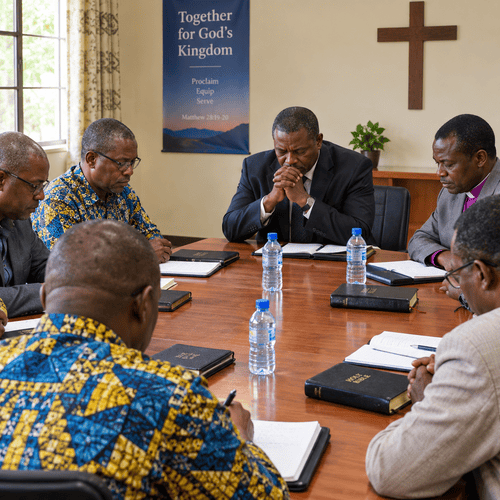
In August 2025, a group of African pastors decided they’d watched this happen long enough. They wrote it all down—14 articles, each one saying clearly what they believe. They called it the Africa Statement on the Prosperity Gospel and Word of Faith Theology.
This article explains what it says, why it matters, and why the case it makes is stronger than its critics allow.
What the Africa Statement actually is
First, some plain facts. The Africa Statement follows a well-known pattern: each article has an affirmation (“we affirm”) and a denial (“we deny”), so nobody can hide behind vague language.
THE STATEMENT AT A GLANCE
Full name: Africa Statement on the Prosperity Gospel and Word of Faith Theology, often shortened to ASPG.
Published: August 2025, from Nairobi, Kenya, by The Ekklesia Afrika Ltd., with Kenneth Mbugua among the authors. Publicly launched in September 2025.
Shape: 14 articles. Each one has an affirmation and a denial, with Bible references attached.
First signatories: 38 church leaders. 29 of them serve in Kenya; the others in Uganda, Zambia, Malawi, South Africa and Cameroon.
Since then: Signatures have grown into the hundreds, reported at around 700 leaders worldwide.
Languages: English, French and Amharic, with Swahili announced at the launch.
Where to read it: The full text and the signatories are published free https://africastatement.org/
Why write a statement at all?
The preface gives a blunt answer. The authors say the most dangerous threats to the church have always come from inside it, not outside it. They point to Paul in Acts 20, warning the Ephesian elders wolves would rise up from among their own number.
The authors’ complaint isn’t only that prosperity teaching exists. It’s that it has quietly moved in everywhere. A church can carry the name “Presbyterian” and not actually teach the Westminster Confession. It can be called “Anglican” and ignore the Thirty-Nine Articles. It can be “Baptist” and owe nothing to the 1689 Confession. The name on the signboard no longer tells us what’s preached inside.
So the statement exists to ask one uncomfortable question of every congregation: will you sign this, or not? The authors say plainly the goal isn’t to cause needless division, but to make clear where different churches truly stand.
That’s worth pausing on. A statement has no legal power. Nobody is forced to sign. Clarity is its only weapon.
First, the strongest case for the other side
Before we critique prosperity preachers, let’s state their case at its best. Here it is.
- God really is a generous Father. James 1:17 says, “Every good gift and every perfect gift is from above, coming down from the Father of lights.” 1 Timothy 6:17 says God “richly provides us with everything to enjoy.” A miserable, joyless Christianity isn’t biblical Christianity.
- The Bible really does promise material blessing. Deuteronomy 28 promises crops, cattle and children. Malachi 3:10 invites God’s people to test Him by bringing the tithe.
- Poverty is a real evil, not a spiritual decoration. Hunger, malaria and unpaid school fees aren’t romantic. A theology that shrugs at them can look cruel. Jesus healed bodies and fed crowds. He didn’t only save souls.
- Faith really does matter. Jesus said to more than one person, “Your faith has made you well.” He rebuked his disciples for having little faith. Faith is not a side issue.
- Some critics have been easy to dismiss. For decades the loudest attacks on prosperity teaching came from wealthy men in wealthy countries, telling poor believers to be content with less. That looked like comfortable people defending their comfort.
The Africa Statement, to its credit, concedes almost all of it in its affirmations before it denies anything. Article 1 affirms God gives health and wealth freely and without hidden motives, and that such gifts should be received with gratitude.
So the disagreement is narrower than people think. Nobody is arguing about whether God gives good things. The argument is about whether He has guaranteed them now, and whether we have found the lever that keeps them flowing in.
1 mistake, 14 symptoms
Read all 14 articles together and a single error keeps surfacing. Prosperity teaching takes the blessings God has promised for the age to come and demands delivery today.
Theologians call this a problem of eschatology. That long word simply means the study of last things—what God has promised to do at the end. The New Testament teaches that God’s kingdom has arrived in Jesus, but has not yet arrived in full. Biblical scholar Geerhardus Vos described Christians as living in the overlap of two ages. We have the first instalment now. We wait for the rest.
Paul says it exactly: “we ourselves, who have the firstfruits of the Spirit, groan inwardly as we wait eagerly for adoption as sons, the redemption of our bodies” (Romans 8:23). Firstfruits, not the full harvest. Groaning, not guarantees. Perfect health belongs to the resurrection body. Wealth without loss belongs to the new creation, where God will wipe away every tear.
Prosperity teaching cancels the waiting. And once the waiting is cancelled, something must explain why the blessing hasn’t come. That’s where the second error enters.
If God has guaranteed health and wealth now, and we’re sick and poor, the fault must be ours. So a mechanism is supplied: give a seed, say the right words, hold the right picture in your mind, stay loyal to the right man of God, break the right ancestral curse. Each of these is a work you perform to secure a blessing.
THE CORE OF THE ARGUMENT IN THREE SENTENCES
Prosperity teaching promises now what God has promised for the age to come.
Because the promise doesn’t arrive, it must invent a mechanism to force it.
Every mechanism it invents is a work—and a work turns grace into a transaction.
The 14 articles at a glance
Each article of the Africa Statement affirms something true before denying something false. The table below summarises them in plain English.
| # | IT AFFIRMS | IT DENIES |
|---|---|---|
| 1 | God is a good Father who freely gives good gifts, including health and wealth. | That He has guaranteed health and wealth to His children, or that lacking them proves spiritual failure. |
| 2 | The cross secures every blessing of salvation, including a perfected body—in glory. | That the cross guarantees health and wealth here on earth, in this present age. |
| 3 | Scripture is understood through normal grammar, context and the church’s historic reading. | That there are hidden meanings only certain “anointed” teachers can unlock. |
| 4 | God genuinely promised material blessing to Israel under the old covenant. | That Christians stand where Israel stood, and so may claim those same promises. |
| 5 | Covenant-breaking Israelites came under real curses, which Christ took upon himself. | That believers today live under generational curses needing special deliverance, prayer sites or payments. |
| 6 | Altars, tabernacle and temple were real meeting places, all fulfilled in Jesus. | That church buildings need altars, or that invisible altars must be raised or pulled down over families and nations. |
| 7 | Suffering is normal, ordained by God for wise and loving purposes, and ends in glory. | That suffering proves weak faith, or that escape requires gifts to a “man of God”. |
| 8 | Giving is a joyful spiritual discipline; generosity brings real blessing and heavenly treasure. | That giving buys miracles, or that failing to give ten per cent brings a curse of bills, illness and loss. |
| 9 | Words carry real power to help or harm, and must be stewarded wisely. | That human words create reality, or that speaking about sickness or poverty attracts it. |
| 10 | All people bear God’s image and may shape creation through work and skill. | That image-bearers are “little gods” who create new realities out of nothing by speech. |
| 11 | Faith is God’s gift, essential to salvation, and God often answers the prayers of faith. | That faith is a force believers use to manifest whatever they want, or that faith shields us from suffering. |
| 12 | The Christian mind must be renewed by continually learning and meditating on Scripture. | That visualising success causes it to materialise, or that this is a means God has appointed. |
| 13 | God appoints elders to shepherd, protect and counsel congregations with real authority. | That one pastor holds your spiritual destiny, or that total loyalty to him is owed on pain of a curse. |
| 14 | Humanity exists to glorify God and enjoy him for ever, treasuring the Giver above the gifts. | That God may be used as a means to any other end, including health or wealth. |
6 places where the argument is settled
1. The cross bought healing—but the delivery date is the resurrection
The central claim of prosperity preaching is that healing and wealth were purchased at Calvary, so refusing them is refusing the cross. The favourite text is Isaiah 53:5.
But the New Testament tells us how to read the verse. Peter applies it directly: “He himself bore our sins in his body on the tree, that we might die to sin and live to righteousness. By his wounds you have been healed” (1 Peter 2:24). The healing in view is healing from sin.
Then there is the evidence of the apostles’ own lives. Paul left Trophimus behind, sick, at Miletus (2 Timothy 4:20). Epaphroditus was ill, near to death (Philippians 2:27). Paul told Timothy to take a little wine for his frequent stomach ailments (1 Timothy 5:23). If any man had access to guaranteed healing, it was Paul. He did not use it, because it did not exist.
God still heals. The Africa Statement doesn’t deny that. It denies healing is an entitlement we can claim on demand.
2. Deuteronomy 28 wasn’t written to you
This is the quiet centre of the whole debate, and Article 4 states it with unusual courage. It agrees God really did promise material prosperity to Israel. The promises in Deuteronomy 28 aren’t exaggerations or spiritual metaphors. They were literal, national and tied to obedience under the covenant God made at Sinai.
The question is whether Christians stand where Israel stood. They don’t. The old covenant had a land, a temple, a priesthood and a set of blessings and curses attached to keeping the law. All of it pointed forward to Christ and was fulfilled in him.
This is why Malachi 3:10, the verse behind a thousand tithing appeals, cannot be turned into a promise of financial return for believers today. It was spoken to a nation under those covenant terms. And the curse side of the arrangement was carried away at the cross: “Christ redeemed us from the curse of the law by becoming a curse for us” (Galatians 3:13).
Article 5 follows the same logic to its pastoral conclusion. If Christ became a curse for his people, then a believer cannot be living under one. There is no need to investigate your ancestors, visit a prayer mountain, or pay for deliverance from a bloodline you never chose. The work is finished.
3. Faith is a hand, not a force
Here the two systems describe 2 different things by the same word.
In Scripture, faith is trust. It is the empty hand that receives what God gives. “For by grace you have been saved through faith. And this is not your own doing; it is the gift of God” (Ephesians 2:8). Faith has no power in itself. All the power belongs to the One it holds on to. A hand does not make bread; it takes it.
In word of faith teaching, faith becomes a substance—a spiritual force released by confident speech, which even God is bound to honour. Article 11 denies this precisely: faith isn’t an independent agent with creative power.
Notice what the difference does to a suffering believer. If faith is a hand, a weak hand still holds a strong Saviour. If faith is a force, then every unanswered prayer is a measurement of your own inner strength. One view sends the sick to Christ. The other sends them into themselves.
And Hebrews 11, the Bible’s own chapter on faith, ends not with mansions but with believers who were destitute, afflicted and sawn in two. They “died in faith, not having received the things promised” (Hebrews 11:13). By word of faith standards, the heroes of faith failed.
4. You aren’t a little god
Article 10 addresses a teaching that shocks many first-time hearers: that human beings, made in God’s image, are themselves small gods with creative authority over their circumstances. The proof text is Psalm 82:6, “I said, ‘You are gods, sons of the Most High, all of you.'”
Read the next verse. “Nevertheless, like men you shall die.” The psalm is a courtroom scene in which God condemns rulers and judges who abuse the weak. He gives them an exalted title and then sentences them to death for failing the poor. It’s the least suitable verse in the Bible for a preacher enriching himself from a congregation of the poor.
Being made in God’s image is glorious enough without inflation. It means we can think, build, farm, trade and create real value out of raw material. It doesn’t mean we speak matter into existence. Only God can.
5. Suffering isn’t evidence something went wrong
Article 7 may well be the most pastorally important of the 14. It affirms God positively ordains suffering for His people, for good, loving and wise purposes—and that Christians shouldn’t treat it as strange.
“Through many tribulations we must enter the kingdom of God” (Acts 14:22). “For it has been granted to you that for the sake of Christ you should not only believe in him but also suffer for his sake” (Philippians 1:29). Paul asked three times for his thorn to be removed. The answer was no, and the reason given was mercy: “My grace is sufficient for you, for my power is made perfect in weakness” (2 Corinthians 12:9).
Martin Luther drew the sharpest line here in 1518. He contrasted a theology of glory, which judges God by visible success, with a theology of the cross, which “calls the thing what it actually is”. A theology of glory looks at a dying believer and sees failure. A theology of the cross looks at a dying believer and sees Christ.
John Calvin wrote that God trains his children by the discipline of the cross, precisely because unbroken prosperity makes us confident in ourselves rather than in him. Charles Spurgeon, who suffered from depression and gout for much of his ministry, said he had learned to “kiss the wave” that threw him against the Rock of Ages. Neither man was rich, comfortable or far from pain.
Job didn’t receive an explanation. He received God. And his confession—”the LORD gave, and the LORD has taken away; blessed be the name of the LORD”—is the exact opposite of positive confession.
6. Giving is worship, not a payment
Article 8 is careful. It affirms generous, regular, sacrificial giving as a real spiritual discipline that brings real blessing. This isn’t an argument for keeping your money.
What it denies is the machinery: that giving is a method for triggering wealth, that miracles can be bought, or that failing to give 10% unleashes devouring forces of bills, sickness and loss.
Scripture is unusually direct about this. Paul warns of people “imagining that godliness is a means of gain” (1 Timothy 6:5). Peter says of false teachers, “in their greed they will exploit you with false words” (2 Peter 2:3). Micah condemned prophets who divined for money. And when Simon the magician offered cash for spiritual power, Peter’s reply was not a negotiation: “May your silver perish with you, because you thought you could obtain the gift of God with money!” (Acts 8:20).
Church history has seen this before. In the 16th century, believers were told money placed in a box would release a soul from purgatory. The seed-faith offering is the same structure with a different product: pay now, receive a spiritual benefit later, and never ask for a refund.
Where these ideas actually came from
2 streams feed the prosperity movement in Africa, and neither of them is African Christianity.
The first is American. Historian Daniel McConnell and historian Kate Bowler have traced the word of faith movement back to EW Kenyon, whose thinking absorbed the metaphysical ideas of New Thought—a 19th-century movement teaching that the mind shapes material reality. Kenyon’s ideas passed to Kenneth Hagin and from there into global charismatic broadcasting. The vocabulary is Christian. The engine underneath—mind over matter, words that create, faith as a force—is not.
The second stream is closer to home. Several of the articles only make sense against the background of African traditional religion: the sacrifice offered to secure a harvest, the ancestral curse that must be lifted by a specialist, the sacred site where power is concentrated, the powerful patron whose favour must be kept. Article 5 answers the curse, Article 6 answers the altar, Article 13 answers the patron.
The Africa Statement isn’t a translation of somebody else’s argument. It addresses the specific shape the error has taken on this continent.
It also settles the most common objection before it’s made. The imported theology here is the prosperity gospel.
Answering the strongest objections
Any document like this attracts criticism. Some of it deserves a serious answer.
| THE OBJECTION | THE ANSWER |
|---|---|
| This is Western theology in African clothing. | It was written, signed and launched by Africans in Nairobi, and translated into African languages. Meanwhile the teaching it rejects was largely imported from mid-twentieth-century America. The critics have the direction of travel backwards. |
| It is anti-wealth and anti-joy. | Articles 1, 8 and 10 affirm God’s good gifts, generous giving, dignified work and the creation of real value. What is denied is the guarantee and the mechanism, not the blessing. |
| It is needlessly divisive. | The preface says the goal is clarity, not division. Jude urges believers to contend for the faith once delivered, and Paul pronounces a curse on any other gospel. Some lines are drawn by the subject matter itself. |
| So you are saying God does not heal. | No. The statement denies entitlement, not divine healing. Christians may pray for healing with confidence, and receive it with thanks, without treating it as a debt God owes. |
| A statement changes nothing. | Largely true, and worth admitting. A signature is not church discipline. Its value depends entirely on whether churches then teach it, and whether elders act on it. |
| Who gave these men the authority? | Nobody, and they claim none. This is the same genre as the Chicago Statement on Biblical Inerrancy of 1978: no jurisdiction, no courts, only argument and voluntary subscription. |
Africa has done this before
There’s a longer story here, and it’s worth telling because it’s often forgotten.
In 325, the church met at Nicaea to answer a teacher who said the Son wasn’t fully God. The man who spent his life defending the true answer was Athanasius of Alexandria—an African. Theologians who shaped the Western church’s understanding of sin, grace and the Trinity included Tertullian, Cyprian and Augustine, all of them North African.
1700 years after Nicaea, African Christians gathered in Nairobi to guard the gospel again. The threat has changed. At Nicaea it was a wrong answer about the person of Christ. Today it’s a wrong answer about what His cross achieved and when. The instinct is the same: write it down, state it clearly, sign your name.
A statement can only demolish
Here’s the honest weakness of the whole project, and its authors would be the first to say it. 14 denials can pull a false building down. They cannot erect a true one up in its place.
Kenneth Mbugua has argued for years the prosperity gospel spread across Africa not simply because it was attractive, but because the churches had no defences. The gospel arrived without the machinery that protects it: meaningful church membership, a plurality of elders who can correct one another, church discipline, and patient teaching of whole books of the Bible. A church with no gatekeeping cannot be surprised when anything walks in.
So the work that follows the signature is the real work: teaching believers a doctrine of God’s providence that can hold both a harvest and a funeral; teaching that ordinary work is a calling from God, not a second-class activity; teaching contentment, which is the only cure the New Testament actually prescribes for the love of money; and teaching generosity that expects nothing in return.
The tomato seller does not need a better technique for extracting money from God. She needs to know that God is already, finally and irreversibly for her in Christ—on the days she sells everything and the days she sells nothing.
6 QUESTIONS TO ASK ABOUT ANY PULPIT
Does the preaching explain the passage in its context, or jump from a single verse to my bank balance?
Is giving described as worship and generosity, or as an investment with an expected return?
When believers stay sick or poor, is the blame placed on their faith, their words or their ancestors?
Can the pastor be corrected by other elders, or is loyalty to him treated as loyalty to God?
Is suffering ever preached as something God uses, rather than only as something to escape?
Is God presented as the treasure himself, or as a means to something else I actually want?
Why it matters
Surveys have long suggested belief in prosperity teaching isn’t a fringe position in Africa but a majority one. In its large study of religion in sub-Saharan Africa, the Pew Research Center found more than half of Christians in most countries surveyed agreed God grants wealth and good health to believers who have enough faith; in Kenya the figure was around 8 in 10. That research is now more than a decade old, but nobody claims the problem has shrunk since.
That is the scale of it. This isn’t a debate about a few television preachers. It’s a debate about what millions believe the cross of Jesus Christ actually accomplished.
The Africa Statement’s answer is simple enough to memorise. The cross didn’t buy us a comfortable life. It bought us God. Everything else is on its way.
Tough Questions, Honest Answers
Who wrote the Africa Statement, and can anyone sign it?
The statement came out of Kenyan evangelical churches and was published from Nairobi by The Ekklesia Afrika Ltd., with Kenneth Mbugua among the authors and others, including editor Graham Heslop, involved in drafting and refining it. 38 leaders signed it first, 29 of them serving in Kenya. Since then the number has grown into the hundreds, drawn from across Africa and beyond.
Anyone who agrees with it may sign it on the official website. Signing is voluntary and carries no legal or denominational weight. Its whole power lies in public agreement: a pastor who signs has told his congregation, in writing, what he will and will not preach.
Is the Africa Statement an attack on Pentecostals and charismatics?
No, and the document is careful about this. It never mentions speaking in tongues, prophecy, or whether the miraculous gifts continue today. Those questions are deliberately left alone, which means believers who disagree about them can still sign it together.
The target is a specific package of teachings: guaranteed health and wealth, faith as a creative force, positive confession, seed-faith giving, generational curses and spiritual altars. Many classical Pentecostals reject that package as firmly as anyone, and some have said so in print. Confusing the two is convenient for prosperity preachers, because it lets them hide inside a much larger and much older movement.
Does the statement teach Christians shouldn’t tithe?
It doesn’t say that. Article 8 affirms giving to the local church is a genuine spiritual discipline, and that Christians are called to be generous, regular and sacrificial with money.
What it denies is the threat attached to the tithe—the idea that failing to give 10% brings God’s curse in the form of unexpected bills, illness or loss. That threat usually comes from Malachi 3, which was addressed to Israel under the old covenant. Under the new covenant, giving is a response to grace already received, not an insurance premium against disaster. Believers may still decide that a tenth is a wise and useful pattern; they simply must not treat it as a payment.
How is this different from the Lausanne Covenant, the Nashville Statement or the Chicago Statement on Biblical Inerrancy?
They belong to the same family of documents but do different jobs. The Lausanne Covenant of 1974 was a positive, wide-ranging commitment to world evangelisation. The Chicago Statement on Biblical Inerrancy of 1978 defended the trustworthiness of Scripture, and it is where the modern affirm-and-deny format became popular. The Nashville Statement of 2017 addressed sexuality and gender.
The Africa Statement borrows the Chicago format and applies it to a doctrinal problem that the Western documents never had to face at close range. It is also the first such document of real weight to be written from inside the African church about a distinctly African situation.
If I reject prosperity teaching, does that mean I should stop praying for healing or money?
Not at all. Jesus told his disciples to ask for daily bread, and James tells the sick to call for the elders of the church to pray over them. Praying about your body and your rent is ordinary Christian obedience.
The difference lies in the posture. One person asks a Father who is free to say yes, no or later, and who is good in every case. The other issues a claim to a God who supposedly owes the goods and must deliver. The first can pray for years without bitterness. The second is one unanswered prayer away from despair, because in that system a refusal means the fault is his.
Is the prosperity gospel “another gospel”? Are those who preach it saved?
The statement treats the teaching itself as a false gospel, echoing Paul’s warning in Galatians 1 against any other gospel. That judgement is about the message, and it is hard to avoid: a system in which blessing is earned by giving, speaking and performing is a different way of relating to God from grace received through faith in Christ.
The eternal state of individuals is another matter, and one that belongs to God. Some who preach this are deliberate frauds, and Scripture has severe words for those who exploit the poor. Others are sincere believers who have simply never been taught anything else, and who would recoil if the system were laid out plainly before them. The right response is to reject the teaching clearly, and to deal with people patiently.
What should I do if my own church teaches seed faith and generational curses?
Begin gently and privately. Go to your pastor, bring your Bible, and ask about specific passages rather than accusing him of heresy. Ask what Article 4 asks: are we today in the same covenant position as Israel in Deuteronomy 28? Many pastors have inherited this teaching without ever examining it.
Read the statement itself with your family and a few trusted members. Give your money knowing it is worship, not a purchase. If the teaching continues after honest appeals, and your elders cannot be corrected, you may need to find a church where the Bible is preached in context and the poor are not treated as customers. That’s a painful decision, and it should never be a quick or bitter one—but no one is required to sit under teaching that damages their soul and their household.
Related Reads
- Word of Faith Movement: What’s Desperately Wrong About It?
- The Prosperity Gospel’s Lies and the True Cost of Discipleship
- Does Abundant Life in Christ Include Material Prosperity?
- From Empty to Overflow: The Abundant Life Jesus Promised
- Manifestation and “Speaking Things Into Existence”: Warfare or Marketing?
- The Desire for Wealth: What Does the Bible Truly Teach?
- More than Tithing: How Grace Motivates Sacrificial Giving
- Why Doesn’t God Heal Everyone When Jesus Healed So Many?