Jesus never wrote a book. He never dictated a letter. As far as we know, nobody took notes at the Sermon on the Mount.
Yet within a single lifetime, 4 Gospels gave the world His words and deeds in remarkable detail. Most Bible-believing scholars place them between about AD 50 and 90. That leaves a gap of 20 years or more after the cross when the story of Jesus lived mainly on people’s lips.
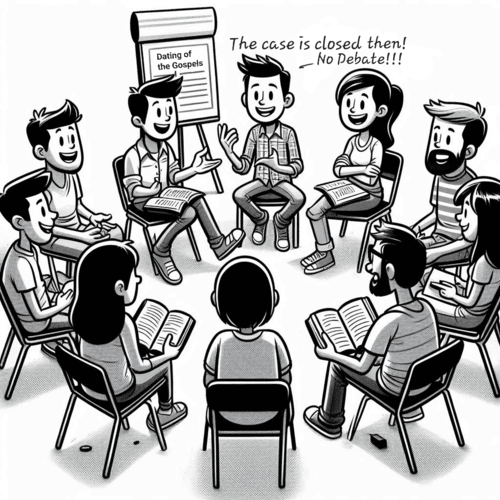
So what happened in that gap? Sceptics often compare it to the party game called “telephone”, where a whispered sentence is passed down a line until it comes out as nonsense. If the Gospels are the end of a long whispering game, how could we trust a word of them?
This post looks at how the first Christians actually passed on the story of Jesus—and why the “telephone game” picture gets almost everything wrong. (For the dating evidence itself, see our companion post, When Were the Gospels Written? The Evidence for Early Dates.)
THE SHORT ANSWER
Before the Gospels were written, Jesus’ words and deeds were passed on as oral tradition—carefully taught, memorised and repeated by His followers.
This was not a loose game of whispers. Jesus taught in a way built to be remembered. His disciples were trained to memorise. Eyewitnesses, led by the apostles, were alive to check the story. And Jesus promised that the Holy Spirit would bring His words to their remembrance (John 14:26).
KEY WORDS IN THIS POST
- Oral tradition: teaching passed on by word of mouth before it is written down.
- Tradition (Greek paradosis): literally “something handed over”. In the New Testament it often means the apostles’ teaching about Jesus.
- Eyewitness: someone who saw and heard events for himself.
- Disciple: a learner or student who follows a teacher.
- Rabbi: a Jewish teacher of God’s law.
The Gap Between the Cross and the Gospels
It helps to see the gap laid out. The table below shows what was happening in the decades between the resurrection and the first written Gospels.
| DATE (APPROX.) | EVENT | WHAT IT TELLS US ABOUT THE TRADITION |
|---|---|---|
| AD 30–33 | Jesus’ death, resurrection and the day of Pentecost | The apostles begin preaching publicly in Jerusalem, the very city where it all happened (Acts 2). |
| AD 33–36 | Paul is converted and, 3 years later, spends 15 days with Peter | Paul checks his message with an eyewitness within a few years of the cross (Galatians 1:18). |
| About AD 48–49 | The Jerusalem council | The leading apostles meet together and agree on the gospel message (Acts 15; Galatians 2:1–10). |
| About AD 50–55 | Paul writes 1 Thessalonians and 1 Corinthians | Paul quotes teaching he had already “received” and “delivered”—so it is older still (1 Corinthians 11:23; 15:3). |
| About AD 50s–60s | The first Gospels are written | Many eyewitnesses are still alive to confirm or correct them (1 Corinthians 15:6). |
Notice two things. First, the gap is short—shorter than the time between many of us and events we remember clearly from our own youth. Second, the gap was never empty. Throughout those years, the apostles were preaching, teaching and checking the message together.
Why the “Telephone Game” Picture Fails
The telephone game works because of how it is set up. One person whispers once. The listener can’t ask for it to be repeated. Nobody checks the message against the original. And the whole point of the game is to see how badly it goes wrong.
The early church was set up in almost exactly the opposite way.
| FEATURE | THE TELEPHONE GAME | THE EARLY CHURCH |
|---|---|---|
| How it is passed on | Whispered once, privately | Taught openly, again and again, in public worship and teaching (Acts 2:42) |
| Who hears it | One person at a time | Whole communities who could notice and correct mistakes |
| Checking with the source | Impossible—the first speaker stays silent | Eyewitnesses, including the apostles, were alive and leading the church |
| How much it matters | It’s a game; errors are the fun | Believers staked their lives on the message; many died for it |
| Opponents | None | Hostile listeners who also knew the facts (Acts 26:26) |
When Paul defended the gospel before King Agrippa, he could appeal to public knowledge:
“For the king knows about these things, and to him I speak boldly. For I am persuaded that none of these things has escaped his notice, for this has not been done in a corner.”
Acts 26:26
A story told openly, among friends and enemies who remembered the events, is very hard to bend.
Jesus Taught So That He Would Be Remembered
Jesus was called “Rabbi” (John 1:38), and He taught like one—only with far greater authority. Much of His teaching is shaped to stick in the memory. Even in English translation the patterns are easy to see.
| MEMORY TECHNIQUE | EXAMPLE FROM JESUS | WHERE TO FIND IT |
|---|---|---|
| Short, sharp sayings | “The last will be first, and the first last.” | Matthew 20:16 |
| Parallel lines | “Ask, and it will be given to you; seek, and you will find; knock, and it will be opened to you.” | Matthew 7:7 |
| Vivid pictures | A camel going through the eye of a needle | Mark 10:25 |
| Stories with a clear shape | The prodigal son, the good Samaritan, the sower | Luke 15:11–32; 10:25–37; Mark 4:1–20 |
| Repeated lists | The Beatitudes: “Blessed are…” again and again | Matthew 5:3–12 |
Jesus also repeated Himself. He travelled from town to town for about 3 years, and a good teacher on the road gives the same core lessons many times. This helps explain why the Gospels sometimes record similar sayings in slightly different settings. It’s not confusion. It’s what we’d expect from a travelling preacher.
And His disciples didn’t first start repeating His words after He died. During His ministry He sent out the Twelve, and later 72 others, to preach His message in the villages (Luke 9:1–6; 10:1–12). They were passing on His teaching while He was still there to correct them.
A World Trained to Remember
We live in a world of screens and search engines. We forget how much ancient people could hold in their heads.
Jewish children learned the Scriptures by heart. Students of the rabbis memorised their teachers’ words with great care. The Mishnah, an early collection of Jewish teaching, praises one famous student this way:
A STUDENT WHO LOST NOTHING
Rabbi Johanan ben Zakkai described his pupil Eliezer ben Hyrcanus as “a plastered cistern which loses not a drop” (Mishnah, Avot 2:8).
A plastered cistern was a water tank sealed so that it didn’t leak. That was the ideal disciple: someone who kept every word of his teacher.
In 1961 the Swedish scholar Birger Gerhardsson argued in Memory and Manuscript that Jesus’ disciples would have learned His teaching in much the same careful way. Some scholars think Gerhardsson pressed the comparison with later rabbis too far. But his basic point stands: Jesus’ first followers came from a culture that valued careful memory, not careless retelling.
Flexible Wording, Fixed Facts
Kenneth Bailey spent more than 30 years living and teaching in the Middle East. He noticed how village communities retold their important stories at evening gatherings. In 1991 he described what he saw as “informal controlled oral tradition”.
Here is how it worked. Anyone might retell a well-known story, and the wording could change a little. But the main points, the key sayings and the punchline were fixed. If a speaker got them wrong, the listeners would correct him on the spot.
This fits the Gospels very well. Compare the accounts of the same event, and you often find:
- The same core facts: who was there, what happened and how it ended.
- The same key words of Jesus: often word for word, or nearly so.
- Different details and wording around them: just what we’d expect from honest witnesses telling the story in their own way.
In fact, the small differences between the Gospels are a sign of honesty, not error. If all 4 accounts matched word for word everywhere, critics would say the writers had simply copied from one another. (For more on how the first 3 Gospels relate, see our post on the Synoptic Problem.)
The Eyewitnesses Stood Guard
The early church didn’t treat the story of Jesus as anyone’s property. It belonged to the eyewitnesses—and the apostles above all. When the apostles chose a replacement for Judas, the one rule was that he must have been with them “during all the time that the Lord Jesus went in and out among us” (Acts 1:21).
Luke tells us his Gospel rests on this kind of testimony:
“Inasmuch as many have undertaken to compile a narrative of the things that have been accomplished among us, just as those who from the beginning were eyewitnesses and ministers of the word have delivered them to us, it seemed good to me also…”
Luke 1:1–3
Two things stand out. Luke knew of “many” earlier accounts, so writing about Jesus had already begun. And he says the facts were “delivered” by eyewitnesses—people who were “from the beginning”.
Richard Bauckham develops this in Jesus and the Eyewitnesses (2006). He argues that the eyewitnesses didn’t simply start the tradition and then disappear. They remained living guardians of it for decades, and the Gospels often name them so that readers knew whom to ask.
Early Christians valued those living voices. Papias, a church leader who lived around AD 60–130, said he made a point of asking people who had heard the apostles:
“For I did not suppose that information from books would help me so much as the word of a living and surviving voice.”
Papias, quoted by Eusebius, Church History 3.39.4
Paul: A Witness to the Tradition Before the Gospels
Paul’s letters are the earliest Christian writings we have. They give us a window into the oral tradition itself, years before the Gospels were finished.
Paul uses 2 special words: “received” and “delivered”. These were the words Jewish teachers used for passing on teaching faithfully, without change. Listen to him:
“For I delivered to you as of first importance what I also received: that Christ died for our sins in accordance with the Scriptures, that he was buried, that he was raised on the third day in accordance with the Scriptures, and that he appeared to Cephas, then to the twelve.”
1 Corinthians 15:3–5
Paul wrote this in about AD 55. But he says he had already “delivered” it when he founded the church in Corinth around AD 50—and that he “received” it before that. Many scholars, including sceptical ones, trace this summary back to within a few years of the cross. Paul does the same with Jesus’ words at the Last Supper (1 Corinthians 11:23–25).
Paul also checked his gospel with the eyewitnesses. About 3 years after his conversion he “went up to Jerusalem to visit Cephas and remained with him fifteen days” (Galatians 1:18). Fourteen years later, he laid his gospel before James, Peter and John, and they gave him “the right hand of fellowship” (Galatians 2:9). The tradition was being checked at the very top.
Was Anything Written Down Early?
“Oral tradition” doesn’t have to mean nothing was written. Writing was common in Jesus’ world. People used small wax tablets for notes. When Zechariah couldn’t speak, “he asked for a writing tablet and wrote, ‘His name is John’” (Luke 1:63).
Alan Millard, in Reading and Writing in the Time of Jesus (2000), shows that reading and writing were widespread enough in first-century Israel that someone could easily have jotted down Jesus’ sayings during His ministry. Matthew, a tax collector, worked with records every day (Matthew 9:9). We can’t prove that anyone took notes. But it would be strange to assume that no one did.
And as we saw, Luke says “many” had already “undertaken to compile a narrative” before he wrote (Luke 1:1).
The Holy Spirit Guarded the Memory
So far we have looked at the human side: memory, eyewitnesses and community checking. These are real, and they answer the sceptic on his own ground. But for the Christian, they are not the whole story.
On the night before He died, Jesus made His disciples a promise:
“But the Helper, the Holy Spirit, whom the Father will send in my name, he will teach you all things and bring to your remembrance all that I have said to you.”
John 14:26
The apostles did not have to rely on memory alone. The same Spirit who inspired the prophets worked in them, so that what they finally wrote was not merely accurate human memory but the very Word of God (2 Timothy 3:16; 2 Peter 1:21). God used natural means—trained memories, many witnesses, careful teaching—and He also stood over the whole process to make sure His words reached us whole.
WHY THIS MATTERS
Our confidence in the Gospels doesn’t rest on clever theories about memory. It rests on God, who keeps His promises.
But God is not against evidence. The historical facts about how the story was passed on fit exactly what we’d expect if Jesus’ promise in John 14:26 was true. Faith and history point the same way.
From Spoken Word to Written Word
If oral tradition was so reliable, why write the Gospels at all? Because the eyewitnesses would not live for ever. As the apostles grew old and began to die, the church needed their witness in a lasting form. Peter wrote that he wanted believers to be able “at any time to recall these things” after his departure (2 Peter 1:15).
The Westminster Confession of Faith describes this step beautifully. God first revealed Himself in many ways, and then:
“…afterwards, for the better preserving and propagating of the truth, and for the more sure establishment and comfort of the Church against the corruption of the flesh, and the malice of Satan and of the world, to commit the same wholly unto writing.”
Westminster Confession of Faith 1.1
WATCH OUT: “TRADITION” THEN AND NOW
Paul told the Thessalonians to “hold to the traditions that you were taught by us, either by our spoken word or by our letter” (2 Thessalonians 2:15). The Roman Catholic Church uses verses like this to argue that unwritten tradition is a second source of authority alongside Scripture.
But the apostles’ spoken teaching and their letters were the same message. Now that the apostles are gone, the only place we can be sure we hear their voice is in what they wrote. That is why the Reformers insisted on sola Scriptura—Scripture alone as our final authority. (See The Case for Sola Scriptura.)
Conclusion: A Living Voice Made Permanent
The years before the Gospels were not a silent gap where legends grew. They were years of public preaching, careful memory and constant checking by people who had walked with Jesus. The words of a Teacher who spoke to be remembered were kept by disciples trained to remember, guarded by eyewitnesses and protected by the Spirit He promised.
The telephone game is about how easily a message gets lost. The story of the Gospels is about how carefully God made sure His message would not be.
“The grass withers, the flower fades, but the word of our God will stand for ever” (Isaiah 40:8).
Tough Questions, Honest Answers
Doesn’t memory research show that people often misremember events?
Yes, individual memory can fail, especially for small details. Bart Ehrman makes this point in Jesus Before the Gospels (2016). But the Gospels don’t rest on one person’s memory. They rest on many eyewitnesses who told the story often, in groups, and checked one another. People also remember most clearly the events that changed their lives—and nothing changed the disciples’ lives more than Jesus. Above all, Jesus promised the Spirit would bring His words to their remembrance (John 14:26).
If the stories were passed on carefully, why do the Gospels differ in some details?
Because careful does not mean identical. Witnesses naturally tell the same event in their own words and highlight different details. The core facts and key sayings stay steady, while the surrounding wording varies. Historians see this as a mark of honest, independent testimony. Many apparent conflicts disappear once we read each account in its own setting.
Did Jesus speak Aramaic? If so, aren’t the Gospels already a translation?
Jesus mostly spoke Aramaic, though He may also have known Greek and Hebrew. The Gospels were written in Greek, so many of His sayings do reach us in translation. But a faithful translation keeps the meaning. The Gospel writers even keep some Aramaic words, such as “Talitha cumi” (Mark 5:41) and “Abba” (Mark 14:36), showing how close they stayed to His original voice.
Hasn’t Kenneth Bailey’s work been criticised?
Yes. Theodore Weeden argued in 2009 that Bailey’s stories from modern villages are not as solid as he claimed. Scholars still debate the details. But the case for reliable tradition doesn’t depend on Bailey. It rests mainly on the New Testament itself: the role of the apostles, Paul’s “received” and “delivered” language, and the fact that eyewitnesses were alive throughout.
Were the disciples too uneducated to remember accurately?
The Jewish leaders called Peter and John “uneducated, common men” (Acts 4:13). That meant they had not trained under the rabbis—not that they couldn’t think or remember. In their world, ordinary people memorised far more than we do. And they had spent about 3 years learning from Jesus Himself, which is why the same verse says the leaders “recognised that they had been with Jesus”.
Could the early church have invented sayings and put them on Jesus’ lips?
If it had, we’d expect Jesus to answer the big debates the early church faced, such as circumcision for Gentile believers (Acts 15). He doesn’t. The Gospels also keep sayings that were hard for the church, like Jesus saying no one knows the day or hour, “not even the Son” (Mark 13:32). Inventors don’t create their own problems. These details point to a church that kept what Jesus said, even when it was awkward.
Does believing in oral tradition mean Christians should accept church tradition too?
No. The apostles’ oral teaching was authoritative because it came from the apostles, whom Christ appointed. That teaching was later written down in the New Testament under the Spirit’s guidance. Later church traditions don’t carry the same authority, and we must test them by Scripture, just as the Bereans tested even Paul’s preaching (Acts 17:11).
Related Reads
- When Were the Gospels Written? The Evidence for Early Dates
- Are the Gospels Eyewitness Accounts? The Mounting Evidence
- Who Wrote the Gospels? Evaluating Modern Scholarship
- The Synoptic Problem: More of a Puzzle than a Problem
- Are the Gospels Historically Reliable? Testing the Four Accounts
- The Miracles of Jesus: Why Sceptics Can’t Dismiss the Gospel Accounts
- The Case for Sola Scriptura: Can We Trust the Reformers?
- Rylands Papyrus P52: Why This Tiny Fragment Still Matters