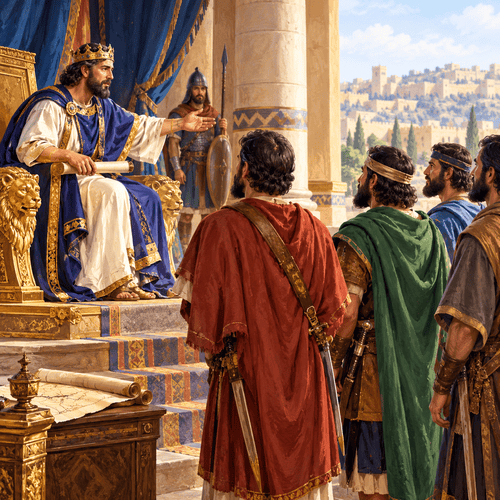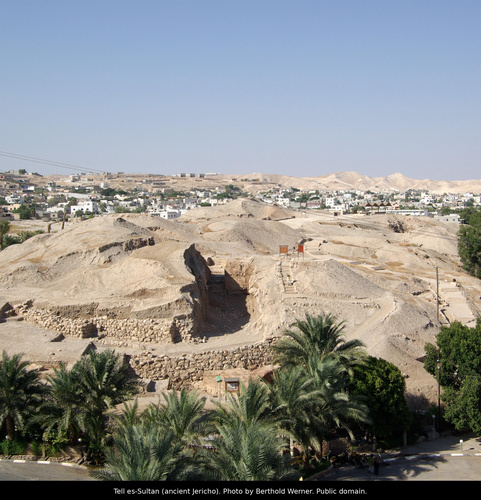
Here’s a serious charge sceptics often raise: one verse in the Bible was faked. A later writer, they say, made up a story about a man and his two dead sons—just to make an old curse look like a true prophecy.
The verse is 1 Kings 16:34. The curse is Joshua 6:26. Between them stand about 500 years.
If the critics are right, the Bible’s writers cheated to make God look good. And if they cheated here, why trust them anywhere else?
So let’s test the charge step by step, in plain words. You don’t need Hebrew or Greek—only a willingness to follow the clues.
2 Verses, 500 Years Apart
First, read the 2 verses side by side. A curse in the Bible is a solemn statement that harm will come on anyone who does a certain thing. Joshua speaks this one ‘before the LORD’—that is, in God’s name and with God’s authority.
THE 2 VERSES
Joshua 6:26 (about 1400 BC): Joshua laid an oath on them at that time, saying, ‘Cursed before the LORD be the man who rises up and rebuilds this city, Jericho. “At the cost of his firstborn shall he lay its foundation, and at the cost of his youngest son shall he set up its gates.”’
1 Kings 16:34 (about 870–850 BC): In his days Hiel of Bethel built Jericho. He laid its foundation at the cost of Abiram his firstborn, and set up its gates at the cost of his youngest son Segub, according to the word of the LORD, which he spoke by Joshua the son of Nun.
How the curse and its fulfilment match
| DETAIL | JOSHUA 6:26 (THE CURSE) | 1 KINGS 16:34 (WHAT HAPPENED) |
|---|---|---|
| Who acts | ‘the man who… rebuilds’ (no name given) | Hiel of Bethel, in King Ahab’s days |
| First cost | his firstborn, at the foundation | Abiram, his firstborn, at the foundation |
| Last cost | his youngest son, at the gates | Segub, his youngest son, at the gates |
John Calvin (1509–1564), the Reformation leader, saw that Joshua was not speaking from personal anger. Joshua, he wrote, ‘was only the herald of celestial vengeance’—a messenger announcing punishment from heaven.
The match is exact—and that is exactly why critics are suspicious. When a prediction fits this well, some assume it was written afterwards.
The Charge: What the Critics Say
Most critical scholars—who study the Bible as an ordinary human book and set aside miracles from the start—speak of ‘editing’, not ‘forgery’. But the result is the same: the prophecy is not real.
3 TERMS YOU’LL MEET IN THIS DEBATE
- Prophecy after the event: a ‘prediction’ written after the event it describes. Its Latin name is vaticinium ex eventu.
- Deuteronomistic History: a theory made popular by the German scholar Martin Noth (1943) that Joshua to Kings were shaped by later editors who shared Deuteronomy’s outlook.
- Recension: a revised edition of an ancient text, made by later copyists.
Critics put the charge in 2 ways:
- Version A—the curse came later. Joshua 6:26 was written after Hiel’s sons died. A later editor put a ‘prophecy’ of the tragedy into Joshua’s mouth. This is the more common view.
- Version B—the fulfilment came later. 1 Kings 16:34 was slipped into Kings to make Joshua’s curse come true. Supporters note that the verse is missing from one Greek edition of Kings (the Antiochene or Lucianic text) and seems to sit oddly in its chapter.
If either version is true, the prophecy is a fake. Here is the evidence against both, strongest first.
8 Reasons the Prophecy Is Real
1. Joshua Was Written Long Before Ahab
Version A needs Joshua 6:26 to be written after Hiel—in the 800s BC or later. But Joshua dates itself. Several times it says something is true ‘to this day’, meaning the day the writer was writing.
‘To this day’ clues that date the book of Joshua
| VERSE | WHAT WAS STILL TRUE WHEN JOSHUA WAS WRITTEN | WHEN IT STOPPED BEING TRUE |
|---|---|---|
| Joshua 6:25 | Rahab ‘has lived in Israel to this day’ | When Rahab died—within one lifetime of Jericho’s fall |
| Joshua 15:63 | Jebusites still lived in Jerusalem | When David captured Jerusalem (2 Samuel 5:6–9), about 1000 BC |
| Joshua 16:10 | Canaanites still lived in Gezer | When Pharaoh took Gezer and gave it to Solomon (1 Kings 9:16), about 950 BC |
Notice the first clue. It sits in the verse just before the curse. The writer who says Rahab is still alive also records the curse—centuries before Hiel.
An editor who kept such old words so carefully is hardly one who invented new ones.
2. A Fake Prophecy Would Name Its Target
Predictions written after the event usually give themselves away: they are too exact. The writer knows the answer, so he adds names and details.
Joshua 6:26 names no builder, tribe, king or century—only ‘the man who rises up’. If a later writer invented it to fit Hiel, why leave Hiel out? This one points at no one in particular—until God’s time came.
3. A Fake Fulfilment Would Be Louder
Now test Version B. If someone added 1 Kings 16:34 to prove Joshua right, we would expect drama: a warning, a shocked crowd, a sermon. Instead we get one plain sentence that reads like a note from a royal record.
It even gives two names—Abiram and Segub—found nowhere else in the Bible. Forgers do not waste ink on names that do nothing; real records do. Kings also tells us Ahab built many cities (1 Kings 22:39), so a rebuilt Jericho fits naturally.
4. A Forger Would Not Leave Loose Ends
Here is a fact that looks like a problem: people lived at Jericho before Hiel. Judges 3:13 mentions ‘the city of palms’, usually taken to be Jericho. In 2 Samuel 10:5, King David tells his insulted messengers, ‘Remain at Jericho until your beards have grown.’ So was Joshua’s curse broken long before Hiel?
No—and the answer is hidden in the curse’s own words. Joshua speaks of a ‘foundation’ and ‘gates’. Those are the parts of a city wall. In Hebrew, the verb ‘build’ with a city as its object often means to fortify it—to turn it into a walled, defended city. The older scholar Carl Friedrich Keil showed this from many other verses. People could live at Jericho; God forbade making it a fortress again.
AN OLDER VOICE: MATTHEW POOLE (1624–1679)
Puritan commentator Matthew Poole wrote that the curse ‘is restrained to the builder, but no way belongs to those who should inhabit it after it was built’.
In plain words: the curse was limited to the man who rebuilt the city’s defences, not to people who simply lived there.
A forger would have tidied away stories that seem to show people living freely at Jericho. The loose ends are there because the writers were reporting, not inventing—and they tie up perfectly. This is an undesigned coincidence: two passages that fit together in a way nobody planned.
5. Tampering Leaves Fingerprints
Ancient copyists sometimes did add words. We can usually catch them because we have many old copies in different languages. Comparing them is called textual criticism—the careful study of manuscripts to find the original wording.
Here is the surprise. A copyist did add Hiel’s story—but in the wrong place for the critics. The Greek translation of Joshua (the Septuagint) adds a line to Joshua 6:26 about a man of Bethel losing his sons. The Hebrew text does not. Scribal ‘help’ leaves fingerprints, and we can see exactly where it happened.
What the old manuscripts show
| TEXT | DOES IT MENTION HIEL’S SONS? | WHAT THIS TELLS US |
|---|---|---|
| Hebrew Joshua 6:26 | No—the curse only | The original curse was left as it was |
| Greek Joshua 6:26 | Yes—a line was added | Later scribes added the fulfilment here, and we can spot it |
| Hebrew 1 Kings 16:34 | Yes | The fulfilment stands in the main text |
| Antiochene Greek Kings | No | One later revision dropped a verse that looked out of place |
As for the Greek edition that lacks 1 Kings 16:34, a copyist who thought the verse looked out of place could easily have dropped it. One late revision cannot outweigh the Hebrew text.
6. The Verse Sits Exactly Where It Belongs
Critics call 1 Kings 16:34 a stray note. Look at its setting:
- Just before it: Ahab builds an altar to Baal, a false god, provoking the LORD more than any king before him (1 Kings 16:32–33).
- The verse itself: Hiel ignores a 500-year-old warning—and it comes true.
- Just after it: Elijah tells Ahab, ‘As the LORD, the God of Israel, lives… there shall be neither dew nor rain these years, except by my word’ (1 Kings 17:1).
One old word comes true; then a fresh word is spoken. The verse is a hinge between the two stories.
Ancient Jewish teachers saw this too. The Talmud (a collection of rabbinic teaching) tells how Ahab mocked Elijah: if Joshua’s curse came true, why not Moses’ warning of drought (Deuteronomy 11:16–17)? Elijah’s answer was the drought. Careful readers have long seen this verse as part of the story, not a patch.
7. Quoting a Prophecy Is Not Forging It
Critics note that 1 Kings 16:34 uses almost the same words as Joshua 6:26. Surely one was copied from the other?
Yes—the writer of Kings is quoting Joshua on purpose. That is how Kings reports fulfilled prophecy again and again (see 1 Kings 15:29 and 2 Kings 9:36). The New Testament does the same. When a newspaper quotes a leader’s promise from last year, no one says it invented the promise. Quoting shows a source; it does not create one.
8. The Real Issue Is a Starting Assumption
Why are so many scholars sure the prophecy is fake? Often the reason is not evidence but a starting belief: God does not tell the future, so any ‘prediction’ that came true must be late.
That is an assumption, not a finding. The twentieth-century thinker Cornelius Van Til often stressed that no one comes to the evidence neutral. Rule God out at the start, and you will always explain prophecy away.
The Bible makes a different claim. God calls himself the one ‘declaring the end from the beginning and from ancient times things not yet done’ (Isaiah 46:10). He gives a test: if a prophet’s word ‘does not come to pass or come true, that is a word that the LORD has not spoken’ (Deuteronomy 18:22). Joshua’s word passed that test.
WHAT CHRISTIANS CONFESS ABOUT THE BIBLE
The Westminster Confession of Faith (1646) says the authority of Scripture ‘dependeth not upon the testimony of any man, or Church; but wholly upon God (who is truth itself) the author thereof’ (1.4).
In plain words: we trust the Bible because God gave it, not because scholars approve of it.
Did Hiel Sacrifice His Sons?
Some paraphrases say Hiel killed his sons as foundation sacrifices—a pagan practice of burying a person under a new building for ‘good luck’. But the Hebrew only says ‘at the cost of’. It does not say how the sons died.
Older Bible teachers read it as God’s judgement. The Geneva Bible notes (1560) say the builder would raise the city ‘to the destruction of all his stock’—his whole family line. John Gill (1697–1771) says Hiel acted ‘either ignorant of that adjuration of Joshua, or in contempt and defiance of it’.
Either way, God’s word stood. If the sons died suddenly, God brought it about. If Hiel killed them, he still did what God foretold. The Westminster Confession teaches that God governs ‘all creatures, actions, and things, from the greatest even to the least’ (5.1), yet he is never the author of sin.
Timeline: Jericho from Curse to Christ
Here is the whole story across almost 1,500 years.
- About 1400 BC—Jericho falls: Joshua speaks the curse (Joshua 6).
- Time of the judges—a settlement, not a fortress: Eglon of Moab occupies ‘the city of palms’ (Judges 3:13).
- About 1000 BC—David’s messengers wait there: Jericho is lived in, but unwalled (2 Samuel 10:5).
- 874–853 BC—Hiel fortifies Jericho: His sons die, as Joshua said (1 Kings 16:34).
- Soon after—Elisha heals the water: The curse gives way to grace (2 Kings 2:19–22).
- About AD 30—Jesus visits Jericho: Bartimaeus and Zacchaeus meet him (Mark 10; Luke 19).
From Curse to Cure
Soon after Hiel, Jericho’s men told the prophet Elisha, ‘the water is bad, and the land is unfruitful’ (2 Kings 2:19). The Hebrew word for ‘unfruitful’ can mean ‘causing loss of children’—an echo of Hiel’s grief. Elisha threw salt into the spring and said, ‘Thus says the LORD, I have healed this water; from now on neither death nor miscarriage shall come from it’ (2 Kings 2:21).
Centuries later, another Joshua came. ‘Jesus’ is the Greek form of the name Joshua. In Jericho he healed blind Bartimaeus and saved Zacchaeus, a hated tax collector. Even Rahab of Jericho appears in his family line (Matthew 1:5).
The first Joshua spoke a curse over Jericho. The second Joshua carried the curse himself. ‘Christ redeemed us from the curse of the law by becoming a curse for us’ (Galatians 3:13).
MATTHEW HENRY (1662–1714) ON HIEL
The commentator Matthew Henry wrote of Hiel that ‘none ever hardened his heart against God, and prospered.’ On Jericho’s curse he added, ‘where it rests there is no getting from under it’.
That is true—unless Someone else takes the curse on himself. That is the good news of the gospel.
Where We Must Be Careful
HONEST LIMITS: 3 THINGS WE SHALL NOT CLAIM
A strong case doesn’t need weak arguments. These points go further than the evidence:
- Archaeology hasn’t found Hiel’s walls. Remains from his time are few, as weather and digging have worn the mound away.
- Old burials under buildings don’t prove sacrifice. Bones under foundations at places like Gezer cannot tell us what Hiel did.
- The Dead Sea Scrolls cannot date Joshua. Scrolls from about 100 BC apply Joshua’s curse to men of their own day. That shows respect for the curse, not its date.
Our case rests on the text itself.
The Verdict
The charge and the evidence, side by side
| WHAT THE CRITICS CLAIM | WHAT THE EVIDENCE SHOWS |
|---|---|
| Joshua 6:26 was written after Hiel | Joshua’s ‘to this day’ clues come from long before Ahab |
| A later writer shaped the curse to fit Hiel | The curse names no one |
| 1 Kings 16:34 was added to prove Joshua right | It is a plain, record-style note |
| People lived at Jericho before Hiel, so the curse failed | The curse was on fortifying the city—‘foundation’ and ‘gates’ |
| The verse is missing from one Greek edition | The Hebrew has it; traceable additions point the other way |
| Prophecy cannot happen | That is a starting assumption, not a finding |
So was 1 Kings 16:34 forged to fit Joshua? No. Remove the belief that God cannot foretell, and what remains is simple: a warning given in God’s name, ignored by a proud man, and fulfilled five hundred years later.
The same God still keeps his word—his warnings and his promises. The question is whether we will listen before it comes true.
Tough Questions, Honest Answers
Is Jericho still under Joshua’s curse today?
No. The curse was aimed at one act—turning Jericho back into a fortress—and it fell on the man who did it. Once Hiel had built the walls and gates, the curse had done exactly what God said. Soon afterwards God healed Jericho’s water through Elisha (2 Kings 2:21), and a group of prophets made their home there. Jesus himself visited the city and brought blessing to it. Today Jericho is an ordinary town, and its people need what every town needs: the good news of Christ.
Can Christians be under a generational curse?
Many people worry that a family curse may follow them. The Bible does teach that sin can harm families for generations, yet in the same breath it promises ‘steadfast love to thousands of those who love me’ (Exodus 20:5–6). Ezekiel 18:20 adds, ‘The son shall not suffer for the iniquity of the father.’ Most important of all, ‘Christ redeemed us from the curse of the law by becoming a curse for us’ (Galatians 3:13). A believer may still feel the effects of family sin, such as bad habits or painful memories. But no curse can hold someone who belongs to Christ: ‘There is therefore now no condemnation for those who are in Christ Jesus’ (Romans 8:1).
Was it fair for Hiel’s sons to die for their father’s sin?
This is a hard question, and we should not rush past it. God’s law told human judges not to punish children for their father’s crimes (Deuteronomy 24:16). But God is not a human judge; he is the giver of life, and no sinner has a right to a long one (Romans 6:23). The curse had been public for 500 years, so Hiel knew—or should have known—the cost before he began. Matthew Poole called it a terrible punishment for Hiel ‘to see his children cut off by Divine vengeance before their time, one after another’. We do not know everything about Abiram and Segub, but we can trust that ‘the Judge of all the earth’ will do what is just (Genesis 18:25).
Did archaeologists find the fallen walls of Jericho?
Jericho has been excavated many times. In the 1930s John Garstang believed he had found walls that fell in Joshua’s day. In the 1950s Kathleen Kenyon dated the city’s destruction to about 1550 BC, too early for Joshua, and many scholars followed her. In 1990 Bryant Wood re-examined her pottery evidence and argued that the destruction fits about 1400 BC—the Bible’s date. The debate goes on, but the Bible’s account has not been disproved. We trust the account because God gave it, and we are glad whenever the ground agrees.
Why did God order Jericho to be completely destroyed?
Jericho was ‘devoted to the LORD for destruction’ (Joshua 6:17)—handed over to God’s judgement. God had waited more than four hundred years, because ‘the iniquity of the Amorites is not yet complete’ (Genesis 15:16). The Canaanites even burned their own children in sacrifice to their gods (Deuteronomy 12:31). Yet even in judgement God showed mercy: Rahab, who trusted him, was saved with her whole family (Joshua 6:25). Jericho’s fall pictures the final judgement, and Rahab’s rescue pictures salvation by faith (Hebrews 11:31).
Is Jericho the oldest city in the world?
Jericho is often called the world’s oldest city, and it is certainly one of the oldest places where people have lived with few long breaks. The very old dates given for its first settlements—often 10,000 years or more—depend on dating methods that assume steady rates over long ages. Those who read Genesis as real history place Jericho’s beginnings after the Flood and the scattering at Babel (Genesis 11). Either way, its long history shows how valuable its spring and its place near the Jordan have always been. For the Bible reader, though, Jericho matters most not for its age but for what God did there.
Why did Jesus visit Jericho if the city was cursed?
Jesus went to Jericho because the curse had long been fulfilled, and because he came for people living under a curse. There he healed blind Bartimaeus, who cried out, ‘Jesus, Son of David, have mercy on me!’ (Mark 10:47). There he called Zacchaeus down from a tree and said, ‘Today salvation has come to this house’ (Luke 19:9). Jesus summed up his mission in one line: ‘For the Son of Man came to seek and to save the lost’ (Luke 19:10). The city once marked by a curse became a place where the true Joshua brought blessing.
Related Reads
- The Mesha Stele: How It Backs Scripture on Omri and Moab
- The Fall of Jericho: Does Archaeology Back the Bible Account?
- Jesus in Joshua: 9 Ways the Book Points to Christ
- Joshua & Yeshua: Exploring the Name and Life Connections
- Slaughter of the Canaanites: Would a Loving God Command It?
- The Masoretic and Septuagint: How Ancient Texts Shaped the Bible
- Fulfilled Bible Prophecies: Why They Matter More Than You Think
- Curses, Hexes and Black Magic: Can These Impact the Christian?
- When Jesus Met Zacchaeus: Who Really Sought Whom?
- Jesus in Deuteronomy: Prophet, Covenant-Keeper, Curse-Bearer