
Few objections to Christianity hit harder than this one: “Your Bible supports slavery.” It gets thrown across dinner tables and lecture halls, and it can leave a believer lost for words. If you’ve ever faced that accusation and didn’t quite know what to say, read on.
The Bible mentions slavery a great deal. But mentioning something isn’t quite the same as approving it—a newspaper that reports a robbery isn’t endorsing robbery.
Before we can answer the objection honestly, we have to ask three questions the critic almost never asks: What kind of slavery is the Bible actually describing? What does it regulate, and why? And where does the whole story finally point?
Once we slow down and read the texts in their own setting, the picture looks very different from the slogan.
Why “Slavery” in the Bible Isn’t What We Think
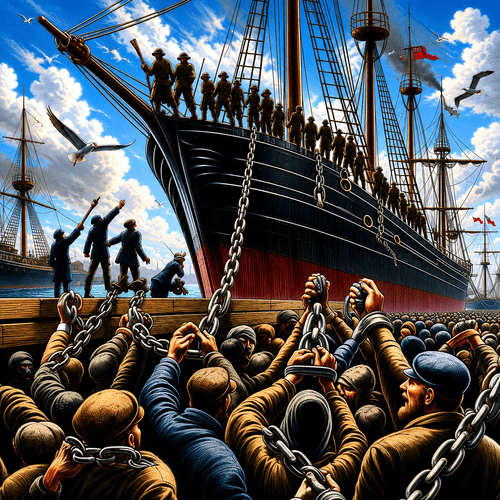
The trouble begins with translation. When a modern reader sees the word “slave”, one image comes to mind: the transatlantic trade—Africans kidnapped, shipped in chains, owned for life, their children born into bondage. That system is called chattel slavery, from an old word meaning property; the enslaved person was treated as a possession, like livestock or furniture.
But the Hebrew word behind most Old Testament references is ebed, and the Greek word in the New Testament is doulos. Both are far broader. They can mean a household servant, a hired labourer, a prisoner of war, or—most commonly in Israel—someone working off a debt. The older English versions often render these words as “bondservant” for exactly this reason. Much of what the Bible calls “slavery” is closer to indentured service: a person in financial ruin sold their labour for a fixed period to clear what they owed, rather like a modern bankruptcy arrangement. To read the cruelty of the Atlantic trade back into every biblical verse is to make a basic category mistake.
Old Testament Slavery: Regulation Without Endorsement
Here’s where the careful reader notices something the critic rarely mentions. The Law of Moses doesn’t establish slavery; it limits and restrains a practice that was already universal across the ancient world. And the limits are remarkable.
A Hebrew servant was to be released in the seventh year, and not sent away empty-handed but supplied generously from his master’s flock and threshing floor (Exodus 21; Deuteronomy 15). Every 50th year, the Year of Jubilee, wiped debts clean and returned people to their families (Leviticus 25).
Two laws are especially striking.
- Exodus 21:16 commands the death penalty for anyone who kidnaps a person and sells them—which is precisely how the transatlantic trade operated. By that standard, the entire machinery of Atlantic slavery would have been a capital crime under the Law of Moses.
- And Deuteronomy 23:15–16 forbids handing a runaway slave back to his master; the escapee was to be sheltered, not returned. Set that beside the Fugitive Slave Acts of nineteenth-century America, which demanded the exact opposite, and the contrast could hardly be sharper.
Why regulate rather than abolish outright? Jesus gave the principle when He spoke about another concession in the Law: it was permitted “because of your hardness of heart” (Matthew 19:8), though it was not so from the beginning. God meets fallen societies where they are and begins to bend them—planting principles that, followed to their conclusion, dismantle the very thing being regulated.
The Dignity Principle: What Scripture Says About Human Worth
Underneath the regulations runs a deeper current. From its opening page, the Bible declares every human being is made in the image of God (Genesis 1:26–27)—the doctrine theologians call the imago Dei, Latin for “image of God”. This is no small claim. It means human worth isn’t granted by status, wealth, or freedom, but stamped on every person by their Maker.
Job grasped the implication centuries before any abolitionist. If he had despised the cause of his servant, what would he do when God rose up? “Did not he who made me in the womb make him?” (Job 31:13–15). Master and servant share one Creator and one origin. Hold that truth firmly, and the moral ground beneath chattel slavery simply gives way. A possession cannot bear the image of God; and a person who bears the image of God cannot rightly be reduced to a possession.
New Testament Clarity—Paul, Slavery, and the Gospel
By the time of the New Testament, the Roman Empire ran on slavery—perhaps a third of the population was enslaved. The apostle Paul didn’t call for an armed revolt, which would have been crushed within days and cost countless lives. He did something more subversive: he undercut the institution from within.
To enslaved believers he wrote if they could gain their freedom, they should take the opportunity (1 Corinthians 7:21). To masters he issued an astonishing command: treat your slaves justly, “stop your threatening”, and remember that you yourself have a Master in heaven who shows no partiality (Ephesians 6:9; Colossians 4:1). In a world where a master held absolute power over his slaves, telling him he stood as an equal before God’s judgement seat was revolutionary.
And Paul went further still. In a list of the lawless and sinful, he names “enslavers”—the Greek word means slave-traders or men-stealers, those who kidnap people to sell them (1 Timothy 1:10). The very trade that built the Atlantic economy is condemned by name in the New Testament. Over it all stands the great equaliser: in Christ “there is neither slave nor free… for you are all one” (Galatians 3:28).
The Letter to Philemon: The Text That Unravels Everything
If you want to watch the gospel quietly dissolving slavery, read the shortest of Paul’s letters. Onesimus, a runaway slave, had met Paul in prison and become a Christian. Paul sends him back to his owner, Philemon—but with a request that detonates the whole relationship. Receive him, Paul writes, “no longer as a slave but more than a slave, as a beloved brother” (Philemon 16).
Think about what that does. Once master and slave sit at the same table as brothers in Christ, equal before God, the logic of ownership no longer survives. Paul even offers to pay any debt Onesimus owes, then gently reminds Philemon that he owes Paul his very soul. The institution isn’t stormed; it is hollowed out from the inside until nothing is left to hold it up.
How Biblical Christianity Fuelled the Abolition Movement
We should be honest: some who called themselves Christians defended slavery, twisting Scripture to excuse their profits—particularly in the American South. That’s a genuine stain, and pretending otherwise helps no one.
But here’s what the critic almost always leaves out: the abolition movement was overwhelmingly driven by Christians reading these very texts. In Britain, William Wilberforce spent decades fighting the slave trade in Parliament, convinced it was an offence against God. Behind him stood the Clapham Sect, a circle of evangelical reformers, alongside Thomas Clarkson and Granville Sharp. John Newton, a former slave-ship captain turned minister, wrote Amazing Grace and lived to see his own testimony help turn the nation. The Quakers had been agitating for decades. Their labour produced the Slave Trade Act of 1807 and the Slavery Abolition Act of 1833.
This was no accident. The conviction that slavery is a moral horror did not fall from the sky; it grew from soil the Bible had been preparing for centuries—the image of God in every person, the equality of all before their Maker, the brotherhood of believers. As the historian Tom Holland has argued, even those who now attack Christianity over slavery are borrowing a moral standard that Christianity itself handed them.
How to Respond When Someone Says “The Bible Supports Slavery”
So what do you actually say? A few steady points will carry us a long way.
- First, distinguish describing from approving. The Bible records slavery the way it records war, polygamy and betrayal—truthfully, not as a recommendation.
- Second, name the regulations. Israel’s laws protected the servant, demanded release, and made man-stealing a capital crime (Exodus 21:16)—the opposite of the Atlantic trade.
- Third, point to the trajectory. From imago Dei to Philemon to the abolitionists, the Bible’s own logic runs against ownership and ends in freedom.
- Finally, ask the gentle counter-question. On what basis do you call slavery evil at all? The conviction that every human has inviolable worth is a profoundly biblical idea. The objection, followed home, leads straight back to the Book it was meant to discredit.
Conclusion
The arc of Scripture bends towards freedom. The same Book that regulated ancient debt-servitude planted the seeds that, in time, abolished chattel slavery—and gave the world the very language of human dignity it now uses to condemn the practice. Read in context, “the Bible supports slavery” turns out to be almost exactly backwards. The Bible is the reason we believe slavery is wrong.
Tough Questions, Honest Answers
Does the Bible condone slavery?
No. The Bible describes and regulates slavery as it existed in the ancient world, but describing something is not the same as condoning it. The Law of Moses restricted the practice, protected servants, demanded their release, and made kidnapping a person to sell them a capital offence (Exodus 21:16). Its overall trajectory—from human dignity to the equality of believers in Christ—runs firmly against the idea of owning another person.
What is the difference between biblical slavery and the transatlantic slave trade?
They are largely different institutions. Most biblical “slavery” was debt-servitude—a person working off what they owed for a limited period, closer to indentured labour, after which they went free. The transatlantic trade was chattel slavery: race-based, lifelong, hereditary, and founded on kidnapping. The Bible explicitly condemns the man-stealing that made the Atlantic trade possible.
Why didn’t God simply abolish slavery in the Old Testament?
God often meets fallen societies where they are and reforms them gradually rather than by sudden decree. Jesus explained that some laws were given “because of your hardness of heart” (Matthew 19:8). Rather than impose an instant ban the ancient economy could not absorb, the Law planted principles—dignity, release, restraint—that would eventually undermine slavery altogether.
What does Exodus 21 teach about how Israel was to treat slaves?
Exodus 21 sets strict limits. A Hebrew servant was to be freed in the seventh year. A servant injured by a master was to be set free as compensation. And, crucially, anyone who kidnapped and sold a person was to be put to death (Exodus 21:16). These were protections largely unheard of in the surrounding cultures.
Did Paul tell slaves to remain enslaved?
Not as a permanent ideal. Paul told believers to serve faithfully wherever they found themselves, but he also urged enslaved Christians to gain their freedom if they could (1 Corinthians 7:21). In Philemon he pressed a slave-owner to receive his returning slave “as a beloved brother”—a relationship that quietly makes ownership impossible.
How did the Bible contribute to the abolition of slavery?
The abolition movement was led largely by Christians acting on biblical convictions—William Wilberforce, the Clapham Sect, John Newton, the Quakers and others. Their case rested on the biblical teaching that every person bears the image of God and that all stand equal before Him. That teaching produced Britain’s Slave Trade Act of 1807 and Slavery Abolition Act of 1833.
What should Christians say when challenged about the Bible and slavery?
Distinguish description from endorsement; point to the protective laws and the death penalty for man-stealing; trace the trajectory from human dignity through Philemon to abolition; and gently ask where the critic’s own conviction that slavery is evil comes from. That conviction is itself a biblical inheritance.