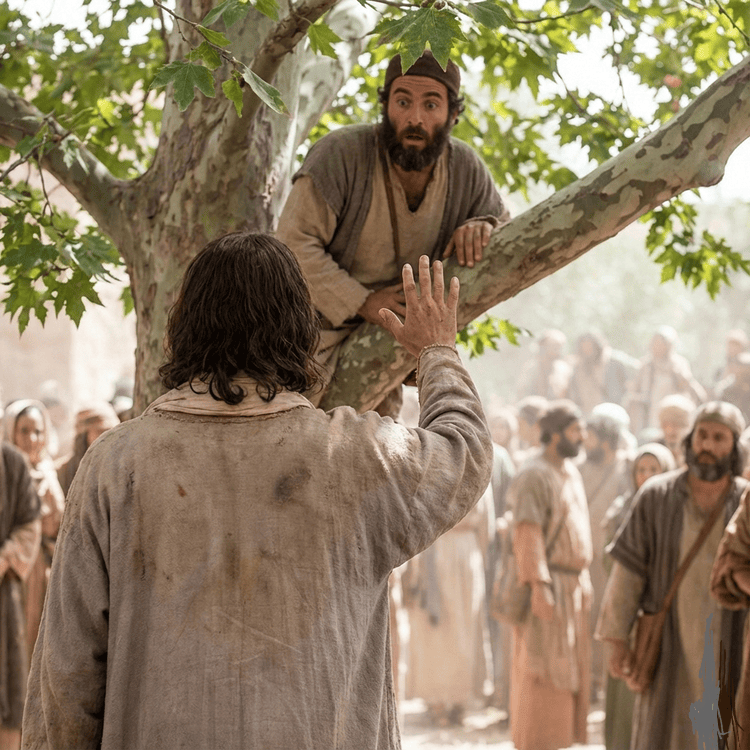
We all know the story: a short tax collector climbs a sycamore tree to catch a glimpse of Jesus passing through Jericho. It’s often painted as a picture of human seeking—a desperate man taking initiative to find the Saviour.
But what if we’ve been reading it backwards?
A closer look at Luke 19:1-10 reveals something far more profound: Jesus was seeking Zacchaeus, not the other way around. And this distinction matters deeply for how we understand salvation itself.
THE TEXT TELLS A DIFFERENT STORY
Jesus Chose The Route: Luke 19:1 says Jesus “entered Jericho and was passing through.” This wasn’t accidental. Jericho wasn’t on the direct path from Galilee to Jerusalem. Jesus deliberately chose to go through this city—and the text will soon show us why.
Jesus Knew the Name: Here’s where it gets remarkable. When Jesus reaches the tree, He “looked up and said to him, ‘Zacchaeus, hurry and come down, for I must stay at your house today'” (v. 5).
Consider what’s happening:
- Jesus knew his name without introduction
- Jesus invited Himself—Zacchaeus extended no invitation
- Jesus used the word “must” (Greek: dei)—indicating divine necessity, not human suggestion
The Initiative Was Entirely Christ’s: Let’s be honest about what Zacchaeus was doing. Verse 3 says he climbed the tree “to see who Jesus was”—that’s curiosity, not saving faith. He wanted a look at the famous rabbi everyone was talking about.
As a chief tax collector, Zacchaeus was despised—a traitor who enriched himself by extorting his own people for Rome. He had no reason to expect Jesus would notice him, much less honour him with a visit.
The crowd’s reaction confirms this: they “grumbled” that Jesus went to be the guest of a sinner (v. 7). This wasn’t expected. This wasn’t normal. This was pure grace breaking through social barriers.
WHAT REFORMED THEOLOGY SEES HERE
No One Seeks God
Romans 3:10-11 is unambiguous: “None is righteous, no, not one; no one understands; no one seeks for God.”
This is the doctrine of total depravity—not that we’re as bad as we could be, but that sin has corrupted every part of us, including our will. In our natural state, we don’t seek God; we run from Him.
Zacchaeus climbing that tree? That was self-interest, curiosity, perhaps even the first stirrings of the Spirit drawing him—but it wasn’t regenerate faith. Dead men don’t seek life; they must be made alive.
Grace That Cannot Be Resisted
Jesus’s call to Zacchaeus demonstrates irresistible grace (or as some prefer, “effectual calling”). When Christ sovereignly calls His own, they respond.
Notice Zacchaeus’s reaction in verse 6: he “hurried and came down and received him joyfully.” There’s no hesitation, no negotiation. The call produced the response.
Then came transformation: “Behold, Lord, the half of my goods I give to the poor. And if I have defrauded anyone of anything, I restore it fourfold” (v. 8).
This is what happens when Jesus seeks and saves. The fruit follows the root; repentance follows regeneration.
The Pattern Throughout the Gospels
This isn’t isolated. Jesus seeking lost sinners is the consistent pattern of the Gospels:
- The Gerasene Demoniac (Mark 5:1-20): Jesus deliberately sailed to Gentile territory to reach one tormented man. The man was utterly helpless—naked, violent, living in tombs, unable to seek salvation. Jesus crossed the sea, endured a storm, cast out demons, and transformed him. When the man wanted to follow, Jesus sent him as a witness: “Go home to your friends and tell them how much the Lord has done for you“.
- Matthew the Tax Collector (Luke 5:27-32): Jesus saw him, called him: “Follow me”. Matthew left everything—immediate response to divine initiative. Jesus explained: “I have not come to call the righteous but sinners to repentance”
- The Samaritan Woman (John 4:1-42): Jesus “had to pass through Samaria” (v. 4)—divine necessity again. He initiated conversation, breaking every social barrier. He revealed her sin and His identity before she believed.
- The Man Born Blind (John 9): Jesus saw him first and healed him. After the Pharisees expelled him, “Jesus heard…and having found him” (v. 35). Only then did Jesus reveal Himself for worship.
- The Twelve Disciples: John 15:16: “You did not choose me, but I chose you”. They were fishing, tax-collecting, living ordinary lives when He called.
- The Good Shepherd (John 10): The shepherd seeks the lost sheep. “I know my own and my own know me” (v. 14). The shepherd’s knowledge comes first.
The pattern is unmistakable: Jesus initiates, finds, calls, and transforms. Human response is real but secondary—it’s the fruit of His seeking, not the cause of His saving.
WHY THIS MATTERS
This isn’t theological hairsplitting. Understanding who seeks whom changes everything:
- It humbles us. We can’t boast in our seeking, our climbing, our initiative. Salvation is sola gratia—by grace alone.
- It comforts us. If Jesus sought us when we were dead in sin, He won’t abandon us now that we’re alive in Him.
- It redirects our worship. Our praise isn’t for our wisdom in seeking but for His mercy in finding.
THE BOTTOM LINE
Yes, Zacchaeus climbed the tree. But Jesus had already set His face toward Jericho. The seeking was His. The saving was His. The initiative was His from beginning to end.
Jesus’s own words close the account: “For the Son of Man came to seek and to save the lost” (v. 10).
Not “to be sought by the seeking.” Not “to meet halfway those who climb high enough.”
To seek. To save. To find what was lost.
Zacchaeus was found that day because Jesus came seeking. That’s the gospel. That’s grace. We love because He first loved us (1 John 4:19). We seek because He first sought us.
RELATED FAQs
Did Zacchaeus’s climbing show any spiritual merit or faith?
No. Reformed theologians like RC Sproul emphasise Zacchaeus’s curiosity was merely common grace—a natural interest that God used for His purposes, but not saving faith itself. John Piper notes “seeing who Jesus was” (Luke 19:3) represents the state of the natural man: curious but spiritually blind. Saving faith came only after Jesus’s sovereign call, not before. The climbing was providentially arranged by God but didn’t earn or contribute to Zacchaeus’s salvation.
Why is the word “must” (dei) in verse 5 so significant theologically?
The Greek word dei appears throughout Luke’s Gospel to describe divine necessity—things that must happen according to God’s predetermined plan. Jesus used the same word about His crucifixion: “The Son of Man must suffer” (Luke 9:22). When Jesus told Zacchaeus “I must stay at your house today,” He was declaring this encounter was part of God’s sovereign salvation plan, not a spontaneous decision based on human initiative. JI Packer highlights this word reveals the “irresistible momentum of divine grace.”
How do Arminians interpret this passage differently?
Arminian scholars like Roger Olson argue Zacchaeus’s climbing demonstrates prevenient grace—God’s grace enabling human response, but still requiring human cooperation. They see Zacchaeus’s initiative as genuine seeking that Jesus rewarded. However, Reformed theologians counter that the text emphasises Jesus’s initiative (knowing his name, inviting Himself) rather than Zacchaeus’s merit. The debate centres on whether human response precedes or follows God’s effectual call.
What’s significant about Jesus using Zacchaeus’s name? Jesus’s knowledge of Zacchaeus’s name without introduction demonstrates divine omniscience and election. Just as Jesus told Nathanael “I saw you under the fig tree” (John 1:48), showing supernatural knowledge, He knew Zacchaeus personally before they met. Sinclair Ferguson notes this echoes John 10:3: “He calls his own sheep by name.” This wasn’t crowd work or lucky guessing—it was the Good Shepherd recognising one of His own sheep.
Why did Jesus choose such a notorious sinner for this public demonstration? Jesus deliberately chose the most scandalous candidate to showcase pure grace. Michael Horton observes that tax collectors represented the “bottom of the barrel” in Jewish society—traitors, extortioners, and ritually unclean. By publicly dining with Zacchaeus, Jesus demonstrated that salvation doesn’t depend on human respectability or moral achievement. The greater the sinner, the greater the display of sovereign grace—making God’s glory, not human merit, the focus.
How does Zacchaeus’s restitution in verse 8 fit with “faith alone”? Zacchaeus’s immediate pledge to give half his goods to the poor and restore fourfold what he’d stolen is the fruit of salvation, not its root. Reformed theologian John Murray emphasised justification is by faith alone, but saving faith is never alone—it always produces works. Zacchaeus’s generosity didn’t earn his salvation; it evidenced the transforming power of Christ’s effectual call. James 2:17 applies here: “Faith by itself, if it does not have works, is dead.”
Does emphasising God’s initiative eliminate human responsibility? Not at all. Reformed theology affirms both divine sovereignty and human responsibility as biblical mysteries that coexist. Timothy Keller explains that while God initiates and completes salvation, humans genuinely respond, repent, and believe—they’re not robots or puppets. Zacchaeus really did hurry down, joyfully receive Jesus, and repent of his sins. The Reformed position is that God’s sovereign grace enables and ensures human response, making it both free and certain. As the Canons of Dort state, divine calling “produces in man both the will to believe and the act of believing.”
OUR RELATED POSTS