
When Solomon’s temple was completed, something extraordinary happened. A cloud so thick and overwhelming filled the building that the priests couldn’t even stand to perform their duties (1 Kings 8:10–11). God had moved in. The temple was not merely a religious building—it was the beating heart of Israel’s entire existence, the place where heaven touched earth. Where a holy God graciously dwelt among a sinful people.
So when Jesus stood in Jerusalem and declared, “I tell you, something greater than the temple is here” (Matthew 12:6), it was no casual remark. It was either breathtaking arrogance. Or the most important announcement in history.
Scripture insists it was the latter. And to understand why, we need to follow a thread that runs from a garden to a golden city.
FROM EDEN TO EXILE: GOD DRAWING NEAR
The Bible’s deepest story isn’t primarily about human sin. Rather, it’s about a God who relentlessly pursues dwelling with His people. In Eden, God walked with Adam in the cool of the day (Genesis 3:8). Sin shattered that intimacy. Humanity was expelled, and the cherubim stood guard at the entrance. The way back was blocked.
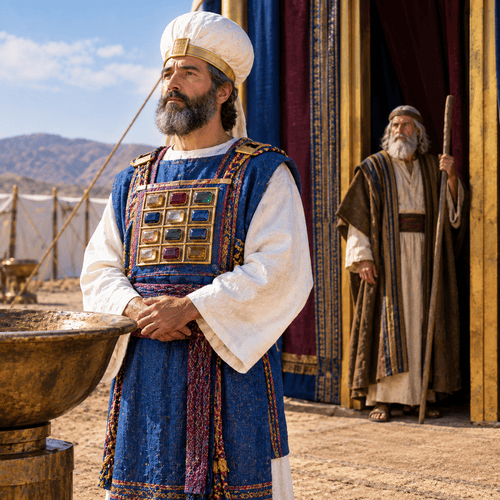
But God would not stay away. The tabernacle in the wilderness was His first great answer: a portable dwelling, the cloud of glory settling between the cherubim on the ark, God travelling with His redeemed people through the desert. Then came Solomon’s temple—permanent, magnificent, the cloud filling it to overflowing. God had come home among His people.
Yet the temple carried an ache within it. Its very architecture was a theology of distance. Court after court, barrier after barrier, and at the centre—a veil. One man, one day a year, could enter the Holy of Holies. The message was unmistakable: God is here, but full access isn’t yet yours. The temple was not the destination. It was a signpost, breathtakingly glorious, pointing beyond itself.
THE SHADOW AND THE SUBSTANCE
The entire Mosaic economy—its sacrifices, its priesthood, its temple—belonged to the age of shadows and copies (Hebrews 8:5; 10:1). These weren’t failures or mistakes. They were enacted prophecies, divine promises in architectural and liturgical form, every stone and curtain and sacrifice whispering: something—or Someone—better is coming.
It came in a stable in Bethlehem.
John chooses his words with surgical precision: “The Word became flesh and tabernacled among us, and we have seen his glory” (John 1:14). The Greek word for “dwelt” is eskēnōsen—God pitched His tent, He tabernacled. John’s telling us: everything the tabernacle and temple were reaching toward has arrived in a human body. The glory that filled Solomon’s house now walks on two feet, eats at tables, and touches lepers.
As Calvin explains it, the shadow isn’t abolished by being discarded—it’s abolished by being fulfilled.
FOUR WAYS CHRIST SURPASSES THE TEMPLE
- First, His presence is superior. The temple housed God’s localised, geographically-bound presence. In Christ, the fullness of deity dwells bodily (Colossians 2:9)—not behind a veil, but in human flesh, accessible, tangible, personal. When the temple curtain tore from top to bottom at Jesus’s death (Matthew 27:51), it was not vandalism. It was God announcing the typological work of the temple was now finished.
- Second, His sacrifice is superior. The temple’s entire purpose was atonement — but those thousands of animal sacrifices could never finally remove guilt (Hebrews 10:4). They could only cover and point forward. Christ is simultaneously the perfect High Priest and the once-for-all sacrifice, entering not a hand-made sanctuary but heaven itself, obtaining an eternal redemption (Hebrews 9:11–14, 24). One sacrifice. Complete. Never to be repeated.
- Third, His access is superior. The temple’s architecture preached restricted access. Christ demolishes every barrier. Jew and Gentile, slave and free, man and woman—all are brought near through His blood (Ephesians 2:14–18; Galatians 3:28). Every believer now approaches the throne of grace with confidence (Hebrews 10:19–22), not because the barriers were lowered, but because Christ absorbed them entirely.
- Fourth, His glory is indestructible. Solomon’s temple was razed by Babylon. Herod’s temple was demolished by Rome. Their glory was magnificent but temporary. When Jesus said “Destroy this temple, and in three days I will raise it up,” He was speaking of His body (John 2:19–21). His temple was destroyed at Calvary and rebuilt on Easter morning—imperishable, never to fall again.
THE TEMPLE GOD ALWAYS INTENDED
This is where the story arrives. The New Jerusalem in Revelation has no temple—”for its temple is the Lord God Almighty and the Lamb” (Revelation 21:22). From Eden’s garden to the golden city, God has been moving toward the same destination: unhindered, face-to-face dwelling with His redeemed people. The temple was a magnificent waypoint on that journey.
Haggai promised the glory of the latter house would surpass the former (Haggai 2:9). That promise was not fulfilled when Herod refurbished the stones—it was fulfilled when the eternal Son stepped into human history.
Every believer now lives in the reality the temple could only preview. We do not travel to a sacred building to find God. We come to a Person—and in Him, every longing encoded in the temple’s stones and sacrifices and cherubim-embroidered veil is not merely answered but exceeded beyond imagination.
The cloud that drove the priests to their knees in Solomon’s temple was always His glory. Now, by grace, it’s the glory we behold—and one day, face to face, will fully see.
RELATED FAQs
Didn’t the temple represent God’s presence among Israel?
How can Jesus claim to be greater than that? The temple represented God’s presence symbolically and partially —a localised, veiled dwelling that Israel could approach only through elaborate ritual. Jesus doesn’t merely represent God’s presence; He is God in human flesh, in whom “the whole fullness of deity dwells bodily” (Colossians 2:9). The temple pointed to Him the way a signpost points to a city—and no one, having arrived, prefers the signpost.
Does this mean the Old Testament temple was a failure or a mistake?
Not at all—Reformed theology insists the temple was a glorious, divinely-ordained institution that accomplished exactly what God intended it to accomplish. Its purpose was never to be the final destination but to serve as an enacted prophecy, a shadow cast by the coming reality of Christ (Hebrews 10:1). A shadow isn’t a failure; it’s proof that a solid object stands nearby in the light.
If Christ fulfilled the temple, why do Christians still gather for corporate worship?
Because the church is the new temple—the gathered community of believers indwelt by the Holy Spirit is itself God’s dwelling place on earth (Ephesians 2:21–22; 1 Corinthians 3:16). Christian corporate worship is not a replacement temple ritual but the assembly of living stones built around the cornerstone, Christ Himself (1 Peter 2:4–5). We gather not to access God through sacred space, but because we are already His sacred space.
Why did God need a Temple at all? Can’t He be worshipped anywhere?
God does not need a Temple—He is infinite and self-sufficient. But in His covenant grace, He appointed the Temple as the official place where He would meet with His people, hear their prayers, and receive their sacrifices—accommodating Himself to human finitude and need. This reflects the Reformed principle that God always prescribes how He is to be worshipped, and His people do not get to invent their own terms of access—a principle that flows directly into the Reformed Regulative Principle of Worship.
How does Jesus as the true temple connect to the Holy Spirit’s work in believers?
Christ is the head of the new temple, and it is the Holy Spirit who incorporates believers into it. At Pentecost, the Spirit descended on the gathered disciples in a way that deliberately echoed the glory-cloud filling Solomon’s temple—God moving into His new dwelling (Acts 2). Every individual believer and the corporate church together become the Spirit’s residence (1 Corinthians 6:19; Ephesians 2:22), making the new covenant temple not a building of stone but a community of transformed lives.
Does the Bible’s temple theme help us understand the book of Revelation?
Profoundly so. Revelation is saturated with temple imagery precisely because it depicts the consummation of what the temple always promised. The New Jerusalem requires no temple building because God and the Lamb are its temple (Revelation 21:22), and the river of life flowing from the throne echoes Ezekiel’s vision of life-giving water flowing from the restored temple (Ezekiel 47). Revelation isn’t introducing a new theme—it is showing the theme of God dwelling with His people reaching its breathtaking, eternal completion.
What should this truth mean practically for a Christian’s daily life?
It should produce a deep, settled boldness and wonder. The awareness that through Christ, we possess what Israel’s greatest kings and priests longed for and never fully experienced (Matthew 13:17; 1 Peter 1:10–12). There is no moment, no location, and no condition in which a believer in Christ is far from God’s presence, for the One greater than the temple is also Immanuel, God with us, always (Matthew 28:20). That reality, rightly grasped, transforms not just how we worship but how we work, suffer, and hope.
OUR RELATED POSTS
- Sacred Fury: What Christ’s Temple Cleansing Truly Means
- Did Jesus Cleanse the Temple Twice?
- Will There Be a Third Jewish Temple in Jerusalem?
- The Temple Curtain: What Its Tearing Truly Signifies
- What Does It Mean To Be God’s Temple?—A Biblical Deepdive
- Jesus in Haggai: How a Rebuilt Temple Points to the Coming King