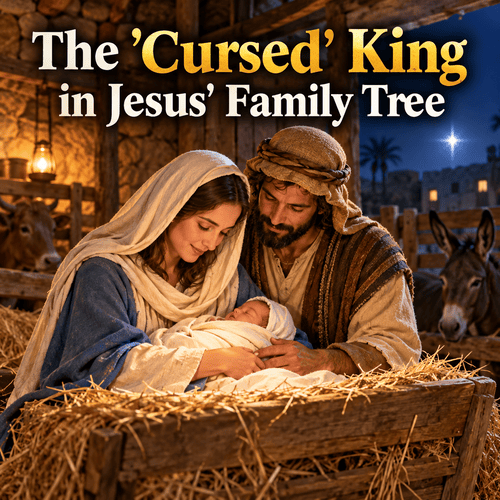
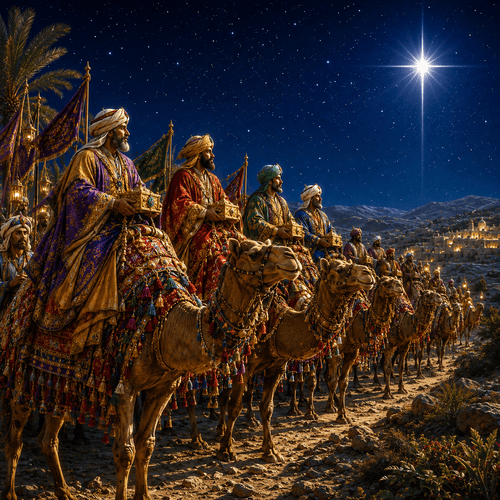
Most of us first met the Magi in a nativity set. Three men in crowns kneel beside the manger. It’s a lovely picture. Only almost every detail of it is missing from the Bible.
Their story takes up only 12 verses (Matthew 2:1-12). The text doesn’t tell us there were 3 of them. It never calls them kings. It doesn’t mention camels. And it doesn’t put them anywhere near a manger.
What Scripture does say is this: a group of foreign stargazers leave home, cross a desert and hundreds of miles to come worship this Jewish baby. The men who knew the Old Testament best, however, sit in Jerusalem and can’t be bothered to walk the five miles to check for themselves. Meanwhile, the king on the throne tries to have the baby killed.
One birth. Three responses. That’s the shape of Matthew 2, and it’s the reason the Magi’s story matters so much.
Who Were the Magi?
The word Matthew uses is the Greek magoi. Most English Bibles translate it “wise men”. It’s also the root of our English word “magic”, which already tells us this isn’t a simple word to pin down.
500 years before Jesus, Greek historian Herodotus described the Magi as one of the tribes of Media, in what’s now Iran. They were a priestly class. They performed sacrifices, chanted sacred songs, and interpreted dreams and signs in the sky. Herodotus says no Persian sacrifice could be conducted without one of them present.
By the time of Jesus, the word had stretched a long way. It could mean several different things, depending on who was speaking:
| WHAT THE WORD COULD MEAN | IN PLAIN ENGLISH | WHERE WE SEE IT |
|---|---|---|
| A Persian or Median priest | A member of an ancient religious order, trained from childhood | Herodotus, writing about Persia |
| A royal adviser and stargazer | A learned man at court who studied the sky and interpreted dreams for the king | The “wise men” of Babylon in Daniel 2 |
| A fortune-teller or magician | A travelling practitioner of the occult, sometimes an outright fraud | Simon in Acts 8; Bar-Jesus in Acts 13 |
Matthew doesn’t specify which of these he means. But notice something that should stop us in our tracks.
Everywhere else in the Bible, these men are the villains
When the same word family appears elsewhere in the New Testament, it’s always a warning. Simon of Samaria “had previously practised magic in the city and amazed the people” (Acts 8:9). In Cyprus, Paul meets a magos named Bar-Jesus and calls him “you son of the devil, you enemy of all righteousness” (Acts 13:10). In the Greek Old Testament, the same word covers the enchanters and diviners of the Babylonian court.
Matthew, however, opens his Gospel by making heroes out of exactly the kind of men the rest of Scripture condemns.
Where did they come from?
Matthew only says “from the east” (Matthew 2:1). Christians have argued over this detail for centuries. This could mean one of three places.
- Persia. The oldest suggestion, and the most natural one, since the word itself is Persian. Early Christian writers largely assumed it.
- Babylon. The ancient world’s great centre of sky-watching, with written records of the movements of planets stretching back centuries. It’s also where the book of Daniel is set.
- Arabia. Justin Martyr, writing in the 2nd century, says so repeatedly. The gifts point this way too, since frankincense and myrrh are tree resins that grow in southern Arabia.
“The east” is as precise as Scripture gets, and it’s precise enough for what Matthew wants us to know: the men were outsiders. Not Israelites. They had no share in the covenant God made with Abraham. They were on the wrong side of every religious line that mattered.
How Many Were There, and Were They Kings?
Short answers: we don’t know, and no.
The number 3 is worked backwards from the 3 kinds of gift. Early Christian writer Origen seems to be the first to state it, more than 200 years after the event. Other ancient traditions, especially in Syriac-speaking churches, speak of 12. The familiar names Caspar, Melchior and Balthasar don’t appear anywhere until roughly the 6th century.
As for them being kings, Tertullian around AD 200 said people in the East “almost” regarded them as kings. The upgrade to royalty came later, by reading two Old Testament promises about kings bringing tribute (Psalm 72:10-11 and Isaiah 60:3) backwards into Matthew’s account.
FIVE THINGS THE TEXT NEVER SAYS
It never says three. The number is guessed from the three gifts.
It never says kings. They were scholars and priests, not monarchs.
It never gives their names. Those arrive about 500 years later.
It never mentions camels. Those are borrowed from Isaiah 60:6.
It never puts them at the manger. Matthew says they entered a house (Matthew 2:11).
Here’s a detail almost everyone misses. Matthew tells us when Herod hears their question, he is troubled, “and all Jerusalem with him” (Matthew 2:3). A whole city doesn’t become unsettled because three tired men on camels ride through the gate. So we may infer the Magi have a contingent with them. Foreign dignitaries travelling with servants, guards and pack animals, asking to see the king—about a rival king—would unsettle a city very quickly indeed.
So whatever the number, this seems like a party, not a trio.
The Star: What Did They Actually See?
This is the question people ask most.
Start with what Matthew actually claims. The Magi say, “we saw his star when it rose” (Matthew 2:2). Then, after they leave Jerusalem, Matthew writes the star “went before them until it came to rest over the place where the child was” (Matthew 2:9).
That second verse is the hard one. Stars don’t go ahead of travellers. Stars don’t stop over particular houses. John Chrysostom noticed this in the 4th century and argued this simply is no ordinary star.
Notice too the star seems to disappear midway. If it had been visible the whole way, the Magi wouldn’t need to stop in Jerusalem and ask for directions. And when it reappears, they “rejoiced exceedingly with great joy” (Matthew 2:10). That’s the joy of getting something back, not of seeing it for the first time.
The main explanations, weighed fairly
| EXPLANATION | WHAT IT PROPOSES | ITS STRENGTH | ITS WEAKNESS |
|---|---|---|---|
| A planetary conjunction | Jupiter and Saturn appearing to meet three times in 7 BC. First suggested by Johannes Kepler. | Loaded with royal meaning for ancient stargazers, and repeated three times over months. | The planets never actually merged into one light. Cannot explain a star that moves and stops. |
| Jupiter in the sign of Aries | A set of subtle events in 6 BC that ancient astrology read as a royal birth in Judea. Argued by Michael Molnar. | Explains why stargazers in particular would read it as a Jewish king. | Almost invisible to the naked eye. Cannot explain Matthew 2:9. |
| A comet | An object recorded by Chinese astronomers in the spring of 5 BC, visible for about seventy days. Argued by Colin Nicholl. | Comets do move slowly across the sky and can appear to hang over a place. | In the ancient world comets almost always meant disaster, not good news. |
| A created light | Not an astronomical object at all, but a light made by God, like the pillar of fire in Exodus. Calvin’s view. | Fits Matthew 2:9 perfectly, in a chapter already full of angels and dreams. | Sets aside the real astronomical data completely. |
Where we land
God rules the natural world as surely as He rules the supernatural one. A planetary alignment fixed in place at creation is no less God’s doing than a miracle performed on the day. The heavens run on His timetable.
But Matthew 2:9 describes something no conjunction has ever done. So the honest position is this: a genuine celestial sign drew them hundreds of miles west, and a light from God guided them the last five miles from Jerusalem to Bethlehem.
And if that leaves us short of certainty, so be it. Matthew isn’t writing an astronomy report. He’s telling us the sky itself was pressed into service to announce a King.
Does this mean astrology works?
No.
- The Bible’s verdict on astrology never changes. Reading omens is forbidden outright (Deuteronomy 18:10-12). Isaiah mocks the Babylonian stargazers and says the fire will consume them like stubble (Isaiah 47:13-14). Jeremiah tells God’s people not to be frightened by signs in the heavens (Jeremiah 10:2).
- God using something doesn’t mean God approves of it. He once spoke through a donkey (Numbers 22:28) without making donkeys into prophets. He called the pagan emperor Cyrus His anointed servant (Isaiah 45:1) without making Him a believer.
- The story moves away from the stars, not towards them. God’s first word to these men comes through the sky. His second comes through the Scriptures. His last comes directly, in a dream (Matthew 2:12). By the end they’re not consulting the heavens at all.
Why Did They Come? God’s Pursuit of Outsiders
This is the heart of the story.
These men weren’t searching for the God of Israel. They were practising a craft their scriptures would have condemned, if they owned one. They had no prophets, no temple, no covenant, no promises. And God goes and gets them anyway.
The sky asked the question; the Bible gave the answer
Psalm 19 says “the heavens declare the glory of God” and their voice goes out through all the earth (Psalm 19:1-4). Paul says the same thing in Romans 1:19-20: what can be known about God is plain from what He has made, so that nobody has an excuse. Theologians call this general revelation, meaning the truth about God that is available to everyone, everywhere, simply by looking at the world.
General revelation is real. It’s also limited. Watch what happens here.
The star gets them to the right country. But the wrong city. They walk into Jerusalem and ask at the palace, because a palace is where sensible folk look for a newborn king. They’re completely wrong. What corrects them isn’t more astronomy. It’s a text: the prophet Micah, quoted aloud by Herod’s own scribes, naming Bethlehem, a village five miles down the road (Matthew 2:5-6, citing Micah 5:2).
That’s why Christians can be generous about what unbelievers see in the natural world, and still insist nobody finds Christ without the Bible. The stars can make a man restless. Only the Word can tell us how to reach Him.
Who moved first?
Scripture is blunt about human beings and their spiritual searching. “No one understands; no one seeks for God” (Romans 3:11). Jesus Himself said, “No one can come to me unless the Father who sent me draws him” (John 6:44).
So read the chapter again and count how many moves belong to God:
- He hung the sign in their sky.
- He stirred them to leave home on a journey of months.
- He brought them safely across hundreds of miles of hard country.
- He supplied the missing verse through the mouths of men who did not believe it.
- He gave the light back for the final stretch to Bethlehem.
- He warned them in a dream not to go back to Herod.
Every single step is God’s initiative. The Magi aren’t clever men who find God. They’re ‘hunted’ men who’re found.
Why would eastern stargazers care about a Jewish king at all?
Scripture doesn’t say, but two threads in the Old Testament make it far less surprising than it first appears.
- Daniel: When Daniel interprets Nebuchadnezzar’s dream, the king makes him “chief prefect over all the wise men of Babylon” (Daniel 2:48). Read that slowly. A Hebrew prophet is placed at the head of the very guild the Magi belong to. Daniel’s book contains a vision of one “like a son of man” receiving a kingdom that all nations will serve (Daniel 7:14), and a dated timetable pointing towards an anointed one (Daniel 9:24-27). Five centuries is a long time, but scholarly guilds copy and keep their documents. It’s entirely possible something of Daniel survived among them.
- Balaam: The second thread is even more striking. In Numbers, a pagan seer is hired from the east, near the Euphrates, by a king who wants Israel destroyed. Instead God takes over his mouth and he says: “a star shall come out of Jacob, and a sceptre shall rise out of Israel” (Numbers 24:17).
Put the two stories side by side and look at what they share. In each one, a man from the east reads signs. In each one, a prophecy speaks of a star and a king. In each one, a ruler is trying to destroy God’s people. And in each one, God takes control of the whole situation and turns it to His own purpose. Matthew’s first readers knew the books of Moses well. They would have noticed the pattern at once.
Beyond the Bible, Jewish historian Josephus reports an old prophecy of a world ruler coming out of Judea was widely discussed. Roman writers Tacitus and Suetonius mention the same expectation independently. Something was genuinely in the air.
A warning we must not skip
The Magi were not saved by their religion. They were rescued out of it. They didn’t arrive at a vague sense of the divine. They arrived at one specific child. In one specific house, in one specific village named by one specific prophet. And they fell on their faces. Peter’s words still stand: “there is no other name under heaven given among men by which we must be saved” (Acts 4:12).
What the story does teach is that God is free. He’s free to begin His work in the unlikeliest place, with the unlikeliest people, through the unlikeliest means. Timothy Keller often pointed out the sharp irony of Matthew 2: the people who ended up worshipping Jesus were the ones nobody expected, while the religious professionals with the right answers stayed exactly where they were.
Matthew has been preparing us for this from his first page. His family tree of Jesus deliberately includes Tamar, Rahab, Ruth and “the wife of Uriah” (Matthew 1:3-6), outsiders and irregulars every one.
The Gifts and What They Mean
“Then, opening their treasures, they offered him gifts, gold and frankincense and myrrh” (Matthew 2:11).
There are three things to say about the gifts, in order of how sure we can be.
First, they’re tribute
Nobody approached royalty empty-handed in the ancient world. These are the standard high-value goods of that world: valuable, portable, and they do not spoil. Calvin’s plain reading is that they brought what their own country produced.
Second, they fulfil a pattern the prophets had drawn
Matthew is soaked in the Old Testament and expects his readers to hear it under the surface.
- Psalm 72 prays the kings of Sheba and Seba will bring gifts to the King, that all nations will serve him, and that “gold of Sheba” will be given to Him (Psalm 72:10-11, 15).
- Isaiah 60 promises the wealth of the nations will come, and names two gifts precisely: “They shall bring gold and frankincense” (Isaiah 60:6).
- The Queen of Sheba travelled from far away to another son of David with gold and spices (1 Kings 10:1-13). Jesus later said, “something greater than Solomon is here” (Matthew 12:42).
Now notice what’s missing from Isaiah’s list. Isaiah names gold and frankincense. He does not name myrrh. Matthew records a third gift the prophecy didn’t require, and myrrh is a burial spice. It appears again at the crucifixion, mixed into wine and offered to Jesus on the cross (Mark 15:23). It appears a third time when Nicodemus brings myrrh and aloes to prepare the body for the tomb (John 19:39).
The shadow of the cross falls across the nursery floor.
| THE GIFT | WHAT IT ACTUALLY WAS | WHAT CHRISTIANS HAVE LONG SEEN IN IT |
|---|---|---|
| Gold | The most precious metal of the ancient world, the standard tribute paid to a monarch | The kingship of Christ. He is the true King the prophets promised. |
| Frankincense | A fragrant tree resin burned in worship, used in the temple incense | The deity of Christ. This is a gift you bring to God, not to a man. |
| Myrrh | A bitter resin used as perfume and, above all, to prepare bodies for burial | The death of Christ. He was born in order to die. |
That threefold reading goes back at least to Irenaeus in the second century. It is genuinely true of Christ, and the prophetic pattern above gives it real warrant. But hold it as a devotional insight rather than as the plain meaning of the verse, because Matthew himself does not spell it out.
Third, the verb matters more than the gifts
Before they open a single treasure chest, “they fell down and worshipped Him” (Matthew 2:11).
The Greek verb is proskyneo, meaning to prostrate yourself in homage. Matthew uses it at the two ends of his Gospel. Here at the beginning, foreigners worship a child. At the very end, in Galilee, the disciples see the risen Jesus and worship Him (Matthew 28:17).
And the Child refuses neither. That’s not a small detail. When people tried to worship Peter, he pulled them up off the floor (Acts 10:25-26). When John fell at an angel’s feet, the angel stopped him (Revelation 19:10). Here, worship is offered to a toddler in a village house, and heaven raises no objection at all.
When Did They Arrive? Correcting the Nativity Set
Not on the night of the birth. Not even close.
- The shepherds and the Magi never met. Luke’s shepherds come to a manger on the night itself (Luke 2:16). Matthew’s visitors enter a house (Matthew 2:11).
- Jesus is no longer a newborn. Luke calls him a brephos, an infant. Matthew calls him a paidion, a young child. Different words, deliberately chosen.
- The visit may have come up to two years after the birth. Herod ordered the killing of boys in Bethlehem “who were two years old or under, according to the time that he had ascertained from the wise men” (Matthew 2:16). He almost certainly allowed himself extra room to be safe.
- Jesus was not born in the year 1. Herod the Great died in 4 BC, according to Jewish historian Josephus. Since Herod was still alive during these events, Jesus must have been born a few years before that, somewhere around 6 to 4 BC.
Three Responses to One King
Now stand back and look at the whole chapter. The same news reaches three different sets of people. Every one of them believes it. Not one of them doubts a king has been born. And they respond in three completely different ways.
| WHO THEY ARE | WHAT THEY KNEW | WHAT THEY DID ABOUT IT |
|---|---|---|
| Herod the Great, king in Jerusalem | Everything. He questioned the scholars and the visitors carefully until he had the place and the timing. | Fear, then lies. He said “that I too may come and worship him” (Matthew 2:8) and then sent soldiers to kill the child. |
| The chief priests and scribes | Perfect knowledge. They quoted Micah from memory and named Bethlehem without hesitation. | Nothing whatsoever. They did not walk the five miles down the road to look. |
| The Magi from the east | Almost nothing. A sign in the sky, a borrowed verse, and a foreign king’s directions. | A journey of months, a fortune in gifts, and their faces on the floor. |
Herod is the obvious villain, and the easiest to dismiss. Most of us are confident we’re not Herod.
The scribes are the real warning. These were serious men. They had studied the Scriptures for years. When asked a hard question they gave the correct answer, immediately, from memory. And then they went back to life as usual. They were five miles from the fulfilment of everything they’d spent their lives reading about. They couldn’t care less.
Knowing where the Messiah is born isn’t the same as going to see him. Proximity to the Bible isn’t submission to it.
The Magi had the least information and the longest road, and they’re the ones on their knees. Grace is like that. It rarely runs along the lines we’d have drawn for it.
Why the Magi Matter in the Advent Story
Here’s what the 12 verses in our text tell us.
- They open the door to the nations: Matthew wrote the most Jewish of the four Gospels. He quotes the Old Testament constantly and assumes his readers know it. And he puts Gentiles at both ends of his book. Foreigners worship Jesus in Chapter 2. Jesus commands His followers to “make disciples of all nations” in Chapter 28 (Matthew 28:19). The same word for worship appears at both ends.
- They fulfil the oldest promise in the Bible: God told Abraham that “in you all the families of the earth shall be blessed” (Genesis 12:3). Isaiah promised a light for the nations, so that God’s salvation would reach the end of the earth (Isaiah 49:6). 2000 years of covenant history arrive at a village house with foreigners on the floor. Simeon said the same thing in the temple at roughly the same time, calling the child “a light for revelation to the Gentiles” (Luke 2:32).
- They set the true King against the false one: Herod held the title “King of the Jews” because Rome had given it to him. The Magi asked after “he who has been born king of the Jews” (Matthew 2:2). Born to it, not appointed to it. That’s the whole quarrel in a single phrase. And the phrase comes back. 30 years later it’s nailed to a piece of wood above a dying man’s head: “This is Jesus, the King of the Jews” (Matthew 27:37). The claim that frightened Herod is the claim that killed him. The gold and the myrrh were always meant for the same person.
- They show us what the whole thing is for: John Piper opened his best-known book on mission with a sentence that fits Matthew 2 exactly: “Missions exists because worship doesn’t.” God didn’t bring these men across a desert so they could gather information. He brought them so they could kneel.
That is what Advent is for as well. The King came, and He came to draw outsiders to Himself.
The question Matthew 2 leaves us with is the one it asked Herod, the scribes and the Magi. The news has reached you. What are you going to do about it?
Tough Questions, Honest Answers
Does the Bible mention magi anywhere apart from Matthew 2?
Yes, and never favourably. Simon of Samaria “had previously practised magic in the city and amazed the people” until Philip’s preaching exposed him (Acts 8:9). On Cyprus, Paul meets a magos called Bar-Jesus and strikes him blind for opposing the gospel (Acts 13:6-11). In the Greek Old Testament, the same word group covers the enchanters and diviners who served the Babylonian court in Daniel’s day. Matthew 2 is the one place in all of Scripture where men of this description appear as anything other than a warning. That is exactly what makes the chapter so startling, and it should shape how we read it. God did not endorse their craft. He rescued men who practised it.
Why does Luke’s Gospel say nothing about the Magi?
Because the Gospel writers select, and they select for different purposes. Luke traces the story from Zechariah in the temple through the shepherds to the presentation of Jesus and then home to Nazareth, writing with an eye on the poor and the overlooked. Matthew traces the royal line, the fulfilment of prophecy, and the reaction of the powerful. Neither writer claims to record everything, and John says as much explicitly about his own Gospel (John 21:25). Silence about an event is not denial of it. Four witnesses who described exactly the same details in exactly the same order would be far more suspicious than four who each tell us something the others left out.
Are the Magi’s bones really in Cologne Cathedral?
A magnificent gilded shrine in Cologne Cathedral has been said since 1164 to hold their remains, brought there from Milan after Frederick Barbarossa captured the city. Before that, the relics were reportedly identified in Constantinople centuries earlier. There’s no way to test any of this, and the chain of custody rests entirely on medieval claims made a thousand years after the event. The shrine is a genuine treasure of medieval craftsmanship and a real part of church history. It is not evidence about the Magi. Christians don’t need relics to trust the text, and the habit of venerating them has done far more harm than good.
What happened to the Magi after they went home?
Scripture tells us only that “they departed to their own country by another way” (Matthew 2:12). Everything else is legend. Later stories have the apostle Thomas meeting and baptising them in the east, or have them dying as martyrs, or have them made bishops. These accounts appear centuries afterwards and can’t be checked. The silence is worth sitting with. God brought these men across a desert to see His Son, and then sent them home without recording a single word of what followed. Faithfulness has never required a documented sequel, and most of God’s people in every generation serve Him without one.
What’s Epiphany, and why is it linked to the Magi?
Epiphany comes from a Greek word meaning “manifestation” or “showing”, and it falls on 6 January. Western churches connect it chiefly with the visit of the Magi, since that is the moment Christ is shown to the world beyond Israel. Eastern churches link it more closely to the baptism of Jesus. The twelve days between 25 December and 6 January are where we get the Twelve Days of Christmas. Christians differ over how much of the church calendar to keep, and Scripture nowhere commands Epiphany, so nobody should be bound in conscience about it. But the truth it marks comes straight out of Matthew 2, and that truth is worth remembering whether or not we mark the date.
How many children did Herod kill in Bethlehem?
Scripture gives no number, and the huge figures found in some older devotional writing, running into thousands, are impossible. Bethlehem was a small village of perhaps a thousand people. Historians who work with ancient population figures generally reckon the number of boys under 2 at somewhere between 6 and 20. That doesn’t soften the horror by even a little, because every one of them was somebody’s son. And was made in God’s image. It does explain why no other ancient source records it. Set beside a king who executed his favourite wife and three of his own sons, a raid on a village would not have reached the history books.
Is it wrong to sing “We Three Kings”?
The carol was written in 1857 by an American clergyman, John Henry Hopkins Jr., and its title gets two things wrong in four words. Scripture gives no number and calls them no kings. But judge the carol by its verses rather than its title. Each gift is explained in turn, and the myrrh verse speaks of sorrowing, sighing, bleeding and dying, and of a body sealed in a cold tomb. Very little Christmas music is willing to admit the child was born in order to die. Sing it with the historical footnote in mind. It teaches the meaning of the gifts better than a good many sermons do.
Related Reads
- Anna the Prophetess: The Widow Who Waited for Jesus
- By Divine Appointment: How the Wise Men Found Baby Jesus
- The Bethlehem Connection: Why God Chose a Humble Town For His Son
- How God Reveals Himself to Us: General and Special Revelation
- Messianic Prophecies: Progressive Specificity You Just Can’t Ignore
- If Jesus is Messiah, Why Aren’t ALL Messianic Prophecies Fulfilled?
- What Does It Mean That Christ Is Our Morning Star?
- The Star Out of Jacob: Who Is Numbers 24:17 Really About?