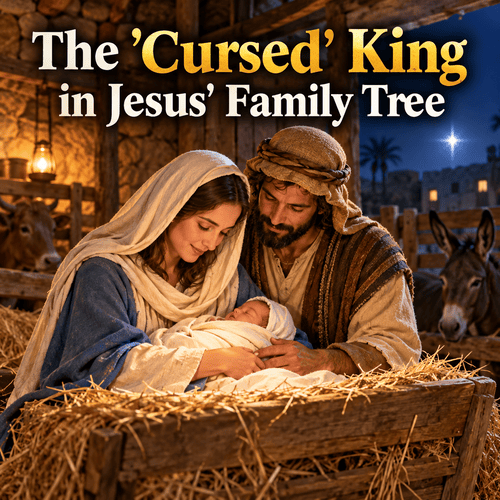
God once said something shocking about a king of Judah: ‘Write this man down as childless’ (Jeremiah 22:30). In other words, none of his sons would ever rule. Cross him off the list.
600 years later, Matthew opens the New Testament with Jesus’ family tree. And there, in verse 11, sits this very same king—Jeconiah.
Some critics say this one name sinks the Christian faith. If Jesus comes from a cursed king, they argue, He can’t be the promised King. Case closed.
But what if the name isn’t a weak spot at all? What if Matthew put it there on purpose—as a bright picture of grace? Below are 5 strong reasons why his name in Jesus’ genealogy (family line) doesn’t hurt Jesus’ claim. In fact, it helps it.
Who Was Jeconiah?
Jeconiah was one of the last kings of Judah, the southern kingdom of God’s people. He came to the throne at 18 and ruled for only 3 months, in 597 BC (2 Kings 24:8). Then Nebuchadnezzar of Babylon captured Jerusalem and took Jeconiah away as a prisoner. He spent the rest of his life in exile—that is, forced to live far from his homeland.
Jeconiah at a Glance: The Key Facts
| DETAIL | WHAT THE BIBLE SAYS |
|---|---|
| Other names | Jehoiachin, Coniah, Jechoniah (see FAQ 1) |
| Father | King Jehoiakim (2 Kings 24:6) |
| Length of reign | Three months, in 597 BC (2 Kings 24:8) |
| God’s verdict | ‘He did what was evil in the sight of the LORD’ (2 Kings 24:9) |
| Children | Seven sons (1 Chronicles 3:17–18) |
| In the New Testament | Named in Jesus’ family line (Matthew 1:11–12) |
What Did God Say About Him?
Through Jeremiah, God spoke 2 hard words against Jeconiah. The first used a picture:
As I live, declares the LORD, though Coniah the son of Jehoiakim, king of Judah, were the signet ring on my right hand, yet I would tear you off
Jeremiah 22:24
A signet ring was a ring carved with the king’s own seal. The king pressed it into soft wax to sign letters and laws. God was saying, ‘Even if you were as close to me as my own seal, I would pull you off my hand.’
The second word is the one critics quote:
Thus says the LORD: ‘Write this man down as childless, a man who shall not succeed in his days, for none of his offspring shall succeed in sitting on the throne of David and ruling again in Judah.’
Jeremiah 22:30
Here’s the surprise: Jeconiah had 7 sons. So ‘childless’ was about the royal record, not his home. In the official list of kings, he’d have no heir on the throne. John Calvin read the verse this way in his commentary on Jeremiah: the king would have children, but no successor.
KEY TERM: WHAT’S A BIBLICAL ‘CURSE’?
In the Bible, a curse isn’t magic or a spell. It is God, the righteous Judge, announcing what will happen because people have broken His covenant—His solemn, binding agreement with them.
The Problem Critics Raise
Now look at how Matthew records Jesus’ family line:
and Josiah the father of Jechoniah and his brothers, at the time of the deportation to Babylon. And after the deportation to Babylon: Jechoniah was the father of Shealtiel, and Shealtiel the father of Zerubbabel
Matthew 1:11–12
The critic’s argument runs like this:
- Step 1: God said no descendant of Jeconiah would sit on David’s throne.
- Step 2: Matthew says Jesus comes from Jeconiah’s line.
- Step 3: So Jesus cannot sit on David’s throne—and so He cannot be the Messiah (God’s promised, anointed King).
Many Christian answers rest on one point. Here are 5. Each can stand on its own.
Five Answers to the Curse of Jeconiah
| # | THE ANSWER IN ONE LINE | KEY BIBLE TEXT |
|---|---|---|
| 1 | The curse had clear limits of time and place | Jeremiah 22:30; 36:30 |
| 2 | Jesus wasn’t Jeconiah’s physical ‘seed’ | Matthew 1:16, 20 |
| 3 | God later reversed the curse | Haggai 2:23 |
| 4 | God’s oath to David outlasts His discipline | Psalm 89:32–34 |
| 5 | Even ancient Jewish teachers said the curse was lifted | Talmud, Sanhedrin 37b–38a |
WHY FIVE ANSWERS MATTER
To win the argument, a critic must defeat all 5 answers. If even one of them stands, the objection falls.
Answer 1: The Curse Had Clear Limits
Read the curse slowly: ‘in his days’ and ‘ruling again in Judah’. The words point to a specific time and place—the old earthly throne in Jerusalem.
And the curse came true, exactly. No son or grandson of Jeconiah ever ruled as king in Judah. His grandson Zerubbabel led the Jews home from Babylon, but he was only ‘governor of Judah’ (Haggai 1:1), serving under the king of Persia.
There’s a helpful example in the same book. God spoke a very similar curse on Jeconiah’s father:
Therefore thus says the LORD concerning Jehoiakim king of Judah: He shall have none to sit on the throne of David
Jeremiah 36:30
Yet Jehoiakim’s son, Jeconiah, did sit on the throne—for 3 months. Was Jeremiah wrong? No. The phrase meant Jehoiakim would have no lasting dynasty (a family line of kings that continues). It didn’t mean ‘no one will ever sit there, not even for a day’.
Two Curses Compared: Father and Son
| Detail | JEHOIAKIM (THE FATHER) | JECONIAH (THE SON) |
|---|---|---|
| What God said | ‘He shall have none to sit on the throne of David’ (36:30) | ‘None of his offspring shall succeed in sitting on the throne of David’ (22:30) |
| What happened | His son reigned for three months, then was taken away | No son or grandson ever reigned as king in Judah |
| What it means | No lasting dynasty—not a total ban | The earthly kingdom ended in his family’s hands |
Jesus doesn’t sit on a small earthly throne under foreign kings. After His resurrection, God raised Him to the throne at His own right hand (Acts 2:30–36). The angel told Mary Jesus ‘will reign over the house of Jacob forever, and of his kingdom there will be no end’ (Luke 1:33).
Answer 2: Jesus Wasn’t Jeconiah’s ‘Seed’
God said none of Jeconiah’s ‘offspring’ would succeed. The Hebrew word, zera, means ‘seed’—a man’s physical children and their children. But Jesus was not Joseph’s physical son. He was born of a virgin, Mary, by the power of the Holy Spirit (Matthew 1:20).
Again and again Matthew writes ‘the father of’. But at Joseph, he breaks the pattern:
and Jacob the father of Joseph the husband of Mary, of whom Jesus was born, who is called Christ.
Matthew 1:16
In Greek, ‘of whom’ is feminine. It points to Mary alone. Joseph is not Jesus’ biological father.
So how is Jesus the heir? Through adoption. Joseph took Mary as his wife and named the child (Matthew 1:25). In Jewish law, this made Jesus his legal son, with every right of a firstborn—including David’s royal claim. Notice that the angel calls Joseph ‘son of David’ (Matthew 1:20). Jesus received David’s royal right through Joseph, but not Jeconiah’s blood.
Jesus is also a true son of David by birth. The angel tells Mary God will give her son ‘the throne of his father David’ (Luke 1:32). Paul says Jesus ‘was descended from David according to the flesh’ (Romans 1:3).
Two Family Lines, Two Purposes: Matthew and Luke
| Detail | MATTHEW 1:1–17 | LUKE 3:23–38 |
|---|---|---|
| Direction | Forward, from Abraham to Jesus | Backward, from Jesus to Adam |
| Goes through David’s son | Solomon, the royal line | Nathan, a younger son |
| Main purpose | Shows Jesus’ legal right to David’s throne | Shows Jesus as a true son of Adam and Saviour of all people |
| Names Jeconiah? | Yes (1:11–12) | No |
Scholars disagree about whose family Luke records. J Gresham Machen, in his classic book The Virgin Birth of Christ (1930), argued that both lists belong to Joseph: Matthew gives the line of legal heirs to the throne, and Luke gives Joseph’s actual ancestors. Our case does not depend on settling this. Either way, Jesus is not Jeconiah’s physical seed.
Answer 3: God Turned the Curse Around
Remember the signet ring God pulled off His hand? Now listen to what God says to Jeconiah’s grandson, around eighty years later:
On that day, declares the LORD of hosts, I will take you, O Zerubbabel my servant, the son of Shealtiel, declares the LORD, and make you like a signet ring, for I have chosen you, declares the LORD of hosts.
Haggai 2:23
God uses the same rare picture—now in reverse.
The Signet Ring: Taken Away, Then Given Back
| Detail | JEREMIAH 22:24 | HAGGAI 2:23 |
|---|---|---|
| Who God speaks to | Coniah (Jeconiah) | Zerubbabel, Jeconiah’s grandson |
| The signet ring | Torn off God’s hand | Made God’s ring again |
| God’s attitude | Rejection | ‘I have chosen you’ |
John Calvin, in his commentary on Haggai, saw that this promise reaches beyond Zerubbabel, who never became king, to Christ, the greater Son from his line.
Kings also ends in hope. After thirty-seven years in prison, Jeconiah was freed and ‘dined regularly at the king’s table’ (2 Kings 25:29). The royal line was down—but it was not dead.
Answer 4: God’s Oath Is Bigger Than His Discipline
God made a covenant with David. O. Palmer Robertson famously described a covenant as ‘a bond in blood sovereignly administered’. It is a life-and-death promise God sets up and keeps. God bound Himself with an oath:
And your house and your kingdom shall be made sure forever before me. Your throne shall be established forever.
2 Samuel 7:16
But what if David’s sons broke His law? God answered ahead of time:
then I will punish their transgression with the rod and their iniquity with stripes, but I will not remove from him my steadfast love or be false to my faithfulness. I will not violate my covenant or alter the word that went forth from my lips.
Psalm 89:30–34
God would punish sinful kings ‘with the rod’—with discipline. Jeconiah’s curse was exactly that rod. But discipline is not the same as cancelling the promise. A father who disciplines his son does not stop being his father.
Jeremiah himself shows this. Straight after the curse on Jeconiah, the very next lines say:
Behold, the days are coming, declares the LORD, when I will raise up for David a righteous Branch, and he shall reign as king and deal wisely, and shall execute justice and righteousness in the land.
Jeremiah 23:5
The chapter numbers in our Bibles were added much later, in the 1200s. In Jeremiah’s scroll, curse and promise sat side by side. Later he even said, ‘David shall never lack a man to sit on the throne of the house of Israel’ (Jeremiah 33:17).
Answer 5: Even Jewish Tradition Says the Curse Was Lifted
Some critics of Jesus today use Jeremiah 22:30 against Him. But their own ancient teachers saw it differently. The Babylonian Talmud (Sanhedrin 37b–38a), a central collection of Jewish teaching, says Jeconiah repented in prison and that God set aside the decree because of his repentance. Another ancient Jewish writing, the Pesikta de-Rav Kahana, says something similar.
We do not build our faith on these writings. But they show that ancient Jewish readers did not see Jeremiah 22:30 as a curse on every descendant of Jeconiah forever.
But What About Luke 3:27?
One more question: Luke’s genealogy also names a Shealtiel and a Zerubbabel (Luke 3:27). Does Luke’s line pass through Jeconiah too?
Notice Luke calls this Shealtiel ‘the son of Neri’, not the son of Jeconiah. There are two good explanations:
- Different men. These were common names, and the two lists split straight after Zerubbabel—Abiud in Matthew, Rhesa in Luke.
- The same men, joined by adoption. Shealtiel may have been Neri’s natural son, counted as Jeconiah’s legal heir. This fits ‘childless’ well: the royal line continued through another branch of David’s family. This family already shows such twists—1 Chronicles 3:19 calls Zerubbabel the son of Pedaiah, while Haggai calls him the son of Shealtiel.
Either way, Jesus is still not Jeconiah’s seed through Joseph. And Answers 1, 3 and 4 aren’t touched at all.
From Curse to Christ: A Timeline
- 598 BC: Jehoiakim’s reign ends in disgrace, as Jeremiah warned (Jeremiah 36:30).
- 597 BC: Jeconiah reigns for three months, then is taken to Babylon.
- 561 BC: He is freed from prison and eats at the king’s table (2 Kings 25:27–30).
- 538–520 BC: Zerubbabel leads exiles home as governor; Haggai calls him God’s signet ring.
- 5 BC: Jesus is born to the virgin Mary and adopted by Joseph, a son of David.
- AD 30: Jesus dies, rises and is raised to David’s throne at God’s right hand (Acts 2:30–36).
Why Matthew Wanted Jeconiah’s Name There
Matthew could have quietly left Jeconiah out—he skips other kings (see FAQ 4). Instead, he names him twice. Here’s why.
- He marks the lowest point. Matthew divides Jesus’ family line into 3 sets of 14 (Matthew 1:17). DA Carson notes in his commentary on Matthew that the exile is the great turning point of the list. Jeconiah stands right at the bottom.
- Jesus ends the real exile. Israel went into exile because of sin. So the angel says Jesus ‘will save his people from their sins’ (Matthew 1:21).
- Grace reaches the worst. Matthew Henry observed that Christ did not refuse to own sinful ancestors, because He came to save sinners. No family story is too dark for grace.
- Jesus took the curse instead of dodging it. Isaiah said the Servant would be ‘cut off out of the land of the living’, with no one to consider ‘his generation’—yet ‘he shall see his offspring’ (Isaiah 53:8, 10). Jesus became ‘a curse for us’ on the cross (Galatians 3:13).
- Adoption is a picture of the gospel. Jesus received a royal name through adoption, not birth. In a similar way, believers receive a place in God’s family by adoption, through Christ (Galatians 4:4–5).
- Jesus is God’s true signet ring. Jeconiah lost the ring. Zerubbabel received it as a promise. Jesus fulfils it: ‘on him God the Father has set his seal’ (John 6:27).
THINK ABOUT IT
Jeconiah was ‘written down as childless’. Jesus died on a cross with no wife and no children. Yet today He has sons and daughters from every nation on earth. That’s how God answers a curse.
Conclusion: One Name, Two Truths
Jeconiah’s name shows us two truths. God’s word of judgement always comes true: Judah’s kings fell, exactly as He said. And God’s word of promise always comes true: David’s throne was waiting for its true King.
Jesus does not hold that throne by finding a gap in God’s word. He holds it by fulfilling every part of it. He is David’s heir by law, David’s son by birth and David’s Lord by right.
So when someone says Jeconiah’s name sinks the faith, invite them to read the whole story. It does not end with a curse. It ends with a King.
Tough Questions, Honest Answers
Is Jeconiah the same person as Jehoiachin and Coniah?
Yes—all three names belong to the same king. The Books of Kings mostly call him Jehoiachin, while Jeremiah and 1 Chronicles call him Jeconiah, and Jeremiah sometimes shortens it to Coniah (Jeremiah 22:24, 28). The names mean roughly ‘the LORD establishes’. Some commentators think Jeremiah used the short form as a sign of God’s displeasure with the king. Matthew uses the Greek spelling, which English Bibles write as ‘Jechoniah’. Having more than one name was common for kings of that time—his uncle Mattaniah was renamed Zedekiah when he took the throne (2 Kings 24:17).
Is there archaeological evidence that King Jehoiachin existed?
Yes, and it is striking. In the early 1900s, German archaeologists digging in ancient Babylon found clay tablets in storerooms near Nebuchadnezzar’s palace. When the scholar Ernst Weidner published them in 1939, they turned out to be lists of oil rations given to foreign captives—including ‘Ya’ukin, king of the land of Yahud’ (Judah) and his sons. The tablets date from around 592 BC. They show that Babylon fed Jehoiachin and his sons as royal captives, which fits the regular allowance described in 2 Kings 25:30. They also confirm that he had sons, so ‘childless’ was never about his household. God’s Word is rooted in real history, and the ground keeps bearing witness to it.
Why does Matthew group Jesus’ ancestors in sets of fourteen?
Matthew 1:17 says there were fourteen generations from Abraham to David, fourteen from David to the exile, and fourteen from the exile to Christ. David is counted at the end of the first set and the start of the second, because he is the hinge of the story. Jeconiah then opens the third set, after the exile. Many scholars point out that in Hebrew the letters of David’s name (D-V-D) add up to fourteen, so the pattern itself may quietly say ‘David’. Ancient family lists were often shaped like this to help people remember them and to teach a message. Matthew’s message is clear: Jesus is the Son of David the whole story was waiting for.
Why does Matthew leave out some kings of Judah?
Matthew skips three kings between Joram and Uzziah—Ahaziah, Joash and Amaziah—and also Jehoiakim, Jeconiah’s father. This is not a mistake. In Bible genealogies, ‘father of’ can also mean ‘ancestor of’, just as Matthew 1:1 calls Jesus ‘the son of David’, though David lived a thousand years earlier. Some scholars suggest the three missing kings were left out because they came from the family of wicked Queen Athaliah, the daughter of Ahab (2 Kings 8:18, 26). Matthew’s first readers knew these kings well from 1 Chronicles 3, so he was not hiding anything. He was shaping the list to teach, not to record every link.
Why do Matthew and Luke give different genealogies of Jesus?
They write for different purposes. Matthew, writing mainly for Jewish readers, begins with Abraham and follows the royal line through Solomon to show that Jesus is the rightful King. Luke writes for a wider audience, so he traces Jesus back through David’s son Nathan all the way to Adam, presenting Him as the Saviour of all people. The lists also differ on Joseph’s father—Jacob in Matthew, Heli in Luke. Some believe Luke gives Mary’s family, with Heli as her father; others, as early as Julius Africanus in the third century, explained the difference by levirate marriage (when a man married his dead brother’s widow to give his brother an heir). Both explanations are reasonable, and neither involves a contradiction. Scripture, given by one Spirit, speaks with one voice.
Was Jesus truly Joseph’s son if Joseph was not His biological father?
Yes—truly, though not biologically. In Jewish law, when a man accepted a child as his own and gave the child his name, the child became his legal son with full rights of inheritance. Joseph did exactly that (Matthew 1:24–25), and people knew Jesus as ‘the carpenter’s son’ (Matthew 13:55). Luke is careful to say Jesus was the son ‘as was supposed’ of Joseph (Luke 3:23). So Jesus’ claim to David’s throne through Joseph was fully legal and real. It also gives us a beautiful picture of how God adopts us as His own children through Christ (Ephesians 1:5).
Do generational curses still affect Christians today?
Some popular teachers say believers must ‘break’ curses passed down from parents and grandparents. But God says plainly, ‘The son shall not suffer for the iniquity of the father’ (Ezekiel 18:20). When Exodus 20:5 speaks of sin visited on children ‘to the third and the fourth generation’, it adds ‘of those who hate me’—that is, children who follow their parents’ sin. For the Christian, Christ has already become ‘a curse for us’ (Galatians 3:13), and there is ‘no condemnation for those who are in Christ Jesus’ (Romans 8:1). We may still feel the effects of family sin, such as broken homes or bad habits, but we are not under a curse that needs special prayers to break. Jeconiah’s own story makes the point: grace runs further down a family line than any curse.
Related Reads
- Solving the Mystery: Why Does Jesus Have Two Genealogies?
- Son of David: How Scripture Confirms Jesus’ Royal Lineage
- Why Must We Affirm the Virgin Birth?
- Isaiah 7:14 and the Virgin Birth: How the Prophecy Points to Jesus
- Jesus in Jeremiah: The Righteous Branch and the New Covenant
- Jesus in Haggai: How a Rebuilt Temple Points to the Coming King
- If Jesus is Messiah, Why Aren’t ALL Messianic Prophecies Fulfilled?
- Bible Genealogies: Do Those Long Lists Really Matter?
- Kings vs Chronicles: Why Does the Bible Tell Israel’s Story Twice?