In 701 BC, Jerusalem faced its darkest hour. The Assyrian war machine—the ancient world’s most feared superpower—stood at the gates. City after city across Judah had already fallen, and King Hezekiah and his people braced themselves for what looked inevitable: total destruction. Then, against every expectation, Jerusalem survived.
For generations, sceptics waved the story away. The accounts in 2 Kings, 2 Chronicles and Isaiah were treated as pious legend—the sort of tale a frightened nation tells itself to feel braver. But over the past century and a half, the ground itself has begun to answer back. Archaeologists have uncovered seven distinct categories of evidence—a tunnel, a seal, an enemy’s own inscription, battlefield reliefs, a smashed altar, wartime letters and royal storage jars—that together sketch a startlingly detailed portrait of a real king, a real invasion and a moment Scripture calls a miracle. These seven Hezekiah archaeological discoveries don’t merely decorate the biblical record; they corroborate it, point by stubborn point. What follows is what the stones say.
The Setting—A Small Kingdom Against A Superpower
Before we dig, it helps to feel just how badly the odds were stacked against Judah.
To understand why Jerusalem’s survival stunned the ancient world, we have to grasp who was knocking at the door. Assyria wasn’t simply a strong kingdom; it was an empire built on terror, with a professional army, siege engineering and a deliberate policy of mass deportation designed to break a conquered people’s identity for ever. By Hezekiah’s day it had swallowed nation after nation, and it was hungry for more.
How the Storm Gathered
- 722 BC—the Northern Kingdom falls. Assyria destroys Samaria and carries Israel into exile. The ten northern tribes effectively vanish from history. Judah, the southern kingdom, is now alone and exposed.
- 715–705 BC—Hezekiah reforms and rearms. He purges idolatry from the temple, fortifies Jerusalem, broadens the city walls and—as we shall see—reroutes its water supply in readiness for a siege.
- 705 BC—the gamble. When the Assyrian king Sargon II dies, Hezekiah judges the moment right to stop paying tribute and break free. It is a calculated act of rebellion against the only superpower he has ever known.
- 701 BC—the reckoning. Sargon’s successor, Sennacherib, marches west to crush the revolt. He sweeps through Judah, takes town after town, and finally surrounds Jerusalem itself.
That’s the knife-edge on which the whole story balances. Now to the evidence.
Discovery 1—Hezekiah’s Tunnel: Engineering for Survival
A water channel cut through solid rock, exactly where the Bible says it should be.
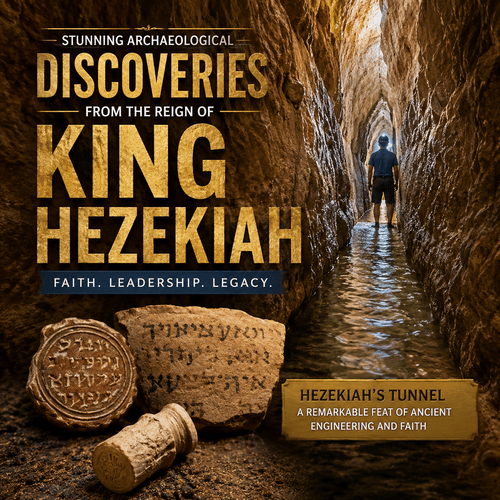
Water is the first thing a besieging army cuts off. Hezekiah’s answer was audacious: he’d hide his water supply inside the city. 2 Kings 20:20 and 2 Chronicles 32:30 record he rerouted the Gihon Spring—Jerusalem’s main source—through a tunnel into a reservoir within the walls, denying it to any attacker outside.
That tunnel is still there, and you can wade through it today. It runs roughly 1,750 feet (about 533 metres) through solid bedrock, snaking in an S-curve beneath the old City of David. Most remarkably of all, the diggers worked from both ends at once and met in the middle—an extraordinary feat of surveying for the eighth century BC.
We even have their signature. In 1880 a boy bathing in the pool spotted writing carved into the tunnel wall. Now known as the Siloam Inscription, it records, in the workers’ own words, the moment the two crews tunnelling from opposite ends heard one another’s picks through the last few feet of rock and finally met. It’s one of the oldest surviving pieces of Hebrew writing—and it confirms not just that the tunnel existed, but that it was hewn exactly as the Bible frames it: a wartime engineering project, dug under pressure. Scripture names the project; and the rock preserves the builders’ triumph.
Discovery 2—Hezekiah’s Royal Seal: The King in His Own Hand
A lump of clay carrying the king’s personal stamp—and his name.
In the ancient world, an official letter was rolled, tied with cord and sealed with a blob of soft clay pressed with the sender’s signet ring. That clay blob is called a bulla (plural bullae). The document itself rots away; the hardened clay seal can survive for thousands of years.
During the Ophel excavations beside the Temple Mount, archaeologist Eilat Mazar recovered a tiny bulla, barely a centimetre across, and in 2015 her team announced what the worn impression actually read: “Belonging to Hezekiah [son of] Ahaz, king of Judah.” For the first time, they were holding an object stamped by the personal seal of a named biblical king of Judah—not a later copy, not a chronicler’s claim, but the impression of his own ring.
The detail that makes scholars sit up is the image on it: a two-winged sun disk flanked by symbols of life. Earlier seals linked to Hezekiah carry a scarab beetle, an Egyptian-flavoured motif. The shift to a sun disk—a symbol of divine protection rather than a pagan deity—fits a king who, midway through his reign, turned decisively towards reform. Even his stationery seems to have changed when his theology did. Other bullae found nearby bear the names of court officials mentioned in Scripture, quietly confirming Hezekiah’s administration was staffed by real, named people.
Discovery 3—Sennacherib’s Prism: When the Enemy Tells Your Story
The most powerful confirmation comes not from Judah, but from Assyria’s own propaganda.
Here’s where the evidence becomes almost too good. We don’t have to rely on Judah’s account of the invasion, because Sennacherib left his own—and it survives.
The Taylor Prism is a six-sided clay cylinder, about the size of a large rolling pin, covered in tightly packed cuneiform (the wedge-shaped script of Mesopotamia). Recovered from the ruins of Nineveh and now in the British Museum, it’s Sennacherib’s official record of his campaigns, written from his point of view to glorify himself. On it, he describes his assault on Judah in 701 BC. He names Hezekiah directly. He boasts of capturing 46 of his fortified cities. And of Hezekiah himself he sneers that he shut him up “like a bird in a cage” inside Jerusalem.
Read that line again, because it’s astonishing. A bird in a cage is trapped—but a caged bird is precisely a bird you have not killed. Sennacherib, a king who carved his victories in stone in exhaustive, gloating detail, describes besieging Jerusalem and shutting Hezekiah inside it. And then the record simply stops. He never claims to have taken the city. He never claims to have deposed or captured Hezekiah. For a monarch whose entire literary purpose was to celebrate total conquest, that silence is deafening—and we shall return to why it matters.
Discovery 4—The Lachish Reliefs and the Destruction Layer: What Fell So Jerusalem Could Stand
A second city did fall—and its ruins show exactly what Jerusalem escaped.
If Sennacherib didn’t take Jerusalem, what was he capable of? The answer is carved across the walls of his own palace. Lachish was the second most important city in Judah, and Sennacherib was so proud of crushing it he commissioned an enormous series of stone panels—the Lachish Reliefs—to line a room in his Nineveh palace. They depict the siege in cinematic detail: siege ramps, archers, battering rams, captives led away, defenders impaled. This was the fate Sennacherib intended for every rebel city.
And the archaeology matches the artwork with chilling precision. Excavations at Tel Lachish, led by the archaeologist David Ussishkin, uncovered the destruction layer from 701 BC: a thick band of ash and rubble, Assyrian arrowheads and sling-stones by the hundred, and the remains of the Assyrian siege ramp—still visible on the site today, the only Assyrian siege ramp ever found. Nearby, a mass grave held the jumbled bones of around 1,500 people.
This is the discovery that makes Jerusalem’s survival so staggering. Lachish was strong, and Lachish fell in a matter of weeks under the full weight of the Assyrian machine. If that’s what happened to Judah’s second city, the obvious question presses in: what on earth stopped the same army outside the capital?
Discovery 5—The Broken Altar and the Silent Figurines: Hezekiah’s Reforms in the Ground
The Bible says Hezekiah tore down the high places. The soil of Lachish shows it happening.
The accounts of Hezekiah aren’t only about the invasion; they describe a sweeping religious reform. 2 Kings 18:4 records he removed the high places, smashed the sacred pillars, cut down the Asherah pole and even destroyed the bronze serpent that had become an object of worship. For a long time this was the sort of claim sceptics filed under “unverifiable.” Then Lachish began to give up its secrets, and three finds in particular line up with the text almost word for word.
- An altar with its horns removed. Israelite altars typically had a raised projection at each of their four corners, called a horn. At Lachish, archaeologists found a stone four-horned altar whose corners had been deliberately cut off—not weathered, not broken by accident, but cleanly amputated, after which the altar was reused as ordinary building stone. Someone had taken the trouble to decommission it. That’s precisely what a reform abolishing unauthorised worship would look like in the ground.
- Figurines that suddenly disappear. In the earlier layers at Lachish, small clay pillar figurines—popular folk-religion objects, often linked to the goddess Asherah—turn up in abundance. Then, in the layer dated to Hezekiah’s reign (Stratum III—a stratum is simply a distinct layer of occupation that archaeologists number from the top down), they sharply drop away. A whole category of idolatrous object thins out at exactly the moment the Bible says a king was stamping idolatry out. Absence, here, is evidence.
- A shrine deliberately defiled. At the city gate, excavators led by archaeologist Yosef Garfinkel uncovered a small shrine that had been put permanently out of use in a pointed way: a carved stone toilet had been installed in its holiest part. Tests showed it was never actually used as a latrine—its purpose was purely symbolic. Installing a toilet in a sacred space was a recognised way of rendering it ritually filthy and unusable for ever. It’s hard to imagine a more vivid match for a campaign to desecrate rival altars.
Taken together, these aren’t the props of a legend invented centuries later. They’re the fingerprints of a real reform, pressed into the earth of a real city.
Discovery 6—The Lachish Letters: Monotheism Under Fire
Wartime notes scribbled on broken pottery—and not one of them hedges its bets.
At Lachish, excavators found a cache of ostraca—pieces of broken pottery reused as cheap notepaper (the word is simply the Greek term for a potsherd). These particular sherds carried ink: short military messages from the fortress’s embattled life, written by officers under threat. They read like field dispatches—anxious, urgent, unmistakably real.
What’s striking for our purposes is the religion in them. Every invocation of God uses the divine name YHWH alone—the personal covenant name of the God of Israel. There are no appeals to Baal, no hedging prayers to a backup deity, none of the syncretism (the blending of different religions) you might expect in a stressed society reaching for any help it can find. Letter IV opens with the blessing “May YHWH cause my lord to hear good news.” One ostracon even preserves a practice alphabet—an abecedary (forerunners of today’s alphabet books)—evidence that even soldiers in a frontier garrison could read and write. This is exactly the religious culture Hezekiah’s reforms were designed to produce: an everyday loyalty to one God, visible not in grand temple inscriptions but in the throwaway notes of working men.
Discovery 7—The LMLK jars: evidence of a functioning state
Hundreds of stamped storage jars reveal an organised kingdom, not a backwater.
Across Judah, archaeologists keep finding storage-jar handles stamped with a small seal impression reading lmlk—four Hebrew letters meaning “belonging to the king.” (Hebrew was written without vowels, so we voice it roughly as la-melekh.) These LMLK jars were large vessels—many holding wine, oil or grain—distributed to fortified towns, Lachish among them, on the eve of the Assyrian invasion.
What they reveal is a state with reach. Stamping royal jars and stockpiling them in strategic cities is the work of a central administration organising for war: standardised containers, a recognised royal seal, a supply network spanning the kingdom. That matters, because a school of thought known as biblical minimalism long argued that Judah in this era was little more than a loose tribal chiefdom, far too primitive for the organised monarchy the Bible describes. The LMLK system says otherwise. It’s the archaeological signature of exactly the kind of functioning kingdom—capable of taxation, storage and logistics—that 2 Chronicles 32 portrays Hezekiah commanding as he braced his people for the siege.
What Sennacherib’s Silence Proves
Step back and look at the whole picture, and one feature dominates it.
Sennacherib wasn’t a modest man. His prism celebrates 46 captured cities. His palace walls glorify the fall of Lachish in loving, brutal detail. Assyrian royal inscriptions exist precisely to broadcast total victory; a defeat, or even an inconclusive result, is normally simply left out. So when we line up the evidence—the prism that names Hezekiah and catalogues his losses, the reliefs that show what a captured Judean city looked like, the destruction layer at Lachish that proves the threat was utterly real—the gap at the centre becomes thunderous. The one prize Sennacherib never claims is the one the Bible says God spared: Jerusalem.
He boasted about everything. He didn’t boast about Jerusalem. The most natural explanation for the deafening silence is that there was nothing to boast about—the city and king he’d caged simply didn’t fall.
What does this prove, and what does it not? Archaeology cannot put a spade through the moment recorded in 2 Kings 19:35, where the angel of the Lord strikes the Assyrian camp overnight and Sennacherib withdraws. No excavation can confirm a miracle as such. But what the spade can do, it has done thoroughly: it confirms the king, the reform, the invasion, the fall of Lachish, the siege of Jerusalem, the survival of the city, and even Sennacherib’s later murder by his own sons (recorded in 2 Kings 19:37 and matched precisely by Assyrian records of his assassination in 681 BC). The entire historical framework around the miracle is solid. The Bible turns out to be describing real events in a real world—which is exactly where it asks to be trusted when it tells us what those events meant.
Tough Questions, Honest Answers
What does Sennacherib’s Prism say, and does it contradict the Bible?
The Prism is Sennacherib’s own victory record. On it he names Hezekiah, claims to have captured 46 fortified towns of Judah, and says he trapped Hezekiah in Jerusalem “like a bird in a cage.” Far from contradicting Scripture, it confirms the broad shape of the biblical account: a devastating Assyrian campaign that reached the very walls of Jerusalem. The two records agree on the invasion, the king and the siege. They diverge only at the end—where the Bible reports a deliverance and the Prism, tellingly, reports no conquest of the city at all.
What happened to the Assyrian army outside Jerusalem—is there a natural explanation?
The Bible says the angel of the Lord struck the camp and the survivors withdrew (2 Kings 19:35). Some historians, noting an old tradition preserved by the Greek writer Herodotus about a plague of mice in Sennacherib’s camp, have suggested an epidemic—mice being ancient carriers of disease—swept through the army. That is plausible as a description of means, and Scripture often works through ordinary causes. But it doesn’t explain the event away. Whether God acted through a plague or otherwise, the result the Bible reports—a besieging army that suddenly broke off and went home without taking the city—is exactly the outcome Sennacherib’s own silence supports.
Why is the tribute amount different in the Bible versus the Prism?
2 Kings 18:14 records Hezekiah paying 300 talents of silver and 30 of gold; the Prism claims 800 talents of silver and 30 of gold. Notice first what they agree on: the gold figure is identical. The silver discrepancy has two straightforward explanations. Assyrian kings routinely inflated tribute figures for propaganda, and the “talent” was not a fixed weight everywhere—the Assyrian (heavy) talent differed from the Judean one, so the two numbers may partly reflect different measuring standards rather than a genuine disagreement. Two independent records lining up exactly on gold and closely on silver is a mark of authenticity, not a problem.
What is a bulla, and why does finding Hezekiah’s seal matter for historians?
A bulla is a small lump of clay used to seal a rolled document, stamped with the sender’s personal seal. Hezekiah’s bulla, identified in 2015 from Eilat Mazar’s Ophel excavations, carries the inscription “Belonging to Hezekiah [son of] Ahaz, king of Judah.” It matters because it is direct, contemporary, physical contact with a named biblical king—an object he himself caused to be made. For historians, that is about as close as the ancient world allows you to get to shaking a king’s hand.
What were the Lachish Letters and what do they reveal about religion in Hezekiah’s time?
The Lachish Letters are short military messages written in ink on potsherds (ostraca), found at the fortress of Lachish. Their significance for this era is the religion they assume: every appeal to God uses the single covenant name YHWH, with no trace of the rival deities that folk religion had mixed in. They show monotheistic devotion functioning at the ordinary, everyday level of soldiers and officials—precisely the cultural shift Hezekiah’s reforms set out to achieve.
Can these religious reforms really be dated to Hezekiah rather than his descendant Josiah?
It’s a fair question, because the Bible records a second great reform under King Josiah a century later (2 Kings 23), and sceptics sometimes argue the archaeology really belongs to him. The decisive factor is the dating of the layers. The dismantled altar, the disappearing figurines and the defiled gate shrine at Lachish all belong to Stratum III—the level destroyed by Sennacherib in 701 BC, well before Josiah was born. Whatever happened later under Josiah, this particular evidence was sealed in the ground by the Assyrian invasion itself, which anchors it firmly to Hezekiah’s reign.
Does archaeology prove the miracle in 2 Kings 19, or only the historical framework?
Only the framework—and that distinction is worth being honest about. No archaeological find can demonstrate that an angel struck the Assyrian camp; miracles by their nature sit outside what a trowel can recover. What archaeology establishes is everything around the miracle: the real king, the real reform, the real invasion, the fall of Lachish, the siege of Jerusalem, the city’s survival and Sennacherib’s later assassination. When the verifiable framework proves this reliable, the believer has solid reason to trust the account’s testimony about the one part the spade cannot reach.
Related Reads
- Is the Bible Historically Reliable? Here’s What the Evidence Shows
- Babylon Archaeology: How the Ruins Confirm Bible Accounts
- Daniel and Friends: What Their Babylonian Names Mean
- Why Did Saul Change His Name to Paul? What the Bible Actually Says
- What Does the Siloam Dam Discovery Reveal About Judah’s Kings?
- What Do the Dead Sea Scrolls Prove? The Case for Bible Reliability
- The Destruction of Tyre: How Ezekiel’s Prophecy Was Fulfilled, Stone by Stone
- Did the Hittites Exist? How Archaeology Vindicates the Bible
- The Ketef Hinnom Scrolls: The Oldest Biblical Text Ever Found
- Where Is Mount Sinai? Weighing the Candidates
- Caiaphas Ossuary: How the Finds Back Bible Reliability
- Nineveh Archaeology and the Bible: What the 2026 Digs Found
- Sodom and Gomorrah: New Evidence That Backs the Bible