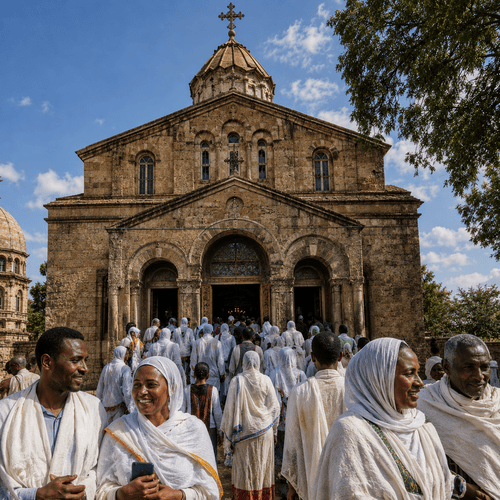
Ask almost anyone to point to “the church” and they’ll point at a building—a spire, a car park, a noticeboard by the road. But those aren’t what the New Testament authors had in mind when they chose the word ekklesia for the church.
So what’s the church, really? Not the bricks. Not the Sunday programme. Not the name on the signboard. This is a plain-English tour of what the Bible actually means by the word—where it comes from, the pictures Scripture uses to paint it, how you’d tell a true church from a counterfeit, and what the whole thing is for.
In short: the church is the assembly of people God calls out of the world to belong to Jesus Christ. It is His body, His bride, His temple—and it becomes visible wherever His Word is faithfully preached, the sacraments are rightly administered, and loving discipline is practised.
What Does Ekklesia Actually Mean?
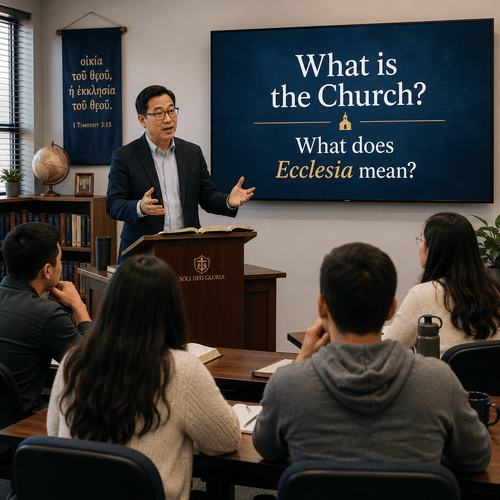
The Greek word for “church” is ekklesia (ek-klay-SEE-a), and it appears 114 times in the New Testament. It’s a compound of ek (“out of”) and a form of kaleo (“to call”). Put the two together and we get the popular rendering: “the called-out ones.”
That’s a lovely phrase—but it needs one small caution. A word’s history isn’t the same as its meaning. In ordinary Greek, ekklesia simply meant an assembly: usually the summoned body of citizens who met to run the affairs of a town. Luke uses it in exactly that everyday sense in Acts 19, where a riotous crowd in Ephesus is called an ekklesia—with no religious meaning whatsoever.
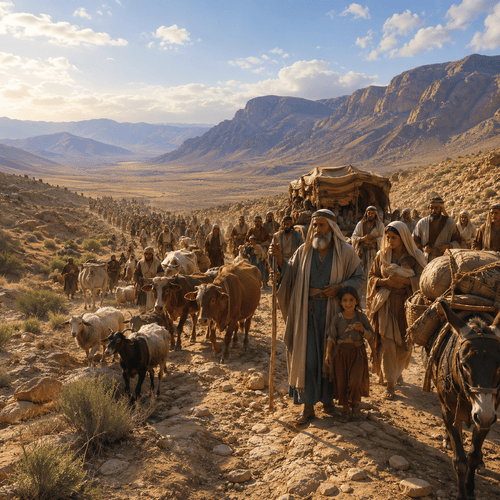
So where does the spiritual weight come from? From two places. First, from the way the New Testament handles the word. Second—and this is the key—from the Greek Old Testament. When Greek-speaking Jews translated the Hebrew Scriptures a couple of centuries BC, the word they chose for the “assembly” or “congregation” of Israel (Hebrew qahal) was ekklesia. Stephen even calls Israel in the wilderness “the congregation in the wilderness” (Acts 7:38).
That’s not a throwaway detail. It means when the apostles called the followers of Jesus the ekklesia, they were staking a claim: this is the continuation of the assembled people of God that had begun long before Bethlehem. Here’s where the word comes from at a glance:
| WORD | LANGUAGE | WHAT IT MEANS |
|---|---|---|
| ekklesia | Greek | A summoned assembly; the “called-out” gathering |
| qahal | Hebrew | The assembly or congregation of Israel |
| kyriakon | Greek | “Belonging to the Lord”—the root of the English word church |
The Church Is a People, Not a Building
Here’s a small irony. Our English word “church” doesn’t come from ekklesia at all. It comes from that third word in the table, kyriakon, meaning “belonging to the Lord.” It travelled through the Germanic languages into Old English and gave the Scots their word kirk. However we trace it, the Bible’s own word for the church is never about architecture. It’s about an assembled people who belong to the Lord.
The earliest Christians proved the point. For roughly the first three centuries AD they had no dedicated buildings at all—they met in one another’s homes, often in secret. The church was flourishing long before a single “church” was ever built. So when the New Testament says the church did this or gathered there, it always means the people, never the premises. Which quietly rearranges a few of our assumptions:
- You don’t so much go to church as belong to one.
- A congregation with no building is still fully a church; a grand building with no living faith is not.
- “Skipping church” isn’t missing an event—it’s stepping back from a people you’re joined to.
Five Pictures of the Church in Scripture
The Bible never hands us a tidy dictionary definition of the church. Instead it gives us a gallery of pictures, each capturing a different angle. Five carry most of the weight:
- The body of Christ. Christ is the head; believers are the limbs and organs (Romans 12; 1 Corinthians 12; Ephesians 1:22–23). Many different parts, wired together, dependent on one another and directed by one Head.
- The bride of Christ. Chosen, loved, cleansed and to be presented one day spotless (Ephesians 5:25–27). Note the “we,” not “me”—it’s the church together who is the bride, not each believer individually.
- The temple of the Spirit. Built on Christ the cornerstone, with God Himself now dwelling in His people rather than in a structure of stone (Ephesians 2:19–22; 1 Corinthians 3:16–17).
- The family of God. Adopted children who call God “Father” and one another brothers and sisters (Romans 8:15–17; Galatians 4:4–5). This isn’t a club we join—but a household we’re born into.
- The flock. Christ is the good Shepherd; pastors and elders are under-shepherds who watch over the sheep (John 10; 1 Peter 5:2). A picture of both tender care and real oversight.
No single image says everything. Held together, they tell us the church is relational, corporate, holy, cherished and led—never a lone individual, and never merely an institution.
Visible and Invisible, Universal and Local
Two old distinctions clear up most of the confusion people feel about the church. They sound technical, but they’re genuinely useful:
| TERM | MEANING |
|---|---|
| The invisible church | Everyone God has truly saved, across all of history—known infallibly only to him. |
| The visible church | The professing community we can actually see on earth: a mixture of true believers and hangers-on. |
| The universal church | The one worldwide body of Christ, spanning every nation and century. |
| The local church | A particular congregation gathered in one place—the church on our corner. |
The visible/invisible distinction is the one that saves a lot of heartache. Jesus said the field would grow wheat and weeds together until the harvest (Matthew 13). That’s why even a healthy church contains people who aren’t truly converted—and why a church’s failures never disprove the reality of the one, true, worldwide people of God. When you meet on Sunday you’re a local, visible church; you’re also part of something you can’t see the edges of.
How Do You Recognise a True Church? The Three Marks
If thousands of institutions call themselves “church,” how do you spot a real one? The 16th-century confessions gave one of the most practical answers ever written. They pointed to three marks—three things you can actually observe from the outside:
| MARK | WHAT IT MEANS | KEY TEXTS |
|---|---|---|
| The Word rightly preached | The true gospel proclaimed—and genuinely heard and received, not just recited | 2 Timothy 4:2 |
| The sacraments rightly administered | Baptism and the Lord’s Supper, kept exactly as Christ instituted them | Matthew 28:19; Luke 22:19 |
| Discipline faithfully exercised | Sin lovingly confronted and the wayward gently restored | Matthew 18:17; 1 Corinthians 5 |
The first mark is the anchor. Where the Word is truly preached, Christ is present; where it’s lost, the church dies—no matter how full the car park. John Calvin sharpened the point: preaching alone isn’t enough. A man proclaiming the gospel on a street corner isn’t a church; the Word has to be preached and received by a gathered people who answer back in faith.
A little history most articles skip: Calvin himself actually named only two marks—the Word and the sacraments. He prized discipline—he called it the “sinews” that hold the body together—but treated it as something that protects the marks rather than a mark in its own right. It was later hands, Theodore Beza among them, and the confessions such as the one drafted by Guido de Brès, that set discipline down as the settled third mark. The same confession draws a bracing contrast between the true church and the false:
| A TRUE CHURCH… | A FALSE CHURCH… |
|---|---|
| Bows to the Word of God as its final authority | Puts its own authority above the Word |
| Keeps the sacraments exactly as Christ gave them | Adds to them or subtracts from them at will |
| Disciplines sin in love | Tolerates sin and leans on human tradition |
| Points people to Christ | Persecutes those who call it back to Christ |
None of this is about arrogance or scoring points off other congregations. The question the marks are really asking is humble and personal: Where am I called to belong?
One People Across the Ages: The Church and Israel
Here’s a question that trips up a lot of readers: when did the church begin? At Pentecost, with the rush of the Spirit in Acts 2? Or earlier?
The best answer follows the storyline of one people of God running right through the Bible. There’s a single, unfolding covenant of grace, and the believing remnant of Israel wasn’t swapped out for a brand-new organisation. On the day of Pentecost, believing Israel became the New Testament church, and believing non-Jews were welcomed in. The apostle Paul gives us the image: one olive tree, with some natural branches broken off through unbelief and wild branches (the nations) grafted in (Romans 11). Not two trees—one.
Trace the single story and it looks like this:
- Abraham. God calls one man and promises to bless the whole world through his offspring.
- Israel. The qahal—the assembled covenant people—is formed and gathered around God’s Word.
- Christ. The true Israel arrives and fulfils every promise (Galatians 3:16).
- Pentecost. The Spirit is poured out; believing Israel becomes the New Testament church.
- Now. People from every nation are grafted into the one olive tree.
So the church isn’t God’s Plan B after Israel “failed.” It’s the flowering of the promise He made to Abraham in the first place—which is why the older confessions can speak of the church as existing “from the beginning of the world.” This isn’t the church crudely “replacing” Israel; believing Israel is the root, and the nations are the branches brought in. Everyone united to Jesus by faith belongs to the same ancient, worldwide family.
So What Is the Church For?
If the church is a people rather than a place, what’s that people meant to do? Three purposes stand out:
- Worship. To gather around God and give him glory—a kind of dialogue in which he speaks through his Word and his people respond in praise, prayer and obedience.
- Building one another up. To grow believers towards maturity, bearing each other’s burdens and spurring one another on (Ephesians 4). You need the church, and the church needs you.
- Mission. To carry the good news out to a watching world (Matthew 28:19–20; 1 Peter 2:9). The church is gathered on Sunday so it can be scattered on Monday.
The Church That Cannot Fail
So the next time someone gestures at a building and calls it “the church,” you’ll know the fuller story. The church is people—called out, gathered, loved and owned by Jesus. It’s His body, His bride, His temple and His flock, stretching across every nation and every century. Not a building, not a brand, not an optional extra to a private faith.
And it’s indestructible. When Jesus first used the word ekklesia, He attached a staggering promise to it: “I will build my church, and the gates of hell shall not prevail against it” (Matthew 16:18). He is the one building it, and nothing—not persecution, not scandal, not death itself—can bring it down. The wisest thing any of us can do is find the truest expression of that people we can, and belong to it wholeheartedly.
Tough Questions, Honest Answers
Do we have to go to church to be Christians?
We’re saved by trusting Christ, not by attending meetings, so church attendance doesn’t earn our salvation. But the New Testament knows nothing of the do-it-yourself Christian who deliberately stays away from other believers. When Jesus saves someone, He places them into a body, and Scripture urges us not to give up meeting together (Hebrews 10:25). Watching a service on a screen while avoiding the actual gathered people of God isn’t the Christian life the Bible describes. If we belong to Christ, we belong to His people—and that tends to show up in turning up.
What’s the difference between a church and a denomination?
A church, in the biblical sense, is a gathered congregation of believers—or the worldwide body of all of them. A denomination is a family of congregations that share the same beliefs, structure and oversight, such as Baptists, Presbyterians or Anglicans. Denominations aren’t found in the New Testament as such; they emerged over the centuries as Christians organised themselves and, sadly, divided over doctrine. A denomination can be a healthy way of keeping churches accountable to a shared confession, but it’s never the same thing as the church itself. The church is the people who belong to Christ, whatever the letterhead says.
What does “catholic” mean in “the holy catholic church”?
When the old creeds confess belief in the “holy catholic church,” the word catholic simply means universal—it has nothing to do with the Roman Catholic Church specifically. It’s a way of saying the true church isn’t confined to one nation, era or building, but stretches across every continent and every century. Christians of almost every tradition happily use the word in this original sense. So when we say it in a service, we’re affirming we belong to something far bigger than our local congregation. The small “c” makes all the difference.
Is the Roman Catholic Church a true church?
This is where the three marks earn their keep, and thoughtful Christians answer it in different ways. Many would say that wherever the genuine gospel is heard and people trust Christ, real believers are found—including within Roman Catholicism. At the same time, the historic Protestant concern is that official Roman teaching on justification, on tradition standing alongside Scripture, and on the number of the sacraments departs from the biblical marks of a true church. So the usual answer is a careful one: God plainly has His people there, yet the institution’s official doctrine is judged to fall short at crucial points. It’s a question best handled with humility rather than slogans.
What’s the difference between the church and the kingdom of God?
The kingdom of God is God’s reign—His rule breaking into the world through King Jesus. The church is the community of people who’ve bowed to that rule and now live under it. The two overlap but aren’t identical: the kingdom is broader, because God’s reign extends over all things, while the church is the people who gladly own Him as King. Think of the church as the present outpost and sign of the kingdom, the place where God’s rule is visibly welcomed. If the kingdom is the “what,” the church is the “who.”
Why are there so many different churches?
Some of the differences are harmless—language, culture, music, location—and simply reflect the fact that the one church shows up in thousands of local forms. Others are more serious, dividing Christians over doctrine, worship and how churches ought to be governed. Much of this traces back to real disagreements about what the Bible teaches, and some of it, honestly, to plain human pride. It’s worth remembering the unity the New Testament calls for is unity in the truth, not an agreement to ignore it. The goal was never one giant institution, but local congregations that faithfully bear the marks of a true church.
Can a group meeting in a home really be a church?
Yes—in fact, that’s exactly how the earliest churches met for the first few centuries. A church isn’t defined by a building, a certain size or a paid minister, but by whether Christ’s people are gathered around His Word, the sacraments and godly oversight. A home group that has these things is a church; a grand cathedral that has abandoned the gospel is not. Size and setting are beside the point. What matters is whether the marks are present and Jesus is honoured as the Head.
Related Reads
- Is the Church the New Israel? Fulfilment, Not Replacement
- Is the Church a Building or the People? What the Bible Says
- What Are the Marks of a True Church?
- What Does “One Holy Catholic Church” Mean?
- The Visible vs Invisible Church: Understanding the Critical Difference
- Church and Kingdom of God: What’s the Difference?
- Baptism and the Lord’s Supper: Why the Sacraments Truly Matter
- Is Social Justice the Mission of the Church?
- Is Apostolic Succession Biblical?
- The Keys of the Kingdom: What Did Jesus Give the Church?
- What Does It Mean That the Church Is the Body of Christ?
- What Does It Mean That the Church Is the Bride of Christ?
- When Did the Church Begin—At Pentecost, or Long Before?
- Household of God: What It Means to Belong to the Church
- Congregational, Presbyterian, Episcopal: Forms of Church Government Compared