We used to leave the traits of our children to a roll of the genetic dice. Today we hand parents the loaded dice and ask them to choose. That, stripped of its gentler language, is what embryo selection offers: a clinic, a cluster of embryos, a screen full of genetic data, and a decision about which of those tiny lives will be transferred and given the chance to grow—and which will not.
The technology sits under a reassuring heading. “Healthy IVF.” “Family balancing.” “Peace of mind.” Few phrases in modern medicine are as warm, or as quietly loaded, as the promise of a healthy baby. Who could object to health? Who’d wish illness on a child?
But the word healthy does an enormous amount of work here, and it’s worth slowing down to ask what it actually means, what it costs, and who gets to decide. This isn’t a scare story about science. It’s an invitation to look honestly at a practice that thousands now treat as routine, and to notice the moral questions we’ve quietly learned to walk past.
What embryo selection actually involves
Before we weigh the ethics, we should be clear about the mechanics, because the debate often runs on assumptions rather than facts.
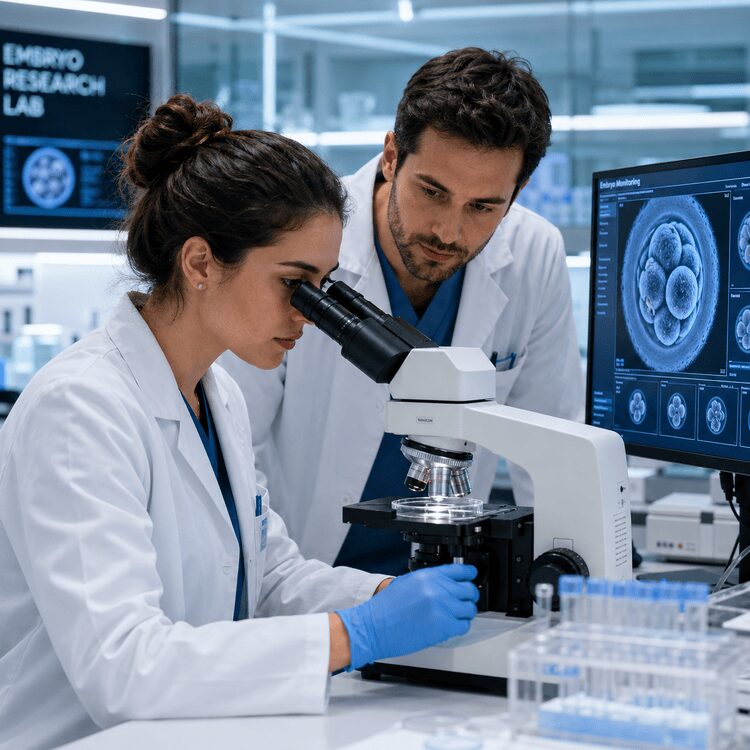
In standard in vitro fertilisation, eggs are retrieved, fertilised in the laboratory, and grown for a few days. Where selection is involved, a handful of cells are removed from each embryo and tested. The clinic then ranks the embryos, transfers the ones judged best, and either freezes or discards the rest.
The testing goes by the umbrella name preimplantation genetic testing, or PGT, which comes in several forms:
| TEST | WHAT IT LOOKS FOR | TYPICAL USE |
|---|---|---|
| PGT-M (monogenic) | A single faulty gene, such as cystic fibrosis or Huntington’s disease | Couples carrying a known inherited condition |
| PGT-A (aneuploidy) | The wrong number of chromosomes | Screening for viability, often for older mothers |
| PGT-SR (structural) | Chromosome rearrangements inherited from a parent | Parents with a known translocation |
| PGT-P (polygenic) | Statistical risk scores drawn from many genes at once | Newer and contested: predicting diabetes, height, even intelligence |
Two things follow from this that are easy to miss.
First, selection always implies rejection. To choose one embryo is to set others aside. In practice this means large numbers of human embryos are created, examined, graded, and then frozen indefinitely or destroyed. The clean word “selection” hides a harder reality.
Second, the newest frontier—polygenic scoring—doesn’t test for disease in any straightforward sense. It generates a statistical probability that a future adult may develop a common condition, or may be shorter, or may score lower on a test. These aren’t diagnoses. They’re odds. And increasingly they’re odds attached to traits that have nothing to do with sickness at all.
That shift, from screening out a fatal childhood illness to nudging the odds on height or intelligence, is where much of the unease begins. But even the simplest cases raise questions we tend to skip.
The question we skip: what’s an embryo?
Every argument about embryo selection eventually circles back to one prior question, and most public discussion avoids it. What’s the embryo we’re selecting?
If the embryo is merely a clump of cells, a biological resource no more significant than a tissue sample, then selecting and discarding embryos is no more troubling than choosing the best seedlings in a tray. The whole ethical weight collapses.
But that’s not what the embryo is. From the moment of fertilisation, the embryo is a distinct, living human organism with its own complete genetic identity—not a part of the mother’s body, not a merely potential human, but a human at the earliest stage of the only kind of life any of us has ever had. We were once embryos. So was every person we love.
The biblical picture presses this home. The Psalmist writes, For you formed my inward parts; you knitted me together in my mother’s womb (Psalm 139:13). God says to the prophet, Before I formed you in the womb I knew you (Jeremiah 1:5). Scripture doesn’t treat the beginning of a human life as a gradual dimmer switch, with dignity fading in somewhere around the second trimester. It treats the unborn as already known, already addressed, already the object of God’s personal attention.
This is the hinge. If the human embryo bears the image of God—So God created man in His own image (Genesis 1:27)—then it possesses a dignity that doesn’t depend on its size, its stage, its health, or its usefulness to anyone else. And that dignity cannot be graded on a screen.
Notice what this does to the conversation. The question is no longer simply “how do we get the healthiest baby?” It becomes “on what basis do we decide that some human lives are worth transferring and others worth discarding?” That’s a far older and graver question than any fertility clinic advertises.
From gift to product
Set the moral status of the embryo aside for a moment, and a second problem remains—one that touches every parent, whatever their beliefs.
Theologian Oliver O’Donovan captured it decades ago in the title of a small, prophetic book: Begotten or Made? His point was the deep difference between a child who is begotten—received as an equal, a gift, someone who simply arrives—and a child who is made, produced to a specification and evaluated against a standard set by someone else.
Philosopher Michael Sandel, writing from outside any Christian commitment, reached a strikingly similar conclusion in The Case Against Perfection. He argued the deepest danger of genetic selection isn’t injustice but the loss of what he called an openness to the unbidden—the willingness to welcome children as they come rather than as products of our will and design.
This is worth sitting with, because it reframes the whole enterprise:
- The old posture was reception. A child came, and we loved the child we were given.
- The new posture is selection. A child is chosen from a set of candidates, according to criteria, and the ones who fall short are set aside.
The relationship changes at the root. When a child must first pass a screening to be transferred, the parent has quietly shifted from host to buyer, and the child from gift to acquisition. Even where the intentions are loving—and they usually are—the structure of the act teaches something: that our children are ours to design. That acceptance is conditional on meeting a standard, and that the measure of a life is its genetic quality.
Scripture speaks a flatly opposing word. Behold, children are a heritage from the Lord, the fruit of the womb a reward (Psalm 127:3). A heritage is received, not manufactured or chosen. A reward is given, not specified in advance.
The word “healthy” and the shadow of eugenics
Return now to that soothing word: healthy.
Nobody wants their children to suffer. The desire to spare a son or daughter from a cruel, painful, life-shortening disease isn’t sinister—it’s love. Christians of all people should have deep sympathy for a couple who carry a devastating genetic condition and dread passing it on.
But “healthy” is a moving line, and history should make us cautious about who holds the pen.
The 20th century’s eugenics movements—on both sides of the Atlantic, and most horrifically in Nazi Germany—began with the same reasonable-sounding premise: that human suffering could be reduced by managing which human beings were allowed to be born. They didn’t start with death camps. They started with charts, statistics, and confident experts deciding which lives were worth living. Philosopher Robert Sparrow and others argue modern embryo selection, whatever its intentions, revives the core eugenic logic in a gentler, privatised, consumer-friendly form. The state no longer coerces; the market simply offers. But the underlying move—ranking human lives by desirability—is unnervingly familiar.
Polygenic scoring sharpens the worry to a point. Once we can generate a risk estimate not just for cystic fibrosis but for depression, obesity, short stature, or predicted intelligence, the definition of a good embryo drifts steadily away from medicine and towards preference. Consider how quickly the frame slides:
| WHERE IT STARTS | WHERE IT DRIFTS |
|---|---|
| Avoiding a fatal childhood disease | Avoiding a manageable adult condition |
| Screening out serious illness | Screening out perceived disadvantage |
| Health | Enhancement |
| A well child | A “better” child |
None of these steps announces itself as a step. Each feels like a small, caring extension of the last. That’s precisely how a line moves without anyone deciding to move it.
And there is one group of people who hear this whole conversation with particular clarity, because it is, in a sense, about them.
What about those we would have screened out?
There are people around us today living with conditions that embryo selection is designed to eliminate. Ask them what they hear in the phrase “healthy baby”: the answer may be sobering.
Disability rights advocates have long made what philosophers call the expressivist objection: that selecting against embryos with a given trait sends a message—not only about that trait, but about the people who live with it. When a society builds an entire industry around screening out a condition, it communicates, however unintentionally, that lives lived with that condition are lives it would rather not have.
People with Down’s syndrome and their families have voiced this most powerfully, as prenatal screening in some countries has driven their birth rate towards zero. They’re not abstractions. They’re neighbours, friends, church members, image-bearers—often living lives of evident joy and worth that the screening logic simply cannot see, because it measures the wrong things.
Here Scripture is bracing. When Moses protested his own inadequacy, the Lord answered, Who has made man’s mouth? Who makes him mute, or deaf, or seeing, or blind? Is it not I, the Lord? (Exodus 4:11). The Bible refuses to treat disability as a mere defect to be engineered away. It locates every human life, in all its fragility, within the purpose of a God who doesn’t measure worth by capability.
This isn’t to dismiss the real anguish of genetic disease. It’s to insist that the people we might have “selected against” are the very people whose dignity the whole debate is meant to protect.
A word to the couple who longs for a child
It would be a failure of honesty—and of compassion—to end without turning to the people for whom this isn’t a debate but a heartache.
Infertility is a grief that many carry in silence. The longing for a child is good, God-given, and woven into the human story from its opening chapters. Couples who walk into a fertility clinic are almost never villains chasing designer babies; they’re usually exhausted, hopeful people who’ve wept in waiting rooms and want, more than anything, to hold a child of their own. Any Christian ethic worth the name must begin there, with tenderness rather than a wagging finger.
So the questions worth asking aren’t accusations. They’re the questions a good friend might raise:
- What happens to the embryos we don’t choose? Are they frozen indefinitely, discarded, or given a chance at life?
- Are we screening to avoid genuine suffering, or to secure a preference? The two feel similar and aren’t the same.
- Have we quietly moved from receiving a child to specifying one? And do we notice the difference?
- Is there another path? Adoption, embryo adoption, or treatment that doesn’t create surplus embryos to be graded may honour both the longing and the lives involved.
These are hard questions precisely because the desire behind them is holy.
Where this leaves us
The promise of “healthy IVF” isn’t a lie, exactly. The technology can, in some cases, spare real suffering. But the word healthy has been asked to carry a moral weight it cannot bear, and behind it stands a set of decisions we’ve largely declined to examine.
We’re, as a culture, learning to treat the beginnings of human life as a product line—designed, graded, selected, discarded—while telling ourselves the whole thing is simply care. It may be time to notice what we’re practising, and what it’s teaching us to believe about one another.
The Christian conviction is neither sentimental nor cruel. It’s this: that every human life, from its first cell, bears the image of the God who made it; that children are gifts to be received rather than products to be specified; and that a life’s worth was never ours to grade.
Hold that conviction, and the loaded dice starts to look less like a gift to parents and more like a burden no one should have to carry.
Tough Questions, Honest Answers
Is all IVF wrong, then?
Not everyone who holds these convictions reaches the same conclusion. The sharpest ethical problem is not IVF as such, but the routine creation of surplus embryos that are then graded, frozen indefinitely, or destroyed. Some couples pursue IVF in ways that limit this, fertilising only as many eggs as they intend to transfer. The technology and the ethics are separable, and the details matter enormously.
Isn’t preventing a fatal disease obviously good?
Preventing suffering is a good aim. The difficulty is the method: embryo selection does not treat or cure a sick child, it identifies and discards embryos predicted to be affected. The goal is compassionate; the means involves ending some human lives to spare others. That is the tension the phrase “healthy baby” conceals.
What’s the difference between screening and eugenics?
Historically, less than we like to think. Eugenics meant improving the human stock by controlling who is born. Modern selection is voluntary and privatised rather than state-enforced, which is a real moral difference, but the underlying logic of ranking lives by desirability is the same, which is why many ethicists urge caution.
Aren’t polygenic risk scores just good medicine?
They are far shakier than they sound. A polygenic score gives a statistical probability, not a diagnosis, and for traits such as intelligence or height it explains only a fraction of the outcome. Selecting embryos on such scores means discarding real human lives on the strength of uncertain odds about an imagined future.
Does the Bible say anything directly about embryos?
Not by name, since the technology is new. But it speaks plainly about the unborn. Passages such as Psalm 139 and Jeremiah 1:5 treat human life in the womb as personally known by God from the very start, which is why Christians have consistently extended that dignity to the embryo.
What about embryos already frozen in storage?
This is one of the quiet tragedies of the practice: vast numbers of embryos sit in indefinite storage. Embryo adoption, where a couple carries and raises a child from a donated embryo, has emerged as one response that treats these lives as children rather than surplus.
How should a Christian respond to friends considering this?
With compassion first. Most people facing these choices are grieving, not scheming. The kindest thing isn’t a lecture but honest questions: about what happens to the embryos not chosen, and about whether the longing for a child can be met in a way that honours every life involved.
Related Reads
- Should Christians Use Prenatal Screening If We’d Never Abort?
- When Is a Person Really Dead? The Brain-Death Debate
- Embryo Adoption: Does It Align with God’s Design for Families?
- The Hidden Costs of IVF: What Fertility Clinics Don’t Tell You
- At Conception or First Breath: When Does Human Life Begin?
- Christian Views on Genetic Engineering: A Biblical Framework for CRISPR