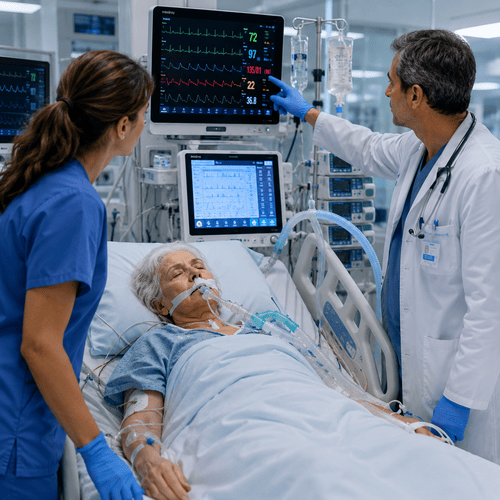
Walk into a modern intensive care unit, and you may find yourself looking at a physiological paradox: a warm body that’s breathing, a monitor displaying a steady heartbeat, and a medical chart that declares the patient is a corpse.
The chest rises and falls. The skin is warm to the touch. Take the wrist and you will feel a pulse. And yet the doctors aren’t being cruel or careless when they tell the family, gently, that their loved one has already died. According to the law of the land and the settled practice of modern medicine, the person on that bed is dead—as dead as if the heart had stopped days ago.
How can both things be true at once? This is the heart of the brain death debate, and it sits on one of the most unsettling questions a human being can ask: when is a person really dead? Not almost dead. Not dying. Dead.
The moment the old definition broke
For most of human history, death announced itself plainly. The breathing stopped, the heart fell silent, the body grew cold. We didn’t need specialists to tell us what had happened. Then, in the middle of the 20th century, the machines arrived.
The ventilator could push air into the lungs long after patients had lost the ability to breathe for themselves. Suddenly doctors could keep a body’s heart beating and its blood flowing even when the brain had been destroyed. The old signposts of death still pointed somewhere—but they no longer pointed to the same place. A new question forced itself onto the profession: if a machine is doing the breathing, and the heart beats only because we’re feeding it oxygen, is the patient alive, or are we merely ventilating a body whose owner has already gone?
What “brain death” actually means
Brain death isn’t a deep coma. It’s not a bleak state from which someone might, against the odds, wake up. It’s the complete and irreversible loss of all function of the brain—including the brainstem, the primitive control centre that keeps us breathing and governs the most basic rhythms of life.
Two slightly different definitions are used around the world:
- Whole-brain death (the standard in the US): the entire brain, both the higher regions and the brainstem, has permanently ceased to function.
- Brainstem death (the standard in the UK): the brainstem itself is irreversibly destroyed. Because nothing can pass through a dead brainstem—no breathing, no consciousness, no reflexes—UK practice treats this as the death of the person as a whole.
Christopher Pallis, the neurologist who shaped British thinking on this, argued the brainstem is the through-station for both consciousness and breathing. Destroy it, and the person can never again be awake or draw a breath unaided.
To confirm the diagnosis, doctors run a strict battery of tests: no pupil response to light, no gag or cough reflex, no reaction to pain, and—most tellingly—an apnoea test, in which the ventilator is briefly removed to see whether the body will make any attempt to breathe on its own. If there’s nothing, the diagnosis stands.
What brain death is not
People often confuse brain death with several conditions that look similar from the bedside but are worlds apart. The differences aren’t academic—they’re the difference between a person who has died and a person who is still very much alive.
| Condition | What is happening | Consciousness | Breathe alone? | Recovery? |
|---|---|---|---|---|
| Coma | The brain is alive but deeply “switched off”; the brainstem often still works | Absent, but the capacity remains | Sometimes | Yes, often |
| Vegetative state | Sleep–wake cycles return and the eyes may open, but there’s no awareness | Absent | Yes | Sometimes, especially early |
| Locked-in syndrome | The person is fully awake and aware but almost completely paralysed | Fully present | Sometimes | Awareness intact; movement limited |
| Brain death | The entire brain, brainstem included, has permanently ceased | None, permanently | No, never | No |
The one to sit with is locked-in syndrome. Here’s a fully awake, thinking, feeling person trapped inside a motionless body, sometimes able to communicate only by blinking. It’s the polar opposite of brain death—and a sobering reminder of why the diagnosis of death must be made with such rigour. Get it wrong in either direction, and the consequences are unthinkable.
Why does the heart keep beating?
If the brain is dead, why does the heart carry on? The answer is one of the quiet marvels of how we’re made.
Unlike almost every other organ, the heart doesn’t wait for orders from the brain to beat. It has its own built-in pacemaker—a cluster of cells called the sinoatrial node—that generates its own electrical rhythm. Give the heart oxygen, and it will keep beating on its own initiative, brain or no brain.
That’s exactly what a ventilator provides. It cannot think, feel or restore a single thought, but it can force oxygen into the lungs, which the beating heart then pumps around the body. The result is the eerie scene we began with: a body that looks alive in every visible way, sustained by a machine, while the organ that made the person who they were has gone dark.
So, no—a brain-dead person cannot hear us, cannot feel our hand, cannot dream. There’s no “someone” left inside to do the hearing. The warmth and the heartbeat are real, but they’re borrowed from the machine, not signs of a life still flickering.
How we got here
The idea that a person could be dead while their heart still beat did not arrive gently. It had to be argued into existence.
- 1959: French neurologists Pierre Mollaret and Maurice Goulon describe coma dépassé—“a state beyond coma”—in patients on ventilators whose brains had utterly ceased. The puzzle finally has a name.
- 1968: A committee at Harvard Medical School, chaired by Henry Beecher, publishes a landmark report proposing “irreversible coma” as a new criterion for death. The Harvard criteria are born.
- 1976–1979: The UK formalises the brainstem death standard, later refined by Christopher Pallis, defining death by the irreversible loss of brainstem function.
- 1981: The US passes the Uniform Determination of Death Act, giving legal force to both cardiac and whole-brain criteria for death.
- 2008: The US President’s Council on Bioethics revisits the whole question in a major report, conceding the concept is harder to defend than once assumed—yet reaffirming it.
Notice something uncomfortable in that timeline. The Harvard committee was candid that one of its aims was practical: ventilators were filling intensive care beds with patients who’d never recover, and a new definition of death would also make it possible to retrieve organs for transplantation while they were still viable. That doesn’t make the criteria wrong—but it does mean that, from the very beginning, the definition of death and the demand for transplantable organs were entangled. Critics have never stopped noticing.
Is brain death legally dead? Yes.
Legally, the matter is settled. In the UK, the US and most of the world, a person correctly diagnosed as brain‐ (or brainstem‐) dead is legally, medically dead. A death certificate can be issued. Ventilation can be withdrawn. Organs may, with consent, be donated. In law there’s no difference between this death and any other.
Which is precisely why the lingering ethical unease is so striking. The law has moved on. A good number of thoughtful doctors, philosophers and theologians haven’t.
The debate that will not go away
For decades the standard justification for brain death was elegant. The brain, it was said, is the body’s great integrator—the conductor of the orchestra. Lose it, and the body is no longer a unified organism but a collection of parts destined to fall apart within hours or days.
Then came the cases that simply wouldn’t fit.
Neurologist D Alan Shewmon gathered and studied records of patients who’d been correctly diagnosed as brain dead and yet, with support, didn’t fall apart. They maintained their body temperature, fought off infections and healed their wounds. In his most famous case, a boy known as “TK” was declared brain dead as a child, and yet his body survived, on a ventilator at home, for more than twenty years. He even grew through puberty.
This was devastating to the tidy theory. If a brain-dead body can grow, heal and mature over decades, the brain is plainly not the only thing holding the organism together. The body is doing a great deal of “integrating” entirely on its own.
Bioethicist Robert Truog went further, arguing brain death, as usually justified, is simply not coherent—and that we have quietly kept the label because our whole system of organ donation depends on it. The 2008 President’s Council on Bioethics felt the force of this and tried to rescue the concept with a fresh rationale: the brain-dead patient, they said, has lost the fundamental “commerce with the surrounding world”—the drive to breathe, to seek, to engage—that marks a living organism. Whether that redefinition truly settles the matter is still argued today.
So the honest state of the debate is this. Brain death is legally secure and clinically useful, yet its deepest philosophical foundations remain genuinely contested. People raising the hardest questions aren’t cranks. They’re neurologists and ethicists who’ve looked closely and aren’t persuaded the emperor is fully clothed.
What Scripture actually says
Where does the Bible fit into a debate about ventilators and brainstems? It doesn’t, of course, hand us a checklist for the intensive care unit. It does something more foundational: it tells us what a human being is, and therefore what death is.
From the very first pages, Scripture describes the making of a living person as God joining dust and breath: then the LORD God formed the man of dust from the ground and breathed into his nostrils the breath of life, and the man became a living creature (Genesis 2:7). A human being, in the Bible’s account, is neither a soul trapped in a machine nor a machine that imagines it has a soul. We’re an embodied unity—dust and breath, body and spirit, held together.
Death, correspondingly, is a coming-apart of what God has joined. At the grave the Preacher writes: and the dust returns to the earth as it was, and the spirit returns to God who gave it (Ecclesiastes 12:7). James puts it starkly: For as the body apart from the spirit is dead, so also faith apart from works is dead (James 2:26). Death, biblically, is the departure of the spirit—the moment the God-given animating principle leaves the body behind.
This is where the debate suddenly looks less like a purely medical question and more like a mystery. Doctors can measure reflexes, blood flow and electrical activity. They cannot put a probe on the soul. When Scripture says the spirit “returns to God,” it doesn’t tell us to look for that moment on a monitor. It leaves the precise instant of departure in God’s hands—known, finally, to Him alone.
Two convictions follow, and they pull gently in different directions:
- Take the body seriously. Because we’re embodied creatures, not ghosts, a warm and breathing body is never “just meat”. It commands respect and care—a healthy check on any coldness that would treat a patient as a mere organ farm.
- Do not mistake biology for the whole person. Because a human being is body and spirit together, the persistence of a heartbeat isn’t, by itself, proof the person is still present. A body can be maintained after the person, biblically speaking, may already have departed.
Scripture, in other words, neither rubber-stamps nor rejects the brain-death criteria. It refuses to let us be careless in either direction.
So where does that leave a grieving family?
At the bedside the abstractions fall away, and one question remains: what do we do? A few honest bearings:
- Certainty of the diagnosis comes first. Brain death must be established rigorously, by more than one experienced doctor, using the full battery of tests—never rushed, never swayed by anyone’s need for an organ. The “dead donor rule”, that organs are taken only from those who’re genuinely dead, exists for exactly this reason and must never be quietly bent.
- Honesty about mystery is a virtue, not a weakness. It’s entirely reasonable for a Christian family to accept a careful brain-death diagnosis as the end of earthly life—and equally reasonable to feel the weight of the mystery and grieve a body that is still warm. Both responses can be faithful.
- Organ donation can be a genuine act of love—the giving of life to another—provided it rests on an honest diagnosis and free consent, and never on redefining death to suit demand.
- The person was never the machine. Whatever the monitors show, our hope for those we love has never rested on a heartbeat. It rests on the God to whom the spirit returns, and on the promise of resurrection for the body that is laid down.
The brain-death debate will not be tidied up any time soon. Good and serious people still disagree about where exactly the line falls. Perhaps that unease is fitting. Death is the last enemy, and it was never going to surrender its secrets neatly to a machine at the bedside. We’re right to approach it with rigour, with humility, and with the quiet confidence that the moment no monitor can capture is held, even now, in the hands of the One who gave the breath in the first place.
Tough Questions, Honest Answers
What is the difference between a coma and brain death?
A coma is a state of deep unconsciousness in which the brain is still alive and, often, the brainstem still works—which means recovery remains possible. Brain death is the complete and permanent loss of all brain function, brainstem included. A person in a coma may wake up; a brain-dead person, by definition, never will.
Can a brain-dead person hear you?
No. Hearing requires a working brain to receive and interpret sound, and in brain death the brain has permanently ceased to function. There is no consciousness and no awareness. Speaking to a brain-dead loved one may bring real comfort to the family, but the person themselves cannot hear, feel or respond.
Why does the heart keep beating after brain death?
The heart has its own internal pacemaker and does not need the brain to beat—only a supply of oxygen. A ventilator provides that oxygen artificially, so the heart carries on pumping even though the brain is gone. The heartbeat is being sustained by the machine, not by any remaining life in the brain.
Is brain death the same as a vegetative state?
No, and the difference is crucial. A person in a vegetative state has lost awareness but retains a functioning brainstem: they can breathe on their own, may have sleep–wake cycles, and some recover. A brain-dead person has no brain function at all, cannot breathe unaided, and will not recover.
Is brain death legally recognised as death?
Yes. In the UK, the US and most countries, a correctly diagnosed brain (or brainstem) death is legally and medically death. A death certificate can be issued, life support can be withdrawn, and organ donation may proceed with consent. In law there is no difference between this and death by any other means.
Can someone recover from brain death?
No. By definition, brain death is irreversible—the brain tissue has been destroyed and cannot regenerate. Dramatic “recovery” stories almost always turn out to be misdiagnosis, where the patient was in a coma or another severe but survivable state rather than truly brain dead. That’s precisely why rigorous testing matters so much.
Does the Bible say when a person is truly dead?
Not in clinical terms. Scripture describes death as the spirit departing and returning to God (Ecclesiastes 12:7; James 2:26), and it treats a human being as a unity of body and spirit. It does not tell us to read that moment off a monitor. Instead it calls us to handle the body with respect, to avoid careless judgements in either direction, and to trust the timing to God.
Related Reads
- Selecting Embryos: The Hidden Ethics of “Healthy” IVF
- Should Christians Use Prenatal Screening If We’d Never Abort?
- Can Christians Be Organ Donors? Biblical Wisdom for Our Times
- End-of-Life Choices: Is Assisted Suicide Ever the Answer?
- End-of-Life Decisions: Can a Christian Choose Cremation Over Burial?
- Christian Views on Genetic Engineering: A Biblical Framework for CRISPR