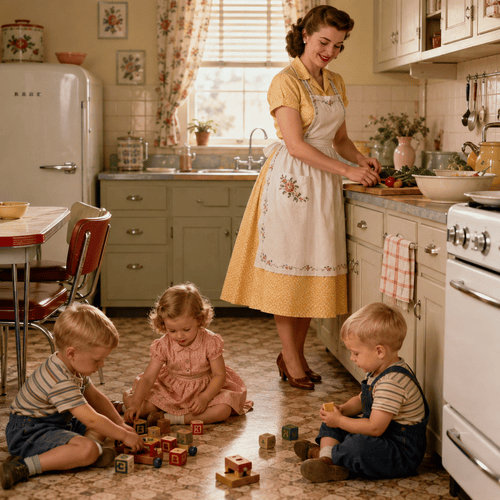
&Scroll through social media today, and you’ll meet her again and again: a calm, smiling woman in a vintage dress, baking bread from scratch in a spotless kitchen, children playing at her feet, a husband who provides while she keeps the home. She is the “trad wife”—short for “traditional wife”.
The word even entered the Cambridge Dictionary’s list of new words for 2025. To some, she’s a beautiful return to how things were meant to be. To others, she’s a warning—a glossy repackaging of ideas that once kept women trapped.
For the Christian, a sharper question sits underneath it all: is the trad wife movement a picture of biblical womanhood? Or is it something else wearing biblical clothing? The honest answer is it’s mostly something else. To see why, we need to look closely—first at what the movement actually is, then at what the Bible actually says.
What the trad wife movement actually is
Before we can weigh it, we have to understand it fairly.
The trad wife trend is, first of all, an aesthetic—a look and a mood—more than a settled set of beliefs. (An “aesthetic” simply means a style, a way of making something look beautiful and appealing.) It rose during the lockdowns of 2020, when many people were tired, anxious, and longing for something slower and calmer. Its best-known faces—women such as Hannah Neeleman of “Ballerina Farm” and the model-turned-influencer Nara Smith—film themselves cooking elaborate meals, wearing pretty dresses, and running picture-perfect homes.
Four facts about the movement matter enormously for how we judge it.
What the research actually shows
- It’s mostly about escape, not conviction. Studies of young female viewers find what draws them isn’t really the “husband earns, wife stays home” model—it’s the aesthetic of simplicity, calm, and rest. It’s a reaction to burnout, not a mass return to old roles. In Britain, surveys from 1984 to 2022 show only about one in 10 adults supports a strict breadwinner-homemaker split.
- Many of its biggest stars aren’t orthodox Christians—and not very “traditional” either. Hannah Neeleman belongs to the Church of Jesus Christ of Latter-day Saints (a group whose teachings differ deeply from biblical Christianity) and is co-CEO of a multi-million-dollar business. Nara Smith has rejected the label outright, saying she and her husband “split chores 50/50.”
- Parts of the movement carry troubling ideas. Researchers such as Seyward Darby have documented how a strand of “trad” culture blends into far-right and even racist ideology, treating childbearing as a duty to a race or nation rather than a gift from God.
- It’s a business. These are paid influencer careers, with brand deals worth hundreds of thousands. In early 2025 one popular “trad wife” publicly apologised for inventing a false persona. The women who perform ‘not-working’ are, in fact, working hard on camera.
So when we ask whether the trad wife movement is biblical, we must be clear about what we’re weighing: a monetised online style, often built on non-Christian or performance-driven foundations, that borrows the furniture of Christian home life without its foundation.
The half-truth worth keeping
Here we must be fair, because the movement isn’t entirely wrong. It has caught hold of something real our culture has badly forgotten.
For decades, women have been told a single story: that worth is found in career, independence, and ambition—the “girlboss” ideal—and that marriage, motherhood, and the home stand in the way of a real life. That story has left many women exhausted and empty. The trad wife trend is, in part, a cry against it. And on that point, the Bible agrees.
Scripture treats the home, marriage, and motherhood as genuinely good—not as a prison, but as a calling with real dignity. The problem isn’t that the movement values the home too much. The problem is what it builds that value on.
The foundation problem: nostalgia isn’t Scripture
The heart of the trad wife movement is nostalgia—a fond longing for an imagined past, usually the white, suburban America of the 1950s. (Nostalgia means missing an earlier time and wishing to return to it.)
This is the first and deepest problem. The Bible doesn’t make any decade, any nation, or any style of dress the standard for godliness. The 1950s aren’t holy ground. A gingham apron isn’t a command of God. When we treat a cultural memory as though it were God’s design, we’ve quietly swapped Scripture for sentiment.
This is why the faithful Christian instinct has always been to test every tradition by the Word of God—not to bow to a romantic picture of the past. A thing isn’t godly because it’s old, or cosy, or beautiful on camera. It’s godly only if God commands it. So the real question isn’t “What did the 1950s look like?” but “What does God actually say about women, men, marriage, and the home?”
What the Bible actually says
Let’s consider what Scripture teaches instead.
1. Men and women are equal in worth. “So God created man in his own image, in the image of God he created him; male and female he created them” (Genesis 1:27). Both the man and the woman carry God’s image. Neither is worth more. Any version of “traditional roles” that treats a wife as a lesser being has left the Bible behind.
2. The wife is a strong helper, not a servant. In Genesis 2:18 God says He will make “a helper fit for” the man. The word translated helper may sound weak in English, but in Hebrew it’s a word the Bible uses again and again for God Himself helping His people (for example, “our help and our shield”, Psalm 33:20). A helper in this sense brings strength alongside—a partner, not a maid.
3. Marriage is a picture of Christ and the church. This is the key that unlocks everything. In Ephesians 5, wives are called to submit to their husbands, and husbands are called to “love your wives, as Christ loved the church and gave himself up for her” (Ephesians 5:25). “Submit” here means willingly to follow another’s leadership—but notice how it’s framed. The husband’s leadership is measured by sacrifice, not power. He leads the way Christ leads: by giving himself up. A domineering, controlling “patriarch” isn’t the biblical picture at all—he is its opposite. (This is why careful teachers such as Kevin DeYoung stress that equality of worth and difference of role belong together.)
4. The excellent wife of Proverbs 31 is anything but passive. This is the passage the trad wife movement loves to quote—and it may be the most damaging to its own image. Read what she actually does.
| THE PROVERBS 31 WOMAN… | VERSE |
|---|---|
| Buys a field and plants a vineyard from her earnings | 31:16 |
| Runs a profitable trade and sells what she makes | 31:18, 24 |
| Works late—“her lamp does not go out at night” | 31:18 |
| Is clothed with “strength and dignity” | 31:25 |
| “Opens her mouth with wisdom” | 31:26 |
| Reaches out generously to the poor | 31:20 |
This is a strong, wise, hard-working, business-minded woman whose husband praises her—he doesn’t manage her. The quiet, ornamental, purely decorative image the trend often sells is almost the exact reverse of the Bible’s own portrait.
5. The Bible does honour a home-centred life—rightly understood. We should not overreact. In Titus 2, older women are told to train younger women to love their husbands and children and to be “working at home” (Titus 2:4–5). There’s a genuine, God-given orientation toward the home here. But notice the setting: it’s discipleship—older believers teaching younger ones inside the church, “that the word of God may not be reviled”. It’s a calling under the gospel, not a look to perform online.
6. True beauty is inward, not curated. Perhaps the sharpest word for our social-media age comes from the apostle Peter. He tells wives their beauty shouldn’t be “external—the braiding of hair and the putting on of gold jewellery” but “the hidden person of the heart… a gentle and quiet spirit, which in God’s sight is very precious” (1 Peter 3:3–4). A movement built on external, filmed, monetised beauty is quietly rebuked by the very passage that most honours godly womanhood.
Where the movement goes wrong
We can now name the distortions clearly.
BIBLICAL WOMANHOOD VS. THE TRAD WIFE IMAGE
- Obedience vs aesthetic. The Bible calls women to obey God; the trend calls women to achieve a look.
- Gospel vs performance. Biblical womanhood flows from being saved by grace; the trend is a performance for a camera and a brand.
- Equal worth vs inferiority. Scripture treats husband and wife as equal in value; parts of the movement drift toward treating the wife as lesser.
- Servant leadership vs domination. The Bible’s husband gives himself up; the trend’s “patriarch” often rules.
- Scripture vs nostalgia. God’s Word is the standard; the trend enthrones a romantic past.
- Grace vs law. For many Christian women the trend becomes a new rule: perform this, or you’re not godly. That’s works-righteousness with an apron.
On that last point especially: when any lifestyle becomes a test of whether you’re truly godly—bake this, dress like this, stay home like this—it has stopped being freedom in Christ and become a heavy law. And the gospel always sets us free from that kind of burden.
The better, freer picture
So what’s the alternative? Not the “girlboss,” and not the “trad wife,” but something older and deeper than both.
Biblical womanhood is rooted in creation and redemption: a woman made in God’s image, saved by Christ, and living out her calling before God. It has real shape—it honours marriage, welcomes children as a blessing, and treats the home as a place of genuine dignity. Yet it’s also gloriously flexible. It looks like Sarah keeping a tent, and like Lydia running a business (Acts 16). It can look like a mother at home with young children, and like a widow trading cloth, and like a wife in a village in India, Nigeria, or the Philippines whose daily life resembles nothing of a 1950s American kitchen.
That last point matters for readers around the world. The trad wife image is deeply Western and often deeply wealthy—homesteads, spare time, expensive simplicity. The Bible’s womanhood is for every culture and every income. It never required a particular dress, a particular house, or a particular decade. It requires a heart shaped by God.
The bottom line
The trad wife movement has stumbled onto a real hunger—for home, for rest, for meaning that the modern world cannot give. But it answers that hunger with nostalgia, not with Christ. It offers a beautiful picture with, too often, an empty or even false foundation.
Biblical womanhood is better news. It doesn’t ask a woman to perform a role for an audience. It calls her to know her Maker, trust her Saviour, and live—at home, at work, in her marriage, in her church—for the God who made her equal in worth, strong in purpose, and free. The Christian woman is not defined by an apron or an aesthetic. She is defined by Christ.
Tough Questions, Honest Answers
Is it sinful for a Christian wife to have a career outside the home?
No. The Bible nowhere forbids it, and the Proverbs 31 woman herself trades, buys land, and runs a business. What Scripture asks is that a wife honour God, love her family, and support her husband’s God-given leadership—and that can be lived out both inside and outside paid work. The danger isn’t employment; it’s letting anything, career or image, take the place God alone should hold.
If we criticise the trad wife trend, are we simply siding with feminism?
No. We’re refusing to let any culture—feminist or nostalgic—define womanhood in place of Scripture. The girlboss story and the trad wife story are both cultural pictures; only the Bible has the authority to tell us who a woman is meant to be. Rejecting both in favour of God’s Word isn’t compromise but faithfulness.
Does the Bible teach that wives are inferior to their husbands?
Absolutely not. Genesis 1:27 says both man and woman are made in God’s image, equal in value and dignity. The Bible distinguishes roles within marriage, but it never ranks worth. A difference in responsibility is not a difference in value—just as a citizen and a king are equally human. Any teaching that treats a wife as a lesser person has departed from Scripture.
Why are so many famous “trad wives” not evangelical Christians?
It’s a revealing fact. Several of the movement’s most visible figures belong to the Latter-day Saints or hold no clear Christian faith at all, while others build the image mainly as a business. This shows that the trend is a cultural and commercial product, not a Christian one—even when it borrows Christian-sounding language. It’s one more reason to judge the movement by Scripture rather than by its most photogenic followers.
Can a woman be a joyful stay-at-home mother without being a “trad wife”?
Yes, wholeheartedly. Choosing to be at home with children is a good and honourable calling that Scripture genuinely commends. The difference is one of foundation: a Christian mother does this out of love for God and family, not to perform an aesthetic or chase a trend. She is free to bake her bread or buy it, to wear an apron or not—because her identity rests in Christ, not in a look. The calling is real; the costume is optional.
Does a wife’s submission mean she has no voice or opinions?
Not at all. The Proverbs 31 wife “opens her mouth with wisdom” and is praised for it, and throughout Scripture godly women speak, counsel, and act with courage—think of Abigail or Deborah. Submission means a wife willingly supports her husband’s leadership in the home; it does not mean silence, weakness, or having no mind of her own. A healthy Christian marriage is a partnership of two image-bearers, not the rule of one over a servant.
What should I do if I feel pressure from this trend in my church or online?
Begin by remembering that your worth comes from Christ, not from how closely your life matches a viral image. Test every claim about “godly womanhood” against Scripture itself, not against social media or nostalgia. Seek the wisdom of mature believers who know the Bible well, and give yourself freedom to live your calling in the season and culture God has actually placed you in. The gospel frees you from performing for anyone’s approval but God’s.
Related Reads
- Paul’s Teaching on Women’s Roles: 1 Timothy 2:12 Explained
- Complementarian vs Egalitarian: What Does the Bible Actually Teach About Gender Roles?
- Feminism’s Impact on Biblical Womanhood: Blessing, Curse, or Both?
- Bone of My Bones: Why Eve Was Created From Adam’s Body
- What Makes a Godly Mom? A Scripture-Backed Guide