
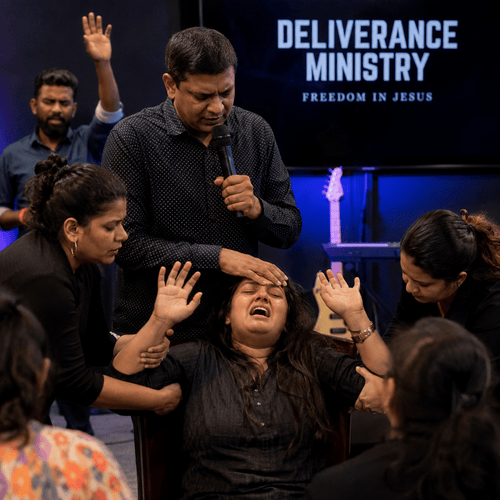
Scroll through Christian TikTok or YouTube Shorts for five minutes and you’ll likely see it: a preacher shouting “Come out!”, a person coughing violently, a crowd gasping. The caption reads something like “Demon cast out live!” These clips gain millions of views. Preachers such as Isaiah Saldivar, Vlad Savchuk, and Alexander Pagani have built huge followings teaching believers to identify and cast out demons, sometimes hundreds in a single service.
Is this the real, biblical thing? Is it spiritual warfare as the New Testament describes it? Or is it something else: a dramatic, algorithm-friendly trend that quietly teaches Christians wrong things about sin, Satan, and salvation?
This article makes a clear, Bible-based case. The short answer: Satan and demons are absolutely real, and the Bible does describe spiritual warfare, but the modern deliverance ministry movement gets several core things wrong, in ways that can genuinely hurt vulnerable people. If you’ve watched these videos and wondered whether something is missing from your own church’s quieter approach to sin and Satan, this article is written directly for you.
First, Some Definitions
Because words here get used loosely, let’s define four terms plainly before going further.
Demon, or evil spirit: a fallen angel, a real, personal, spiritual being opposed to God, described throughout Scripture (Ephesians 6:12; Revelation 12:9).
Possession: a spirit fully controlling a person’s body and will from the inside. In the Gospels, this happened to unbelievers, such as the man among the tombs (Mark 5:1-20).
Oppression: a spirit attacking, tempting, or harassing a person from outside, without controlling them. Job’s suffering and Paul’s “thorn in the flesh” (2 Corinthians 12:7) are oppression, not possession.
Deliverance: in today’s charismatic movement, a ritual in which a minister names a spirit and orders it to leave a person, often a professing Christian.
Keep the oppression-versus-possession line in mind. It’s the single most important distinction in this whole conversation, and it’s exactly where the modern movement quietly changes what the Bible teaches.
What We Can Agree On
Before critiquing anything, it’s only fair to name what the deliverance movement does get right.
COMMON GROUND. Satan is a real, personal enemy, not a metaphor for bad luck (1 Peter 5:8). Spiritual warfare is a genuine biblical category (Ephesians 6:12). And much of the modern Western church has drifted into practical unbelief, quietly acting as though the spiritual world barely exists. That drift is also a mistake.
Novelist and scholar CS Lewis put this well: there are two equal and opposite errors people can fall into about devils. One is disbelieving in them altogether. The other is taking an excessive and unhealthy interest in them. The deliverance trend is a reaction against the first error, but it often lands hard in the second. Our concern in this article isn’t with the reality of Satan, but with the specific methods and claims now spreading rapidly through charismatic media, and with whether those methods actually match what the Bible teaches about how believers overcome him.
Where It Starts to Go Wrong: A Side-by-Side Look
| DELIVERANCE MINISTRY TEACHES | WHAT THE BIBLE ACTUALLY SAYS |
|---|---|
| A born-again Christian can be possessed by a demon and needs it cast out. | Believers are the temple of the Holy Spirit (1 Corinthians 6:19); light has no fellowship with darkness (2 Corinthians 6:14). Scripture never calls a believer “demonised.” |
| Unbroken generational curses pass down through families, even to Christians, until ritually cancelled. | Christ “redeemed us from the curse… by becoming a curse for us” (Galatians 3:13). The inherited-curse idea was already overturned in Ezekiel 18:20. |
| Struggles like lust, addiction, or anger are usually a named demon to be expelled. | These are called “works of the flesh” (Galatians 5:19-21), dealt with by repentance and the Spirit’s help, not eviction. |
| Spiritual authority means verbally binding, rebuking, and commanding spirits by name. | Even the archangel Michael, disputing with the devil, did not dare rebuke him directly, but said, “The Lord rebuke you” (Jude 9). |
| Dramatic manifestation (screaming, shaking, vomiting) is evidence that real deliverance is happening. | Jesus told His disciples not to rejoice that spirits submitted to them, but that their “names are written in heaven” (Luke 10:20). |
Two of these five claims carry most of the theological weight. Let’s examine them closely.
Can a Christian Actually Have a Demon?
This is the load-bearing question in the whole debate, so it’s worth slowing down.
The apostle Paul asks the Corinthians a rhetorical question: “Do you not know that your body is a temple of the Holy Spirit within you, whom you have from God?” (1 Corinthians 6:19). A temple isn’t a building a hostile spirit can also occupy. Paul goes further in 2 Corinthians 6:14-16, asking, “What fellowship has light with darkness? … what agreement has the temple of God with idols?” The plain biblical answer is: none.
The apostle John writes “he who is in you is greater than he who is in the world” (1 John 4:4), speaking directly to believers, comparing the Spirit inside them with the devil outside them. Paul tells the Romans that “you are not in the flesh but in the Spirit, if in fact the Spirit of God dwells in you. Anyone who does not have the Spirit of Christ does not belong to him” (Romans 8:9). A person cannot belong to Christ and simultaneously be possessed by His enemy.
Notice, too, what the Gospels never record. In all of Jesus’s many exorcisms, not once does He cast a demon out of one of His own disciples. The demonised people in the Gospels are consistently outsiders to the covenant community, never the Twelve, never an existing follower.
None of this means Christians are untouchable. Scripture gives real categories for what a believer does experience: temptation (1 Corinthians 10:13), deception (2 Corinthians 11:3), oppression and buffeting from outside (2 Corinthians 12:7), and Satan gaining “a foothold” through unresolved sin (Ephesians 4:26-27, which warns believers to “give no opportunity to the devil”). These are serious. But a foothold isn’t an occupation. The remedy for a foothold isn’t an exorcism ritual; it’s closing the door through repentance, honest confession, and walking in the light.
What About Generational Curses?
This teaching holds that sins or judgements from ancestors, such as idolatry or occult involvement, attach themselves to descendants and must be ritually broken, even for believers.
The Old Testament proverb behind this idea, that “the fathers have eaten sour grapes, and the children’s teeth are set on edge,” is directly quoted by God in Ezekiel 18:2-4, only to be overturned there. “The soul who sins shall die,” God says; the son will not suffer for the father’s sin. Jeremiah 31:29-30 makes the same point.
The New Testament then closes the door entirely. Galatians 3:13 states that Christ “redeemed us from the curse of the law by becoming a curse for us.” Colossians 2:13-14 says that God, in Christ, cancelled “the record of debt that stood against us,” nailing it to the cross. For anyone united to Christ, there is no leftover family curse quietly running in the background, waiting for the right prayer formula to switch it off. The cross has already dealt with it, completely, and in the past tense.
The Weapons God Actually Gives Us
If not dramatic confrontation, how does the Bible say believers are to fight? Ephesians 6:10-18 is the definitive passage, Paul’s only sustained teaching on spiritual warfare, and it’s strikingly calm.
Paul’s armour, in plain terms (Ephesians 6:14-18)
- Truth: knowing and holding to what is actually true, against the enemy’s lies.
- Righteousness: a clean conscience, guarded by obedience.
- The gospel of peace: being ready to explain and stand on the good news.
- Faith: trusting God’s promises even under attack.
- Salvation: the settled assurance of belonging to Christ.
- The word of God: Scripture itself, described as “the sword of the Spirit.”
- Prayer: “praying at all times in the Spirit.”
Notice the verb Paul repeats throughout the passage: stand. Not attack, not hunt, not command, but stand. The picture is a soldier holding a position already won, not a commando storming enemy territory. This matters enormously, because the deliverance movement’s characteristic vocabulary, binding, commanding, and rebuking spirits by name, simply isn’t the vocabulary Paul gives believers for ordinary spiritual warfare.
The clearest biblical warning against copying supernatural technique comes in Acts 19:13-16. Some travelling exorcists try invoking “the name of the Lord Jesus” as a formula, precisely the kind of command-based method taught today, and the evil spirit answers back and physically overpowers them. Scripture records this as a public failure, not a model to imitate. Fittingly, Jude 9 tells us that even the archangel Michael, disputing with the devil himself, did not presume to rebuke him directly, but said only, “The Lord rebuke you.”
Where the Trend Turns Genuinely Dangerous
Given all this, here’s where the modern deliverance movement causes real harm, not in theory, but in the lives of ordinary believers.
- It undermines assurance of salvation. Telling a Christian they might be possessed contradicts the very promises, such as Romans 8 and 1 Corinthians 6, that are meant to comfort them.
- It replaces repentance with ritual. Casting a demon “off” a besetting sin skips the actual biblical process of conviction, confession, and the slow, Spirit-empowered work of putting sin to death (Romans 8:13). When the sin returns, as it usually does, the sufferer is told they need more deliverance, not more discipleship.
- It manufactures fear. A worldview where curses and named spirits lurk behind every struggle keeps people anxious rather than resting in Christ’s finished work.
- It misdiagnoses real needs. Grief, trauma, clinical depression, and medical conditions have all been wrongly treated as demonic, delaying the medical or pastoral care a person actually needs.
- It rewards performance over substance. Vlad Savchuk has himself publicly admitted that ministers “exploited manifestations” for social media reach, filming and editing dramatic reactions for viral attention rather than for the person’s good.
- It has enabled real abuse. Documented cases exist of coercive, hours-long sessions, invasive questioning that implanted false memories, and, in one widely circulated video, a minister physically endangering a woman during a deliverance attempt.
Jesus’s own warning fits precisely here: “Many will say to me on that day, ‘Lord, Lord, did we not… cast out demons in your name?’ … I will declare to them, ‘I never knew you.’” (Matthew 7:22-23). Visible power is never, by itself, proof that something is from God. Scripture is the test, not the manifestation (Isaiah 8:20).
So What Does Real Deliverance Look Like?
Not a stage, not a formula, not a viral clip. Real deliverance is what the Heidelberg Catechism calls the believer’s only comfort: belonging, body and soul, to Jesus Christ, who has fully paid for all sin and has delivered His people from the power of the devil. That deliverance already happened at the cross; Paul tells the Colossians that God “has delivered us from the domain of darkness” (Colossians 1:13). It continues daily, not through dramatic sessions, but through ordinary means: the preached word, prayer, the sacraments, honest confession to fellow believers, and a local church that walks alongside you as you fight sin, one day at a time.
That is slower than a 30-second clip. It’s also, unlike the clip, exactly what the Bible actually promises. A believer struggling with sin, fear, or a sense of spiritual attack does not need a stage or a camera. They need what every generation of the church before this one has offered: sound preaching, patient discipleship, and brothers and sisters willing to walk with them until the fight is won.
Tough Questions, Honest Answers
Can I get “delivered” from an addiction in a single prayer session?
Some people do experience a real, sudden change after prayer, and God can and does work powerfully and quickly. But the Bible’s normal pattern for breaking sinful habits is ongoing: daily repentance, accountability, and the Spirit’s steady work in a believer’s life (Philippians 1:6). Treating one dramatic session as the whole solution risks deep discouragement the first time an old temptation returns.
Is deliverance ministry practised the same way in every church?
No. Many churches simply pray for people struggling with sin or hardship in a careful, pastoral way, and that is not controversial at all. The concerns raised in this article apply to the more theatrical, viral strand of the movement: naming spirits, commanding them out, and treating it as a headline ministry. A church that prays for people without that framework is not really practising the trend described here.
Why do the reactions in these videos look so dramatic? Are people faking it?
Not necessarily faking, though not necessarily demonic either. Strong emotional or physical reactions can arise from intense group pressure, suggestion, exhaustion, or genuine underlying distress; ordinary psychology explains a great deal of this. Scripture never tells believers to judge spiritual reality by how dramatic something looks (1 Samuel 16:7).
A friend has invited me to a deliverance service. Should I go?
Go with discernment rather than fear, if you go at all. Watch whether the teaching lines up with Scripture, whether leaders point people to Christ’s finished work rather than to themselves, and whether anyone is pressured into anything. If the service begins to feel coercive, or teaches that believers can be possessed, it is wise to leave quietly and speak with a trusted pastor afterwards.
What should church elders specifically watch for?
Elders should be alert to sessions that run for hours, isolate a vulnerable person from family, ask leading questions designed to “uncover” hidden sin or trauma, or treat dramatic manifestation as a badge of spiritual success. Biblical eldership exists to protect the flock (1 Peter 5:2-3), and that includes protecting people from well-meaning but harmful practice. Where a member has genuinely encountered occult involvement or a similarly serious matter, elders should still handle it prayerfully, quietly, and within ordinary pastoral care, rather than staging it as a public spectacle.
Is it wrong to simply pray, “In Jesus’ name, be gone,” when I feel tempted?
There is nothing wrong with resisting temptation in Jesus’s name; Scripture itself instructs believers to “resist the devil” (James 4:7). The caution here is not about praying against temptation, but about turning that prayer into a formula aimed at an imagined indwelling spirit, rather than a plea for God’s help to say no to sin yourself.
How should I talk to a teenager who is watching this content online?
Do not mock their interest, since Satan and spiritual warfare are genuinely biblical topics worth discussing seriously. Instead, walk gently through the difference between oppression and possession, show them what Ephesians 6 actually names as the believer’s weapons, and ask what specifically draws them to the videos. Often it is the drama rather than the doctrine, and that is worth naming honestly together.
Related Reads
- Manifestation and “Speaking Things Into Existence”: Warfare or Marketing?
- Are Occult Symbols in Video Games a Doorway for Spiritual Attack?
- Can Christians Be Demon Possessed? What the Bible Teaches
- Did the Witch of Endor Actually Raise Samuel from the Dead?
- Spiritual Warfare: A Believer’s Guide to Complete Battle Armour
- Are Demonic Strongholds Real? How Do We Overcome Them?
- Kinds of Spirits in the Bible—How Many Are There?