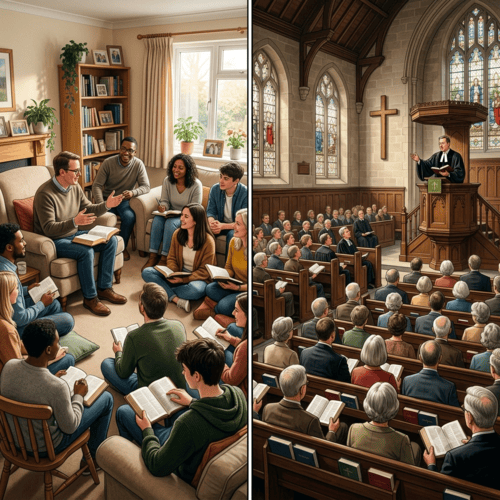

Walk into three different churches on a Sunday morning and ask each pastor the same question—Who has authority here? Who answers to whom?—and you’ll likely get three different kinds of answers. One says the members collectively have authority. Another says the council of elders has. The third says the bishop does. And all three pastors will insist they’re simply following the Bible. All three are sincere. All three open the same Bible. Now, who among the three is right?
Let’s weigh the three systems by Scripture. And by history. And see where the evidence leads.
First, the Question Behind the Question
Before we can compare the three systems, there’s a more basic question to settle first, one that decides how strongly anyone should hold their view at all: did God command one specific way of running a church, or did He leave the details open?
This matters enormously. If God commanded one system, every other system is disobedience, however sincere. If He left the details open, Christians can disagree here the way they disagree over which Bible translation to preach from—without either side sinning. Historically, Christians have answered this in three ways.
- By divine right (in Latin, jure divino). On this view, Christ Himself fixed one pattern of government, and any church that departs from it is disobeying Him, not just choosing differently. Scottish Presbyterians such as Andrew Melville argued this for Presbyterian government—elders and church courts, they said, are commanded, not optional. Curiously, bishops such as Lancelot Andrewes used the identical logic in the opposite direction, insisting bishops are commanded too.
- By prudence (in Latin, adiaphora, meaning roughly “things Scripture leaves open”). On this view, the Bible gives principles a church must follow—its leaders must be plural, morally qualified, and accountable—but leaves the exact shape of government to human wisdom and circumstance. Richard Hooker defended bishops on this basis: not because Christ commanded them, but because they’re ancient and they work. Martin Luther, similarly, barely cared which structure his churches used, so long as the gospel was preached faithfully.
- The middle position. This is the view taken in this article, and it’s also the view written into the Westminster Confession of Faith (1.6). On this reading, some things about church government are genuinely commanded in Scripture—that there must be elders, that discipline must be exercised, that the gospel must be preached. Other details, such as exactly how a court should be structured, are left to ordinary Christian wisdom, guided by general biblical principles rather than a specific verse.
Why settle this before comparing the three systems? Because it changes the tone of everything that follows. The Belgic Confession, in Article 29, doesn’t list church government among the marks that make a church a true church. The three marks it does recommend are the right preaching of the gospel, the right use of the sacraments, and the faithful practice of discipline.
A church doesn’t stop being a true church because it has the “wrong” polity. But polity still matters: it’s the machinery that makes that third mark, discipline, actually work—or fail.
Three Systems, Defined Precisely
| POLITY | WHO HOLDS AUTHORITY | TYPICAL STRUCTURE | FOUND IN |
|---|---|---|---|
| Episcopal | Bishops—a distinct order above ordinary presbyters, standing in a claimed line of succession from the apostles | Bishop, then Presbyter or Priest, then Deacon | Anglicanism, Roman Catholicism, Eastern Orthodoxy, and Methodism in modified form |
| Presbyterian | Elders (presbyters), one order with two functions—teaching and ruling—governing jointly in graded courts | Session, then Presbytery, then Synod or General Assembly, with rights of appeal | Presbyterian and continental confessional churches |
| Congregational | The gathered local congregation itself, under Christ | Local elders and deacons lead; the congregation holds final say; wider associations advise but cannot bind | Congregationalists, most Baptists, and most independent or non-denominational churches |
One term may cause some confusion: Episcopal, the style of government, isn’t the same as Episcopal, the denomination. Also, many churches run a hybrid, so constitution and practice may not match. Plenty of independent, non-denominational churches are congregational in constitution while thoroughly elder-led in daily practice.
The Exegetical Battlefield: Elder or Bishop?
The single strongest textual argument in the whole debate turns on one observation: in the New Testament, “elder” (presbyteros) and “overseer” or “bishop” (episkopos) name the same office—one word points to the man’s maturity, the other to his task.
- Acts 20:17,28. Paul summons the elders (presbyteroi) of Ephesus, then tells those same men that the Spirit made them overseers (episkopoi) to shepherd God’s flock.
- Titus 1:5–7. Paul tells Titus to appoint elders in every town, “for an overseer, as God’s steward, must be above reproach.” The word “for” ties the two titles to one office.
- 1 Peter 5:1–2. Peter, an apostle, calls himself “a fellow elder” and instructs elders to shepherd the flock, “exercising oversight.”
- Philippians 1:1. Paul greets “the overseers and deacons” of one congregation, in the plural, with no third rank named above them.
Jerome, writing around AD 386, conceded this. His commentary on Titus states plainly presbyter and bishop were originally one office, and that the later elevation of a bishop over his fellow presbyters arose from custom, not from any command of the Lord—but as a remedy for schism.
The episcopal case, stated fairly, replies Timothy and Titus exercise a wider, supervisory authority—appointing and disciplining elders (1 Timothy 5:19–22; Titus 1:5); that James appears to preside at the Jerusalem council (Acts 15:13–21); and that Ignatius of Antioch, writing barely a decade after John died, already urges obedience to “the bishop, with the presbytery and the deacons.”
Three replies, briefly. Timothy and Titus are temporary, itinerant apostolic delegates, not settled diocesan bishops. James speaks inside a council of apostles and elders, and the decision is issued by the whole body (Acts 15:22), not by James alone. Ignatius describes one man leading one congregation, with its own elders and deacons around him—a local lead-pastor figure, not yet an archbishop ruling many congregations.
Modern exegetes press this further. Benjamin Merkle argues the overlap in terminology is airtight enough that the burden of proof sits with anyone proposing a third order above the presbyter. Guy Prentiss Waters adds the qualification lists in 1 Timothy 3 and Titus 1 describe exactly two offices, overseer and deacon, and never mention a third.
The Case for Graded Courts
Acts 15 supplies the presbyterian hinge. Apostles and elders drawn from more than one congregation gather, deliberate, and issue decisions that Paul then delivers to the churches “to observe” (Acts 16:4)—binding authority, not friendly suggestion.
This pattern echoes something older: the elders of Israel in Exodus 18 and Numbers 11, the tribal judges of Deuteronomy 1:13–17, and the Sanhedrin. The apostles didn’t invent graded eldership with rights of appeal; they inherited it from the synagogue. Jonathan Leeman, who writes from a congregational position, still concedes this connection in Acts 15 is one of the strongest arguments in the whole debate.
Samuel Miller and Thomas Witherow marshalled the Acts 15 case with unusual precision, arguing that a court higher than the single congregation becomes necessary once more than one congregation exists in real relationship with another. Charles Hodge and Robert Lewis Dabney treated graded courts as a matter of scriptural warrant rather than convenience.
The Case for the Gathered Congregation
Congregationalists have their own strong texts.
- Matthew 18:15–20. When private correction fails, “tell it to the church,” and it’s the church itself, not some court above it, that finally binds and looses.
- 1 Corinthians 5:4–5. Paul instructs the whole gathered congregation at Corinth to carry out the discipline of an unrepentant member.
- 2 Corinthians 2:6. The offender here was punished “by the majority,” which on the plain reading describes a congregational vote.
- Acts 6:1–6. The congregation chooses seven qualified men, and the apostles then lay hands on them.
John Owen, a congregationalist in his later years despite earlier presbyterian sympathies, argued a gathered congregation’s authority flows directly from its own covenant union with Christ. When a group of believers gathers together and commits to Christ and to each other, that gathering is itself directly bound to Christ. On this view, a local congregation doesn’t need permission from a wider body—a presbytery, bishop or association—to hold real authority. It already has that authority, simply by being a church gathered under Christ.
Presbyterians don’t deny the congregation genuinely holds power in electing its officers and receiving members. But they insist that power is different from that of jurisdiction—of actually judging and ruling on cases—which the congregation’s elected officers exercise on its behalf.
Mark Dever admits this distinction points to something true. His warning is simple: a church can have “congregational government” written into its constitution and still function nothing like it in practice. Take Matthew 18, where Jesus says a serious, unresolved sin should finally go to “the church” as a whole. If a congregation never actually does this—if every hard case quietly gets handled behind closed doors by the pastor alone, and the members are never actually asked to weigh in—the real power in that church has drifted to one man, whatever the paperwork says.
Four Principles Underneath Every System
- Christ’s sole headship. No polity may install a vicar or an earthly head as a substitute for Christ. Any structure stands under judgement the moment a pastor, bishop, or assembly begins functioning as though it were the head.
- Ministerial, not legislative, authority. Courts and bishops may declare what Christ has already said in His word. They may not legislate new law of their own devising.
- Liberty of conscience. God alone is Lord of the conscience. Good church government exists to protect this liberty, never to override it with human rules dressed up as divine ones.
- The keys, rightly understood. The keys of the kingdom aren’t a bureaucratic instrument. They’re the preaching of the gospel and the exercise of church discipline—the gospel applied to real people. Every argument in this debate is really about who is entrusted to use those keys, and how carefully.
How We Got Here: A Short Timeline
- About AD 110. Ignatius of Antioch writes of a single bishop in each city church.
- AD 250. Cyprian of Carthage builds the single-bishop model into a full doctrine: the church’s unity is located in the bishop himself.
- 1541. John Calvin’s Ecclesiastical Ordinances set out four offices in Geneva: pastors, teachers, elders, deacons.
- 1560—1578. Scotland’s First and Second Books of Discipline, shaped by John Knox and then Andrew Melville, build graded courts and a doctrine of two kingdoms, church and state, each sovereign within its own sphere.
- 1582. Robert Browne publishes Reformation without Tarrying for Any—the birth cry of separatist congregationalism.
- 1618–19. The Synod of Dort fixes the Continental Reformed church order.
- 1643–49. The Westminster Assembly. A presbyterian majority; the Dissenting Brethren, including Thomas Goodwin and Jeremiah Burroughs, press the congregational case with courtesy and real force.
- 1648, 1658, 1689. The Cambridge Platform, the Savoy Declaration and the Second London Baptist Confession keep Westminster’s doctrine almost word for word, revising mainly the chapters on the church.
- 1843. The Disruption. Thomas Chalmers leads over 450 ministers out of the Church of Scotland, surrendering stipends and manses rather than accept the state’s intrusion into the church’s spiritual independence—the clearest illustration on record that this argument is about Christ’s crown rights, not committee structure.
The lesson history teaches isn’t flattering to anybody. Episcopal provinces have been led whole-cloth into heresy by their own bishops. Presbyterian assemblies have voted away their own confessions in the 20th century. Independent congregations have collapsed around single unaccountable men more times than can easily be counted. No structure purifies itself automatically.
Strengths and Weaknesses in Each System
| SYSTEM | REAL STRENGTH | REAL WEAKNESS |
|---|---|---|
| Episcopal | Historic continuity; a clear line of accountability for clergy; can act decisively in mission; protects a minister from a hostile congregation | There’s a thin exegetical base for any third order above the elder; vulnerable to capture by the state; error, once it starts at the top, spreads down through the whole structure |
| Presbyterian | Matches the elder and overseer identity found in the text; gives a wronged member somewhere real to appeal; disciplines ministers corporately rather than only locally | Courts can turn procedural and slow; a captured assembly captures everything beneath it, including the property; the case for graded courts rests on inference from Acts 15 rather than direct command |
| Congregational | Clear textual warrant in Matthew 18 and 1 Corinthians 5; high ownership among ordinary members; error tends to stay contained locally rather than spreading | In practice, frequently produces the opposite of its own theory—an unaccountable pastor with a compliant board; no external recourse for a wronged member; often weak examination of ministers before installation |
Here’s the irony worth sitting with. The polity with the strongest theoretical safeguards against one-man rule—congregationalism, on paper—is the one that most often produces exactly that in practice. That’s because structure without exercised discipline is only paper. Gregg Allison writes pointedly on this: healthy church government is never merely a constitution filed in a drawer, but officers who’re actually examined, held to account, and removable when they fail.
What All Three Actually Share
Despite centuries of division, look at what unites nearly every serious form of church government: qualified officers meeting the tests of 1 Timothy 3 and Titus 1; a plurality of elders rather than one solitary ruler; the office of deacon; some genuine exercise of discipline; and some real measure of congregational consent, even where final jurisdiction sits elsewhere. James Bannerman observes the overlap between the three systems is far larger than the arguments between their advocates usually suggest.
Church Discipline: Where Polity Stops Being Theory
Polity is invisible until a pastor falls, or a member is genuinely wronged. Imagine a case runs through all three systems: a pastor is credibly accused of financial dishonesty.
Under episcopal government, the bishop investigates and rules, subject only to appeal through the wider hierarchy. Under presbyterian government, the local session investigates first; if it deadlocks, or a party appeals, the case moves to presbytery, and from there, if needed, to synod or assembly. Under congregational government, the gathered members must judge the case directly, following Matthew 18, with no higher body to appeal to beyond the local church.
Ask, for each system: who actually decides? Who reviews that decision? And where does the wronged member go if the first answer is wrong?
Multisite Church: An Unacknowledged Episcopacy?
One of the more interesting modern wrinkles in this old debate: many multisite and online congregations today are congregational by constitution, yet function as something closer to a diocese in daily practice—one preaching pastor, several campuses, and campus pastors answering to a central office rather than their own local congregation. Jonathan Leeman has pressed exactly this critique against his own broader camp: a structure can remain congregational on the incorporation papers while functioning as thoroughgoing episcopacy in real, lived authority.
Choosing a Church: What Actually Matters
The marks of the church—the gospel rightly preached, the sacraments rightly administered, and discipline faithfully exercised—always come before polity. But once those marks are present, four practical questions convert this debate from theology into action.
- Who can discipline the pastor if he falls into serious sin or persistent error?
- Where does a wronged member appeal, if the first decision feels unjust?
- Who controls the money and the property, and under what real check?
- Who can actually remove an unfit officer, and how difficult is that step in practice?
Edmund Clowney made a point that’s easy to miss after pages of arguing over which system is most biblical: none of the structures exists for its own sake. A bishop, a session of elders, a congregational business meeting—whichever one a church has—its entire job is to serve two things: the church’s worship of God, and its mission of reaching people with the gospel. The moment a church starts protecting its structure for its own sake—defending the system itself rather than asking whether it’s still helping people worship and serve well—something has gone wrong, no matter how correct that system’s paperwork looks.
Christ’s Crown Rights
Every one of the three systems, at its best, is trying to answer the same question: how does Christ, the sole head of His church, actually rule His people today? He rules by His word, through His Spirit, and through the officers He appoints—whichever structure they sit inside. Government, on this view, is never ownership. It’s stewardship, held for a season by men who will one day answer to the Master who’s coming back for what already belongs to Him.
Tough Questions, Honest Answers
Did the apostles leave one required blueprint for church government, or genuine liberty on this point?
Scripture isn’t silent here, but it’s also not as prescriptive as some assume. The New Testament clearly requires a plurality of qualified elders, the office of deacon, and a plain use of the keys through preaching and discipline. What it doesn’t spell out in comparable detail is exactly how far authority should extend beyond the local congregation, and that gap is where episcopal, presbyterian and congregational readers diverge. The most honest answer, built into the Westminster Confession’s own language, is that the substance of government is revealed while some circumstances are left to Christian prudence under general rules. That leaves real room for disagreement among believers who take the text with equal seriousness.
Why did the concept of a single bishop over a city’s elders spread so quickly if the New Testament pattern seems to be plurality?
Early congregations needed a visible point of unity to guard against the specific dangers of their moment, above all the splintering pressure of early heresies and rival teachers. It was natural for one elder among equals to take a leading role in presiding at the Lord’s Table and chairing the elders’ meetings, and for that informal primacy to harden into a formal office within a generation or two. Ignatius of Antioch shows this hardening already underway by AD 110, addressed to congregations still small enough for one man to know personally. The move from first-among-equals to a distinct order took centuries more, and Jerome’s later admission shows that even churchmen inside that developed system knew its origin was custom rather than command. Fast adoption is evidence of practical usefulness under pressure, not evidence of apostolic institution.
Can a Christian move in good conscience between churches with different forms of government?
Yes, provided the three marks of a true church remain intact: the gospel rightly preached, the sacraments rightly administered, and discipline genuinely exercised. Polity isn’t one of those marks, so a believer isn’t compromising the gospel by worshipping under bishops in one season and under elders and deacons in another. What matters more than the label is whether that congregation’s leaders are actually examined, actually accountable, and actually willing to use the keys when a real case demands it. A wise believer asks the four practical questions raised above (see section, Choosing a Church: What Actually Matters) wherever they land.
Does a larger, more bureaucratic denomination actually protect people better than a small independent church?
Not automatically, and this is one of the most important practical points in the whole debate. Bureaucracy relocates risk rather than removing it: an episcopal system moves the risk to the top, where one bishop’s failure can affect an entire province, while a small independent congregation moves the risk to a single unaccountable pastor with a compliant board. Presbyterian and connectional systems built genuine external appeal into their structure precisely to spread that risk, but even a well-designed court system fails the moment its members stop actually using it. Size and structure can make abuse harder to hide, but only living, exercised discipline actually prevents it.
What happens under congregational government when the accused pastor also chairs the only meeting that could judge him?
This is congregationalism’s sharpest practical weakness, and honest advocates of the system admit it openly. The usual safeguard is a plurality of other elders and deacons who can call and moderate a meeting without the accused presiding, together with a congregational constitution written to specify exactly this scenario before it is ever needed. Some independent congregations also maintain relationships with sister churches or a wider association specifically so an outside voice can be invited into a crisis, even though that outside body holds no binding authority. Where none of these safeguards exist in writing beforehand, a congregation typically discovers the gap only in the middle of the crisis itself, which is the worst possible time to design a process.
Is “non-denominational” the same thing as congregational government?
Not necessarily, and the two get confused constantly. Non-denominational simply means a church has no formal ties to a wider denomination; it says nothing about who actually holds authority inside that congregation. Many non-denominational churches are congregational in their bylaws but function, in practice, as elder-led or even as a single strong pastor’s personal domain, precisely the multisite-style pattern discussed above. The honest question to ask any non-denominational church is not whether it belongs to a denomination, but who, inside it, can actually discipline the senior pastor if he needs disciplining.
Does church polity affect debates over who may be ordained as an elder?
Indirectly, yes, because polity determines who examines a candidate and by what standard. Under episcopal and presbyterian systems, a body outside the local congregation, a bishop or a presbytery, tests a man’s doctrine and character against a shared confessional standard before he is set apart, which tends to produce more consistent qualification across congregations. Under congregational government that examination is usually done locally, allowing faster response to a specific congregation’s needs but also more variation in how rigorously 1 Timothy 3 and Titus 1 are actually applied. The debate over who qualifies as an elder is ultimately a question of biblical qualification rather than of polity, but the system a church uses shapes how consistently that qualification gets tested in practice.
Related Reads
- Is Apostolic Succession Biblical?
- Are House Churches Biblical? What the New Testament Prescribes
- Reformed Church Eldership: The Role and its Qualifications
- The Priesthood of All Believers: What the Bible Really Teaches
- What Is the Church? A Biblical Definition of Ekklesia
- What Are the Marks of a True Church?