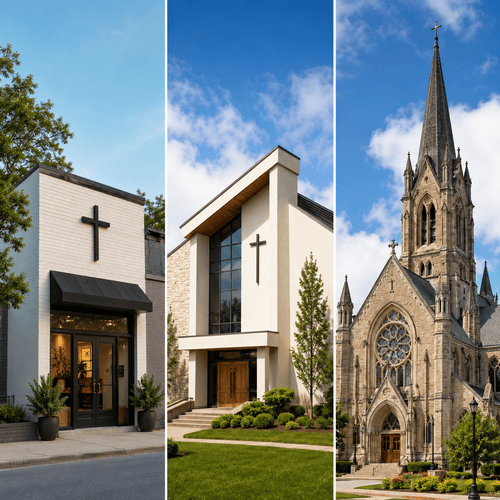
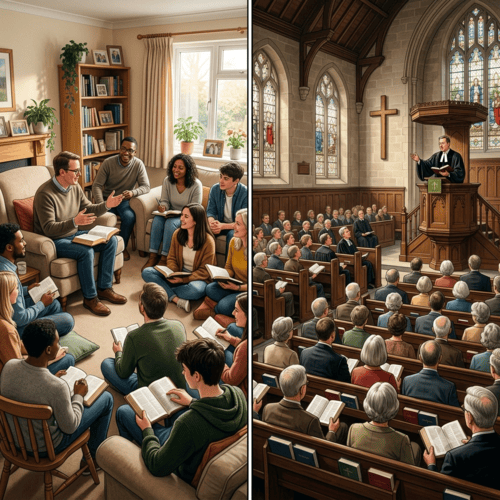
The first Christians met in living rooms—but a living room doesn’t make a church, and a cathedral doesn’t unmake one. Here’s the distinction that settles the question.
Across the English-speaking world a quiet exodus is under way. Believers weary of slick production, sprawling programmes and anonymous auditoriums are looking backwards—to the plain, unhurried fellowship of the earliest Christians, who gathered around a table in someone’s front room. The question they keep pressing is a good one: when the church migrated from living rooms to cathedrals, did it lose something essential?
The short answer is: yes and no. Yes, the first congregations really did meet in homes, and the warmth of that setting is worth recovering. But no—a living room doesn’t make a gathering a church, any more than a spire makes one. Scripture is far less interested in the postcode of the church than in its marks. Get those right, and a company of believers meeting over coffee in a terraced house is as truly a church as any congregation beneath a dome. Get them wrong, and the most beautiful building in Christendom houses a club, not a church.
Where the First Christians Actually Met
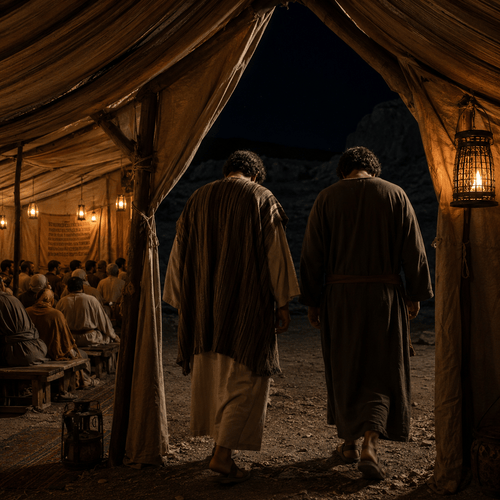
The New Testament is entirely unembarrassed about the domestic setting of early worship. Again and again the apostle Paul greets “the church” that met in a named believer’s home:
- Priscilla and Aquila—Paul sends greetings to the church in their house (Romans 16:5); the same couple later hosts a congregation in Ephesus (1 Corinthians 16:19).
- Nympha of Laodicea—Colossians 4:15 names a woman whose home sheltered a congregation.
- Philemon and Archippus—Paul’s little letter to Philemon is addressed also to the church in your house (Philemon 1:2).
- Mary, mother of John Mark—the Jerusalem believers gather to pray in her home while Peter languishes in prison (Acts 12:12).
Luke’s summary of the young church captures both halves of its life—the corporate and the domestic:
“And day by day, attending the temple together and breaking bread in their homes, they received their food with glad and generous hearts.” Acts 2:46 (ESV)
Why homes, though? Not out of principle but out of circumstance. Historian Roger Gehring, in his study of early Christian households, and Robert Banks, in his classic work on Paul’s idea of community, both stress the domestic setting reflected the realities of the age rather than a fixed theology of architecture:
- No church buildings existed: for roughly the first two centuries there simply was no distinct Christian architecture to meet in.
- Congregations were small: a single household could hold them.
- Persecution was intermittent: public gatherings could be dangerous or impossible.
- The household was society’s building block: Roman life was organised around the oikos, so the home was the natural cradle for a new movement.
A brief timeline of the church’s meeting places
- AD 30–200—the household years: Christians meet almost exclusively in private homes; there is no dedicated “church building.”
- AD 230s—the adapted house: at Dura-Europos in Syria a private house is remodelled into a purpose-built meeting place—the earliest identified Christian building.
- AD 313 onwards—the basilica era: once Constantine’s Edict of Milan legalises the faith, congregations begin raising large public basilicas, and the house church recedes.
Descriptive or Prescriptive? The Distinction That Settles It
Here’s where the whole question turns. There’s a world of difference between what Scripture describes and what Scripture commands—and confusing the two produces endless mischief. Gordon Fee and Douglas Stuart, in their widely used guide How to Read the Bible for All Its Worth, put the principle plainly: narrative reports what happened; it doesn’t automatically legislate what must always happen.
- A descriptive text tells us what the early church did.
- A prescriptive text tells us what every church must do.
The house setting of the first congregations is described, never commanded. No apostle ever writes, “You shall meet only in homes.” The believers gathered in living rooms for the same reason they travelled by ship—it was simply what the moment allowed. And the fact that Paul sailed the Mediterranean no more forbids the modern missionary from boarding an aeroplane than the fact that the church met in Priscilla’s home forbids a congregation from meeting under a roof of its own.
The point cuts both ways. Just as the home isn’t commanded, neither is it forbidden. The venue is a matter of Christian freedom—what older theologians called things indifferent (adiaphora). Scripture leaves the building open and fixes its gaze on something else entirely: on what the gathering must be and do.
What Actually Makes a Church a Church
If the building is indifferent, what isn’t? The historic Protestant answer is the doctrine of the marks of a true church—the God-given features that distinguish a real church from a mere religious club. John Calvin, in his Institutes, taught that wherever the Word is truly preached and the sacraments are rightly administered, there a church of God undoubtedly exists. The confessional tradition that followed him—expressed most memorably in the Belgic Confession of 1561, drafted by Guido de Brès—set out three such marks.
1. The faithful preaching of the Word
A church is born and sustained by the preached gospel. This is not a discussion group swapping opinions but the authoritative exposition of Scripture by those set apart to preach. As Paul reminds the Romans, faith comes by hearing, and hearing through the word of Christ (Romans 10:17); and the ascended Christ himself gives the church its shepherds and teachers (Ephesians 4:11).
2. The right administration of the sacraments
Baptism and the Lord’s Supper, administered according to Christ’s own institution (Matthew 28:19; 1 Corinthians 11:23–26), are not private ceremonies to be improvised over the kitchen counter. They are ordinances of the whole church, to be guarded and reverently ordered.
3. The faithful exercise of church discipline
This is the loving correction that keeps a church holy and its members accountable, following the pattern Jesus himself laid down (Matthew 18:15–17). Without it, a fellowship has no way to guard the Lord’s Table or to protect the flock from wolves.
The test is never the roof over the gathering. It’s the marks within it.
The Peril of the Do-It-Yourself Congregation
This is precisely where an unstructured house church becomes vulnerable. Strip away ordained leadership and outside accountability, and a gathering is exposed to three predictable dangers:
- Unaccountable leadership: a charismatic personality with no ordination, no oversight and no wider body to answer to. Both church history and this week’s headlines are littered with the wreckage.
- Doctrinal drift: without trained, examined teachers, error creeps in unchecked and a fellowship can wander far from the faith without ever noticing.
- No recourse in conflict: when things go wrong, there is no higher court of appeal, no presbytery or council to intervene.
Scripture’s antidote is not less structure but the right structure: qualified, plural, ordained elders. Paul left Titus in Crete for the express purpose of appointing elders in every town (Titus 1:5); he and Barnabas appointed elders in every church they planted (Acts 14:23); and the qualifications for an overseer in 1 Timothy 3 are exacting. Even in its house-meeting simplicity, the New Testament church was never leaderless. The intimacy of the home never meant the abolition of order:
“But all things should be done decently and in order.” 1 Corinthians 14:40 (ESV)
So, Can a House Church Be a True Church?
Emphatically—provided it’s a church, and not merely a gathering. The dividing line doesn’t run between “home” and “building.” It runs between order and disorder, between accountability and autonomy. Theologian Edmund Clowney captured the heart of it: the church is defined not by its premises but by its relationship to Christ, expressed in His appointed marks.
| INFORMAL HOME FELLOWSHIP | ORDERED HOUSE CHURCH | |
|---|---|---|
| Leadership | Self-appointed or leaderless | Ordained, examined elders |
| Accountability | Answerable to no one | Accountable to a wider body of churches |
| Preaching | Shared opinions, open-mic | Faithful exposition of Scripture |
| Sacraments | Improvised or absent | Administered as Christ instituted |
| Discipline | None | Exercised with love and care |
| Status | A fellowship, a small group | A true church of Jesus Christ |
A congregation meeting in a home that has these things isn’t a lesser church. It’s simply a church that meets in a home. Some of the healthiest congregations on earth today—from persecuted house-church networks to fledgling church plants in the West—gather in exactly this way, and they are churches in the fullest sense.
Recovering What the House Church Impulse Gets Right
None of this is a licence to sneer at the longing that drives people towards house churches in the first place. That longing is often healthier than the polished machinery it flees. The impulse rightly recovers three things a large institution can quietly lose:
- The “one another” commands: the New Testament’s dozens of mutual duties—love one another, bear one another’s burdens, confess to one another—assume a fellowship small and close enough to actually practise them.
- Hospitality as worship: the shared meal, the open home and the table become genuine means of grace rather than an afterthought.
- Every-member ministry: not a passive audience watching a stage, but a body in which each part actually works.
The remedy for a cold, consumerist congregation isn’t to abandon order but to fill order with warmth:
“And let us consider how to stir up one another to love and good works, not neglecting to meet together, as is the habit of some, but encouraging one another.” Hebrews 10:24–25 (ESV)
So, are house churches biblical? Emphatically—when they are churches. The New Testament gives us no blueprint for architecture and every instruction for order. A congregation gathered in a living room, under faithful preaching, around rightly administered sacraments, led by godly elders who answer to the wider body, is as biblical a church as has ever existed. The question was never the walls. It was always the marks.
Tough Questions, Honest Answers
Is a house church the same thing as a small group or home group within a larger church?
No, and the difference matters. A small group is a subdivision of an existing church, meeting midweek for study and fellowship while remaining under that church’s preaching, sacraments and eldership. A house church, by contrast, claims to be a church in its own right. The test is not the venue but whether the four marks—Word, sacraments, discipline and ordained leadership—are actually present.
Are the underground house churches in places like China or Iran true churches?
Where they carry the marks of a true church, yes—fully and without qualification. Persecution forces the domestic setting upon them; it does not diminish their standing before God. Many of these congregations are elder-led, doctrinally serious and rigorous about the sacraments, which is precisely what makes them churches. Their situation is the clearest modern proof that necessity, not architecture, has always shaped where God’s people meet.
Doesn’t the “priesthood of all believers” mean any member can preach and baptise?
This is a common misreading of a precious truth. The priesthood of all believers means every Christian has direct access to God through Christ and a genuine ministry to offer—it does not erase the distinct office of elder or teacher. Scripture still reserves the preaching and sacramental role for those called, examined and set apart (Ephesians 4:11–12; Romans 10:15; James 3:1). Universal access to God and an ordered ministry are friends, not enemies.
Can a single family worshipping at home count as a church?
Family worship is commanded, wonderful and sadly neglected—but it is not the same as the gathered church. The assembly of the church involves believers drawn together beyond a single household, the ministry of ordained elders, and the administration of the sacraments. A family altar builds the church; it does not, on its own, constitute one. Keep both, and treasure the distinction between them.
How large can a house church get before it “has to” become a regular church?
There is no biblical number, because size is a practical question, not a theological one. When a home can no longer hold the congregation, the New Testament instinct is to multiply—planting another gathering—or to find larger premises, not to change the church’s essential nature. A house church does not “graduate” into becoming a real church; it is already one. It simply outgrows the living room.
Is online or “virtual” church the modern equivalent of the house church?
Not really, and it is worth being clear why. The early house church was still a physical, embodied gathering—real people breaking real bread in the same room. A screen can extend the reach of teaching and serve the housebound, but it cannot supply the bodily assembly the New Testament assumes or administer the physical sacraments (Hebrews 10:25). Streaming is a helpful supplement to church; it is not a substitute for it.
Did the Reformers or the Puritans ever practise house churches?
Yes—whenever persecution left them no choice. Under Mary Tudor, the Scottish Covenanters, and the French Huguenots, believers met secretly in homes, barns and open fields—gatherings often called conventicles. They did so precisely because they held that the church is defined by its marks and not by its building, and they returned gladly to public worship once they were free. Their example affirms the house gathering under necessity while prizing order above all.
Related Reads
- When Did the Church Begin—At Pentecost, or Long Before?
- The Priesthood of All Believers: What the Bible Really Teaches
- Reformed Church Eldership: The Role and its Qualifications
- Faithful to the Pattern: Why Paul Reserves Ordination for Men
- Do Unbelieving Kids Disqualify Church Leaders?
- Household of God: What It Means to Belong to the Church
- Congregational, Presbyterian, Episcopal: Forms of Church Government Compared