
Does God Have Favourites?
Open the Bible and the arithmetic looks strange.
David took another man’s wife while her husband was away fighting his wars. Then David had the husband abandoned in battle so he’d be killed. That’s adultery and murder, committed by a head of state using the powers of his office. Saul, the king before him, offered a sacrifice a few minutes too early and failed to destroy every animal in a captured camp. Saul lost his throne and his dynasty. David kept both, and had the Messiah promised through his line.
And it’s David, not Saul, whom God calls a man after his own heart (1 Samuel 13:14; Acts 13:22).
To many readers this looks like favouritism—as though God has a soft spot for one man and a cold eye for another, and the rules bend accordingly. That would be a serious charge, because Scripture itself insists God shows no partiality. The answer turns on one point most discussions miss entirely: the phrase isn’t a character reference. It’s an appointment notice. Once that is clear, everything else falls into place.
What the Phrase Actually Says
Start with when it was said. Samuel speaks these words in 1 Samuel 13. David doesn’t appear in the story until three chapters later. He isn’t named or introduced. And he has done nothing—good or bad.
That timing matters. A description announced before the man walks on stage cannot be a report card on his behaviour. God isn’t awarding a grade; He’s announcing in advance He has selected someone.
The Hebrew supports this. The phrase is ish kilvavo, “a man according to his heart”, and it sits in a sentence that reads: the LORD has sought out for Himself a man according to His own heart. Those two words are the giveaway.
Peter Kyle McCarter Jr., in his major commentary on 1 Samuel, argues the idiom means something close to “a man of His own choosing”. Benjamin JM Johnson also makes the same case in detail: the heart in view is God’s heart, not David’s, and the point is divine preference, not human merit. Old Testament scholar Dale Ralph Davis presses it further—the emphasis falls on God’s pleasure in choosing, not David’s pleasing qualities.
| SAUL | DAVID | |
|---|---|---|
| Who asked for him? | The people demanded a king like the nations (1 Samuel 8:5) | Nobody. God sought him out for himself (1 Samuel 13:14) |
| Chosen by what standard? | Height, looks, bearing (1 Samuel 9:2; 10:23) | God’s own hidden purpose (1 Samuel 16:7) |
| What’s he called? | The king you have chosen (1 Samuel 12:13) | A man after God’s own heart |
The contrast isn’t “a bad man versus a good man”. It is your king versus my king—chosen by God’s standards, which nobody could see in advance, not even Samuel, who took one look at David’s eldest brother and assumed the job was filled (1 Samuel 16:6).
One verse here is worth rescuing from misuse. The LORD sees not as man sees: man looks on the outward appearance, but the LORD looks on the heart (1 Samuel 16:7). It’s usually quoted as though God scanned the room and spotted a good heart in David. In context it corrects Samuel’s method—stop shopping by height. It doesn’t say David passed an inner examination.
Paul’s Surprising Choice of Words
The phrase surfaces again in Paul’s sermon at Antioch: I have found in David the son of Jesse a man after my heart, who will do all my will (Acts 13:22). Paul is stitching three texts together—Psalm 89:20, 1 Samuel 13:14, and, for that last clause, Isaiah 44:28.
That last source is the surprise. In Isaiah 44:28 the words are spoken about Cyrus—a Persian emperor who didn’t worship the God of Israel, didn’t even know Him, and is called God’s shepherd and anointed anyway (Isaiah 45:1, 4). If that language fits a pagan king, it plainly doesn’t mean moral flawlessness. It means: this is the man through whom I will accomplish what I have decided to do.
Notice where Paul goes next: Of this man’s offspring God has brought to Israel a Saviour, Jesus (Acts 13:23). David is a stepping stone in an argument about Christ, mentioned for the promise running through him, not as a model of virtue.
Undivided, Not Unblemished
Does the phrase then say nothing about David himself? It does—but less than people assume, and something more precise. Scripture gives its own definition. Years later, assessing Solomon, the historian writes Solomon’s heart wasn’t wholly true to the LORD his God, as was the heart of David his father (1 Kings 11:4). The Hebrew word behind “wholly true” is shalem: whole, complete, undivided—the same family as shalom.
So the quality praised is undivided loyalty, not spotless behaviour. Solomon’s failure wasn’t that he sinned more often than David; it was that he added other gods alongside the LORD. David, for all his catastrophic failures, never did that. His heart was whole in having one object of worship, even when his life didn’t match his creed.
And Scripture files the exception openly: David did what was right in the eyes of the LORD except in the matter of Uriah the Hittite (1 Kings 15:5). The exception is marked in the same breath as the commendation. This isn’t spin.
THREE THINGS “A MAN AFTER GOD’S OWN HEART” DOESN’T MEAN
- It doesn’t mean sinless. No episode in David’s life gets more space than his worst one (2 Samuel 11-12).
- It doesn’t mean God overlooked it. The consequences fell hard.
- It doesn’t mean he tried harder than Saul. By any human scoreboard, Saul’s offences were smaller.
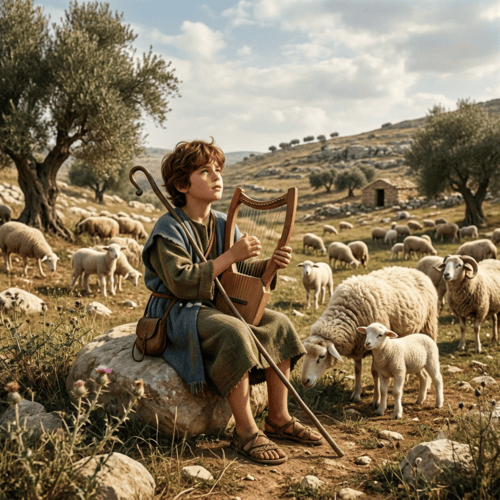
Psalm 78 says the same from another angle. God took David from following the nursing ewes, and with upright heart he shepherded them (Psalm 78:70-72). The commendation attaches to his work as shepherd of God’s people—his office—not to his private record.
Saul and David: Two Confessions
Still, the objection stands. Both men sinned. Both said “I have sinned”. Why did one keep the kingdom and the other lose it? Read the two confessions side by side.
| SAUL (1 SAMUEL 15) | DAVID (2 SAMUEL 12; PSALM 51) | |
|---|---|---|
| The words | “I have sinned”—then at once, “because I feared the people” (v. 24) | “I have sinned against the LORD” (12:13). No qualifier |
| Who is blamed? | The people, the soldiers, the circumstances | Himself alone: against you, you only, have I sinned (Psalm 51:4) |
| What follows? | Consulting a medium at Endor (1 Samuel 28) | A psalm handed to the choirmaster for public singing |
| The Spirit | The Spirit departs from him (1 Samuel 16:14) | Take not your Holy Spirit from me (Psalm 51:11) |
Look at the last line. David had watched the Spirit leave Saul; his prayer isn’t entitlement but a plea—don’t do to me what you did to him. And look at the third. Saul, confronted, protected his reputation. David wrote his own disgrace into a song and handed it to the national worship leader. Israel sang about its greatest king’s worst crime, in public, for centuries.
Here’s the vital point, easily got backwards. David’s repentance didn’t earn God’s favour. It was evidence that God’s favour was already at work in him. A dead man doesn’t choose to breathe; breathing shows he is alive. Repentance isn’t the payment for grace but proof of it.
Sinclair Ferguson has often observed repentance isn’t one act performed once but the whole shape of the Christian life. That’s David. He fails, and comes back. He fails again over the census, and before anyone confronts him his conscience strikes: I have sinned greatly in what I have done (2 Samuel 24:10).
The confessional tradition in Reformation churches says exactly this and names David as its example. Believers may fall into grievous sins and bring temporal judgement on themselves, yet not fall from the state of grace, because they’re kept by God and not by themselves (Westminster Confession of Faith 17.3).
Why God Chose Him: The Answer Paul Gives
So why David? The honest answer the Bible gives is: because God decided to. 1 Samuel 16 reads like a controlled experiment. 7 sons file past; each is rejected. The 8th isn’t even called in from the field—nobody thought him worth a reckoning. Every visible reason is stripped away until the only explanation left is God’s own purpose.
It’s the pattern of Israel’s election: It was not because you were more in number than any other people that the LORD set his love on you… but it is because the LORD loves you (Deuteronomy 7:7-8). The reason sits in God, not the one chosen. Dutch theologian Herman Bavinck made this his settled emphasis: grace that could be earned wouldn’t be grace at all.
But the strongest evidence almost never gets quoted, and it comes from Paul. In Romans 4 he is proving that God credits righteousness apart from works, and he needs a witness. Whom does he call? David—quoting Psalm 32, David’s own psalm of confession: Blessed are those whose lawless deeds are forgiven, and whose sins are covered (Romans 4:7).
THE POINT IN ONE SENTENCE
The man Scripture calls “after God’s own heart” is the same man Paul uses to prove righteousness is credited apart from works. The two descriptions aren’t in tension. They’re the same doctrine, said twice.
David isn’t Exhibit A for human merit. He’s Exhibit A for forgiveness. He’s called blessed not because there was nothing to count against him, but because God chose not to count it.
Does God Have Favourites?
Now to the second half of the question. Scripture is emphatic God shows no partiality. The Greek word is prosopolempsia—literally “face-receiving”, accepting someone for their face, appearance or status. Deuteronomy 10:17, Acts 10:34, Romans 2:11 and James 2:1-9 all deny it of God flatly.
But read the contexts and a pattern emerges. Every one concerns judgement—deciding a case—and every one concerns judging by external status: bribes (Deuteronomy 10:17), nationality (Acts 10:34), Jew and Greek at the judgement seat (Romans 2:11), the rich visitor given the better seat in church (James 2:1-9). Partiality, in Bible language, is corruption in a judge. Nobody will stand before God and find their money or family name tilted the scales. Election is a different category, and confusing the two is where the objection goes wrong.
| PARTIALITY (CONDEMNED) | PARTICULARITY (GOD’S FREEDOM) | |
|---|---|---|
| What kind of act? | A judgement—deciding what someone is owed | A gift—giving what nobody is owed |
| On what basis? | External status: wealth, race, looks, bribes | God’s own purpose alone (Romans 9:11) |
| Who is wronged? | The one denied what justice owed them | Nobody. Grace withheld isn’t justice denied |
| Bible verdict | Always condemned | Always defended (Romans 9:14-15) |
Paul saw the objection coming and raised it himself. Having said God chose Jacob over Esau though they were not yet born and had done nothing either good or bad, he asks: Is there injustice on God’s part? Answer: By no means!—followed by God’s words to Moses, I will have mercy on whom I have mercy (Romans 9:11-15).
The logic is simple once you see it. Justice gives people what they’re owed; nobody is owed mercy—that’s what makes it mercy. If a rich man pays off one stranger’s debt, the other debtors haven’t been robbed. A gift freely given to one isn’t theft from another.
And if David were the favourite, look how he was treated
There’s a second answer, and it’s decisive. Favouritism, as humans practise it, means protection: the favourite is shielded, excused, covered for. Now look at David.
WHAT BEING CHOSEN COST DAVID
- He was exposed, not covered. A prophet confronted him to his face, and the scene stands in Scripture for all time (2 Samuel 12:1-12).
- The judgement was public and permanent. The sword shall never depart from your house (2 Samuel 12:10). Amnon, Tamar, Absalom and Adonijah are that sentence working out.
- He buried a child (2 Samuel 12:18).
- He lost his throne to his own son, fleeing Jerusalem barefoot and weeping (2 Samuel 15:30).
- His sin was set to music. Psalm 51 names the occasion in its heading. Israel sang it in worship.
If David had been God’s pet, 2 Samuel 11 would have been quietly dropped from the national archive. Instead it stands in full, in the sacred text of David’s own people. No royal court in the ancient world published anything like it about its founding dynasty. That isn’t how a God protects a favourite.
Amos states the principle: You only have I known of all the families of the earth; therefore I will punish you for all your iniquities (Amos 3:2). Being chosen brought more accountability, not less. Hebrews 12:6 says the same to Christians—the Lord disciplines the son He receives. Discipline is the mark of sonship, not its contradiction.
Chosenness was never a privilege ticket either. It was a job: You shall be shepherd of my people Israel (2 Samuel 5:2). David was picked to serve, and every psalm in which he pours out anguish and exhaustion shows what that service cost.
The Man Who Really Did All God’s Will
One thread remains, and it ties the whole question together. Acts 13:22 says the chosen man will do all my will. David plainly didn’t. He did some of it, failed at much of it, and repented of the rest. The description outruns the man.
Scripture knows this. Long after David was buried, God kept promising a coming king and calling Him David: I will set up over them one shepherd, my servant David (Ezekiel 34:23; see also 37:24). The name had become a title waiting for its true holder.
And here’s the detail that seals it. David wrote in Psalm 40:8, I delight to do your will, O my God. Hebrews takes those very words and puts them in the mouth of Christ as he enters the world: Behold, I have come to do your will, O God (Hebrews 10:7). Jesus Himself said, My food is to do the will of him who sent me (John 4:34).
David supplied the script; only his greater Son could speak it without a false note. Theologian Geerhardus Vos taught a generation to read the Old Testament this way: its great figures aren’t chiefly models to copy but signposts, and they point most clearly where they fall short.
So the phrase was never an invitation to measure ourselves against David and hope we score well. It announces that God chooses freely, forgives fully, disciplines those He loves, and keeps His people right through their worst failures—not because they’re impressive, but because He is faithful.
David isn’t the hero of his own story. He’s the evidence the story has a hero, and that it isn’t him.
Tough Questions, Honest Answers
Did God know David would sin with Bathsheba when He chose him?
Yes. God doesn’t learn anything, and He wasn’t caught out. That’s precisely why the choice cannot have been based on David’s foreseen goodness—God foresaw the adultery and the murder just as clearly as the psalms and the courage. Scripture is comfortable holding these together: at Pentecost, Peter says Jesus was handed over according to God’s definite plan and foreknowledge, and in the same sentence holds the men who did it fully guilty (Acts 2:23). God’s choice of David was never a bet placed on a promising candidate. It was a decision made with full knowledge of what David would become and what it would cost to forgive him.
Why did David’s infant son die for David’s sin?
The text is careful here. Nathan doesn’t say the child dies as a punishment the child deserved; he says the child dies as part of the judgement falling on David (2 Samuel 12:14). David is the one being disciplined, and the loss is his. It’s a hard passage and Scripture doesn’t soften it. But it does give us David’s own response, and it’s remarkable: he stops fasting, worships, and says, I shall go to him, but he will not return to me (2 Samuel 12:23). That’s not resignation—it’s confidence about where the child now is. Christians have long taken those words as real ground for hope regarding covenant children who die in infancy.
Was Saul saved? Did God’s rejection of him mean he was eternally lost?
Scripture doesn’t tell us, and it’s wiser not to pretend otherwise. What the text says clearly is that Saul was rejected from being king (1 Samuel 15:26) and that the Spirit who’d equipped him for that office departed from him (1 Samuel 16:14). Both of those statements are about his role, not explicitly about his eternal destiny. The signs aren’t encouraging—he consulted a medium and died by his own hand—but the Bible declines to pronounce a verdict, and so should we. What his life does teach is that holding a sacred office, being anointed, and even prophesying aren’t the same thing as belonging to God.
Is anyone else in the Bible called a man after God’s own heart?
No. David alone carries this description. Others receive their own titles: Abraham is called the friend of God (James 2:23), Noah is described as righteous and blameless in his generation (Genesis 6:9), Job as blameless and upright (Job 1:1), and Enoch simply walked with God (Genesis 5:24). The uniqueness of David’s title is a clue to its meaning—it’s bound up with kingship and the covenant promise of an everlasting throne (2 Samuel 7:12-16), which is why it eventually transfers to Christ rather than to a series of imitators.
Why was David not executed, when the law required death for both adultery and murder?
This is one of the sharpest questions in the Old Testament, and the answer isn’t that kings were exempt. Nathan’s reply gives the real explanation: The LORD also has put away your sin; you shall not die (2 Samuel 12:13). That’s an act of sovereign pardon, not a legal technicality—and it leaves a debt hanging over the story, because a just God cannot simply wave away murder. Psalm 51 shows David sensing this: he says God takes no delight in sacrifice, because no animal could cover what he had done (Psalm 51:16). The debt isn’t cancelled but carried forward, until it’s finally paid at the cross by the descendant of the man who incurred it.
Do the imprecatory psalms show God’s heart, or just David’s temper?
The psalms that call down judgement on enemies (Psalms 69, 109, 137) are genuinely uncomfortable, but they’re not private outbursts. Notice what David doesn’t do: he doesn’t take revenge himself. He hands the matter over to the only Judge who can weigh it rightly, which is exactly what Romans 12:19 tells Christians to do. These prayers are also, in the main, prayers of the king asking God to defend his covenant people against those attacking them, not personal score-settling. Christians can pray them today by directing them where the New Testament directs them: against evil itself, against the powers of darkness, and in longing for the final judgement that will put every wrong right.
How can I become a person after God’s own heart today?
The question is a fair one, but the starting point matters. You don’t become such a person by out-performing David—remember what he actually did. The New Testament’s answer: this standing comes by being joined to Christ, the true king after God’s heart, so that what is His becomes yours (Romans 4:5-8 uses David himself to make this point). From there the marks follow naturally: undivided loyalty with no rival gods, honest and quick repentance rather than managed excuses, a life soaked in Scripture and worship, and faithfulness in whatever ordinary work God has given you—which for David, remember, began with sheep.
Related Reads
- God Helps Those Who Help Themselves: Is It in the Bible?
- Why Do People Hate the Doctrine of Election?
- The Purpose of Election: Why Does God Choose?
- Understanding Predestination: Is God’s Choice Arbitrary?
- Unconditional Election: Why God’s Choice Is Entirely His Own
- Called Vs Chosen: Why Do The Differences Matter?