
Have a group of churchgoers quote a Bible verse about hard work, and sooner or later someone will say it: God helps those who help themselves. Preach it from a pulpit and heads will nod. Print it on a poster and nobody blinks. Survey after survey in the English-speaking world has found roughly three out of four adults believe the sentence comes from the Bible, and among people who call themselves Christians the number isn’t much lower.
It’s simply not there. You may search every page of every translation and you’ll not find it.
That would be a useful piece of trivia and nothing more. What makes it worth a whole article is this: the saying doesn’t merely fail to appear in Scripture. It teaches the opposite of what Scripture teaches. And because it sounds so sensible, so grown-up, so obviously true, it has quietly become the working religion of millions of people who’d be shocked to be told they believe something the Bible flatly denies.
The Bible doesn’t say God helps those who help themselves. The Bible says God helps those who cannot help themselves. That’s not a clever reversal for effect. It’s the whole story of redemption in a single line.
Where the saying actually comes from
The phrase has a family tree, and it’s worth tracing, because knowing the parents tells you a great deal about the child.
A short timeline
- Around the 6th century BC—Aesop tells the fable of Hercules and the Wagoner. A carter’s wheel sinks in the mud and he calls on his gods for help. Hercules tells him to put his own shoulder to the wheel first. The moral has come down to us as: the gods help those who help themselves.
- 5th century BC—Greek tragedians say much the same. Lines in Sophocles and Euripides carry the sense that heaven doesn’t assist the idle man.
- 1698—the English politician Algernon Sidney uses the phrase in recognisable modern English in his book Discourses Concerning Government, published after his execution.
- 1736—Benjamin Franklin prints it in Poor Richard’s Almanack, and from there it enters the bloodstream of American popular wisdom and never leaves.
The Franklin connection matters more than most people realise. Franklin wasn’t a Christian in any orthodox sense. He was a deist, which means he believed in a distant Creator who wound up the universe like a clock and then stepped back to let it run. If that’s your God, self-reliance isn’t one option among many. It’s the only option available.
THE POINT TO GRASP
This saying isn’t neutral folk wisdom that happens to be missing from the Bible. It carries its own doctrine of God—a God who watches from a distance and rewards initiative. Swallow the slogan and you’ve swallowed the theology attached to it.
What the Bible actually says about who God helps
Set the slogan beside the Bible and the contrast isn’t subtle. Scripture goes out of its way, again and again, to describe the people God rescues as those with nothing left to offer.
| PASSAGE | WHO GOD HELPS |
|---|---|
| Romans 5:6 | While we were still weak, at the right time Christ died for the ungodly. Not the promising. The ungodly. |
| Ephesians 2:1–5 | We were dead in the trespasses and sins before God made us alive together with Christ. A dead man cannot help himself. That is what makes him dead. |
| Romans 9:16 | So then it depends not on human will or exertion, but on God, who has mercy. Paul names effort directly and rules it out as the deciding factor. |
| Deuteronomy 10:18 | God executes justice for the fatherless and the widow—the two groups in ancient Israel with the least power to act for themselves. |
| Luke 18:9–14 | The man who lists his achievements goes home unjustified. The man who can only say God, be merciful to me, a sinner goes home righteous. |
That last one is the slogan’s obituary. Jesus tells a story in which one man helps himself and the other cannot, and it’s the helpless one who walks away right with God. If God helps those who help themselves were true, the Pharisee would be the hero of the parable. He’s clearly not. He’s the warning.
An old error in modern dress
Church history has a name for this mistake, and the name is worth learning because it explains why the error keeps coming back.
In the early 5th century a British monk named Pelagius grew alarmed at what he saw as moral laziness among Christians. He taught human beings are born with the natural ability to obey God, that we take the first step towards him, and that grace is God’s help along the way rather than the source of the whole journey. Pelagianism, as it came to be called, makes salvation something we begin and God completes.
Augustine of Hippo answered him. Augustine had prayed a line in his Confessions that Pelagius could not bear: “Give what you command, and command what you will.” In other words, Lord, if you require obedience of me, then you must supply the very obedience you require. Pelagius heard that as an excuse for idleness. Augustine understood it as the only honest prayer we sinners can pray.
The church sided with Augustine. Pelagianism was condemned at the Council of Ephesus in 431. A softer version—semi-Pelagianism, which says we make the first small move and God supplies the rest—was condemned at the Second Council of Orange in 529. The Council was blunt: even the desire to be cleansed is itself a gift, not an achievement.
BB Warfield, the great Princeton theologian of the last century, coined a sharp word for what’s left when grace is made a response rather than a cause: autosoterism, self-salvation. Warfield argued when all the systems are boiled down, only two remain. Either salvation comes wholly from God, or it comes, at the crucial point, from us. There is no third scheme, however carefully the language is softened.
RC Sproul made the same observation about our own day, and put it more provocatively. Pelagianism, he argued, isn’t an exotic heresy from the history books. It’s the natural religion of the fallen human heart. And a diluted, semi-Pelagian version of it is the default setting of a great deal of modern evangelical preaching.
What the historic confessions say
The churches of the Reformation put this in writing, and the wording is unusually direct.
| Confession | What it says |
|---|---|
| Heidelberg Catechism, Q&A 8 (1563) | Apart from being born again by the Spirit of God, we’re “wholly incapable of doing any good.” |
| Canons of Dort, III/IV.3 (1619) | All people are conceived in sin and are neither able nor willing to return to God, apart from the regenerating work of the Spirit. |
| Westminster Confession 9.3 (1646) | By the fall, the human will lost all ability to any spiritual good accompanying salvation. |
| Westminster Confession 16.3 | The believer’s ability to do good works is “not at all of themselves, but wholly from the Spirit of Christ.” |
Read that last line slowly, because it’s the one that settles the argument. Not at all of themselves. The confession isn’t saying most of our ability comes from God and a little from us. It leaves no percentage on our side of the ledger at all. John Calvin had said the same in the Institutes of the Christian Religion: man is so bound by the yoke of sin that of his own nature he cannot even aim at what is good, let alone accomplish it.
The grain of truth: God works through means
At this point a fair-minded reader will object: Doesn’t the Bible tell us to work? Doesn’t Proverbs mock the sluggard and send him to school with the ant? Doesn’t Paul say if a man will not work he shouldn’t eat?
Yes. All of that is true, and no honest reading of Scripture can avoid it. The Bible has nothing good to say about laziness. So where exactly does the slogan go wrong?
The answer is found in a doctrine sometimes called the use of means. The Westminster Confession puts it this way in its chapter on providence: God ordinarily works through means, though He remains free to work without them, above them, and against them. God feeds you—through farmers, markets and your own two hands. God protects a city—through walls, watchmen and sensible planning.
Nehemiah shows it in a single verse. Facing enemies who mean to attack his building project, he writes: And we prayed to our God and set a guard as a protection against them day and night. Not prayer instead of sentries. Not sentries instead of prayer. Both, in that order, without embarrassment.
THE DISTINCTION THAT UNLOCKS THE WHOLE QUESTION
Means aren’t merit. Setting a guard over the city doesn’t place God under obligation. It’s simply the ordinary channel through which God, who has already decided to keep the city, keeps it. The farmer’s labour doesn’t compel the harvest; it’s the appointed path along which God gives it.
So the Bible commands effort—real, strenuous, sweating effort. John Owen, writing on putting sin to death, told his readers to be killing sin or it would be killing them. That is not the language of passivity. The question is never whether the Christian works. The question is what the work is, and where it stands in the order of things.
Getting the order right
Everything turns on one small word in one famous passage. Paul writes to the Philippians: work out your own salvation with fear and trembling, for it is God who works in you, both to will and to work for his good pleasure.
For. Not and God will help you afterwards. Not and God will meet you halfway. The reason you can work at all is that God is already at work inside you. Sinclair Ferguson has made much of this pattern: the gospel gives before it demands, and every command in the Christian life rests on a gift already given. Turn that order around and you’ve not made Christianity more demanding—you’ve made it a different religion.
It helps to keep two things distinct here, because confusing them is where most people go wrong.
| JUSTIFICATION | SANCTIFICATION | |
|---|---|---|
| What it is | God declaring the sinner righteous, on the basis of Christ’s work alone | God making the believer holy over a lifetime |
| My contribution | Nothing whatever. Received by faith, and even the faith is a gift | Hard, daily, deliberate effort—which is itself worked in me by the Spirit |
| Where the slogan fails | It makes my effort the ground of God’s favour | It makes my effort self-generated rather than Spirit-given |
Why this saying wounds people
If the slogan were only a technical error, it could be corrected in a footnote. It’s worse. It functions as a means test for the mercy of God, and it does real damage to real people.
- To the depressed believer it says: help is being withheld until your performance improves. Which is precisely the thing he cannot deliver, and precisely why he is asking.
- To the person struggling with addiction it says: grace begins where your willpower runs out—so the further you fall, the further away God moves.
- To the poor it says: providence tracks productivity. This is a slander on God who describes Himself as the defender of the widow and the fatherless.
- To the dying it says nothing at all. And a gospel with nothing to say at a deathbed isn’t a gospel.
JI Packer observed the deepest problem with a religion of self-help isn’t that it’s too hard but that it’s fundamentally dishonest about our condition. It offers a ladder to people who have no legs. The slogan is, in the end, the Pharisee’s prayer rewritten as an aphorism—polished, respectable, and fatal.
The cross settles the question
There’s one argument that ends the discussion, and Paul makes it in a single sentence to the Galatians: if righteousness were through the law, then Christ died for no purpose.
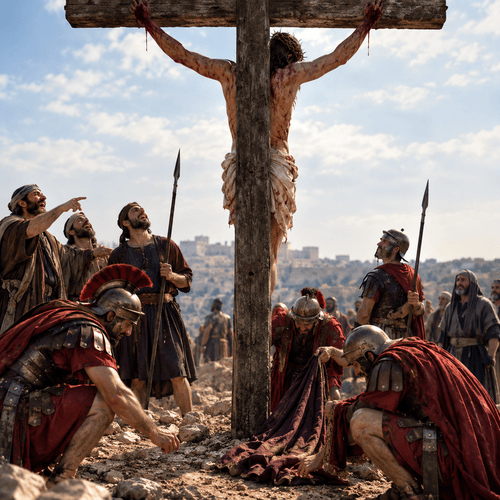
Follow the logic. If human beings could get themselves into a position where God’s help was owed to them—even a little, even at the starting line—then the cross was an overreaction. God could have sent better instructions, a stronger example, a firmer warning. Instead He sent His Son to die. The cross is God’s own verdict on our capacity to help ourselves, and the verdict is we have none.
So what should we say instead?
Not: God helps those who help themselves.
Rather: God helps those who cannot help themselves—and then, having helped them, He puts them to work.
That second half matters as much as the first. The Christian who has understood grace isn’t the one sitting still and waiting. He’s the one who works harder than anyone. He works from acceptance, not for it. He rests in a finished work and labours out of it.
The slogan promises a God who meets you halfway. The gospel offers something infinitely better: a God who came all the way—to a manger, to a cross, to a tomb—for people who couldn’t take a single step towards Him. Franklin’s proverb will make you tired. Christ’s invitation is addressed precisely to those who already are: Come to me, all who labour and are heavy laden, and I will give you rest.
Tough Questions, Honest Answers
Is “God helps those who help themselves” found in the Quran or in other religions?
The exact phrase isn’t in the Quran, though Quran 13:11 is often quoted in a similar spirit, and there is a well-known Islamic tradition in which a man is told to tie his camel and then trust in God. Interestingly, the camel saying is much closer to the biblical doctrine of means than the English slogan is: it assumes God is actively keeping the camel, and simply tells the man to use the rope God provided. Versions of the idea appear across many cultures, which is exactly what we should expect, since self-reliance is the instinctive religion of the human heart everywhere. That widespread appeal is a reason for caution, not confidence. A saying can be universally admired and still be untrue.
Doesn’t Hebrews 11:6 say that God rewards those who seek him?
It does, and the verse repays close attention. It says that whoever would draw near to God must believe that he exists and that he rewards those who seek him—which makes faith, not effort, the thing God responds to. Rewards inside a covenant of grace are not wages paid for services rendered; they are a father’s gifts to children who are already his. Augustine put it memorably: when God crowns our merits, he is crowning his own gifts. The reward is real, but it never becomes the reason God accepted us in the first place.
What about James 2, that faith without works is dead? Isn’t that the same idea?
No, because James and the slogan are answering different questions. James is asking how you can tell a living faith from a dead one, and his answer is that living faith produces works, just as a living tree produces fruit. The works are the evidence of faith, not the cause of God’s help. Notice too that James’s examples—Abraham and Rahab—are people who acted on promises God had already made to them. Fruit proves the tree is alive; it does not make it alive.
Is it wrong for a Christian to use self-help books, counselling or medication?
Not at all. These are means, and Scripture positively commends the use of means: Paul tells Timothy to take a little wine for his stomach, and Luke, a physician, is called a beloved brother rather than a man of weak faith. The error is never in using the tool; it is in treating the tool as the ground of God’s favour rather than a gift of it. A believer can go to a counsellor with real hope precisely because he is not depending on the counsellor for his standing before God. Test any resource by asking what it assumes about human nature—some self-help material is simply Pelagianism with a better cover design.
Is this saying the same thing as the prosperity gospel?
They’re cousins rather than twins. The prosperity gospel promises material returns on your faith; the slogan promises divine assistance in return for your initiative. What they share is the deeper mistake: both make God a respondent rather than an initiator, waiting to see what we will do before he acts. Both also turn hardship into evidence of personal failure, which is why both are so cruel to the suffering. Job’s friends held a version of this theology, and God’s assessment of their counsel at the end of the book is not flattering.
If God helps the helpless, should I stop saving money, planning ahead or seeing a doctor?
That’s the opposite error, and Scripture guards against it just as firmly. The Westminster Confession notes God ordinarily works through means, so ignoring the means isn’t deeper faith but a kind of presumption—precisely the temptation Jesus refused when Satan invited Him to jump from the temple. Nehemiah prayed and set a guard. Joseph stored grain through 7 years of plenty. Trust in providence doesn’t cancel prudence; it’s the only thing that makes prudence calm rather than anxious, because the outcome doesn’t finally rest on how well you planned.
How should I answer a friend who quotes this to me as Scripture?
Start by agreeing with what they’re reaching for, because they’re usually reaching for something true—God is not indifferent to diligence, and faith is not an excuse for idleness. Then say gently that the line is from Benjamin Franklin rather than the Bible, and ask them to read Romans 5:6 aloud: while we were still weak, at the right time Christ died for the ungodly. Then ask the simple question: who did Christ die for? The text answers for you, and the answer is not “those who helped themselves.” Most people have never once been told the phrase is not in the Bible, so keep the tone curious rather than corrective—you are handing them better news, not winning a point.
Related Reads
- Why Does God Call David a Man After His Own Heart? Does He Have Favourites?
- Did Jesus Teach Calvinism? John 6 and the Doctrines of Grace
- Prevenient Grace: 5 Reasons the Doctrine Fails
- What Is TULIP Calvinism? The Five Points Explained
- Total Depravity: The Doctrine That Makes Grace Make Sense
- Common Grace Vs Saving Grace: How Are They Different?
- Word of Faith Movement: What’s Desperately Wrong About It?