
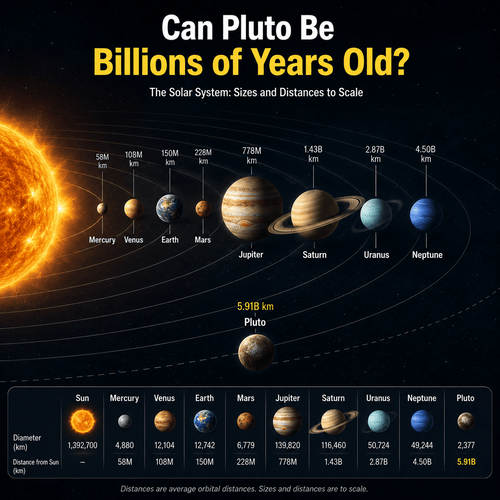
Pluto is small. Pluto is cold. Pluto is a long way from the sun. For most of the 20th century, everything astronomers believed about it pointed in one direction: this is a frozen, silent, dead world sitting at the edge of the solar system, unchanged for billions of years.
Then, on 14 July 2015, a piano-sized spacecraft called New Horizons swept past Pluto at nearly 50,000 kilometres per hour, and the pictures came back. Nothing looked the way it was supposed to look.
Ten years later, the surprises haven’t stopped coming. Fresh studies published in 2024 and 2025, including the first observations of Pluto by the James Webb Space Telescope, have deepened the puzzle rather than settled it. And the puzzle is worth studying, because it touches an even bigger question: how old is the solar system really, and how do we know?
A World That Should Have Been Dead
Let’s start with the basic Pluto facts, because the facts do most of the work in this discussion.
| FEATURE | VALUE | WHAT IT MEANS |
|---|---|---|
| Average distance from the sun | About 5.9 billion km (39 times the Earth–sun distance) | Sunlight there is roughly a thousand times weaker than on Earth |
| Diameter | About 2,377 km | Smaller than the width of Australia; about two-thirds the size of our moon |
| Surface temperature | Around minus 230°C | Cold enough for nitrogen gas to fall as frost |
| Density | About 1.85 grams per cubic centimetre | Roughly two-thirds rock, one-third ice |
| Year length | 248 Earth years | Pluto has not completed one orbit since it was discovered in 1930 |
| Moons | Five, of which Charon is by far the largest | Charon is about half Pluto’s width—an unusually large partner |
Now hold on to one simple idea, because the whole argument rests on it: small things lose heat quickly.
A cup of tea goes cold in 20 minutes. A bathtub of hot water takes hours. A swimming pool takes days. The larger the object, the smaller its surface is compared with its volume, and the longer it holds warmth. Pluto is small. It has been sitting in the deep freeze of the outer solar system, and on the standard timeline it’s been sitting there for about 4.5 billion years.
Any warmth left over from the moment it formed should have leaked away long ago. It should be geologically dead—no volcanoes, no moving ice, no fresh surfaces. It should simply sit there and collect scars from passing rocks.
That’s exactly what astronomers expected. It’s not what they found.
The Puzzle in Plain English
Danny Faulkner, an astronomer with Answers in Genesis, wrote after the flyby that Pluto ought to be far too cold for recent volcanic activity, that any leftover heat from its formation would have dissipated long ago, and that its low density rules out the long-lived radioactive heating usually invoked for Earth. “This is why the lack of craters on Pluto is such a shock,” he observed.
Notice Faulkner is closing three doors one after another.
- Pluto cannot be warmed from outside, because the sun is far too distant and far too faint at that range.
- It cannot still be living off the warmth it had when it was made, because a small object radiates its heat away, and 4.5 billion years is more than enough time for the tank to run empty.
- And it cannot run on radioactivity the way the earth does, because radioactive elements sit in rock, and Pluto’s low density tells us it’s largely ice rather than rock—there is simply not enough fuel on board.
And that’s the reason the missing craters matter so much. Craters are the ordinary record of time passing; if they’ve been wiped off a surface, something has been actively resurfacing that surface, and resurfacing takes power. So where does that power come from?
The Heart With No Scars
Space isn’t empty. Small pieces of rock and ice are constantly flying about, and when one strikes a solid surface it leaves a bowl-shaped hole called an impact crater. Craters build up over time, so counting them is the standard way astronomers estimate how long a surface has been exposed. Many craters means an old surface. Few craters means the surface is new—something has wiped the old scars away.
The most famous feature on Pluto is a huge, pale, heart-shaped region. Its western half is a vast plain of frozen nitrogen roughly 1,000 kilometres across, named Sputnik Planitia. When the images were analysed, scientists couldn’t find a single impact crater on it. Not one, down to the smallest features the cameras could resolve—about 625 metres across in the sharpest pictures.
David Trilling, an astronomer at Northern Arizona University, decided to work out what that empty surface actually means. His reasoning was simple. Space in that region isn’t completely empty—small chunks of rock and ice are drifting about, and astronomers have a rough idea of how many. So he asked a straightforward question: if you left a fresh patch of ground sitting out there, how long would you have to wait before something hit it hard enough to leave a mark the cameras could see?
His answer was less than ten million years. That sounds like a very long time, and by ordinary standards it is. But it’s only about a 500th of Pluto’s supposed age. Trilling himself called that maximum age surprisingly young.
Other scientists brought the number down much further. William McKinnon and his colleagues noticed the frozen nitrogen isn’t sitting still. It’s slowly turning over from below, the way thick porridge moves in a warm pan—rising in the middle of each patch, spreading out, then sinking again at the edges. Scientists call these slow-moving patches convection cells, and on Pluto they’re tens of kilometres across. If that’s what’s happening, the whole visible surface would be wiped clean and replaced in as little as 500,000 years.
Put That in Perspective
If Pluto’s supposed 4.5-billion-year history were compressed into one calendar year, the entire visible surface of Sputnik Planitia would have formed during the final hour of 31 December.
Kelsi Singer of the Southwest Research Institute and her team went on to map more than a 1000 craters elsewhere on Pluto and found a mixture of ancient, middle-aged and very young terrain. Their conclusion: Pluto has been geologically active throughout its history.
Notice carefully what that conclusion does. It doesn’t solve the problem. It makes it far worse. A single brief burst of activity may be explained away as a one-off event. Continuous activity for billions of years on a tiny, frozen world, however, needs a power supply—and nobody can find one.
The New Clues: What Scientists Found Since 2023
If the 2015 flyby had been the end of the story, sceptics could fairly say the fuss had died down. It hasn’t. Three recent lines of evidence have made Pluto look even younger, not older.
An ice supervolcano called Kiladze
A cryovolcano is an “ice volcano”. Instead of erupting molten rock, it erupts a slushy mixture of water and other chemicals from below the crust, which then freezes on the surface. Pluto already had two suspected cryovolcanic regions, Virgil Fossae and Uncama Fossa.
Then attention turned to a 50-kilometre depression named Kiladze. It was catalogued as an impact crater, but a closer look showed it lacks the shape a crater should have. Its walls are broken by collapse pits and faults, and its chemical signature is entirely different from the surrounding land: water ice instead of methane ice.
A team led by Al Emran, working with veteran planetary scientist Dale Cruikshank, concluded Kiladze is most likely a collapsed volcanic caldera—an ice supervolcano. They estimated one or more explosive eruptions flung out something like 1,000 cubic kilometres of icy magma, and that the eruption happened, in their words, “possibly in the last several million years”—significantly more recently than the general age of Pluto’s surface.
The ammonia clock
Here’s the detail that turns an interesting discovery into a serious problem for the standard timeline.
The water ice at Kiladze carries the chemical fingerprint of an ammonia compound. Ammonia matters for two reasons.
- It’s antifreeze. Ammonia mixed with water lowers the freezing point substantially—by tens of degrees, and by as much as 100°C in the right mixture. Without something like it, Pluto’s interior would be frozen solid.
- It’s fragile. Pure ammonia is quickly destroyed on an exposed surface by ultraviolet light from the sun, by charged particles in the solar wind, and by cosmic rays arriving from deep space. It cannot sit on the surface indefinitely.
So finding ammonia on the surface is rather like finding a footprint in fresh snow. The footprint doesn’t tell you the age of the mountain, but it tells you somebody walked past recently. Researchers used exactly this reasoning to argue that Kiladze erupted recently in Pluto’s history.
We should be careful here, because the case is stronger when it’s stated accurately. What has been detected isn’t necessarily pure ammonia ice but an ammoniated compound, possibly a salt, and such compounds survive radiation better than pure ammonia does. The clock is therefore a rough one. But it still runs in the same direction, and the same argument crops up again and again across the outer solar system.
What the James Webb Space Telescope saw in 2025
In 2025, an international team led by Tanguy Bertrand of the Paris Observatory published the first detailed infrared study of Pluto using the James Webb Space Telescope. For the first time, instruments could separate Pluto’s heat glow from Charon’s and study the haze suspended in Pluto’s thin atmosphere.
The results confirmed a prediction made nearly a decade earlier by Xi Zhang of the University of California, Santa Cruz. The haze particles absorb ultraviolet sunlight and radiate heat away, cooling the upper atmosphere—while at the same time giving gas molecules enough energy to escape Pluto’s weak gravity altogether. Pluto is losing methane to space at a rate of roughly 1.4 kilograms every second.
Some of the lost gas doesn’t simply vanish. It drifts across to Charon, freezes onto its poles and is chemically darkened by radiation into reddish organic material called tholins. Charon’s strange red cap is, quite literally, made of Pluto’s exhaled atmosphere.
The Question the Loss Rate Raises
A body that has been leaking volatile ices for 4.5 billion years needs a very large tank and a very reliable pump. Pluto’s nitrogen and methane sit in a limited surface reservoir that must be constantly recharged from below. Everything about the system looks like a process that started recently, not one that has been running from the deep past.
The Real Problem Isn’t Craters. It’s Heat.
This is the heart of the matter, and it’s where the argument becomes very difficult to escape.
A critic can fairly say a missing crater doesn’t by itself prove a young world. Craters can be erased. Fair enough. But erasing craters isn’t free. Moving ice, resurfacing plains, cracking a crust and firing a cryovolcano all require energy. So the question isn’t “why are there no craters?” It’s “where does the power come from?”
In our solar system there are only four realistic sources of internal heat for a body like Pluto. Every one of them fails.
| POSSIBLE HEAT SOURCE | HOW IT WORKS | WHY IT DOESN’T WORK FOR PLUTO |
|---|---|---|
| Sunlight | Warms a surface from outside | At 39 times Earth’s distance, sunlight is about a thousand times weaker. It cannot melt ice, let alone drive volcanoes |
| Radioactive decay | Unstable elements in rock release heat as they break down | Pluto is a small body with a modest rocky fraction. The available budget is tiny, and it also fades over time as the elements run out |
| Tidal heating | A larger neighbour’s gravity flexes and kneads the body, generating friction heat, as Jupiter does to Io | Pluto and Charon are locked face to face on an almost perfectly circular orbit. There’s no flexing left to do. Tidal heating has already finished |
| Leftover formation heat | Warmth from the violence of the body’s birth | This is precisely the heat that should have drained away over billions of years in a small object |
The Institute for Creation Research put the difficulty simply: secular astrophysicists don’t know “how tiny, distant Pluto could have maintained this energy” across the vast ages they assume.
Astrophysicist Jason Lisle, writing a year after the flyby, drew the obvious conclusion from geology. Mountains of water ice, canyons, frozen nitrogen lakes and evidence of past eruptions all point to a world that was once internally warm. “Apparently, Pluto was warmer when the Lord first created it,” he wrote. On a timeline of thousands of years rather than billions, leftover warmth isn’t a mystery at all. It’s simply what you’d expect from a young world still settling down.
Watch What Happens When the Data Doesn’t Fit
This is the part of the story that most news reports leave out, and it’s the most revealing part of all.
When evidence conflicts with the assumed age, the age is almost never the thing that gets questioned. Instead, new mechanisms are proposed to protect it. Each proposal is clever, and each is published by capable scientists doing careful work. But look at the pattern they form when you line them up.
| THE PROBLEM | THE PROPOSED SOLUTION | YEAR |
|---|---|---|
| A subsurface ocean should have frozen solid long ago | A layer of gas hydrates acts as an insulating blanket over the ocean | 2019 |
| The interior should be frozen | Ammonia acts as a natural antifreeze, keeping pockets liquid | ongoing |
| Sputnik Planitia sits in the wrong place and has the wrong shape | A 730 km object struck Pluto at a shallow angle and left a heavy rocky core buried inside—a model that removes the need for a present-day ocean altogether | 2024 |
| The presence of an ocean needs to be explained | A salty, dense ocean survives beneath an ice shell 40 to 80 km thick | 2024 |
| Where did the heat for an ocean come from? | Charon formed by “kiss and capture”, and the friction of that encounter supplied the heat | 2025 |
Two things deserve attention.
- The proposals point in opposite directions. In April 2024 a team led by Harry Ballantyne at the University of Bern published a model of an oceanless Pluto, arguing a buried rocky mass, not an ocean, explains the basin. In January 2025 a team led by Adeene Denton at the University of Arizona published a model designed to explain how Pluto got its ocean. Both were published in respected journals within nine months of each other.
- The reason for the newest model is stated openly. Denton’s “kiss and capture” scenario—in which, as she describes it, “the bodies collide, stick together briefly and then separate”—was welcomed partly because it supplies heat without requiring Pluto to have formed in the intensely radioactive early solar system. That timing requirement, the researchers noted, had been troubling planetary scientists.
Only One Explanation Works — But No One’s Buying
The point isn’t that these scientists are dishonest. They’re not. The point is that the age is treated as fixed and the physics is asked to bend around it. A framework in which the central claim is never the thing that can be wrong is a framework worth examining carefully. If Pluto had turned out cold, cratered and dead, that would have been announced as a triumphant confirmation of the standard timeline. It turned out warm and active—and that too is a confirmation. A claim that fits every possible result isn’t being tested by any of them.
Pluto Isn’t the Only Surprise
One anomaly is a puzzle. A dozen anomalies pointing the same way is a pattern. Pluto sits inside a long list of outer solar system bodies that look far younger and far livelier than a 4.5-billion-year timeline would predict.
- Io, moon of Jupiter: It’s the most volcanically active body known, yet it resurfaces itself so fast that impact craters are essentially absent.
- Enceladus, moon of Saturn: The small icy moon just 500 km across, sprays jets of water vapour and ice grains into space from cracks near its south pole.
- Europa, moon of Jupiter. It’s cracked, remarkably smooth ice shell with very few craters, suggests frequent renewal.
- Triton, moon of Neptune. It’s even colder than Pluto, and yet Voyager 2 photographed dark plumes erupting from its surface.
- Ceres, in the asteroid belt. It has bright deposits of salt on its floor that should have faded; their presence implies recent activity from below.
- Comets. These are icy bodies that lose material every time they pass the sun and should have been exhausted long ago, which is why additional reservoirs are said to keep resupplying them.
Each case has its own proposed rescue. But the direction of the surprises is consistent, and it’s always the same direction: younger than expected, more active than expected, less exhausted than expected.
Answering the Strongest Objections
A case is only worth trusting if it faces the best arguments against it. Here are the four strongest, stated fairly.
“Pluto also has ancient, heavily cratered ground. Does that not disprove a young Pluto?”
It would, if the claim were that Pluto has no craters at all. But that is not the claim. No one disputes that some parts of Pluto are heavily covered with impact marks. The real question is how quickly those craters formed. Scientists estimate the age of a surface by counting its craters, but this depends on assumptions about how often objects have struck Pluto. If the early solar system experienced a period of intense bombardment over a short time—whether during the Creation Week or during the upheavals associated with the Flood—then a heavily cratered surface could reflect the intensity of that event rather than billions of years of time. This is still an area of research, so it would be wrong to claim the discussion is completely settled.
“A surface without craters simply means it was resurfaced, not that Pluto is young.”
Agreed. That’s why the argument in this article doesn’t depend on counting craters. The important point is the resurfacing itself. Something must provide the energy needed to renew Pluto’s surface. Yet, if Pluto has really been cold and isolated for about four billion years, where would that energy come from? The explanations proposed so far require either a heat source that should have run out long ago or a special mechanism to explain why Pluto is still geologically active.
“This is an argument from ignorance. Science hasn’t explained it yet.”
That’s a serious objection, and deserves a serious answer. Science often solves problems that once seemed impossible to explain. Some of these questions may eventually have better answers. But there’s a difference between one unexplained observation and a growing pattern of observations that repeatedly create problems for the assumed timeline. When new explanations are proposed mainly because the observations don’t fit the expected age, that’s significant. It suggests the four-billion-year timeline itself may be under pressure.
“Creationists just cherry-pick evidence that supports their view.”
This criticism would be stronger if creationists accepted every argument that appeared to support their position. They don’t. Danny Faulkner, for example, reviewed 25 of the most popular astronomical arguments used by young-earth creationists. He concluded some should be rejected altogether, others needed updating, and only a few were genuinely strong. That’s what a self-correcting position looks like. The Pluto argument survived that review because it’s based on a basic physical principle: small, cold, isolated bodies lose their heat. The question is whether Pluto should still be showing signs of internal activity having supposedly spent billions of years in such a state.
What the Heavens Are Actually Telling Us
Scripture doesn’t tell us Pluto’s age directly. Pluto isn’t mentioned in the Bible, and it would be foolish to pretend otherwise. But Scripture does tell us the kind of world we’re living in.
Genesis places the sun, moon and stars on the fourth day of a completed creation week: “And God set them in the expanse of the heavens to give light on the earth” (Genesis 1:17). What was made was not a half-formed cloud of gas waiting billions of years to organise itself. It was finished, functioning and, in God’s own assessment, good.
That matters for how we read a young-looking world. If God created a mature solar system, then bodies that still carry warmth from their making aren’t an embarrassment. They’re a signature.
Two cautions are worth stating plainly.
- This isn’t a God-of-the-gaps argument. The claim is not “science cannot explain Pluto, therefore God”. The claim is that the evidence fits a recently created solar system more naturally than an ancient one, and that the ancient interpretation survives only by continual repair.
- Pluto isn’t a test of faith. No one is saved or lost over a dwarf planet. Christians who disagree about the age of the solar system are not thereby denying the gospel, and this article is not written to make anyone feel unwelcome. It is written because truth about the created order is worth pursuing carefully.
Where This Leaves Us
Strip away the technical language and the position is very simple.
A small, frozen body 5.5 billion kilometres from the sun has no working heat source, and yet it’s churning nitrogen ice, erupting ice volcanoes, venting gas to space and painting its own moon red. Every proposed solution requires an additional mechanism that was not predicted before the data arrived and was designed afterwards to fit it.
There’s a much simpler reading. Pluto looks young because Pluto is young. It still has warmth because it hasn’t had time to lose it. It has few scars in places because there hasn’t been time to collect them. It’s still leaking gas because the tank hasn’t yet run dry.
Astronomers went to Pluto expecting a corpse. What came back down the radio link was a world that’s still breathing. That’s worth thinking about carefully.
Tough Questions, Honest Answers
Why was Pluto demoted from a planet to a dwarf planet?
In 2006 the International Astronomical Union adopted a new definition requiring a planet to orbit the sun, to be round under its own gravity, and to have cleared other objects out of its orbital neighbourhood. Pluto meets the first two conditions but not the third, because it shares its region with many other icy bodies. The decision was about naming conventions, not about new discoveries, and a number of astronomers still object to it. Nothing in the reclassification changes the scientific puzzle discussed above. A dwarf planet that should be frozen solid but isn’t remains exactly as difficult to explain under either label.
How far away is Pluto, and how long did New Horizons take to get there?
Pluto orbits at an average distance of about 5.9 billion kilometres from the sun, though its orbit is noticeably stretched, so the distance varies considerably. New Horizons launched in January 2006 and reached Pluto in July 2015—a journey of nine and a half years at some of the highest speeds ever achieved by a spacecraft. Radio signals from that distance take more than four hours to reach Earth even travelling at the speed of light. That distance is precisely why Pluto ought to be cold and inert, and why what New Horizons found was so unexpected.
Could there be life in an ocean beneath Pluto’s surface?
Some researchers have proposed a salty ocean beneath a thick ice shell, and this has naturally led to speculation about life. The speculation runs far ahead of the evidence. Liquid water is a requirement for life as we know it, but it is nowhere near sufficient—living cells need information-rich molecules that have never been observed to assemble by chemistry alone. Scripture presents life as a direct act of God rather than a chemical accident, and the burden of proof rests firmly on those claiming otherwise. If liquid water is found on Pluto, the honest scientific response is that Pluto has water, not that Pluto has life.
Does the Bible say anything about planets we cannot see with the naked eye?
It doesn’t name them. Scripture isn’t an astronomy textbook, and it describes the heavens in the ordinary language of an observer standing on the earth. What it does say is comprehensive: God made the heavenly bodies, He set them in place, and He sustains them. Isaiah 40:26 speaks of Him calling out their host by number and by name, which comfortably covers objects nobody on earth had yet seen. Pluto was unknown to human beings until 1930, but it was never unknown to its Maker.
If nobody can collect rock samples, how do scientists estimate the age of a surface at all?
For distant worlds the main method is crater counting. Astronomers estimate how often objects of a given size strike a surface, count the craters they can see, and calculate how long it would take to accumulate that many. The method is genuinely useful for comparing one region with another—it can tell you this plain is younger than that highland. But it cannot deliver an absolute age without an assumed impact rate stretching back billions of years, and that rate is estimated, not measured. This is why crater ages should be read as relative comparisons rather than as readings from a clock.
What’s the Kuiper Belt, and why do creationists mention comets when it comes up?
The Kuiper Belt is a broad zone of icy bodies beyond Neptune, and Pluto is one of its largest members. It matters to this discussion because comets pose a longstanding age problem. Every time a comet passes near the sun it loses material, so comets have limited lifetimes—far shorter than the assumed age of the solar system. Rather than concluding that the solar system is young, astronomers proposed reservoirs that continually resupply fresh comets, of which the Kuiper Belt is one. Objects certainly exist out there, but the deeper question is whether the reservoir was proposed because the evidence demanded it or because the timeline required it.
Will any spacecraft visit Pluto again?
Not in the foreseeable future. New Horizons was a flyby mission, so it swept past in a matter of hours and continued outwards into the Kuiper Belt, where it remains operational and still returning data. Several orbiter concepts have been proposed, but none has been approved, and the travel time alone would be well over a decade. Most new findings therefore come from re-analysing the 2015 data and from telescopes such as James Webb observing from a distance. That makes the existing dataset unusually valuable—and it means the questions raised here are likely to remain open for a long time.
Related Reads
- The Sun’s Age: Is It Really a Showstopper for a Young Earth?
- Saturn, the Ringed Planet: Challenge to Random Evolution
- Distant Starlight: New Solutions to the Light-Time Problem
- Can a Young Earth Explain Impact Craters? Evidence Says Yes
- 6000 Years Or 4.5 Billion: How Old is the Earth Really?
- How the Grand Canyon Challenges Evolution’s Deep Time
- The Cambrian Explosion: Why the Fossil Record Runs Top-Down