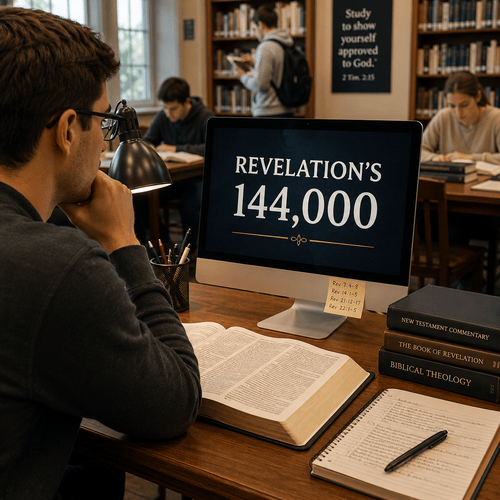
Few numbers in the Bible can start as many arguments as this one. The 144,000. The number has been printed on prophecy paperbacks, preached as a squad of end-time Jewish missionaries, and claimed by religious movements as their own membership roll. Often it suggests to ordinary believers heaven has a quota, and they’re left wondering whether they’re inside that number or outside it.
So let’s slow down. And read the two passages that actually mention the number, in the order John wrote them, and let Revelation explain its own symbols. The answer turns out to be one of the most comforting pictures of the church in the Bible.
The whole doctrine rests on two passages
This is the first thing to notice. The number appears in only two places in Scripture:
- Revelation 7:1-8 and
- Revelation 14:1-5.
Every chart, timeline and claim about who these people are must be built out of those two short paragraphs.
Where the number appears: an answer to a terrified question
Revelation 6 opens the seven seals, and the sixth seal brings the sky rolling back and kings hiding in caves. The chapter ends with a question shouted by the terrified: “for the great day of their wrath has come, and who can stand?” (Revelation 6:17).
Chapter 7 is the answer. Before the seventh seal is opened, John presses pause and shows us who can stand. That’s the purpose of the whole chapter. It isn’t a side note about a special class of people; it’s a reassurance to frightened Christians that when the day of wrath falls, God knows exactly who belongs to Him.
Scholars call this an interlude. Vern Poythress of Westminster Theological Seminary notes such pauses aren’t delays but explanations: they show the same events from heaven’s viewpoint, so the church on earth can understand what’s happening to it.
However, it does raise the question: if the answer covers only 144,000 individuals, where does that leave the rest of the church?
John hears a number, then sees a crowd
Chapter 7 gives us two panels, and the seam between them is the most important clue in the whole discussion.
- Panel one (verses 4-8): John says, “And I heard the number of the sealed, 144,000, sealed from every tribe of the sons of Israel.”
- Panel two (verses 9-17): John says, “After this I looked, and behold, a great multitude that no one could number, from every nation, from all tribes and peoples and languages.”
Notice the verbs: John hears one thing, then sees another. So, are they two groups, or one group described twice?
Revelation already hints at how we’re to read the pattern. In Chapter 5, John weeps because no one’s worthy to open the scroll, but an elder tells him to stop crying because the Lion of the tribe of Judah has conquered. Then John looks, and what he sees isn’t a lion at all: “I saw a Lamb standing, as though it had been slain” (Revelation 5:6). One person, two pictures. The Lion conquers by being the Lamb.
The Pattern John Has Already Taught Us
Revelation 5:5—John HEARS of the conquering Lion of Judah.
Revelation 5:6—John SEES a slain Lamb. One Christ, two images.
Revelation 7:4—John HEARS a counted number sealed out of the tribes of Israel.
Revelation 7:9—John SEES an uncountable crowd out of every nation.
One church, two images: numbered and secure on earth, innumerable in glory.
Read this way, the apparent contradiction becomes the message. God can count His people to the last person, so not one is lost; no human being could ever count them, so the promise to Abraham of descendants beyond numbering has been kept. GK Beale, in his massive commentary on Revelation, argues these are two views of one company: the church mustered for battle, and the church standing in glory.
12 times 12 times a 1000
Now look at the number itself. It isn’t a random total. It’s 12 x 12 x 1,000.
- 12: the number of the tribes of Israel and of the apostles of the Lamb—the old covenant people and the new covenant people.
- 12 again: squared, which in biblical usage signals fullness and completeness rather than an exact headcount.
- One thousand: ten cubed, the standard biblical way of saying “an enormous amount”. When Psalm 50:10 says God owns “the cattle on a thousand hills”, nobody goes counting hills.
If that still feels like clever arithmetic, Revelation settles it in Chapter 21. There John measures the New Jerusalem, which is explicitly the whole redeemed community, the Bride of Christ. It is 12,000 stadia on each side; its wall is 144 cubits; it has twelve gates named for the tribes and twelve foundations named for the apostles. The same numbers describe every believer without exception. Nobody treats those measurements as an architect’s survey. Why treat 144,000 as a census figure?
There’s also a plain instruction at the front of the book. Revelation 1:1 says God “signified” this revelation to John—the Greek word means to make known by signs. We all accept that in practice: nobody expects a literal seven-horned Lamb or a woman clothed with the sun. William Hendriksen put it simply: this is a book of symbols, and we mustn’t abandon symbolism the moment we reach a number we’d like to be literal.
The tribal list that matches no other list in the Bible
Here’s the part most readers skip, and it’s the strongest evidence of all. The Old Testament contains roughly 20 lists of the twelve tribes. The list in Revelation 7:5-8 matches none of them. Every difference is deliberate.
| What Revelation 7 Does | What We Would Expect | Why John Does It |
|---|---|---|
| Judah is listed first | Reuben, the firstborn son (Genesis 29:32) | Judah is the tribe of the Messiah (Genesis 49:10; Hebrews 7:14). The list is arranged around Christ, not birth order. |
| Dan is left out completely | Dan appears in every Old Testament tribal list | Dan housed Micah’s stolen idol and later Jeroboam’s golden calf (Judges 18:30-31; 1 Kings 12:29-30). Idolatry has no place here. |
| Ephraim is left out, but “Joseph” is listed alongside Manasseh | Ephraim and Manasseh, or simply Joseph | Ephraim became the byword for northern unfaithfulness (Hosea 4:17). The apostate name is quietly dropped. |
| Levi is counted as one of the twelve | Levi is normally excluded: no land, no place in the military census (Numbers 1:47-49) | Here every member is a priest (Revelation 1:6; 5:10; 1 Peter 2:9). The whole people is now Levi. |
| Each tribe has exactly 12,000 | Unequal tribal sizes, as in Numbers 1 and 26 | Real censuses are never tidy. Perfect symmetry is the signature of a symbol. |
Put those five observations together: and the picture begins to emerge. This isn’t a register of Jewish families. It’s an idealised Israel: headed by the Messiah’s tribe, purged of idolaters, entirely priestly, perfectly ordered. It’s Israel as God always intended it to be—which is to say, the people of God gathered in Jesus Christ.
Revelation has already prepared us for this. Twice Jesus speaks of those “who say that they are Jews and are not” (Revelation 2:9; 3:9). Paul says the same without symbols: “If you are Christ’s, then you are Abraham’s offspring” (Galatians 3:29).
Sealed for the battle, not spared from it
Why count them at all? Because in the Old Testament a census had one main purpose: to number the men fit for war (Numbers 1:3; 26:2). Richard Bauckham has shown how deeply Revelation echoes this language, reading the book almost as a Christian war scroll—a muster of the Lamb’s army before the fighting begins.
That single insight unlocks the strangest line in the discussion. Revelation 14:4 says of the 144,000, “It is these who have not defiled themselves with women, for they are virgins.” Read as biology, that would make the redeemed 144,000 celibate men, excluding every woman and every married believer in history. Read as military language it is straightforward: soldiers on campaign kept themselves ritually pure and abstained from ordinary domestic life (1 Samuel 21:5; Deuteronomy 23:9-14). These are consecrated troops, not bachelors—and in a book whose great enemy is a prostitute city, “virgin” is the natural word for a people who refuse to sleep with the world.
Then comes the irony that makes Revelation what it is. This army fights, but carries no weapons: “they have conquered him by the blood of the Lamb and by the word of their testimony, for they loved not their lives even unto death” (Revelation 12:11). The Lamb’s soldiers win by witness, and when necessary by dying.
So what does the seal actually do? Notice what it’s set against: the beast’s mark on the hand or forehead (Revelation 13:16-17). Both images come from Ezekiel 9:4-6, where a mark identifies those who grieve over the sins of the city. In Paul, the seal is not an object but a person: God “has also put His seal on us and given us His Spirit” (2 Corinthians 1:22). The seal is ownership.
Does the Seal Protect the Body?
No—and Revelation says so plainly. The sealed are kept THROUGH the tribulation, not out of it: the multitude are those “coming out of the great tribulation” (Revelation 7:14).
Revelation 9:4 shows what sealing does—the demonic locusts may not touch the sealed.
Yet chapters 6, 11 and 13 show sealed saints being killed for their testimony.
The seal guarantees the soul, not the skin (Matthew 10:28).
On Mount Zion: the same company, safely arrived
When the 144,000 reappear in Revelation 14, four details confirm what we have been arguing.
- They stand with the Lamb on Mount Zion. Hebrews 12:22-24 tells us where that is: the heavenly Jerusalem, filled with “the assembly of the firstborn”. Zion isn’t a select enclosure; it’s the gathering place of all who belong to Christ.
- They have the Father’s name on their foreheads. And what does Revelation 22:4 promise to every servant of God in the new creation? “They will see his face, and his name will be on their foreheads.” The same mark, the same people.
- They are “firstfruits”. Firstfruits are the first portion of a harvest offered to God as a pledge that the whole harvest is his (Jeremiah 2:3; James 1:18; Romans 8:23). The word never means “a small elite instead of the rest”.
- “In their mouth no lie was found.” The exact opposite of the beast and the false prophet, whose power lies in deception; it also echoes Zephaniah 3:13. Truthfulness marks the Lamb’s people against a world running on propaganda.
Dennis Johnson captures the effect: John keeps showing the church from two angles at once—fragile and hunted from below, invincible from above—so that suffering Christians will believe the second picture is the truer one.
Taking the other views seriously
An honest case must state the alternatives at their strongest. Here they are, with the main difficulty each one faces.
| View | Its Strongest Point | The Difficulty |
|---|---|---|
| 144,000 literal Jewish evangelists sealed during a future tribulation (CI Scofield, John Walvoord, Charles Ryrie) | The contrast between a counted group “from the tribes of Israel” and an uncountable crowd “from every nation” does look like two bodies. | John’s hearing-and-seeing pattern in 5:5-6 points the other way; the tribal list is unworkable; genealogies were lost in AD 70; and redemption and firstfruits language belongs elsewhere to the whole church. |
| A heavenly class of 144,000 with a separate earthly “great crowd” (Jehovah’s Witnesses) | It takes the number at face value and the two groups as distinct. | Revelation 7:9 places the multitude “before the throne”, not on earth; 5:9-10 makes every purchased person a priest and king; Jesus promises one flock, not two tiers (John 10:16). |
| Jewish believers sealed before the fall of Jerusalem in AD 70 | It explains the urgency and Jewish framing, and matches Jesus’ warning to flee (Matthew 24:16-20). | Too narrow for Revelation 14:1-5, where the same group stands on the heavenly Mount Zion, redeemed “from mankind”. |
| A future ingathering of the Jewish people, foreshadowed here (Romans 11:26) | It rightly refuses to write off God’s purposes for Israel. | Whatever we conclude about Romans 11, Revelation 7 is not describing it: the list is symbolic and the sealed are already believers under pressure. |
| The whole covenant people of God, in every age and from every nation (Augustine, Matthew Henry, William Hendriksen, Anthony Hoekema, GK Beale, Vern Poythress) | It fits the literary structure, the symbolism of the number, the impossible tribal list, the purpose of chapter 7, and the New Testament as a whole. | It asks readers to accept that a precise number can be a symbol—exactly what Revelation 21 already requires of them. |
One footnote is worth knowing. The reading followed here was carried by Augustine before him and by careful expositors after him, insisting always on one discipline: let Scripture interpret Scripture.
Why this is the best news in the chapter
Two anxieties usually sit underneath this question, and both deserve a direct answer.
- “Have I missed the cut?” No, because there is no cut. The number isn’t a quota that fills up; it’s a symbol of completeness. Revelation ends with an open invitation: “let the one who desires take the water of life without price” (22:17).
- “What about groups who claim to be the 144,000?” Every movement that identifies itself as the literal 144,000 must shrink the church to the size of its own membership. But the counting here is comfort, not competition. God counts His people the way a shepherd counts sheep at the gate—so that He will notice at once if one is missing.
That is how Jesus speaks of it: “this is the will of him who sent me, that I should lose nothing of all that he has given me” (John 6:39). And Paul: “the Lord knows those who are his” (2 Timothy 2:19).
So who are the 144,000, really? They’re the church—you, if you belong to Christ. Counted before the battle so that no one can be lost in it. Sealed by the Holy Spirit, so that the powers of hell may frighten us but cannot own us. Drawn from every language on earth, yet arranged in the shape of Israel, because there has only ever been one people of God and one Saviour for them. Numbered on earth, uncountable in glory, standing at last on Mount Zion with the Lamb.
The mystery, it turns out, was never about a secret elite. It was about how safe ordinary believers are.
Tough Questions, Honest Answers
Do Jehovah’s Witnesses still add people to the 144,000 today?
Officially, the Watchtower organisation announced in 1935 the heavenly calling had essentially closed, which left later converts hoping only for life on a renewed earth. The awkward detail is that the number of Witnesses who take the bread and wine at their annual Memorial has risen steadily since around 2005, which the organisation has had to explain in various ways. The deeper problem is not the arithmetic but the two-tier idea itself. Scripture knows no second-class Christians: everyone united to Christ is a priest and a king (Revelation 5:9-10), an heir of the same inheritance (Romans 8:17), and a citizen of the same heavenly city (Philippians 3:20). A gospel that offers most believers a lesser hope is not the gospel of the New Testament.
Can anyone today actually prove descent from the 12 tribes?
Practically, no. Israel’s genealogical records were kept at the temple, and they perished with it in AD 70; the Jewish historian Josephus wrote of priestly registers that no longer exist. Two lines survive in fragmentary form: many Jewish families preserve a tradition of priestly or Levitical descent, and genetic studies have found shared markers among some who claim it—but a shared marker isn’t a tribal register, and the northern tribes have been untraceable since the Assyrian deportations. This is a real problem for any view that requires 12,000 verified members of each tribe, including tribes whose identity vanished twenty-seven centuries ago. It’s no problem at all for the reading offered here, since the list was always a portrait rather than a register.
Does Romans 11:26, “all Israel will be saved”, require a future mass conversion of Jewish people?
Christians who agree about Revelation 7 still differ here, and the difference isn’t a test of orthodoxy. Some take “all Israel” to mean the full number of Jewish and Gentile believers together, the one olive tree of Romans 11:17-24. Others take it to mean a large-scale turning of the Jewish people to Christ before the end, reading verse 25 as the removal of a temporary hardening. Still others take it as the remnant of Jewish believers gathered throughout this age. What all three agree on is the point Paul is making: God hasn’t abandoned His promises, and Jewish people are saved in exactly the same way everyone else is—by faith in Jesus the Messiah. Notice too that Paul does not settle the question by appealing to a number in Revelation, and neither should we.
Is Dan permanently excluded from God’s people?
No, and Scripture makes that clear elsewhere. Ezekiel’s vision of the restored land actually lists Dan first among the tribal allotments (Ezekiel 48:1-2), and Dan appears in the tribal registers of Genesis, Numbers and Ezekiel without any hint of final rejection. The omission in Revelation 7 is a rhetorical signal, not a divine sentence: John drops the two names most associated with idolatry to show this company has been purged of it. If anything, the pairing of the two visions is a mercy. The tribe most linked with false worship is not written off; it’s put at the head of the restored inheritance.
What’s the “new song” of Revelation 14:3 that no one else can learn?
The song is new in the sense that the whole new covenant is new—it belongs to the age of the Lamb who was slain. It cannot be learned by others not because the words are secret but because the experience behind them cannot be borrowed. Only those who have actually been redeemed can sing about being redeemed, in the same way that only a rescued person can sing a rescue song and mean it. This is why Revelation 5:9 gives the content of the song: the Lamb was slain and purchased people from every tribe and tongue. Angels can admire that song, and 1 Peter 1:12 says they long to look into it, but they cannot sing it from the inside.
Is the seal on the forehead something visible, like baptism or a physical sign?
The seal is invisible to human eyes but perfectly visible to God and to the powers of the unseen world. Paul identifies it plainly as the Holy Spirit himself, given as a guarantee of what is still to come (2 Corinthians 1:22; Ephesians 1:13-14). Baptism is best understood as the outward sign and public mark of that inward reality, which is why the New Testament links baptism so closely with the Spirit—but the water is the sign, not the seal. This matters pastorally in two directions. It means no ceremony can manufacture the seal, and it also means no persecutor can strip it off you.
Does Revelation teach that only a fixed number of people will be saved?
Not at all, and the very next paragraph after the 144,000 says so: the redeemed are a multitude “that no one could number” (Revelation 7:9). Scripture does teach that God knows his people exactly and eternally—they were chosen in Christ before the foundation of the world (Ephesians 1:4) and their names are written in the Lamb’s book of life (Revelation 21:27). But God’s certainty about the outcome is never presented as a reason for anyone to hold back. The last invitation in the Bible is thrown wide open: “let the one who desires take the water of life without price” (Revelation 22:17). If you want to come, that desire is not evidence that you have been excluded; it is evidence that you are being drawn.
Related Reads
- Why Is Dan Excluded from the 144,000 in Revelation 7?
- The Mark of the Beast: What Revelation 13 Really Means by ‘666’
- What Is Dispensational Premillennialism? A Biblical Assessment
- What Is Amillennialism? A Biblical Assessment
- What Do Jehovah’s Witnesses Believe? A Biblical Examination of JW Doctrine
- What is the Lamb’s Book of Life? A Biblical Guide
- Christ’s Return: A Primer on the Four Millennial Views
- Revelation and Daniel 7: Is Johnxe2x80x99s Vision the Sequel?
- John 10:16 Meaning: Who Are Jesus’ “Other Sheep”?
- Mount Zion Meaning: From David’s Hill to the People of God