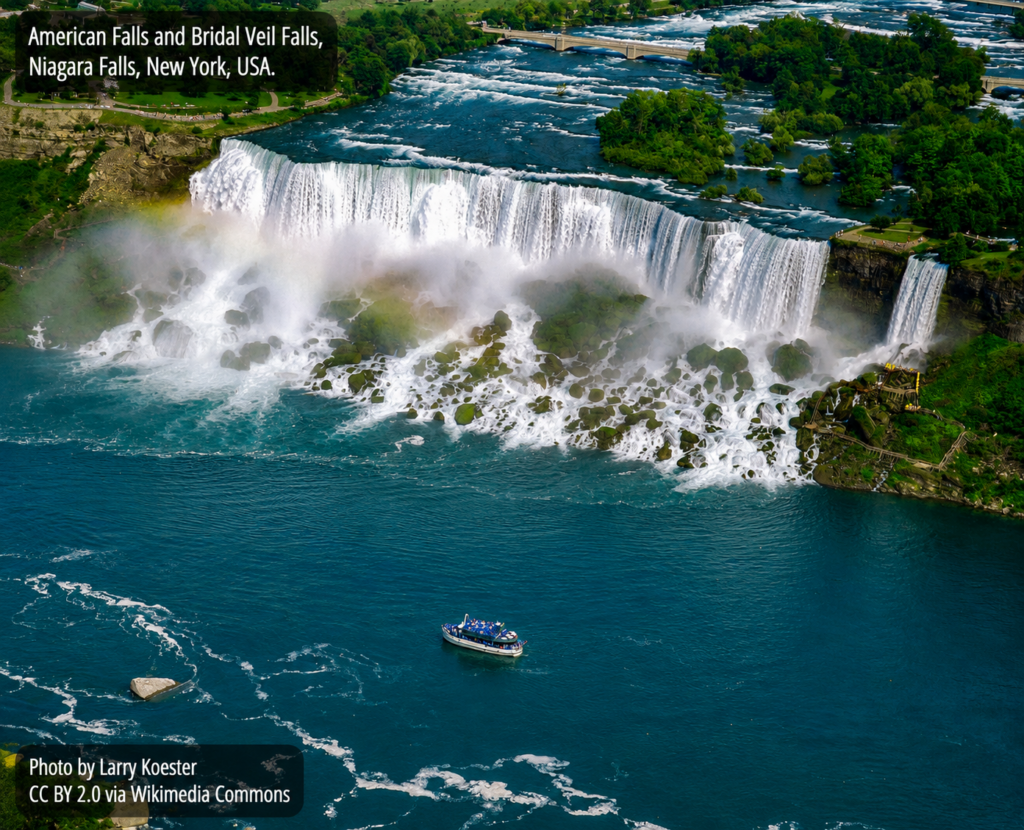
Stand at the railing above the Horseshoe Falls: the first thing that hits us isn’t the view. It’s the sound, and the shaking under our feet. Thousands of tonnes of water fall 57 metres every second. The spray climbs so high that on a clear day we can spot a rainbow hanging in it.
But the falls do far more than look beautiful. They dig. Every year the waterfall creeps a little further upstream, leaving behind a deep, steep-walled canyon called the Niagara Gorge—about 11.5 kilometres of it so far.
That’s where the question starts. A canyon still being dug in front of our eyes is a canyon we can put a clock on. If we know how fast the falls move backwards, and how far they’ve travelled, we can work out roughly how long they’ve been at work. The answer has embarrassed the long-ages story of earth history for nearly 200 years.
A clock few want to read
In 1830 English geologist Robert Bakewell reported what the hotel owner beside the falls had told him: in 40 years there, the falls had moved back about 40 yards—roughly 0.9 metres a year. Divide the gorge by that figure and you get a canyon around 10,000 years old.
Then Charles Lyell arrived. Lyell was the most influential geologist of the 19th century. His system, called uniformitarianism, holds that the rocks were shaped by the same gentle processes we see today, working steadily over immense ages. He visited in 1841 and published a far lower figure: not more than one foot a year. That stretched the gorge out to 35,000 years.
Where did Lyell get his number? Not from a survey. He got it from a conversation with his tour guide, who said the American Falls had moved back 40 feet between 1815 and 1841.
Then the surveyors came. Careful measurements in 1842, 1875 and 1883 showed the Canadian falls retreating at three to five feet a year—several times faster than Lyell had claimed. On those figures the gorge is only 7,000 to 10,000 years old.
The Lesson Under the Numbers
Lyell chose the lowest available figure, from the weakest available source, in the direction that suited his system—and the measurements corrected him by a factor of three to five.
This is the point worth carrying away. Nobody comes to the evidence with an open mind. Lyell needed deep time, so he found it in a tour guide’s memory. The Christian who comes expecting the fingerprints of a real global judgement isn’t being more biased than Lyell was. He’s simply honest about where he starts.
And here’s the striking part. Even mainstream geology today dates the gorge at only about 12,500 years. In a story that speaks of billions of years, one of the most famous landscapes on earth is admitted to be a few thousand years old. The disagreement is not about millions. It’s about thousands.
How a waterfall eats backwards
To see why the timing matters, look at what the falls are cutting through. The gorge slices down through a neat stack of flat layers, like a knife through a cake.
| ROCK LAYER | WHAT IT IS | WHY IT MATTERS |
|---|---|---|
| Lockport Group | Hard dolostone (a limestone-like rock rich in magnesium), packed with fossils, only 17 to 20 metres thick | The hard cap forming the lip of the falls |
| DeCew Formation | Dolomite and mudstone, with a sharp lower contact | Dissolved and hollowed along its base |
| Rochester Shale | Soft dark grey shale, nearly 19 metres thick | The weak link—this is what gets scooped out |
| Queenston Formation | Thick red shale | The soft floor beneath the whole escarpment |
The mechanism is simple to picture. The plunging water digs out the soft Rochester Shale underneath. The hard dolostone above is left hanging over empty space like a shelf, until the shelf breaks off and crashes into the river—and the waterfall has moved a few metres upstream.
That’s the textbook explanation. But two recent findings make the picture more complicated—and strengthen our case.
- The caprock is already cracked. Recent studies show the Niagara Escarpment is full of natural cracks, both between its layers and through the rock. Water has also widened some of these cracks into small cavities and caves. In other words, the hard rock is already divided into blocks that can be pulled away.
- The slow-collapse model has a problem. Engineers Yukinori Hayakawa and Yukinori Matsukura calculated how much rock would have to be removed before the overhanging caprock could break under its own weight. Their result: the undercut would need to extend tens of metres. At Niagara, it’s only about 10 metres—far too little for the caprock to collapse in this way.
So the water may not be slowly grinding the rock away. Instead, it can pull out blocks along cracks that already exist. And that matters because block removal can become much faster as the volume of water increases.
The gorge isn’t one canyon
Walk the length of the Niagara Gorge and you notice something odd. It isn’t one uniform trench but a series of very different sections joined end to end—wide in some places, startlingly narrow in others. Geologists have named them: the Lewiston Branch Gorge, the Old Narrow Gorge, the Whirlpool Narrow Gorge, the Eddy Basin, the Lower Great Gorge, the Upper Great Gorge.
Why would one river cut six different-looking canyons?
Mainstream geology has an honest answer: the volume of water changed. For a long stretch, water from the upper Great Lakes bypassed Lake Erie and drained north-east towards the Ottawa River, leaving Niagara on a fraction of its flow. The narrow sections are the starved periods; the broad sections are the flood periods.
Read That Again Slowly
Standard geology has already accepted two facts that matter to the Flood argument.
- First: the falls retreat faster when more water flows over them. We can measure this directly. Since hydroelectric projects began diverting water from the river, the retreat rate has dropped from about one metre a year to roughly a tenth of a metre a year.
- Second: the gorge wasn’t carved at one steady rate. Its history shows periods of faster cutting and periods of slower cutting.
If both points are accepted, the key question is no longer whether water flow affects the rate of erosion. It clearly does. The real question is how large those past increases in water flow were—and what caused them.
This is where the biblical model has something powerful to offer. In the creationist framework the Ice Age wasn’t a cycle repeating over millions of years but a single event triggered by the Flood. Michael Oard, a meteorologist who has spent decades modelling it, argues the Flood left the oceans unusually warm and the air thick with volcanic dust. Warm seas evaporate heavily; dusty skies keep summers cool. The result is enormous snowfall that doesn’t melt—a rapid, one-off ice age lasting centuries, not aeons.
When those ice sheets melted, vast temporary lakes formed and burst, sending discharges through the Niagara region that dwarf anything flowing today. If the wide sections were carved in weeks of catastrophic drainage rather than millennia of gentle trickling, the 12,000 year figure collapses into a few centuries.
We have now watched it happen
For much of the 20th century, when creationists said canyons could form quickly, it was largely scoffed at. That’s no longer the case. We’ve now seen rapid canyon formation happen—and secular geologists themselves have documented and published these examples.
| WHERE | WHAT HAPPENED | HOW LONG |
|---|---|---|
| Canyon Lake Gorge, Texas (2002) | A single flood cut about 7 metres into limestone and turned a soil-covered valley into a true bedrock canyon with waterfalls, inner channels and potholes | About three days |
| Ricobayo, Spain (surveyed to 2015) | A canyon 270 metres long and about 100 metres deep was carved into fresh, unweathered granite by ordinary spillway floods | About six years |
| Mount St Helens, USA (1980–82) | Mudflows and a breached lake carved a canyon system through volcanic deposits and solid rock, complete with its own little river | Days |
| Burlingame Canyon, USA (1926) | An overflowing irrigation ditch cut a canyon roughly 460 metres long and 30 metres deep | Six days |
Look closely at the Texas case. The rock was limestone—the same family as the Niagara caprock. The mechanism was the plucking of blocks—the same mechanism now identified at Niagara. And it produced waterfalls, the very feature we’re trying to explain. Three days.
The Spanish case is more awkward still. The rock was granite, far harder than anything at Niagara, and the floods were modest—smaller than Niagara’s everyday flow. Yet the erosion bore no relationship at all to the size of the flood. What controlled it was the pattern of cracks. The same team noted their findings bear directly on how gorge formation is modelled, and they cite Niagara as the classic natural example of a fast-moving waterfall.
Geologist Steve Austin, who studied the Mount St Helens canyons firsthand, made a point that became well known among creationists: a canyon can be explained by a little water over a long time, or a lot of water over a short time.
We’ve observed the second option happen. Tas Walker of Creation Ministries International makes a related point: a landscape does not carry a built-in clock. The rocks show us what happened, but they do not, by themselves, tell us how long it took. The time scale is an interpretation added by the observer.
The layers the gorge cuts through
Andrew Snelling, a geologist with a doctorate from the University of Sydney, argues the real evidence for the Flood isn’t any single landform but the scale and character of the sedimentary layers themselves. Niagara is a good place to test that, because the gorge gives a clean vertical cut through them.
Four things those walls show
- Sheets across a continent. The Lockport dolostone at the lip of the falls is no local deposit. The same rock runs from New York across Ontario, north to Manitoulin Island, and west into Michigan, Wisconsin and Illinois—one of the most extensive dolostone plains in the world. Nothing on that scale is forming anywhere today.
- Contacts with no time in them. Where one layer meets the next, the boundary is knife-sharp and flat. There are no fossil soils, no root systems, no deep weathering profiles—none of the mess that hundreds of thousands of years of exposed land would leave behind. The layers sit on one another like sheets of paper. The technical literature even admits some of these gaps are of unknown duration. The time is inferred from the fossils, not observed in the rock.
- Sea creatures in the middle of a continent. The official fossil list for the gorge includes brachiopods, crinoids, corals, bryozoans, molluscs, graptolites, worms, sponges and fish—marine animals buried hundreds of kilometres from any ocean and well above sea level. Something put the sea on top of the continent and buried its inhabitants fast enough to preserve them.
- The dolomite problem. Dolostone forms when magnesium replaces some of the calcium in limestone. Geologists have never satisfactorily reproduced this at ordinary temperatures, and vast dolostone beds aren’t forming in today’s oceans. They’re just what you’d expect from hot, mineral-rich water surging through fresh carbonate mud.
The Strongest Objection
Lockport contains what geologists call “reef mounds.” If these are genuine coral reefs that grew in place, they’d seem to require a long time to form—potentially centuries or more. That would be difficult to fit within a single Flood year.
Creationist researchers, including John Whitmore, argue these structures don’t closely resemble modern living reefs. Modern reefs have a solid framework of corals growing and cementing together. The Lockport mounds, by contrast, are largely made up of broken shell material and carbonate mud, with fossils mixed throughout. Creationists argue this looks more like material that was transported and deposited than a reef that slowly grew in place.
The debate is real and ongoing. It shouldn’t be dismissed—but neither has it been settled against the Flood view.
What we shouldn’t claim
A case is only watertight if it doesn’t leak at the edges. Three cautions:
- Niagara doesn’t date the Flood. It dates a drainage event that happened afterwards. Anyone who says “the gorge is 9000 years old, therefore Genesis” has confused two different numbers.
- The radiocarbon dates need answering, not ignoring. Shells from the gorge sediments give ages of several thousand years. But shells are the worst possible material for this method in limestone country. Freshwater molluscs absorb ancient dissolved carbonate and can register thousands of years old while still alive—the hard-water effect, acknowledged in mainstream literature. Add an atmosphere still adjusting after a global catastrophe, and early dates will run high.
- We must not repeat Lyell’s mistake in reverse. It would be no better to assume a constant fast rate than a constant slow one. The defensible claim isn’t that we know the number, but that the rate follows the water—and the water was once vastly greater than it’s now.
Understood that way, Niagara doesn’t prove the Flood by itself. What it destroys is the intuition that stands in the Flood’s way—the feeling that a landscape like this simply must require unimaginable ages.
The rainbow over the gorge
Psalm 104 describes what happened after the Flood in striking terms. The waters withdrew, the mountains rose, the valleys sank, and the waters were given boundaries they couldn’t cross. From a Flood-geology perspective, this fits a world being rapidly reshaped as the waters drained away.
And that brings us back to Niagara’s most famous sight: the rainbow above the mist.
After the Flood, God placed the rainbow in the clouds as a promise that He’d never again destroy the earth with a flood. Here, above one of the great scars that Flood geology sees as a reminder of that judgement, the rainbow appears again and again—a striking picture of judgement and mercy together.
But the point is bigger than Niagara or erosion rates. The same God who judged the world with water has appointed a day when He will judge the world again.
Eight people were saved through the first judgement, carried safely in an ark. That’s the gospel in miniature: God provides the refuge, God shuts the door, and those inside are saved by His grace—not by their own strength.
So the rocks at Niagara aren’t the main point. They’re witnesses. They remind us catastrophe is real and that we should take the biblical account of the Flood seriously.
Tough Questions, Honest Answers
Will Niagara Falls eventually disappear into Lake Erie?
It will not so much disappear as change character. About 32 kilometres of river separate the present falls from Lake Erie, and at today’s heavily controlled rate of roughly ten centimetres a year, that’s a long way off. Long before it arrives, the falls will most likely break down into a series of rapids, because the hard caprock thins out upstream and the river will lose the sharp ledge that makes a waterfall possible. Interestingly, this is what a young-earth model predicts: a feature with a short past and a limited future, not a permanent fixture of a timeless world. Scripture never treats the present order as everlasting. Peter tells us the heavens and earth that now exist are being kept until the day of judgement, and Paul describes creation itself as groaning, waiting to be set free. A dying waterfall is a small parable of a creation under the curse and awaiting renewal.
Do other waterfalls give young ages too, or is Niagara being cherry-picked?
It’s a fair challenge, and the answer is Niagara isn’t alone. St Anthony Falls in Minneapolis has retreated measurably within recorded American history and is conventionally dated at only about 12,000 years. Victoria Falls in Africa sits in a zigzag gorge formed by the same process of headward retreat along cracks in basalt, and is likewise measured in thousands of years rather than millions. The general pattern holds: waterfalls that are cutting through solid rock give young ages wherever we can measure them, which is why long-age geology has to explain them as recent latecomers on an ancient landscape. That explanation may be possible, but notice that it is required rather than observed. We take these features at face value because we believe God has made a world that’s intelligible and honest, and that its ordinary testimony isn’t systematically misleading.
Has Niagara Falls ever stopped flowing, and does that tell us anything?
Twice, in a manner of speaking. In March 1848 an ice jam on Lake Erie choked off the river and the falls fell almost silent for around 30 hours; people walked out onto the dry riverbed and collected artefacts. Then in 1969 engineers deliberately dammed the American Falls to inspect the rock face, and what they found was more heavily fractured and unstable than expected, with an enormous pile of fallen rubble at the base. Both events are useful. The first shows how completely a waterfall depends on the water supplied to it, which is the heart of our argument about changing flow. The second confirms the fractured, block-by-block character of the rock that makes rapid retreat possible. God’s works are open to investigation, and honest investigation has consistently served the biblical account better than its critics expected.
Where did the Great Lakes themselves come from?
The basins sit almost exactly where the soft shale layers lie, and they were gouged out by the ice sheets that flowed across them. In the biblical framework this is the second act of a single story: the Flood laid down the alternating hard and soft layers, and the post-Flood Ice Age exploited that weakness, scraping out the soft rock and leaving the hard rock standing as escarpments. That’s why the lakes and the Niagara Escarpment share the same geometry—they’re two results of one process working on one set of Flood-laid rocks. It’s worth noticing how much explanatory economy this gives us. One catastrophe and its aftermath account for the layers, the lakes, the escarpment and the gorge, without needing to invent long ages between them.
Do the flood stories told by peoples around the world support Genesis?
Hundreds of cultures preserve accounts of a great deluge, including nations of the Great Lakes region such as the Ojibwe and the Haudenosaunee, and many include a survivor, a vessel or refuge, and animals. This is what we’d expect if all humanity descends from the eight people who came off the ark and later scattered from Babel, carrying the memory with them and reshaping it over generations. But we should be careful about how much weight we place on it. These traditions are corroboration, not authority; they confirm the memory is universal, while only Scripture tells us truly what happened and why. Our confidence rests on the word of God, which doesn’t need the world’s stories to prop it up, though it’s unsurprising to find their echoes.
How do Christians who accept an old earth explain Niagara?
Most simply accept the conventional 12,000-year figure for the gorge, since it sits comfortably inside a long-age framework as a very late event. That’s not an unreasonable move on their own terms, and it’s worth saying plainly the disagreement here is among brothers and sisters who hold the same Scriptures to be inspired and inerrant. Where we press the question isn’t on the gorge but on the layers beneath it, because that’s where the real issue lies: whether the fossil-bearing rocks record a world of death stretching back long before Adam. If they do, then death entered the world before sin did, and the link Paul draws between the first Adam and the last is weakened at the root. That’s why we think the debate matters more than a discussion about dating techniques would suggest.
If I believe the earth is old, am I denying the gospel?
No. A person is saved by the finished work of Christ received through faith, not by the opinion we hold about the age of rocks. And there are godly, faithful believers on the other side of this question whose love for Christ we have no business doubting. But not every question that falls short of salvation is unimportant. What we believe about Genesis shapes what we believe about the entry of death, the goodness of the original creation, the historicity of Adam, and the trustworthiness of Scripture when it speaks about matters we can check. Our conviction is that the plain reading of the text is also the honest reading of the evidence, and that Christians need not choose between the two. Hold the position firmly, argue it well, and hold your brother charitably while you do.
Related Reads
- Does Noah’s Flood Explain Australia’s Wave Rock?
- Rocks Don’t Lie: 10 Global Evidences Supporting Noah’s Flood
- Mt St Helens: How One Volcano Challenges Geological Timescales
- Why Noah’s Flood Was Global: Scientific Evidences Often Overlooked
- Noah’s Flood: Where Did All the Water Come From? And Go?
- Ancient Flood Stories Compared: What Makes Noah’s Account Different?
- How Did the Mountains Form After Noah's Flood?