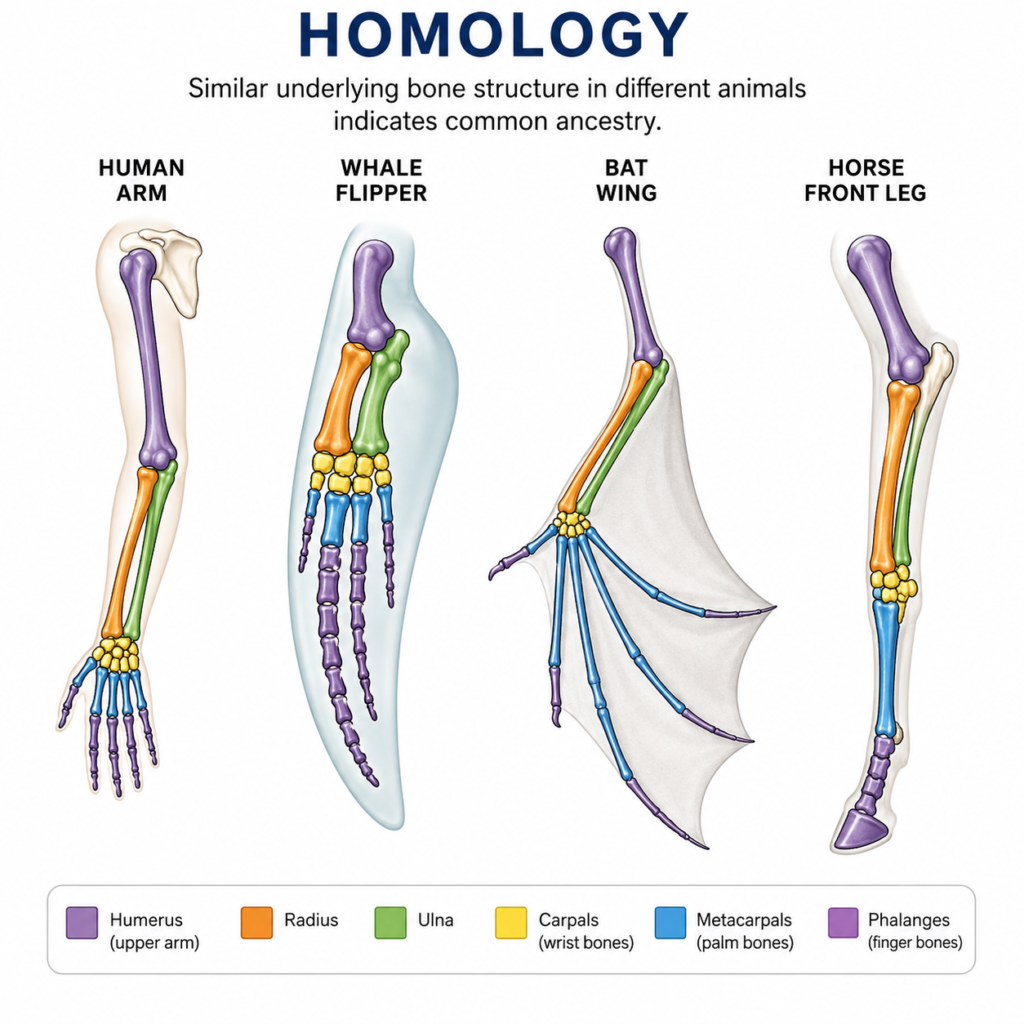
Open almost any school biology textbook and you’ll find the same picture. Four skeletons sit side by side: a human arm, a whale’s flipper, a bat’s wing and a horse’s front leg. The bones are colour-coded to show that they match. One long upper bone. Two bones below it. A cluster of small wrist bones. Then the fingers.
The caption underneath is always some version of the same sentence: this is proof that all four animals came from one common ancestor.
It’s a powerful picture. It looks like the argument is settled even before it has started. But there’s something the caption doesn’t tell you.
The scientist who discovered this pattern, named it, and worked out the rules for recognising it didn’t believe in evolution. And the scientist who tested the pattern most carefully in the 20th century called it, in the title of his own book, an unsolved problem.
So does similarity actually prove ancestry? Or does it only prove similarity?
First, what does “homology” actually mean?
Before we go further we need to clarify two words.
| WORD | SIMPLE MEANING | EXAMPLE |
|---|---|---|
| Homology | The same structure in different creatures, even when it’s used for completely different jobs. | Your arm and a bat’s wing. Same bones in the same order. One picks up a cup, the other flies. |
| Analogy | Different structures that happen to do the same job. | A bird’s wing and an insect’s wing. Both fly, but they’re built from entirely different materials. |
So homology is about shared structure. Analogy is about shared function. Hold on to that difference, because almost the whole debate turns on it.
Now here’s the key thing to notice. Both definitions describe what we see. Neither says anything about why it’s there. That gap between what we see and why it’s there is where this whole discussion lives.
The man who discovered homology was no evolutionist
Richard Owen (1804–1892) was the leading comparative anatomist of his generation and the founder of what became the Natural History Museum in London. He gave us the words above. In his 1848 work on the vertebrate skeleton he defined a homologue as the same organ in different animals under every variety of form and function.
Owen was no evolutionist. He explained the shared pattern using what he called the archetype—a single underlying body plan, an ideal design, which all backboned animals are variations upon. And Owen was open about where he thought the plan existed. It existed in the mind of God.
This matters more than most people realise. The entire science of comparative anatomy—the careful mapping of which bone matches which bone across thousands of species—was built by men working inside a design framework. Homology wasn’t a discovery of evolutionary theory. It was a discovery that evolutionary theory later borrowed.
What Charles Darwin did wasn’t to find new bones. He kept Owen’s pattern and changed its definition. Homology stopped meaning “the same structure” and started meaning “the same structure because it was inherited from a shared ancestor“.
That small change of wording is where the trouble begins.
The hidden circle in the argument
Watch what happens when you put the new definition into the old argument.
THE CIRCLE, STEP BY STEP
Step 1. Homology is defined as: similarity caused by common ancestry.
Step 2. We then look at the bat’s wing and the human arm and call them homologous.
Step 3. We then announce that homology is evidence for common ancestry.
But step 3 was already assumed in step 1. The conclusion was smuggled into the definition. Nothing has been proved. The argument has simply walked in a circle and arrived back where it started.
You don’t have to take this from a critic of evolution. Biologists themselves admit it. Ronald Brady, writing in the journal Cladistics in 1985, argued that if you build your explanation into your description of the evidence, you’re no longer explaining anything—you’re only repeating yourself. The pattern has to be established independently of any theory about its cause, or it cannot serve as evidence for that cause.
And in practice, biologists still recognise homology using rules that came from Owen and other pre-Darwinian anatomists: does the structure sit in the same position, does it connect to the same neighbouring parts, does it share fine details of construction? These are questions about pattern. None of them requires evolution to be true.
So we should separate two things that are usually glued together:
- The pattern is a fact. Bats, whales, horses and humans really do share a common body plan. Nobody disputes this.
- The explanation is a claim. “This pattern exists because they all descended from one ancestor” is an interpretation laid on top of the fact. It is not the fact itself.
Once you see the difference, the textbook caption looks very different. It’s not reporting an observation. It’s offering a theory—and quietly presenting it as though it were the observation.
Gavin de Beer and the test that failed
If common ancestry really is the reason for shared structures, that claim can be tested. And the test is obvious.
Inheritance travels through genes. If you inherited your arm from a distant ancestor, and the bat inherited its wing from that same ancestor, then the instructions for building those limbs should also have been inherited. Same structure should mean same genes, built by the same developmental steps, from the same starting material in the embryo.
Gavin de Beer (1899–1972) was the man who first ran the test. He was an embryologist, a convinced evolutionist, and Director of the British Museum (Natural History). He’d already dismantled one famous evolutionary claim in Embryos and Ancestors, showing that embryos don’t replay their evolutionary history as Ernst Haeckel had taught.
In 1971 he published a short Oxford monograph with a title that says everything: Homology: An Unsolved Problem. Three expectations, three failures.
| WHAT COMMON ANCESTRY PREDICTS | WHAT WE ACTUALLY FIND | WHY IT MATTERS |
|---|---|---|
| Homologous organs should grow from the same part of the embryo. | The gut of a shark forms from the roof of the embryonic gut cavity; in the lamprey it forms from the floor; in the frog from roof and floor together; in birds and reptiles from a completely different layer. | The same organ is being built from different raw material. There’s no single inherited starting point to trace back. |
| Homologous organs should be built by the same developmental steps. | The fingers and toes of salamanders form in a different order and direction from those of frogs, reptiles, birds and mammals. | If the process of building the limb isn’t shared, calling the finished limbs “inherited” is an assumption, not an observation. |
| Homologous organs should be built by the same genes. | Corresponding structures across different creatures are repeatedly produced by different genes and different genetic pathways—from lens formation in the eye to sex determination to body segmentation in insects. | This is the deepest failure. Genes are the actual channel of inheritance. If the genes aren’t shared, the structure wasn’t inherited in the way the theory requires. |
De Beer then asked the question that gives his book its title. What could possibly keep two structures corresponding so precisely, generation after generation, when they are not controlled by the same genes? He had no answer. He said so honestly.
That was more than fifty years ago. The problem has not been solved since. It has been renamed and relocated—but the gap between the structure and the genes that are supposed to have carried it is still there.
“But what about Pax6?”
There is one famous reply to all of this. In the 1990s the laboratory of Walter Gehring in Basel showed something remarkable. A mouse gene called Pax6 could be switched on in the wrong place in a fruit fly, and an eye would grow there. A mouse gene making an eye in an insect. Surely, the argument goes, this proves there is one deep shared master gene for eyes, inherited from a common ancestor far back in time.
It is a genuinely fascinating result. But look carefully at what actually grew.
- The eye that grew was a fly’s eye. Not a mouse eye. A compound insect eye, made of hundreds of separate units. The mouse gene didn’t supply the design. It only pressed the switch.
- The two eyes are built on incompatible foundations. Insect and vertebrate eyes use different types of light-detecting cell and completely different chemical chains for turning light into a nerve signal. They’re not two versions of one thing.
- So the same gene switches on structures that aren’t the same. That’s the opposite of what the objection needs.
Now put the two findings side by side and see where we’ve arrived.
| THE FINDING | WHAT IT SHOWS |
|---|---|
| De Beer: the same structure can be produced by different genes. | Structure does not reliably track genes. |
| Gehring: the same gene can produce different structures. | Genes do not reliably track structure. |
| Taken together | The link between the genes that are inherited and the structures we compare is broken at both ends. Yet that link is precisely what the argument from homology depends on. |
To their credit, biologists haven’t ignored this. Günter Wagner, an evolutionary biologist at Yale, wrote a whole book in 2014 trying to rebuild the idea of homology on a new foundation. We should be fair and say clearly he is not a design theorist and does not intend to help our case. But the very existence of that project concedes the point: the classic textbook version of homology didn’t survive the testing.
The problem everyone already admits: convergence
Here’s the part of the argument that doesn’t depend on any critic of evolution, because mainstream biology grants it openly.
Convergence means striking similarity that everybody agrees was not inherited. The creatures are placed on distant branches of the evolutionary tree, so the similarity is said to have appeared independently, more than once.
| SIMILARITY | WHERE IT APPEARS | AGREED EXPLANATION |
|---|---|---|
| The camera eye—lens, iris, retina | Vertebrates and the octopus | Not inherited. Arose separately. |
| Echolocation—navigating by sound | Bats and dolphins | Not inherited. Arose separately. |
| Wolf-like body, skull and teeth | Placental wolves and the extinct Tasmanian “wolf” | Not inherited. Arose separately. |
| A whole redesigned system of photosynthesis (C4) | Dozens of unrelated plant groups | Not inherited. Arose dozens of times separately. |
Simon Conway Morris, the Cambridge palaeontologist, has spent much of his career cataloguing these cases, and the list runs into the hundreds. And the pattern isn’t only skin deep. Work published in 2010 by Ying Li, Stephen Rossiter and their colleagues found a hearing gene called Prestin shows the same changes in its sequence in echolocating bats and in dolphins. Similarity in the DNA itself, which everyone agrees was not inherited from a shared ancestor.
Now think about what this concession does to the original argument.
THE ARGUMENT CANNOT SURVIVE ITS OWN EXCEPTION
Evolutionary biology says: similarity proves ancestry.
Evolutionary biology also says: except in hundreds of cases, where similarity arose independently, including in the DNA.
So similarity by itself cannot prove ancestry. Everyone already agrees it doesn’t always.
This raises the obvious question: how do we decide which similarities count as inherited and which don’t? The answer is that it depends on where the creatures already sit on the assumed family tree. Similarity that fits the tree is called inheritance. Similarity that doesn’t fit is called convergence.
The tree is not the conclusion drawn from the similarities. The tree is the ruler used to sort them.
When the trees disagree with each other
You might expect that at least the family tree itself is firm ground. It’s not as firm as the diagrams suggest.
When different genes from the same set of animals are used to build a family tree, the trees frequently come out different. Antonis Rokas and Sean Carroll documented this conflict across animal groups. Trees built from anatomy and trees built from DNA also clash regularly. W Ford Doolittle has gone further and questioned whether a single tree of life can be recovered at all.
This doesn’t mean biologists are being dishonest. It means the tree isn’t simply read off the data. It’s reconstructed, using assumptions, and where the signals conflict some of the evidence has to be set aside and explained away. That’s a normal part of scientific work. But it should make us slower to treat the resulting diagram as a plain observed fact.
The change that can’t be made
There’s one more difficulty, and it comes from developmental biology.
To turn one body plan into another, you’d need to change the genes that act earliest in the growth of the embryo—the ones that lay out the basic architecture before anything else is built.
Christiane Nüsslein-Volhard and Eric Wieschaus won a Nobel Prize for systematically mutating those early-acting genes in the fruit fly. The result was consistent. Mutate them and you don’t get a new body plan. You get a dead or badly deformed embryo. Eric Davidson, who spent his career mapping these networks, described the deepest layers as effectively unchangeable—touch them and development collapses.
So the changes required by the theory are precisely the changes that living things can’t survive.
This is not a simple two-sided fight
Everyone who doubts the homology argument isn’t a Bible-believing Christian. Michael Denton, a biochemist, has argued in his two books that the shared body plans of living things look like expressions of deep, law-like patterns built into nature, more like the fixed forms of chemistry than like a family record. Denton isn’t a young-earth creationist and accepts a form of common descent. We cite him precisely because of that. The adequacy of ancestry as an explanation of homology is disputed on purely biological grounds, by people with no theological motive at all.
So what’s the alternative?
Showing that an argument fails isn’t the same as offering something better. If shared structures were not inherited from one universal ancestor, what were they?
The answer is common design. But that phrase is often stated so badly that critics knock it over easily, so let us state it properly first.
The weak version, and the strong version
The weak version says God reused parts to save effort, like a builder who orders the same windows for every house. Critics rightly reply that God is not short of options and doesn’t need to economise. If that were the whole claim, the argument would deserve to lose.
The strong version comes from engineering. Every engineer knows the difference between a specification and an implementation.
SPECIFICATION VS IMPLEMENTATION
The specification is what the thing must be and do: a jointed limb with one bone, then two bones, then many small bones, then digits.
The implementation is how it actually gets built: which materials, which sequence, which instructions.
One specification can be built by many different implementations. Two factories can produce the same component to the same standard using entirely different machinery.
Now look back at what Gavin de Beer found. Conserved structure, varied implementation. Same specification, different genes, different embryonic tissue, different developmental route.
For descent, that result is a problem, because inheritance can only travel through the implementation. For design, it is exactly what we should expect, because in design the specification comes first and the implementation serves it.
This is the heart of the creationist reading. The evolutionary account has to move from the bottom up: genes are copied, structures follow. So the structure can never be more stable than the genes that build it. Design works from the top down: the plan is fixed, and the plan can be realised in more ways than one.
When we test which of the two pictures matches the laboratory data, the top-down picture fits better. That’s not smuggling faith in to the lab.
Two models, side by side
Let’s set out what each model leads us to expect, and what was actually found.
| OBSERVATION | UNIVERSAL COMMON DESCENT EXPECTS | COMMON DESIGN EXPECTS |
|---|---|---|
| Do homologous structures come from the same genes? | Yes. Genes are the channel of inheritance, so shared structures should mean shared genes. | Not necessarily. The plan is what is shared; the build can differ. |
| Do they come from the same embryonic tissue? | Yes. The developmental route should be inherited along with the structure. | Not necessarily. Different routes may reach the same specified outcome. |
| Should striking similarity appear in unrelated groups? | Only rarely, and it must be explained away as coincidence. | Yes, and often. A good solution is worth using again wherever it is needed. |
| Should each group have genes found nowhere else? | Very few. Almost everything should have relatives elsewhere on the tree. | Yes. Each design has parts unique to it. |
| Should non-coding DNA be largely useless leftovers? | Yes. Discarded material should accumulate over deep time. | No. Apparent junk should turn out to be doing something. |
Read down the last two columns. On every line the design column matches what laboratories have actually reported over the past 30 years. That’s what we mean by a science-backed reading.
Testing the alternative: the dependency graph
Now to the most interesting piece of recent work, because it turns “common design” from a slogan into a measurable model.
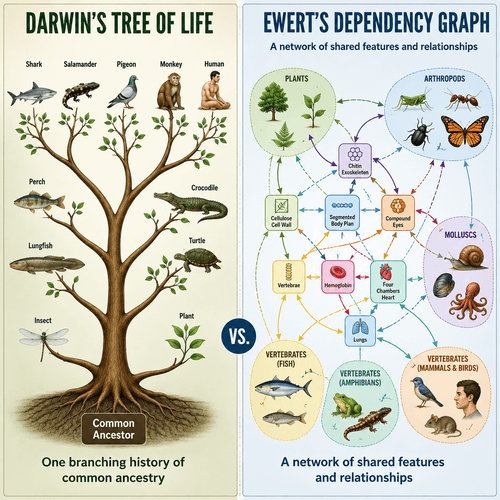
Software engineers face exactly our problem. Programmes share large amounts of code. Why? Not because one programme gave birth to another. It’s because programmes import shared libraries—blocks of ready-made code that any project may call upon.
This produces a very particular pattern, and it is not a tree.
| MODEL | THE RULE IT FOLLOWS | THE PATTERN IT PRODUCES |
|---|---|---|
| Family tree (common descent) | You may only receive what your direct parent had. Nothing can jump sideways between branches. | Neat nested groups. A feature shared by two distant branches must have appeared twice, independently. |
| Dependency graph (design reuse) | Any project may import any library it needs, regardless of who built what first. | Overlapping, criss-crossing groups. The same module appears in unrelated projects because both needed it. |
Winston Ewert, a computer engineer, asked the obvious question in a 2018 paper: which of the two models better fits the distribution of genes across living things? He took gene family data from several large public databases covering many hundreds of species, and compared how well a tree model and a dependency graph model each accounted for which genes appear in which organisms.
The dependency graph fitted the data substantially better than the tree.
WHY THIS RESULT MATTERS
What it does. It takes the pattern that’s usually treated as proof of ancestry and shows that a design-based model, borrowed unchanged from software engineering, explains the same data more successfully. Common design is therefore testable and quantitative, not merely a pious alternative label.
Why it fits. Under a dependency graph, shared modules appearing in unrelated groups are ordinary and expected—they are imports, not coincidences. Under a tree, every such case has to be written off as convergence.
Honesty about its status. The paper appeared in BIO-Complexity, a journal edited by design theorists, and the model hasn’t yet been widely tested by researchers outside the community. However, a strong result awaiting independent replication is still a strong result.
Three more lines of evidence
1. Orphan genes: the genes with no family at all
De Beer showed the same structure can be built by different genes. There’s a second discovery that presses even harder.
When genomes are sequenced, researchers regularly find orphan genes—sometimes called taxonomically restricted genes. These are working, functional genes that are found in one group of creatures and have no recognisable relative anywhere else in the living world.
They’re not rare oddities. Depending on the group, they can account for a noticeable percentage of the whole genome, and they are frequently tied to features unique to that creature.
The difficulty for universal common descent is direct. If everything alive descended from one starting point by copying and modifying what came before, then everything should have relatives. Orphan genes have none. Under a design model they are unremarkable: every design has parts that belong to it alone.
2. The vanishing pile of junk
For decades the sections of DNA that do not code for proteins were called junk—the accumulated wreckage of a long evolutionary past. It was presented as one of the strongest arguments against design. Why would a designer fill a genome with rubbish?
That pile has been shrinking steadily. Non-coding DNA is now known to include switches that turn genes on and off, sequences that control the timing of development, regions that shape how the genome is physically folded, and vast numbers of functional RNA molecules. The ENCODE project reported biochemical activity across the large majority of the human genome, and although the meaning of the word “function” in that report has been sharply debated, the direction of travel is not in dispute.
Notice which side made the correct prediction. Design theorists such as Jonathan Wells and Richard Sternberg argued for function while junk was still the consensus. That’s what a scientific prediction looks like—made in advance, at some risk, and later vindicated.
3. Continuity within kinds, gaps between them
Creation scientists aren’t opposed to the idea of shared ancestry as such. They’re opposed to the claim that it is universal. And they’ve built a research programme to find where the boundaries lie.
The field is called baraminology, and researchers such as Kurt Wise and Todd Wood use statistical methods to measure how closely groups of organisms cluster on large sets of characteristics. What emerges is a repeating pattern.
- Inside a group, the data are continuous. Members shade into one another, and shared ancestry is the natural reading.
- Between groups, there are gaps. The clusters do not join up, and no amount of additional data smooths them into one another.
The fossil record shows the same shape. In the Cambrian rocks, the great majority of animal body plans appear in a geologically brief window, already distinct, without the long series of intermediate forms the tree model requires beneath them. Stephen Meyer examines this at length in Darwin’s Doubt.
Put the two together and the picture is not one tree. It is a forest—many separate starting points, each with genuine branching inside it.
If you’re a student in a biology class
You may be reading this with an examination coming. Here’s some practical advice.
- Learn the material properly. Know the four limbs, know the definitions, know why the argument is persuasive. Answer the question you’re asked. Christians should be the best students in the room, not the most difficult.
- Know exactly where you disagree. You’re not denying the bones. You’re declining one interpretation of the bones. That is a much narrower and much stronger position, and it is one you can defend calmly.
- Ask good questions rather than making speeches. “How do we tell homology from convergence?” is a better contribution than an argument, and it is a genuinely open question in the field.
- Keep your tone gentle. “In your hearts honour Christ the Lord as holy, always being prepared to make a defence… yet do it with gentleness and respect” (1 Peter 3:15).
So, does similarity prove ancestry?
Here’s the whole case in one place.
| THE CLAIM | THE DIFFICULTY |
|---|---|
| Homology proves common ancestry. | Only because homology has been defined as similarity due to common ancestry. The conclusion is inside the definition. |
| Shared structures were inherited together. | Gavin de Beer showed they often grow from different embryonic tissue, by different developmental routes, under the control of different genes. |
| A shared master gene proves shared ancestry. | The same gene switches on structures built on entirely different foundations. Genes and structures do not track one another. |
| Striking similarity requires inheritance. | Mainstream biology already accepts hundreds of cases where striking similarity—including in DNA sequence—arose without inheritance. |
| The family tree is what the evidence shows. | Different genes yield conflicting trees, and the tree is used to decide which similarities count as inherited in the first place. |
The pattern in living things is real, deep and magnificent. Richard Owen saw it, mapped it, and called it an archetype. Gavin de Beer tested the modern explanation of it and reported honestly that the explanation did not work.
Similarity is a fact. Ancestry is an interpretation. And when the interpretation is examined closely—when we look for the shared genes, the shared embryonic origins, the shared developmental routes that inheritance requires—they are repeatedly not there.
What’s there is a pattern that behaves like reused design rather than inherited descent: conserved plans built by varied machinery, excellent solutions appearing again and again in unrelated creatures, genes belonging to one group and no other, and a distribution across the living world that a software dependency graph models better than a family tree.
What’s there is a single, coherent, endlessly varied design. The Christian has a name for the reason why: “In the beginning was the Word… All things were made through Him, and without Him wasn’t any thing made that was made” (John 1:1, 3).
The four skeletons in the textbook aren’t the family record of a distant ancestor. They’re four sentences written by the same hand.
Frequently Asked Questions
If we didn’t evolve from apes, why do humans and chimpanzees share around 98% of their DNA?
The first thing to say is that the famous figure moves considerably depending on what’s being measured. Early comparisons looked only at sections that could be lined up neatly, leaving out insertions, deletions and large structural differences; recent complete genome work gives a noticeably lower figure. But even at its highest, the number does not settle anything. Similar creatures living in the same world, breathing the same air and eating similar food will need similar biological machinery, and similar machinery needs similar instructions. The percentage measures resemblance, and resemblance is exactly what is in dispute—it is not independent evidence for how the resemblance arose. We should also remember that a small percentage of an enormous genome still amounts to many millions of differences, including differences in how genes are switched on and off.
What about shared “mistakes” in our DNA, such as endogenous retroviruses and broken genes? Surely identical errors prove shared ancestry?
This is the strongest argument on the other side and deserves respect rather than dismissal. The reasoning is that two students with the same wrong answer probably copied from each other. But the force of the argument rests on the assumption that these sequences are truly random junk, and that assumption has weakened considerably. Many retroviral-like sequences turn out to sit in functional positions and play regulatory roles, and viruses are now known to insert at preferred sites rather than at random. Similarly, the broken vitamin C gene shared by humans and some primates may have been lost in similar ways because the same fragile stretches of DNA fail in similar ways. A Christian can also hold that some of these losses are real and inherited within a created kind, without conceding that all life shares one ancestor.
Isn’t the recurrent laryngeal nerve, which takes a long detour around the heart, proof of bad design rather than a wise Designer?
Notice first that this is a theological argument, not a biological one—it claims to know what God would have done. That is a heavy claim for a creature to make about its Creator. Biologically, the nerve is not merely passing through; it supplies structures along its route, and the developmental sequence in the embryo constrains where nerves can run once the heart and neck are forming. More importantly, an engineer judges a design by the whole system, not by one component viewed in isolation. Scripture also warns us that we are in no position to audit God’s workmanship: “Who are you, O man, to answer back to God?” (Romans 9:20). And Christians should add that we live in a creation subject to futility because of the Fall (Romans 8:20–22), so not every feature of the present world is a direct statement of original design.
Are vestigial organs like the appendix and the tailbone evidence for evolution?
The list of supposedly useless organs has shrunk dramatically. The appendix is now recognised as part of the immune system and as a reservoir for helpful gut bacteria; the coccyx is a firm anchor for muscles that support the pelvic floor; the tonsils, thymus and other former entries on the list have all been given back their functions. This history should make us cautious, because the argument depended on our ignorance, and our ignorance kept shrinking. But there is a deeper problem with the logic. A reduced or unused structure would show loss of function, and evolution needs an explanation for how complex functions are gained, not for how they decay. Christians can freely accept that features degrade in a fallen world without accepting that this explains their origin.
Do Christians reject all evolution, or only some of it?
Almost no Christian denies that living things change, adapt and diversify. Bacteria develop resistance, finch beaks alter with the seasons, and the whole dog family clearly descends from a smaller original stock. This is observed, repeatable science and Genesis 1 leaves ample room for it inside the created kinds. What is disputed is the further claim that this same process, extended over vast time, can turn one basic body plan into another and account for every living thing from a single origin. That is not observed; it is extrapolated. So the disagreement is not about whether change happens, but about whether the small changes we can watch are the right kind of change to build what we actually see.
Is intelligent design real science, or is it religion wearing a laboratory coat?
Design detection is used without controversy in several fields—archaeology distinguishes a shaped tool from a broken stone, and forensic science distinguishes an accident from a crime. In each case the reasoning is the same: certain effects have only ever been observed to come from intelligent causes. Applied to biology, the argument is an inference from what we know, not an appeal to what we do not know. It is fair to note that the design argument by itself does not identify the Designer; it takes you only as far as a Mind. As Reformed Christians we would add something further: the objection assumes there is a neutral, religion-free science available, and we do not think there is. Every scientist works from prior commitments about what kind of causes are permitted to exist.
If one Designer made everything, why do parasites, viruses and predators share the same elegant designs?
This is really the problem of evil in biological clothing, and it should be answered honestly rather than brushed aside. Scripture does not describe the present world as the world God pronounced very good; it describes a creation now subject to futility and groaning, awaiting release (Romans 8:20–22). Many organisms we call harmful are harmless or beneficial in their normal setting, and turn destructive only in the wrong host or the wrong tissue—degradation of an original function rather than the original function itself. It is also worth noticing that the objection cannot be raised without a standard: to call something cruel, you must borrow a moral yardstick that a purposeless universe cannot supply. And the Christian answer is finally not a theory but a person—a Creator who entered his own damaged creation, suffered in it, and has promised to make it new.
Related Reads
- Common Descent or Common Design: Which Explains Life’s Unity?
- When Similarity Proves Nothing: Convergent Evolution and the Case for Common Design
- The Big Hoax: Turns Out ‘Junk’ DNA Isn’t Junk After All
- ‘Bad’ Design: Flaw in Nature Or Flaw in Our Perspective?
- Nature’s Perfect Motor: How the Bacterial Flagellum Defies Evolution
- Is Intelligent Design Biblical? Addressing Christian Concerns
- Is the Blood Clotting Cascade Irreducibly Complex?
- Dependency Graph of Life: Why Genes Don’t Fit Darwin’s Tree
- The Cambrian Explosion: Why the Fossil Record Runs Top-Down
- Can Random Mutations Create New Genes?
- "After Their Kind": What Genesis Does and Doesn't Claim