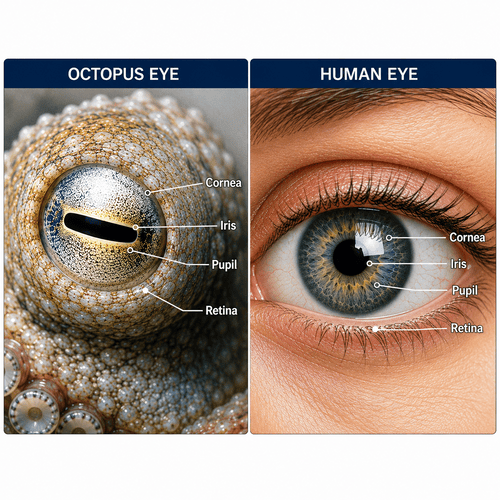
Set an octopus eye alongside the human eye. They look almost the same. Both have a clear front window, a coloured ring that opens and closes, a lens that focuses light, and a light-sensitive screen at the back. If you found two watches this similar, you’d assume they came from the same factory.
So here’s a fair question. Do we share this eye with octopuses because we inherited it from a common ancestor?
Almost no evolutionary biologist would say yes. The family tree of animals doesn’t allow it. The creature they believe sits at the join between us and the octopus had nothing like a camera eye. So the textbooks say something else entirely: the two eyes were built separately, from scratch, twice over.
That answer has a name. It’s called convergent evolution. And once we see what it really means, we’ve been handed one of the strongest arguments for design that exists. What’s more, we’re handed it, remarkably, by the other side.
What convergent evolution actually means
Let’s slow down and define our terms, because the whole argument turns on them.
FOUR WORDS YOU NEED
Homology—similarity that’s said to come from a shared ancestor. Our arm and a whale’s flipper have the same bone pattern, so they’re called homologous.
Analogy—similarity in function but not in ancestry. A bird’s wing and an insect’s wing both fly, but no one claims they were inherited from one winged parent.
Convergent evolution—the claim that two unrelated creatures independently developed the same feature, because natural selection pushed them towards the same solution.
Homoplasy—the technical umbrella word for any similarity that does not come from shared ancestry. Convergence is the best-known kind.
Now watch what happens when you put these words back into the argument for common ancestry.
Charles Darwin’s case rested heavily on homology. Why do a bat’s wing, a horse’s leg, a mole’s digging paw and our hand all use one bone, then two bones, then a cluster of small bones, then five digits? Because, he argued, they were all inherited from one ancestor who had that pattern. Similarity means inheritance. That’s the engine of the whole theory.
The rule that quietly swallows itself
But similarity doesn’t always fit the tree. Sometimes the same feature shows up in two creatures the tree says are distant cousins. What happens then?
The similarity is simply reclassified. It stops being homology and becomes convergence.
So the working rule is this:
Similarity that fits the evolutionary tree is called inheritance.
Similarity that does not fit the tree is called coincidence.
The tree itself was built from similarity in the first place.
Notice the circle. Similarity is offered as evidence for the tree. But whenever similarity contradicts the tree, the tree wins and the similarity is explained away. The evidence is never allowed to overturn the conclusion it was meant to support.
This raises a hard question that every honest reader should ask. What possible pattern of similarity could ever count against common ancestry? If shared features prove common descent, and unshared features prove nothing, and features shared by the wrong creatures prove convergence, no observation can ever go against the theory. A theory that fits every possible result isn’t being confirmed by the evidence. It’s simply being protected from it.
There’s a piece of history worth knowing here. The word homology didn’t begin with Darwin. Richard Owen coined it before him, and he meant something simpler: the same organ in different animals, whatever its form or function. Owen saw a shared blueprint, an archetype in the mind of the Creator. After Darwin, the same word was quietly redefined as “similarity due to common descent”—which builds the conclusion straight into the definition. Ever since, using the word has meant conceding the argument.
Exhibit one: the eye, invented again and again
Return to the octopus. The two eyes look alike, but they’re built by completely different methods.
Our eye grows outwards from your developing brain. A bud pushes out from the neural tube, and the lens forms separately from the skin layer and drops into place. The octopus eye does the opposite. It folds inwards from the skin, like a pocket pushed into the body.
Even the wiring runs the other way. In your retina, the nerve fibres lie in front of the light-detecting cells. In the octopus, they lie behind. Same result, opposite construction.
The lens tells the same story. Lenses are made of proteins called crystallins—proteins that are transparent and bend light. Here is the striking part: different creatures make their crystallins out of completely different parent proteins. Birds and reptiles use a protein normally involved in processing waste nitrogen. Some animals use an enzyme from energy metabolism. Squid and octopuses use a detoxification enzyme. Different raw materials, same optical result.
WHAT THIS PATTERN LOOKS LIKE IN ENGINEERING
Two teams are given the same brief: build a device that focuses light onto a sensor.
Team A has metal and glass in its workshop. Team B has plastic and resin.
Both deliver a working camera. The specification matched. The parts did not.
This is exactly what we see in eyes—and it is the fingerprint of a shared requirement being met, not a shared part being passed down.
Then comes the twist that makes the story stranger still. There is a master control gene called Pax6 that switches on eye development. It is found across the animal kingdom, in creatures whose eyes are supposedly independent inventions. Walter Gehring’s team took the mouse version of this gene and switched it on in the wrong place in a fruit fly. The fly grew eyes there—fly eyes, but eyes.
So the switch is shared, while the eyes are said to be separately invented. Standard theory calls this “deep homology” and moves on. But look at it plainly. A common control system, deployed across designs that are otherwise unrelated, is precisely how engineers work. One codebase; many products.
How many times have eyes appeared independently? Luitfried von Salvini-Plawen and Ernst Mayr put the figure between forty and sixty-five. Sixty-five separate strokes of luck, all landing on optics.
Exhibit two: echolocation, matching down to the molecule
Bats and dolphins both hunt by sound. They send out clicks and read the echoes, building a picture of the world in darkness or muddy water. Nobody claims they inherited this from a shared ancestor; their branches on the tree are far apart. So echolocation is filed under convergence.
Fair enough, you might say. Sound is sound, and physics may push two hunters towards the same trick.
But the match goes deeper than behaviour. Inside the inner ear sits a protein called prestin. It works like a tiny motor, changing shape at high speed to amplify faint sounds. In 2010, two research teams—one led by Jianzhi Zhang, the other including Yang Liu, James Cotton and Stephen Rossiter—compared prestin sequences across mammals. When they drew a family tree using prestin alone, echolocating bats and dolphins came out sitting together, as though they were close relatives.
They are not. The protein sequence had converged.
WHY THIS CASE MATTERS MORE THAN FINS AND WINGS
A dolphin and a shark are both torpedo-shaped. Water forces that on anything that swims fast. Physics explains the similarity.
But there is no law of physics that requires a particular amino acid at a particular position in a protein chain.
Sequence space is not constrained the way body shape is. A protein of modest length has more possible sequences than there are atoms in the observable universe.
So when two unrelated creatures land on the same sequence changes, “physics made them do it” is no longer available as an answer.
Honesty requires a caution here, and it strengthens rather than weakens the case. In 2013 Joe Parker and colleagues reported convergent signatures across hundreds of genes in echolocating mammals. Two follow-up studies—by Zhengting Zou and Jianzhi Zhang, and by Gregg Thomas and Matthew Hahn—argued that the genome-wide signal was mostly within what chance would produce anyway. That criticism lands on the broad claim. It does not remove prestin, which stands on its own.
And there is a further wrinkle inside the bats themselves. Genetic studies place some echolocating bats closer to non-echolocating fruit bats than to other echolocators. Either the whole sonar system was invented twice within one group, or it was invented once and then completely lost. Neither is a small thing to swallow.
Exhibit three: the same antifreeze at both poles
This is the cleanest example in the literature, and it deserves to be better known.
Fish in Antarctic waters survive below the freezing point of blood because they carry antifreeze glycoproteins—molecules that latch onto tiny ice crystals and stop them growing. Fish in Arctic waters carry an almost identical molecule.
Chi-Hing Cheng, Arthur DeVries and their colleagues traced where these genes came from. The Antarctic version was built out of a digestive enzyme gene, trypsinogen. The Arctic cod version has no such origin. Same molecule; different parentage; opposite ends of the earth.
Put simply: the solution was reached twice, from different starting materials, for the same problem.
The list is long
These three are not rare exceptions. Convergence is everywhere, and the deeper biologists look into the genes, the more of it they find.
| EXAMPLE | WHAT’S OBSERVED | WHY IT’S STRIKING |
|---|---|---|
| Marsupial and placental look-alikes | Thylacine and wolf; marsupial mole and golden mole; sugar glider and flying squirrel | Whole body plans matched in lineages separated at the root of mammals |
| Sabre teeth | Appeared at least four or five times in unrelated meat-eating lineages | A complete hunting system, repeated |
| Powered flight | Insects, pterosaurs, birds, bats | Four independent solutions to the hardest engineering problem in biology |
| Electric organs in fish | At least six independent origins, recruiting the same sodium channel gene | Reported by Jason Gallant, Harold Zakon and colleagues in 2014 |
| C4 photosynthesis | Arose independently more than sixty times in plants | Requires biochemistry and leaf anatomy to change together |
| Resistance to plant poisons | Identical amino acid changes at the same positions in butterflies, bugs, beetles and aphids | Documented by Susanne Dobler, Peter Andolfatto and colleagues; the tightest molecular match known |
| Vocal learning | Songbirds, parrots and humans share brain circuits and gene activity patterns | Reported by Andreas Pfenning, Erich Jarvis and colleagues |
| Bioluminescence | Dozens of independent origins using different light-producing chemicals | Same effect, different chemistry each time |
One more thing is worth noticing, and it costs nothing to observe. Read the papers themselves and the vocabulary repeats: remarkable, striking, stunning, surprising. Scientists are not usually surprised by what their theory predicts. Surprise is what a framework registers when the data did not follow from it.
The strongest objection: constraint, not design
The best answer from the other side comes from Simon Conway Morris, the Cambridge palaeontologist. His argument runs like this. Life is not free to do anything it likes. The number of workable solutions to any biological problem is small. So evolution keeps rediscovering the same few answers, the way water running down a hillside keeps finding the same channels.
Conway Morris is himself a Christian, and he should be engaged with respect rather than treated as an opponent. But the argument does not do the work it is asked to do. Four replies:
- Being findable is not the same as being found. Constraint may explain why only a few solutions work. It does not explain how a blind, unguided search located them repeatedly, within the time and population sizes actually available.
- The argument concedes the point it means to deny. Channels, attractors, inevitable outcomes—this is the language of a system aimed at targets. If the landscape of possible life is shaped so that blind search keeps hitting the same optima, then that shaping now needs explaining. You have not removed design; you have pushed it back a step, into the structure of nature itself.
- Physics constrains shape, not sequence. Hydrodynamics really does explain why fast swimmers are streamlined. It explains nothing about why the same amino acid appears at the same position in two unrelated animals.
- The field cannot agree with itself. Stephen Jay Gould argued that if you replayed the tape of life it would come out utterly differently. Conway Morris argues the opposite—that the outcomes were more or less inevitable. Both cannot be right, and the same data is being used to support both.
A word about the “badly designed” eye
Whenever eyes come up, someone raises the inverted retina. Why would a wise Creator run the nerve wiring in front of the light-sensing cells, when the octopus has it the sensible way round?
The objection has not aged well.
- Kristian Franze and colleagues found that Müller cells in the retina act like living optical fibres, guiding light through the nerve layer to the receptors underneath. Amichai Labin and Erez Ribak later modelled them as light guides that sort wavelengths as they go.
- The layer behind the photoreceptors, the retinal pigment epithelium, has to sit right there. It recycles the chemicals that make vision work. Move it and vision fails.
- Photoreceptors are among the hungriest cells in the body. They need the rich, dark blood supply of the choroid directly behind them.
So the arrangement is not a blunder. It is a set of competing demands resolved together—light transmission, chemical recycling and blood supply, all balanced in one structure. Engineers call that a trade-off, and solving trade-offs well is the mark of a good designer, not a careless one. The octopus, living in dimmer water with different energy demands, faced a different brief.
What common design actually predicts
It is not enough to say the other explanation is strained. A good argument has to offer something positive. So what does common design predict, and does the evidence fit?
Think about how human designers actually work. They do not build every product from nothing. They keep a library of proven parts and reuse them wherever they fit. A car company puts the same engine in a saloon and a van. A software firm reuses the same code across unrelated apps.
TWO PREDICTIONS, SIDE BY SIDE
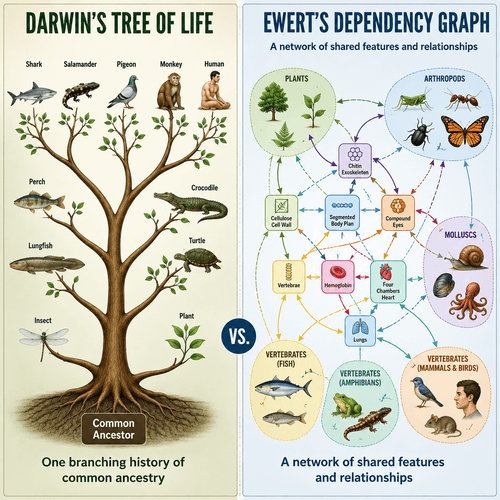
Common descent predicts a tree. Shared features should line up in a single branching pattern. Conflicts should be rare and small.
Common design predicts a mosaic. Shared modules should appear wherever the requirement appears, cutting across any single family tree. And the same function should sometimes be delivered by different components, because a designer is not obliged to use one blueprint.
What we observe: shared control genes across supposedly independent inventions; identical solutions in unrelated lineages; different building blocks producing the same result; and gene trees that routinely contradict one another.
The mosaic is what is on the table.
This is not merely a debating point. Winston Ewert has modelled the distribution of gene families as a dependency graph—the structure software engineers use to map which modules a program draws on—rather than as a branching tree, and reported that the graph fits the data far better. The work is early and needs testing by others. But it shows that common design can be stated as a model that makes predictions and can be measured, not only as a criticism of someone else’s.
And notice the arithmetic problem convergence creates. If the unguided origin of a complex, information-rich system is deeply improbable once, then saying it happened independently forty times does not divide the difficulty. It multiplies it.
Why a Christian should expect exactly this
So far the argument has stayed on scientific ground. But the data has a shape, and Scripture told us what shape to expect.
Creation according to kinds
Genesis 1 does not describe one original organism branching endlessly. It describes God creating living things “according to their kinds”—a phrase repeated ten times in a single chapter. The expectation Scripture sets is variety within kinds and real discontinuity between them. Deep similarity turning up across unbridgeable gaps is not an embarrassment to that model. It is what that model leads you to expect.
The evidence is public, and the problem is not the evidence
Psalm 19 begins, “The heavens declare the glory of God.” Paul is blunter still. God’s invisible attributes, he writes, have been “clearly perceived, ever since the creation of the world, in the things that have been made, so that they are without excuse” (Romans 1:20). Note the words. Not faintly hinted at. Clearly perceived.
That verse reframes this whole discussion. The Christian is not scraping together fragments of evidence to make a shaky case for a designer. The design is plain. What Romans 1:18 describes is people holding that truth down. The obstacle is not a shortage of data.
Nobody comes to the evidence empty-handed
This is where the Reformed tradition has something distinctive to contribute. Cornelius Van Til argued that there are no brute facts—no facts that simply sit there, meaning nothing, until we interpret them. Every fact is already God’s fact, and every person interprets it from a starting position they did not arrive at neutrally. His memorable picture of the unbeliever was a small child who must first sit on her father’s lap in order to slap his face.
Greg Bahnsen sharpened this into a method. The Christian position, he argued, is proved by the impossibility of the contrary: rationality itself requires the God being denied. John Frame makes the same point about evidence—facts and their interpretation cannot be pulled apart, because there is no view from nowhere. K. Scott Oliphint adds that every person already knows God, so apologetics is never introducing a stranger; it is addressing a suppressed acquaintance.
Apply that here. Modern biology operates under a rule called methodological naturalism, which forbids any explanation involving an intelligent cause before the investigation starts. Under that rule, when the same complex system appears in unrelated creatures, convergence is not the winning explanation. It is the only explanation allowed to enter the room. Vern Poythress, who trained in mathematics before theology, makes the constructive counterpoint: the regularities we call scientific laws are not impersonal machinery but the faithful, spoken government of God. Order in nature is personal at its root.
One Mind, and a free one
Two things must be held together. “In wisdom have you made them all,” says Psalm 104:24. Reused modules across unrelated kinds display the consistency of one Mind. But God is also free. Job 38 to 41 parades creature after creature as evidence of God’s wisdom, and includes the ostrich, of whom God says he gave her no share in understanding (Job 39:17). God is not obliged to make everything optimal by our standards, or to build twice from one blueprint.
Different solutions to the same problem are therefore not a difficulty for design. They are the signature of an Artist who is not bound to repeat himself.
And the deepest answer to why nature keeps arriving at the same solutions is not a mechanism at all. It is a Person. “All things were created through him and for him. And he is before all things, and in him all things hold together” (Colossians 1:16-17). The unity of nature’s answers rests on the unity of the Word through whom all things were made. The Belgic Confession puts it beautifully: creation is a book in which every creature is a letter, leading us to contemplate the invisible things of God.
What this argument doesn’t prove
BEING CLEAR ABOUT THE LIMITS
It does not disprove common descent on its own. It shows that the main line of evidence for common descent does not work the way it is presented, and that the theory absorbs contrary data rather than being tested by it.
Small-scale independent adaptation is real and observed. Bacteria really do develop resistance separately in different places. Nobody disputes that.
This is not an argument from ignorance. The claim is not “science cannot explain it, therefore God.” The claim is that repeated, independent arrival at the same complex, information-rich solutions is what intelligent agency characteristically produces, and what blind search characteristically does not.
And a designer is not yet the Saviour. Even a successful design argument leaves you at the door. It clears away obstacles. It does not give sight. Only the Spirit does that, through the gospel of Christ crucified and risen.
ONE QUESTION WORTH ASKING IN CONVERSATION
If a friend tells you that similar features prove common ancestry, ask this, gently and with real curiosity:
“What would similarity have to look like before you concluded it was not inherited?”
If every pattern of similarity confirms the theory, then similarity is not evidence for it. That is not a trap. It is an invitation to think—and to be asked in the spirit of 1 Peter 3:15, with gentleness and respect.
Conclusion: they told us themselves
The argument of this article has not required us to doubt a single observation. Every case in it comes from mainstream research, published by scientists who accept evolution.
They are the ones who tell us that eyes were invented dozens of times over. That a hearing protein in bats matches one in dolphins. That the same antifreeze appeared at both poles from different starting points. That the same amino acid changes turned up in four unrelated insect groups facing the same poison.
Every one of those statements is an admission that similarity is not inheritance.
Which leaves the honest reader with a straight question. When the same brilliant solution appears again and again in creatures that never shared it, is the better explanation blind chance arriving repeatedly at the same target—or one Mind, working with a consistent set of good ideas, across a creation that was spoken into being and is held together still?
“The heavens declare the glory of God, and the sky above proclaims his handiwork” (Psalm 19:1). So, it turns out, do the eyes of an octopus.
Frequently Asked Questions
What is the difference between homologous and analogous structures?
Homologous structures are similar features said to be inherited from a shared ancestor, such as the matching bone pattern in your arm and a bat’s wing. Analogous structures are similar in function but not attributed to shared ancestry, such as a bird’s wing and an insect’s wing. The difficulty is that nothing in the structures themselves tells you which label applies. The decision is made by asking where the creatures sit on the evolutionary tree—which is the very thing the similarity was supposed to help establish. On a design view, the distinction dissolves: shared features reflect a shared Designer reusing good solutions, whether or not the creatures are related.
Is convergent evolution the same as parallel evolution?
They are usually distinguished, though the boundary is disputed even among evolutionary biologists. Convergence normally means distantly related creatures arriving at the same feature from different starting points; parallel evolution means closely related creatures changing in the same direction from a similar starting point. Both sit under the wider term homoplasy, which covers any similarity not explained by inheritance. The fact that specialists argue over where one ends and the other begins is itself telling, because the classification depends on the assumed family tree rather than on anything observable in the organism. Christians should notice how much theory-laden interpretation is built into words presented as plain description.
Does convergent evolution happen in humans?
Yes, in the limited sense that separate human populations have adapted to the same challenge through different genetic routes. Tibetans, Andeans and Ethiopian highlanders all cope with thin mountain air, but the genes involved are not the same in each group. Similarly, the ability to digest milk into adulthood arose through different mutations in Europe and in Africa. These are real, observed cases, and Christians should concede them cheerfully. They show variation and selection fine-tuning an existing human design—which is exactly what Scripture’s account of one human family spreading across the earth would lead us to expect. What they do not show is the origin of any new complex system.
Does antibiotic resistance prove that convergence supports large-scale evolution?
Antibiotic resistance is genuine and often arises independently in different places, so it is a fair example of convergence. But look closely at what happens. Resistance usually comes from a small change to an existing protein, the loss of a function, or a gene picked up ready-made from another bacterium. None of these builds a new complex system. Michael Behe has argued that observed resistance frequently involves breaking or blunting something that already worked, which helps the microbe survive the drug at a cost elsewhere. Extrapolating from a broken lock to the invention of the eye is not a small step; it is a different kind of claim altogether.
If God reused designs, why do unrelated animals share the same broken genes?
This is the strongest objection to common design, and it deserves a straight answer. The usual example is the vitamin C gene, which appears damaged in both humans and guinea pigs. But the damage is not identical: the specific lesions differ between the lineages, which is awkward for the inheritance explanation too. More importantly, the history of the term “junk DNA” should make everyone cautious. Sequences confidently declared functionless have repeatedly turned out to be doing something. Christians can hold two things together: some genuine degradation is exactly what we should expect in a creation subjected to futility (Romans 8:20-22), and confident claims about what is broken have a poor track record.
How do scientists actually decide whether a trait is convergent?
They compare the distribution of the trait against a family tree, usually built from genetic data, and count which explanation requires fewer changes. If the trait fits the tree, it is called inherited; if it does not, it is called convergent. The methods are sophisticated, but the logic depends entirely on trusting the tree. And trees built from different genes frequently disagree with one another, which is why the literature is full of revisions. This should not make anyone dismiss the science, but it should temper the confidence with which conclusions are announced to the public.
What about mosaic animals like the platypus?
The platypus lays eggs, produces milk, has a bill with electrical sensors, and the male carries venom—a combination drawn from groups the evolutionary tree keeps far apart. Standard theory explains each feature separately as retained, lost or independently acquired. A design view reads the same animal more naturally: a Designer working from a palette of proven components is free to combine them as he pleases, and is not restricted to the branching pattern a family tree requires. Creatures like this are not awkward exceptions to be managed. They are a display of the freedom and inventiveness of the One who made them, of whom Psalm 104:24 says that in wisdom he made them all.
Related Reads
- Common Descent or Common Design: Which Explains Life’s Unity?
- Does Similarity Prove Common Ancestry? The Homology Problem
- The Inverted Retina: Design Flaw Or Optimal Engineering?
- ‘Bad’ Design: Flaw in Nature Or Flaw in Our Perspective?
- Irreducible Complexity: A Compelling Case for Intelligent Design
- Intelligent Design: Is It A God of the Gaps Argument?
- How the Grand Canyon Challenges Evolution’s Deep Time
- Dependency Graph of Life: Why Genes Don’t Fit Darwin’s Tree
- The Cambrian Explosion: Why the Fossil Record Runs Top-Down
- Can Random Mutations Create New Genes?