Deep in the rocks of our planet there’s a puzzle that has troubled scientists for more than 150 years. It has a name: the Cambrian explosion.
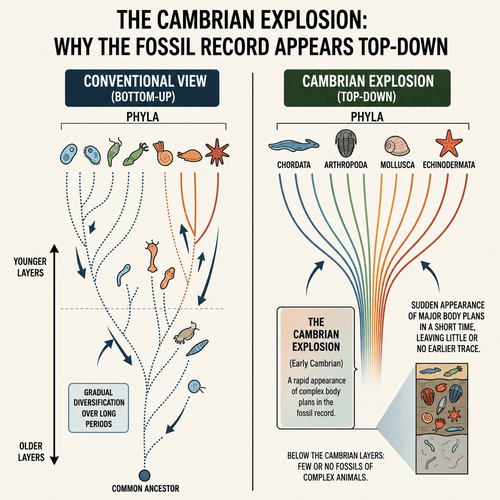
Here’s the puzzle in plain terms. If all living things slowly grew apart from one shared ancestor, the story buried in the rocks should look like a growing tree. First a single trunk. Then a few branches. Then many small twigs. Small differences first, piling up slowly, until at last we get the huge differences that separate a starfish from a spider.
That’s not what we find.
The rocks show the tree upside down. Nearly every major kind of animal body appears near the bottom of the fossil record all at once, already finished, already working, with no ancestors in the layers below. After that burst, life produces plenty of new species—but almost no new kinds of body. Scientists have a name for this shape. They call it top-down.
This post explains what the Cambrian explosion is, why it’s the opposite of what common descent predicts, and how that pattern is explained away. And why we believe it points to a Designer.
FOUR WORDS YOU NEED BEFORE WE START
Cambrian—a slice of rock layers near the bottom of the fossil record.
Phylum—a top-level group of animals sharing one basic body design. Arthropods (jointed legs and outer shell) are one phylum. Chordates (a nerve cord down the back) are another. There are roughly 30 to 35 of them.
Diversity—how many different kinds there are. A thousand kinds of beetle is high diversity.
Disparity—how different the kinds are from each other. A beetle and a jellyfish are very different, so they show high disparity.
Keep those last two apart in your mind. The whole argument of this post turns on them.
What common descent predicts
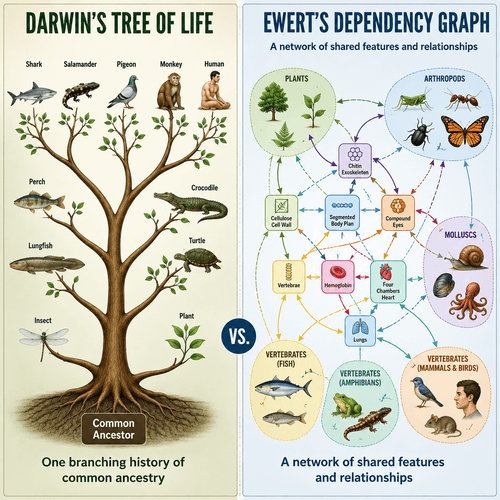
Common descent is the claim that every living thing came from one original ancestor by small changes over long ages. Charles Darwin knew exactly what shape this would leave in the rocks, and he drew it: lines splitting off slowly, varieties becoming species, species becoming families, and only after enormous stretches of time becoming groups as different as insects and fish.
Think of it as a cone standing on its point. Narrow at the bottom, wide at the top. Big differences are the total of many small differences, so big differences must come last.
This is a real prediction, and that matters. A prediction that cannot fail is worth nothing. Darwin’s prediction can fail, and it can be checked. So let’s check it.
Climbing the layers, from the bottom up
- Deepest fossil-bearing rocks (Doushantuo, China; dated by mainstream science around 600 million years). These rocks contain tiny fossils preserved in remarkable detail—so well that individual cells can sometimes be examined. They include algae, sponge-like forms and what have been interpreted as animal embryos. But there are no clear adult animals showing the basic body plan we’d expect, with a definite front and back or left and right. One fossil, Vernanimalcula, was once presented as the earliest known animal of this kind. It has since been widely questioned and may simply be an unusual feature created during fossilisation.
- The Ediacaran layers (mainstream dating: about 575–539 million years ago). Strange soft-bodied life forms such as Charnia, Dickinsonia and Kimberella. Most are flat, quilted or frond-shaped, and most sat still on the sea floor. Adolf Seilacher, who studied them for decades, argued they were a separate grade of life altogether that left no descendants.
- The base of the Cambrian layers. These layers begin with evidence of animals digging through the sea floor, especially the distinctive burrows known as Treptichnus pedum. Above them are scattered shells, spines and tubes.
- The explosion itself (Chengjiang in China; Sirius Passet in Greenland). Then the picture changes dramatically. We suddenly find many familiar animal groups: arthropods with complex eyes, animals with nerve cords, molluscs, brachiopods, worms and echinoderms. Yet the fossil layers below do not show a long series of clear ancestors gradually developing these major body designs.
- The Burgess Shale, Canada. This famous fossil deposit contains spectacular creatures such as Anomalocaris, Opabinia, Hallucigenia, Marrella and Pikaia. They show just how many different forms of animal life were already present.
- Everything above. Higher layers contain enormous numbers of fossils and many new species. But the major animal body plans are already present. No clearly new animal phylum appears higher in the fossil record.
Now put Darwin’s prediction beside the record and compare them directly.
| QUESTION | WHAT COMMON DESCENT PREDICTS | WHAT THE FOSSIL RECORD SHOWS |
|---|---|---|
| Where do the biggest differences appear? | High up, after small differences have piled up | Low down, in the first animal layers |
| What lies beneath the major groups? | Long series of in-between forms | Soft Ediacaran forms with no clear link to them |
| What shape does the record make? | A cone standing on its point (narrow, then wide) | A cone standing on its wide end (wide, then narrowing) |
| Do new body designs keep appearing higher up? | Yes, wherever change continues | No. Not a single new phylum in the entire record above |
This is the heart of the matter, so let us say it slowly. Our objection isn’t simply that there are gaps. Everyone agrees the record is incomplete. Our objection is that the record runs in the wrong direction. Disparity comes before diversity. A missing piece of evidence is one thing; evidence pointing the opposite way is quite another.
And this isn’t something Christians invented. Stephen Jay Gould, an atheist and one of the best-known evolutionary writers of the 20th century, built his book Wonderful Life around it: the Cambrian layers hold a range of body designs never matched since, and the story above them is mostly loss and reshuffling within the designs that were already there. Roger Lewin reported the same pattern in the journal Science in 1988, using that very phrase—the record looks top-down. Douglas Erwin and James Valentine, in their 2013 book on the subject, accept the suddenness plainly and then spend the book hunting for a natural cause.
DARWIN KNEW, AND HE SAID SO
Darwin didn’t hide this. In Chapter 10 of On the Origin of Species he admitted the absence of ancestors below the Cambrian layers was a serious difficulty for his theory. He said the case must for the present remain inexplicable. He hoped future digging would solve it.
That was a fair hope in 1859. We have now had more than 165 years of digging, thousands of sites, and new methods that find fossils smaller than a grain of sand. The ancestors haven’t turned up. At some point a promise that is never kept has to be counted as a failed prediction.
The four standard replies—and why none works
Scientists who hold to common descent know all this. They offer four main replies. Let’s state each one fairly.
Reply 1: The ancestors were soft and didn’t fossilise
- The lower rocks do preserve soft things. They give us bacteria, single-celled algae, soft-bodied Ediacaran creatures, and at Doushantuo, structures at the level of single cells. Softness is clearly not the barrier.
- The Cambrian sites themselves prove the point. Chengjiang and the Burgess Shale preserve jellyfish, worms, eyes, even gut contents and last meals. Conditions that can capture a jellyfish can capture an ancestor.
- Smallness doesn’t save the theory either. We can and do find organisms smaller than a grain of sand in these rocks. The “too small to see” escape has been closed by the evidence.
Reply 2: The Ediacaran creatures are the missing ancestors
Here we must be honest: there’s some real evidence.
- What we grant. Kimberella does look like a plausible mollusc-type animal that crawled and scraped food from the sea floor. And in 2018 Ilya Bobrovskiy and his colleagues recovered cholesterol-type molecules from Dickinsonia, giving good reason to call it an animal.
- What that still leaves. One or two odd creatures isn’t the same as graded series leading to arthropods, and to chordates, and to echinoderms, and to molluscs, and to the rest. The theory needs dozens of ladders. What we have are one or two loose rungs.
- Most Ediacarans fit nowhere. Their relationships are still genuinely disputed by specialists, and many show no clear match to any later body plan.
- Behaviour changes as sharply as anatomy. Below the boundary the tracks in the mud are simple, flat and shallow. At the boundary, complex three-dimensional burrowing appears—the change Mary Droser and David Bottjer named the Cambrian substrate revolution.
Reply 3: Molecular clocks show the split happened much earlier
A molecular clock compares the DNA of living animals and works backwards, assuming changes build up at a steady rate, to guess when two groups last shared an ancestor.
- The clocks don’t agree with each other. Published estimates have ranged from around 600 million years to well over a billion, depending on which genes and which calibration points are chosen. That spread is itself a warning about the method.
- Specialists have criticised the long dates. Kevin Peterson and colleagues argue rates of change vary so much between creatures that deep estimates get badly stretched.
- The method assumes what it must prove. A molecular clock can’t be read without first assuming common descent and then fixing the clock against dates taken from the fossil record. It’s not independent evidence. Even taken at face value, it doesn’t fill the gap—it only makes the gap far bigger.
Reply 4: Something in the environment set it off
The favourite triggers are a rise in oxygen, the melting of a frozen earth, empty living space, and an arms race between the first predators and their prey.
- Oxygen permits; it doesn’t design. More oxygen may well be needed for large active animals. But oxygen is fuel, not instructions. Filling a workshop with air doesn’t produce a machine.
- Empty space and hungry predators are opportunity, not information. Charles Marshall has argued this case as well as anyone. Empty space and new pressures may explain why change would be rewarded. They do not explain where the working instructions for a jointed leg or a focusing eye came from. Selection can only choose between things that already exist.
- The specialists admit the limit. Douglas Erwin and James Valentine acknowledge environmental triggers leave the hardest question standing: how we get from a genetic code to a new, working, three-dimensional body.
The deeper problem: where does the information come from?
So far, we’ve been taking things apart. That isn’t enough. A new kind of animal body isn’t just new bricks. It’s a new set of building instructions, arranged in a strict order, all of which must be right at once.
The control system can’t be rewired
Every animal grows from a single cell by following a switching system: Gene A turns on Gene B, which turns on Genes C and D, all in the right place at the right hour. Biologists call this a gene regulatory network.
Eric Davidson of Caltech spent his career mapping these networks. He concluded the deepest switches—the ones that lay out the basic body plan at the very start—resist change. Disturb them and we don’t get a new design. We get a dead embryo. In a 2006 paper in Science with Douglas Erwin, he set out this layered structure and argued the core switches are almost immune to alteration. Davidson wasn’t a creationist and had no religious motive. He simply doubted that small-mutation Darwinian models could explain where body plans came from.
There’s experimental backing too. Christiane Nüsslein-Volhard and Eric Wieschaus won the Nobel Prize for systematically mutating fruit fly genes to see what each one does. The result that matters here is simple and devastating: mutations affecting the body plan early in development are lethal or produce grossly deformed animals. The genes we must change to invent a new phylum are exactly the genes that can’t change and still survive.
THE PROBLEM IN ONE PICTURE
Imagine a tall building already standing. We may repaint the rooms, move the furniture, even add a floor. That’s the kind of change we really do observe in living things. That explains a great deal—finches, dogs, beetles, bacteria.
Now try to change the foundations and the steel frame while the building is occupied and in use. That’s what a new body plan requires. It isn’t a bigger version of repainting. It’s a different kind of job—and every attempt we can actually observe brings the building down.
One more point, and it cuts deep: the instructions aren’t all in the DNA. The internal scaffolding of the cell, the position of targets on the cell membrane, and electrical patterns across tissues all carry information about shape. Michael Levin’s work on bioelectric signals, and Günter Wagner and Stuart Newman on the origin of biological form, are ordinary mainstream science, not design advocacy. If mutating genes isn’t even the whole toolkit, then explaining new body plans by mutation and selection becomes harder, not easier.
A better reading: creation, then catastrophe
Now we come to what we believe. And here we must say something that changes the whole picture. The layers aren’t a calendar. They’re a record of burial. Once we see that, the top-down pattern stops being a mystery. It also starts making sense.
First, the creation of finished kinds
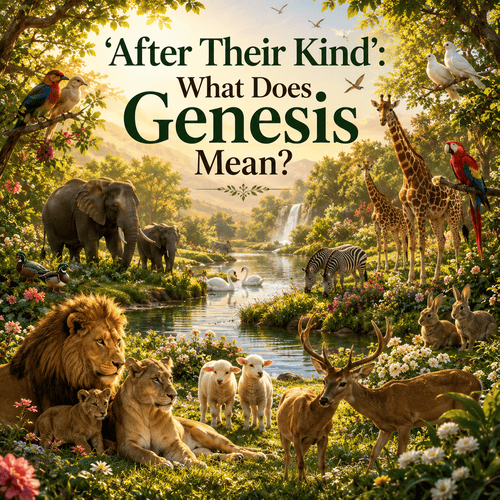
“And God said, ‘Let the waters swarm with swarms of living creatures…’ So God created the great sea creatures and every living creature that moves, with which the waters swarm, according to their kinds” (Genesis 1:20–21, ESV).
Read that against the fossil evidence. God speaks and it happens. The waters swarm—not one creature, but a full and crowded sea. And the creatures come according to their kinds—distinct designs from the beginning, each able to vary richly inside its own limits, none turning into another. That’s disparity first and diversity afterwards. It’s precisely the shape the Cambrian layers show.
Then, the Flood that buried them
Genesis 7 describes water covering the whole earth, the fountains of the great deep bursting open, and every land creature outside the ark dying. A year-long global catastrophe of that size would tear up sea floors, shift continent-sized volumes of sediment, and bury living things fast and in enormous numbers. That isn’t a small adjustment to earth history. It’s a different history.
| WHAT WE SEE IN THE ROCKS | HOW THE FLOOD MODEL READS IT |
|---|---|
| A huge, worn-flat erosion surface beneath the Cambrian layers across much of the world (the Great Unconformity) | The opening of the Flood: violent, sheet-like erosion stripping the pre-Flood surface as the waters rose |
| Cambrian creatures are almost all sea-floor dwellers, and almost none are land animals or plants | The lowest sea floors and their creatures were buried first, before the rising waters reached higher habitats and dry land |
| Bodies preserved whole, with eyes, gills, guts and last meals intact | Rapid burial by underwater mud flows. A jellyfish lying on the sea bed does not last a week, let alone an age |
| Layers stacked in broad, continent-wide sheets that can be traced across whole landmasses | Successive surges of the same rising flood. Timothy Clarey’s work on these megasequences reads the lowest of them as the Flood’s first great advance |
| A general order to the fossils, low to high | Not an order of ancestry but of burial—driven by habitat, sea depth, mobility, and how bodies settle in moving water |
Notice what this does to the argument. Under common descent, the order of the fossils is the family tree, so the order has to be explained by ancestry—and it can’t be. Under the Flood model, the order is simply where things lived and how they were buried. Nothing needs to have evolved into anything. The trilobite is in the lower layers because that is where trilobites lived, not because it was anybody’s grandfather.
WHERE CREATIONISTS ARE STILL WORKING
We don’t pretend this is all settled.
Creation geologists don’t all agree on exactly which layer marks the start of the Flood, or which marks its end. Kurt Wise, Steven Austin, Andrew Snelling and Timothy Clarey each argue differently.
A full model of how the Ediacaran layers fit—pre-Flood sea floor communities, or the very first burials—is still being worked out.
Rapid processes on this scale raise real physical questions, such as where all the heat went. Creationist researchers are open about this and are working on it.
What we do claim is this: the pattern in the rocks fits creation and catastrophe far better than it fits slow common descent, and the honest gaps in our model are smaller than the gap where the ancestors ought to be.
Common descent or common design?
This post belongs to a series asking one question: when we see similar features in different creatures, is the better explanation a shared ancestor or a shared Designer reusing good solutions? If there really is one single family tree, then independent kinds of evidence should all point to the same tree. They clearly don’t.
- Molecules and anatomy disagree at the deepest level. Whether sponges or comb jellies branch off first from the rest of the animals has been argued back and forth since Casey Dunn’s 2008 study, and after nearly two decades there is still no settled answer about the very base of the supposed tree.
- A century of consensus was overturned. For generations, segmented worms and arthropods were grouped together because both have segments. Molecular work broke the grouping up, and the shared segments had to be reinterpreted as separate developments.
- The same fossil, opposite ends of the tree. Saccorhytus was announced in 2017 as the earliest known relative of our own branch of the animal kingdom. In 2022 it was reclassified into a completely different group. One fossil, one set of features, two opposite conclusions.
If similarity were simply the fingerprint of inheritance, this deep and stubborn disagreement should not keep happening. If similarity is often the fingerprint of a Designer reusing good engineering—the way one firm fits the same excellent bearing in a car, an aircraft and a wind turbine—the confusion is exactly what we would expect. You cannot build a family tree out of parts that were never inherited.
Three more things worth knowing
The eye that arrives already finished: Trilobites, common in Cambrian rocks, had eyes made of calcite crystals. Riccardo Levi-Setti documented that some of these lenses are built in two layers of different composition, a design that corrects the blurring you otherwise get when light passes through a single lens. Human opticians reached the same solution in the seventeenth century. Vision does not creep into the fossil record. It appears at the bottom, already excellent.
A whole working world, not a pile of animals: The Cambrian layers do not give us lone creatures floating about. They give us complete communities: predators with grasping limbs, prey with armour and spines, filter feeders, scavengers, burrowers, and the food chains joining them. Explaining one new animal is hard. Explaining a working economy of animals that all need each other is far harder—unless it was all made at once, and made to work together.
The pattern repeats, and then stops: Sudden appearance isn’t a Cambrian oddity. Darwin himself called the abrupt arrival of flowering plants an abominable mystery, and the same suddenness marks the mammal and bird records. Meanwhile the reverse never happens: nowhere in the whole record above the Cambrian does a new phylum appear. If some engine built 30 body plans, why has it built none since? The silence is as telling as the explosion.
WHAT WOULD CHANGE OUR MINDS
Here’s what would count against us:
A well-documented series of fossils below the Cambrian layers showing a step-by-step path from a simple form into any one of the Cambrian phyla.
A demonstrated mechanism by which the earliest switches in an animal’s development can be rewired and still yield a living, working animal.
On the Flood side: fossils repeatedly and reliably found out of place—a rabbit properly in place in Cambrian rock would be a serious problem for us, and we’d have to say so.
Today, 165 years after Darwin’s theory, we’re still waiting.
Facts, and the frame we read them in
Everyone agrees about the fossils. Gould agreed the Cambrian is sudden. Erwin and Valentine agree. The disagreement isn’t really about what’s in the rock. It’s about what we’re permitted to say caused it.
Christians have said this for a long time. Cornelius Van Til taught there are no brute facts—no piece of evidence arrives with no interpretation attached. Greg Bahnsen pressed the same point: the argument between belief and unbelief is usually not about the evidence but about the framework each side brings to the evidence. Jason Lisle, an astrophysicist, applied this directly to the age question: the millions of years aren’t dug up out of the ground like a bone. They’re calculated using assumptions about starting conditions and unchanging rates that nobody was there to check.
Kurt Wise, a creation geologist trained under Stephen Jay Gould, put the priority plainly: his commitment rests first on what Scripture says, and he’d hold it even if the evidence looked bad. Critics quote that against him. But every person alive reasons from some first commitment, and the honest question isn’t whether we have one, but whether ours can bear the weight.
Conclusion: reading the record the right way up
The rocks tell a story, and the story has a shape. Many complete designs, low down, arriving together, carrying eyes and limbs and nervous systems and the instructions for building them. Above that, variety within those designs, and no new designs at all. Bodies buried whole and fast, in sheets that stretch across continents.
That is not a tree growing slowly upward from a seed. It is a creation, made complete and made to swarm, and then a judgement that buried it. RC Sproul, who came late in life to hold the days of Genesis as ordinary days, kept pressing one point: the Bible doesn’t present creation as a slow accident but as the act of a God whose word does what it says. Romans 1:20 (ESV) tells us that God’s invisible attributes are “clearly perceived, ever since the creation of the world, in the things that have been made”. The Cambrian rocks are among them. Read them the right way up, and they’re not a problem to be explained away. They’re a witness.
Frequently asked questions
Do I have to hold a young earth to be a faithful Christian?
No, and we should say that clearly. Salvation rests on Christ alone, received by faith alone, and many godly Reformed believers have held an old earth while loving and submitting to Scripture. We hold the young-earth position because we believe it is what the text of Genesis most naturally teaches and what the genealogies assume, and because we think a global Flood explains the rocks well. But we hold it as a matter of faithful interpretation, not as a test of who belongs to Christ. Christians who disagree here should still be able to pray together, take the Lord’s Supper together, and defend the resurrection together.
If the earth is young, why do dating methods give millions of years?
Radiometric dating doesn’t read an age straight off the rock. It measures how much of one substance and how much of another are present now, and then calculates an age using assumptions: how much was there at the start, that nothing has entered or left the sample, and that the rate of change has never varied. None of those three can be checked by observation, because nobody watched. There are also well-documented cases where the methods have given badly wrong ages for rocks of known age, such as freshly formed volcanic rock. That doesn’t prove the earth is young by itself, and we should not claim more than that; it does show that these dates are conclusions built on assumptions rather than direct measurements.
If the Flood buried everything, why are no human fossils found in Cambrian rocks?
That’s a fair question and creationists have a straightforward answer. The Cambrian layers hold sea-floor creatures from the deepest habitats, which were the first environments overwhelmed as the waters rose. People lived on land, at higher elevations, and were mobile enough to flee to the highest ground, so they would be among the last to be buried and would be buried in conditions least likely to preserve them. Human remains are rare in the fossil record generally, even in layers where nobody disputes that people were living. The honest point to add is that our model predicts humans should not turn up low down, so if they ever did, we would have to rethink it.
Did anything similar happen with plants?
Yes, and Darwin himself was troubled by it. Flowering plants appear abruptly in the record, already varied and already equipped with their distinctive reproductive machinery, and he famously called their origin an abominable mystery. The same suddenness marks the fossil records of mammals and of birds. This matters because it shows the Cambrian is not a freak of preservation but an example of how the record generally behaves. Sudden appearance, then variation within limits, is exactly what creation according to kinds would lead us to expect.
What about the big jump in species after the Cambrian layers?
Geologists call it the Great Ordovician Biodiversification Event, and it is often raised as though it answers our objection. In fact it makes our case. That increase multiplied species inside body designs that were already present; it did not produce one new body plan. This is exactly the difference between diversity and disparity we set out at the start of the post. Creatures are very good at varying within a kind, which is what Genesis leads us to expect, and have never once been observed producing a new kind.
Are the main Cambrian fossil sites all in one unusual place?
No, and this closes a common escape route. Exceptional Cambrian deposits are found at Chengjiang in China, the Burgess Shale in Canada, Sirius Passet in Greenland, Emu Bay in Australia and the House Range in Utah, among others. Different continents, different rock types, different research teams, and the same basic story: finished body plans present, ancestors absent. If this were an accident of one strange locality, it would not repeat across the globe. A worldwide pattern is what a worldwide event would leave behind.
Is the Cambrian explosion mentioned in the Bible?
No, and we should say so plainly. Scripture is not a geology textbook, does not name rock layers, and anyone claiming to find the word Cambrian in Genesis is reading in what is not there. What Genesis does give us is the character of what happened: God spoke, the waters swarmed with living creatures according to their kinds, and later a Flood covered the earth and destroyed what breathed. Those claims are theological, and they are true. That the rocks show finished sea creatures appearing together and buried suddenly is not something our faith depends on—but we are glad of it, and we are not surprised by it, because the God who made the world is the God who wrote the book.
Related Reads
- Common Descent or Common Design: Which Explains Life’s Unity?
- The Cambrian Explosion: A Challenge for Evolution
- Dependency Graph of Life: Why Genes Don’t Fit Darwin’s Tree
- Can Random Mutations Create New Genes?
- Buried Testimony: Do Fossils Support Creation Or Evolution?
- Transitional Fossils: Why the Missing Links Are Still Missing
- Rocks Don’t Lie: 10 Global Evidences Supporting Noah’s Flood
- Can Pluto Be Billions of Years Old? Surprising Clues Scientists Discovered
- "After Their Kind": What Genesis Does and Doesn't Claim