EVOLUTION’S MECHANISM PROBLEM
Ask people how evolution works and most will answer something like this: mutations happen by accident, natural selection keeps the useful ones, and given enough time we can get from a bacterium to a blue whale. Sounds sensible. But there’s a question hiding inside the answer, a question the whole debate turns on.
Where do brand new genes come from?
Not slightly different versions of genes that already exist. Not small tweaks to old instructions. Genuinely new genes, carrying new information, doing jobs that nothing in the parent organism could do.
This post looks at the machinery of evolution—the actual, proposed, physical mechanism—and asks a simple question: has anyone ever watched it build something new? The answer, we will argue, is far more interesting than either side usually admits. Nature is full of change. But almost all of the change we can measure moves in one direction: things get broken, blunted, borrowed or rearranged. Very little gets built.
If that is true, then similarity between creatures needs a different explanation than inheritance from a shared ancestor. It may point instead to shared design—a single Architect reusing good parts.
FIRST, FOUR WORDS FOR THE JOURNEY
Gene: a section of DNA that carries the instructions for making one protein (or for controlling when other genes switch on).
Protein: a molecular machine. Proteins digest your food, carry oxygen in your blood and copy your DNA. A protein is a chain of building blocks called amino acids, folded into a precise three-dimensional shape.
Mutation: a copying mistake in DNA. Most are harmless. Some are harmful. A very few are useful.
Natural selection: the simple fact that creatures which survive and breed better leave more offspring. Selection is not a builder. It is a filter. It can only choose between things that already exist.
That last point is worth pausing on, because it does the heavy lifting in everything that follows. Selection cannot invent. It can only sort. So the entire creative burden falls on mutation—on accidents.
The real question isn’t “how much change?” but “what kind?”
Christians are often accused of accepting “small” evolution but rejecting “big” evolution, as though we simply cannot imagine large numbers. That isn’t the argument. Nobody doubts that dogs vary, that finches’ beaks change, or that bacteria become resistant to drugs. We know all of that happens.
The real question is about the kind of change, not the amount. Michael Behe, a biochemist at Lehigh University, sorted every adaptive change ever recorded in the laboratory into three simple categories. Once you see these three categories, the whole landscape becomes clear.
| CATEGORY | WHAT HAPPENS | PLAIN EXAMPLE | DOES IT ADD NEW INFORMATION? |
|---|---|---|---|
| Gain of function | A brand new coded feature appears that was not there before | A new protein machine with a new folded shape | Yes—this is what evolution needs |
| Modification of function | An existing feature is adjusted, tuned or re-aimed | An enzyme becomes slightly better at gripping a different molecule | No—it edits what already exists |
| Loss of function | An existing feature is damaged, switched off or deleted | A gene for a protective spine is broken, so the spine never grows | No—it subtracts |
Table 1: Michael Behe’s three categories of adaptive change. Only the first category can build a body plan. It is also, by a very wide margin, the rarest.
Behe’s survey of four decades of laboratory evolution led him to what he called the First Rule of Adaptive Evolution: if an advantage can be gained by breaking or blunting something, that’s the route evolution will take. Why? Because there are vastly more ways to break a machine than to improve it, so damaging mutations arrive first. And arrive constantly. Evolution takes the cheap route because the cheap route is the only one it can reliably find.
Douglas Axe: why finding a new protein is like finding one house on a billion planets
Imagine a protein 150 amino acids long—quite a modest size. At each of those 150 positions, life uses one of 20 possible amino acids. The number of possible chains is 20 multiplied by itself 150 times. That’s a number with almost 200 digits.
Scientists call this vast space of possibilities sequence space. Almost all of it is rubbish. A random chain of amino acids doesn’t fold into anything useful; it usually collapses into a sticky, functionless clump. Working proteins sit on tiny islands of function in an enormous, empty ocean.
Douglas Axe, a molecular biologist trained at Caltech who spent years at the University of Cambridge, set out to measure how tiny those islands are. Working with a section of a bacterial enzyme, he published an estimate in the Journal of Molecular Biology in 2004: roughly one workable sequence in 10 to the power of 77.
WHY THIS NUMBER MATTERS SO MUCH
Natural selection can only work once a protein already does something useful. Until then, there’s nothing for selection to reward.
So the journey to a new island of function has to be made blind—by random mutation alone, with no guidance and no encouragement.
Axe’s figure says those islands are so rare, and so far apart, that a blind search will never reach one. Not in billions of years. Not in the age of the universe.
In his book Undeniable, Axe adds a second idea he calls functional coherence: real inventions need many parts working together towards one purpose. Half a machine isn’t half useful. It’s simply useless—and useless things earn no reward from selection.
Axe also has an answer to those who dismiss ordinary people’s instinct that living things look designed. He calls it the universal design intuition, and he argues it’s not ignorance but sound reasoning: we all know, from a lifetime of experience, that clever coordinated arrangements come from minds.
Michael Behe: the edge of what mutations can reach
Douglas Axe’s argument is mathematical. Michael Behe’s is observational, and in some ways harder to escape, because it uses real creatures fighting for their lives.
Consider the malaria parasite. When the drug chloroquine was introduced, resistance to most drugs appeared within a few years. Chloroquine resistance took decades—and when researchers worked out why, they found that it needs at least two changes to the same protein, and that one of those changes is harmful on its own. So the parasite has to pass through a valley before reaching the hill. Behe cites malaria specialist Nicholas White’s estimate that this happens roughly once in every 10 to the power of 20 parasites.
That number is enormous, yet malaria clears it, because there are astronomically many parasites in the world. This is Behe’s point. He’s not saying two coordinated mutations are impossible. He’s saying we can now measure the price, and then ask which creatures can afford it.
| ORGANISM | POPULATION SIZE AND SPEED | CAN IT AFFORD TWO COORDINATED CHANGES? |
|---|---|---|
| Malaria parasite | Trillions of parasites, days per generation | Yes—just barely, and it took decades |
| Bacteria (for example HIV or E. coli) | Astronomical numbers, hours per generation | Yes—yet still no new molecular machines have appeared |
| Large animals (whales, apes, humans) | Thousands to millions, many years per generation | No—the population is far too small and generations far too slow |
Table 2: Behe’s “edge of evolution”. The creatures with enough numbers to buy multi-step changes are microbes—and even they have never been observed to build a new molecular machine. The creatures said to have evolved lungs, eyes and wings are precisely the ones that cannot afford the price.
HIV is the sharpest test we have. It has mutated inside millions of human bodies, with a mutation rate far higher than ours, for decades. It has changed. It has escaped drugs. It has not invented a single new protein machine.
John Sanford: the genome is running downhill, not uphill
John Sanford spent his career as a plant geneticist at Cornell University and co-invented the “gene gun”, the technology used to insert genes into crops. He holds dozens of patents. He is not a man unfamiliar with how genomes work.
His argument, which he calls genetic entropy, runs like this.
- Every human baby is born with roughly 60 to 100 brand new mutations that neither parent had.
- The overwhelming majority are either neutral or very slightly harmful. Outright disasters are rare; tiny scratches are constant.
- Natural selection has limited eyesight. If a mutation’s effect on survival is smaller than the ordinary noise of life—accidents, weather, who happens to find a mate—selection simply cannot see it. Geneticists call this the nearly-neutral zone.
- Therefore slight damage accumulates faster than selection can remove it. Over many generations, the genome degrades.
Here’s the part that should make everyone stop and think: this isn’t only a creationist worry. Michael Lynch, a leading evolutionary geneticist, published a warning in the Proceedings of the National Academy of Sciences in 2010 about measurable decline in human genetic health under modern relaxed selection. Alexey Kondrashov, another mainstream geneticist, published a paper whose title asks why, given the mutation load, we have not died out many times over. The disagreement is about the size and seriousness of the problem, not its existence.
The wait time problem
There’s a second and even more awkward difficulty. Suppose a creature needs a handful of specific mutations, in specific places, to produce something new. How long must it wait?
John Sanford and colleagues modelled this in 2015 in the journal Theoretical Biology and Medical Modelling, using a human-like population of 10,000 individuals with realistic mutation and reproduction rates.
| TARGET NEEDED | ESTIMATED WAITING TIME | TIME ACTUALLY AVAILABLE |
|---|---|---|
| A specific string of 2 letters of DNA | Around 84 million years | About 6 million years |
| A specific string of 5 letters | Billions of years | About 6 million years |
| A specific string of 8 letters | Around 18 billion years | About 6 million years |
Table 3: Sanford and colleagues’ waiting-time estimates for a population of 10,000, compared with the roughly 6 million years usually allowed for human evolution. Note how quickly the waiting time explodes as the requirement grows: this is why the problem is not solved by adding more time.
An older version of this problem was raised, remarkably, by one of the founders of modern evolutionary theory. JBS Haldane calculated in 1957 that a population can only fix roughly one beneficial mutation every 300 generations. Applied to the human line, that allows perhaps 1,700 beneficial changes since the supposed split from other apes—against tens of millions of genetic differences that need explaining. This is still known as Haldane’s dilemma. It hasn’t been convincingly answered.
Orphan genes: the genes with no family tree
Now to the newest and, perhaps, most striking evidence.
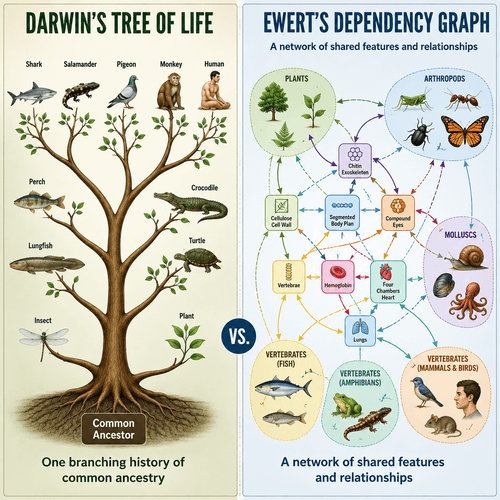
Common descent makes a clear prediction. If all life is one branching family, genes should have relatives. Compare any gene in a mouse and we should find a recognisable cousin in a rat, a fainter cousin in a fish, a fainter one still in a fly. Genes should nest inside one another like Russian dolls.
As genome after genome has been sequenced, biologists have kept meeting genes that refuse to do this. They’re called orphan genes (or taxonomically restricted genes). They have no detectable relatives outside a narrow group of creatures. In many species, somewhere between 10 and 30% of genes fall into this category. Some are essential. Many produce the very features that make a species distinctive.
WHY ORPHAN GENES ARE SO HARD TO EXPLAIN BY ACCIDENT
Nothing to copy from. A gene with no relatives can’t have been produced by gradually modifying an existing gene, because there is no existing gene to modify.
Everything must arrive together. A working gene needs a start signal, a stop signal, a switch that turns it on in the right cell at the right time, a sequence that folds into something useful, and a role in a network that’s already running. Any one of these alone is useless.
They appear in bulk, and at every level. This isn’t a handful of oddities. Orphans turn up in their thousands, in group after group, exactly where a nested family tree says they should not be.
Some apparent orphans aren’t really orphans: a 2020 study in PLoS Biology by Caroline Weisman, Andrew Murray and Sean Eddy showed that our search tools lose the trail when sequences are short and change quickly, so relatives can exist but stay hidden. And a small number of genuinely new genes have been documented—the antifreeze protein in Antarctic fish, for example, which was reshaped from a digestive enzyme.
But look closely at what these documented cases actually deliver. They’re typically short, floppy, weakly used and modestly helpful. Not one is a new folded machine. Not one is a new organ, a new tissue type or a new body plan. The distance between “a short new peptide appeared” and “an eye appeared” is the entire question, and it isn’t bridged by these examples. It’s illustrated by them.
“But genes get duplicated”—the standard answer, examined
The usual reply is gene duplication. A gene is accidentally copied twice; the spare copy is free to change; eventually it becomes something new. It is a clever idea, and it certainly happens. But notice the difficulty it creates rather than solves.
- A spare copy is invisible to selection. While it drifts, it is doing nothing useful, so nothing protects it. Selection cannot guard a work in progress.
- Unguarded DNA decays. Mutations accumulate in the spare copy at random. The usual observed fate of a duplicate gene is not a new invention. It’s a pseudogene—a broken, unread remnant.
- The gap still has to be crossed blind. Duplication gives us a second copy of an island we’re already standing on. It doesn’t tell us how to cross the ocean to a different island. Douglas Axe’s problem returns unchanged.
- Copying is not composing. Photocopying a page of a novel twice doesn’t write a new chapter. The information content hasn’t increased; it has been repeated.
A further difficulty: the genome does several jobs at once
John Sanford makes one more point that deserves to be better known. DNA is not a simple list where each letter does one job. The same stretch of DNA can, at the same time, code for a protein, contain a switch controlling another gene, carry a signal for how the DNA should be folded and packed, and hold instructions for how the message should be cut and spliced. Sanford calls this a poly-functional genome.
The consequence is severe. If one letter serves four different codes simultaneously, a mutation that improves one code will almost certainly damage the other three. The proportion of mutations that are beneficial overall collapses towards nothing. The more we learn about how much the genome is doing at once—and the collapse of the old idea that most of it is useless “junk”—the tighter this constraint becomes.
The longest experiment ever run: what actually happened
Since 1988, Richard Lenski at Michigan State University has grown E. coli bacteria continuously, generation after generation, for more than 75,000 generations. On a human timescale that is well over a million years of reproduction. This is the cleanest test of the mechanism that anyone has ever performed. What did the bacteria do?
| WHAT WAS GAINED | WHAT WAS LOST |
|---|---|
| Ability to use citrate as food—achieved by duplicating an existing transport gene and placing it next to an existing switch Larger cells and faster growth in the laboratory broth | The ability to use ribose, deleted in every single population Several other feeding abilities, abandoned as unnecessary DNA repair machinery, broken in several lines Swimming ability, lost in some lines |
Table 4: A summary of Richard Lenski’s long-term experiment. Note that even the celebrated citrate gain was a rearrangement of parts the bacterium already owned—a new wiring diagram, not a new component. Meanwhile the losses were broad, repeated and predictable. Richard Lenski himself reads these results as evidence of open-ended innovation; we simply ask readers to weigh what is in each column.
This is Behe’s First Rule under a microscope. Given the freedom to adapt for a million equivalent years, the bacteria adapted mostly by throwing equipment overboard.
Antibiotic resistance: the example that proves the opposite of what is claimed
Antibiotic resistance is presented as evolution in action, and in a limited sense it is. But when you look at the molecular detail, resistance nearly always arrives by one of three routes—and none of them creates anything.
| ROUTE TO RESISTANCE | WHAT ACTUALLY HAPPENS AT THE MOLECULAR LEVEL | BUILD, BREAK OR BORROW? |
|---|---|---|
| Closing the door | The bacterium breaks the gene for the surface pore the drug enters through. The drug can no longer get in—but the bacterium also loses the nutrients that pore admitted | Break |
| Blurring the target | The drug’s target protein is altered so the drug grips it less well. The protein usually does its own job slightly worse as a result | Blunt |
| Picking up a tool | The bacterium receives a ready-made resistance gene from another bacterium by horizontal gene transfer. The information is moved, not made | Borrow |
Table 5: The three main routes to antibiotic resistance. Notice that the first two carry a real cost, which is why resistant strains often lose ground once the drug is withdrawn. Resistance is survival by sacrifice, not by invention.
The same pattern appears everywhere once we look for it. Sticklebacks lose their protective pelvic spines because a control switch beside the Pitx1 gene is deleted. Our dog breeds—from chihuahuas to great danes—come overwhelmingly from losses and reshuffling within an existing wolf genome, which is precisely why so many pedigree breeds carry inherited disease. Cave fish lose their eyes. Flightless birds lose their flight.
Life is remarkably good at adapting by breaking things. That’s a real and fascinating capability. It’s simply not the capability the story of common descent requires.
THE LIMITS OF THIS ARGUMENT
Let’s say plainly what this argument does and doesn’t prove.
It’s an inference, not a proof. We’re arguing design is the best available explanation, not that a pathway has been proved impossible for all time. If someone demonstrates a workable step-by-step route to a new protein fold, that would count as real evidence against us, and we should say so in advance.
Some of this research is contested. Critics reply that waiting-time calculations assume a fixed target, when evolution aims at nothing in particular; that Douglas Axe measured the rarity of one particular fold rather than of function in general; and that Michael Behe’s rule does not prevent rare gains from accumulating. Some of Michael Behe’s work appears in journals founded by design advocates, and readers deserve to know that.
The Fall doesn’t depend on genetic entropy. We believe genetic decay fits Scripture beautifully. But our doctrine rests on God’s revelation, not on a scientific model. If the model were revised tomorrow, Romans 8 would stand untouched.
The positive case: what design actually explains
Critics say design is only a gap-filler—that we point at what science cannot yet explain and insert God. That charge would stick if our argument were merely negative. It is not.
- We know of one cause of large volumes of functional information, and it is mind. Every book, every program, every blueprint in human experience traces back to intelligence. When we find a four-letter coded language that is read, copied, proofread, edited and translated, inferring an author is not a failure of imagination. It is the ordinary logic of every other field, including forensics and archaeology.
- Design predicts what we keep finding. Reused parts across unrelated creatures. Function turning up in DNA once dismissed as junk. Layers of code stacked on top of one another. Firm limits on how far breeding can push a species.
- Design explains similarity without requiring descent. A good engineer reuses a good component. Shared parts are evidence of a shared source; whether that source is an ancestor or an Architect is exactly the question, and cannot be assumed at the start.
Stephen Meyer, in Signature in the Cell, presses the point that DNA carries not merely order but specified information—the kind of arrangement we recognise instantly as linguistic. And R. C. Sproul, in Not a Chance, made a philosophical observation that cuts deeper than any laboratory result: chance is not a force. It is a word describing our ignorance of causes. Chance has no being, and what has no being can do no work. To say a gene arose “by chance” is not an explanation. It is a decision to stop explaining.
| QUESTION | WHAT COMMON DESCENT PREDICTS | WHAT COMMON DESIGN PREDICTS |
|---|---|---|
| Orphan genes | Relatives will be found as tools improve | Many will remain genuinely isolated, in groups |
| “Junk” DNA | Most non-coding DNA is genuine debris | Function will keep being discovered in it |
| Laboratory evolution | Given enough generations, novelty will appear | A ceiling will be reached; adaptation will run by loss |
| Selective breeding | No fixed boundary to variation | Firm limits, reached and never passed |
Table 6: Both models make testable predictions. This is why the debate is a scientific one and not merely a matter of belief—and it is why we are content to let future research judge between them.
What Scripture says about a world running down
For the Christian, none of this should be surprising. Scripture describes a creation that was made good, made in distinct kinds, and then damaged.
THE BIBLICAL PATTERN
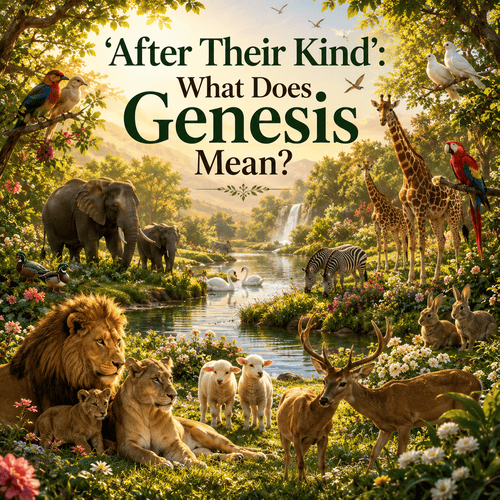
Made in kinds. “And God said, ’Let the earth sprout vegetation, plants yielding seed, and fruit trees bearing fruit in which is their seed, each according to its kind, on the earth.’ And it was so.” (Genesis 1:11, ESV) The phrase “according to its kind” recurs ten times in Genesis 1. Real variation within boundaries is exactly what we observe.
Then subjected to decay. “For the creation was subjected to futility, not willingly, but because of him who subjected it, in hope that the creation itself will be set free from its bondage to corruption.” (Romans 8:20-21, ESV)
And groaning still. “For we know that the whole creation has been groaning together in the pains of childbirth until now.” (Romans 8:22, ESV)
Notice how well this fits the data. The direction of measurable genetic change is downhill. Genomes accumulate damage. Species lose abilities. Breeds bred for one striking feature carry hidden weaknesses. A world under the curse of Genesis 3 is a world where the arrow of change points towards decay—which is precisely what geneticists measure, whatever framework they use to interpret it.
Where this leaves us
Let us gather the threads.
- Natural selection cannot create. It can only choose between options that already exist, so every creative act must come from random mutation.
- Working proteins are astonishingly rare in the space of possible sequences, and selection cannot help you reach one until you have already arrived.
- We can now measure the cost of even two coordinated mutations, and the creatures said to have evolved most cannot afford it.
- Mutations accumulate as damage faster than selection can clear it, and the waiting time for specific new sequences vastly exceeds the time available.
- Thousands of genes have no family tree, appearing suddenly and in bulk, exactly where nested inheritance says they should not.
- In the longest evolution experiment ever run, and in every famous case of observed adaptation, the mechanism worked mainly by breaking things.
Put together, these are not scattered doubts. They are a single, consistent finding about the mechanism: it’s a superb editor and a poor author. It tunes, trims and dismantles with great skill. It has never been caught writing.
And if the mechanism cannot write, then the writing in every living cell needs an author. The similarities running through all of life are real, and they demand an explanation. We suggest the better explanation is not a long unguided accident but a common Designer, reusing excellent designs, and writing His signature into every cell of every creature that has ever lived.
“I praise you, for I am fearfully and wonderfully made. Wonderful are your works; my soul knows it very well.” (Psalm 139:14, ESV)
Frequently Asked Questions
Does Michael Behe actually believe in common descent?
Yes, and this surprises people on both sides of the debate. Michael Behe accepts an ancient earth and accepts that living things share ancestors, including humans and other primates. His objection is entirely about mechanism: he argues that unguided mutation and selection cannot account for the molecular machinery inside cells. From a Reformed standpoint we can use his mechanism arguments with real profit while disagreeing with him about history, because his laboratory work stands on its own evidence. It is also a useful reminder that intelligent design is a narrower claim than biblical creation, and that clear thinking requires us to keep separate questions separate. We should never pretend a scholar agrees with us more than he does.
What’s the difference between intelligent design and biblical creation?
Intelligent design makes one minimal claim: that some features of nature are better explained by an intelligent cause than by undirected processes. It says nothing about Scripture, nothing about the age of the earth, and nothing about who the designer is. Biblical creation begins somewhere else entirely—with God’s own revelation of Himself in His Word. The two overlap in their conclusions and often in their personnel, but they are different kinds of argument, and confusing them weakens both. As a Reformed publication we hold that Scripture, not scientific inference, is our final authority; design arguments are useful servants, never masters.
Didn’t the Dover court case in 2005 settle this question?
The Kitzmiller vs Dover ruling held that teaching intelligent design in one Pennsylvania school district breached the American constitution’s establishment clause. Notice carefully what kind of question that is. A judge was ruling on law, on the motives of a school board and on what may be taught in a state school. No court can decide how rare functional protein folds are, and no legal judgment has ever caused an enzyme to fold differently. Christians should also remember that our confidence has never rested on official approval; the church has flourished under far heavier legal disapproval than this.
Is “junk DNA” real, and did the ENCODE project disprove it?
The ENCODE project reported biochemical activity across the large majority of the human genome, and design advocates welcomed this as vindication of their prediction that function would be found. Critics reply, not unreasonably, that a stretch of DNA being copied or bound by a protein is not the same as it doing something genuinely useful. The honest position is that the argument continues and the final figure is not yet settled. We would rather state that plainly than claim a victory we cannot yet demonstrate. What we can say is that the confident older claim that most of the genome is useless rubbish has not survived contact with the evidence—and that Christians who expected purpose in God’s handiwork were not being foolish.
Have scientists ever watched a new species appear?
Yes, if by species we mean a population that can no longer interbreed with its relatives. This has been observed in plants that double their chromosomes, in insects that shift to a new host plant, and elsewhere. Design advocates and most creationists accept it without difficulty. The important point is that new species can and do arise through variation, isolation and even loss, without a single new gene appearing—so observed speciation does not answer the mechanism question at all. It is entirely consistent with Genesis, where creatures multiply and diversify richly within the kinds God made.
Do mainstream geneticists accept John Sanford’s genetic entropy?
Not in the strong form he presents it, and we should be straightforward about that. But mutational load is a genuine and long-standing mainstream concern, discussed openly by geneticists such as Michael Lynch and Alexey Kondrashov. The debate is about magnitude—how harmful the average mutation is, how well selection removes it, and whether the trend is terminal—not about whether damage accumulates. There is a real difference between a claim that has been refuted and a claim that is contested, and honest apologetics keeps the two apart. Overstating scientific support does far more damage to our witness than admitting a live disagreement.
If humans and chimpanzees share about 98 per cent of their DNA, doesn’t that settle it?
That figure depends heavily on what is being compared and how insertions and deletions are counted; comparisons of whole genomes rather than aligned sections give noticeably lower percentages. But even granting the number, similarity is evidence that both models must explain rather than evidence for one of them. Common descent reads shared sequence as inheritance; common design reads it as shared architecture, in the way two buildings by one architect share features. The mechanism question is untouched by the percentage: it asks whether the differences that remain, however small a fraction they are, could be produced by the processes on offer in the time available. And Scripture locates human distinctiveness not in a genetic percentage at all, but in the image of God, in which we alone were made.
Related Reads
- Common Descent or Common Design: Which Explains Life’s Unity?
- Can Random Mutations Create Complex Life? The Math Says No
- Failing the Math Test: Darwinism’s Wait Time Problem
- Haldane’s Dilemma: Why Can’t Evolution’s Math Add Up?
- Dependency Graph of Life: Why Genes Don’t Fit Darwin’s Tree
- The Cambrian Explosion: Why the Fossil Record Runs Top-Down
- Fruit Fly Mutations: What Decades of Research Actually Tell Us
- The Big Hoax: Turns Out ‘Junk’ DNA Isn’t Junk After All