
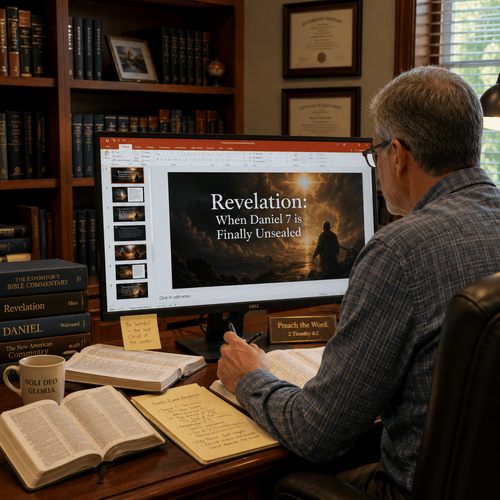
Open Daniel Chapter 7. Four monsters climb out of a storm-tossed sea. The last of them has ten horns, and among those horns a small one grows with a boasting mouth. It attacks God’s people and wins. Then thrones are set in place, an ancient figure in white robes sits down, books are opened, and someone “like a son of man” arrives on the clouds and is handed a kingdom that never ends.
Now open Revelation 13. A monster climbs out of the sea. It has ten horns. It has a boasting, blaspheming mouth. It attacks God’s people and wins. Turn next to Revelation 20, and thrones are set in place and books are opened.
Most readers notice this immediately, and they draw the obvious conclusion. Revelation must be the sequel to Daniel 7.
That instinct is sound. In fact the evidence for it is far stronger than most Christians realise. But the word “sequel” is slippery, and left unexamined it can carry in ideas that do real harm. This post makes the case in three steps: the evidence that John’s vision is built on Daniel; why “sequel” is almost the right word but not quite; and what the whole connection means for the church that reads it.
Four Things People Mean by “Sequel”
The word carries at least four different meanings, and they are not equally true.
- Revelation continues Daniel’s story. Largely true.
- Revelation explains Daniel. True—and far more important than most readers notice.
- Revelation replaces Daniel. False, and worth saying out loud.
- Revelation simply borrows Daniel’s furniture. Much too weak.
By the end of this post a better word than “sequel” will have come into view. That word is unsealing.
The Evidence: John’s Vision Is Built on Daniel
Start with a fact that surprises almost everyone. Revelation never quotes the Old Testament. Not once in 22 chapters does John write “as it is written” or “the prophet says.” There is not a single formal quotation in the book.
And yet Revelation is the most Old Testament-soaked book in the New Testament. It works entirely by allusion—a quiet echo, where a writer uses the words and pictures of an older text and trusts us to recognise them. Scholars who count these echoes arrive at figures between roughly 250 and more than 600, depending on how strict they are. Four books dominate the list: Isaiah, Ezekiel, the Psalms and Daniel.
Gregory Beale, who wrote his doctoral thesis on precisely this question, argues Daniel does something the other three don’t. Isaiah and Ezekiel hand John language and scenery. Daniel hands him a framework—the shape of the story he is telling. Benjamin Gladd, who studied under him, puts the same point simply: John doesn’t decorate his vision with Daniel. He thinks with Daniel.
Here’s what that claim looks like when we set the two texts side by side.
| IN DANIEL 7 | IN REVELATION | WHAT JOHN DOES WITH IT |
|---|---|---|
| 7:2–3 — four beasts rise from the sea | 13:1 — one beast rises from the sea | Four are collapsed into one |
| 7:4–6 — lion, bear, leopard | 13:2 — leopard, bear, lion | The same three, in reverse order |
| 7:8, 25 — a mouth speaking great things against God | 13:5 — a mouth uttering haughty and blasphemous words | Taken over almost word for word |
| 7:9 — thrones placed; hair like pure wool, white as snow | 1:13–14; 4:2 — the same throne, the same white hair | The description is moved onto Christ |
| 7:10 — a thousand thousands, ten thousand times ten thousand | 5:11 — myriads of myriads and thousands of thousands | The same court, now singing |
| 7:10 — the books were opened | 20:12 — books were opened | The same courtroom scene |
| 7:13 — one like a son of man comes with the clouds | 1:7, 1:13, 14:14 | Blended with Zechariah 12:10 |
| 7:21 — the horn makes war on the saints and prevails | 13:7 — the beast makes war on the saints and conquers | Repeated directly |
| 7:22 — judgment given for the saints | 20:4 — thrones, and judgment committed to them | Repeated directly |
| 7:25 — a time, times, and half a time | 11:2–3; 12:6, 14; 13:5 | Reissued five separate times |
| 7:18, 27 — the kingdom for ever and ever | 22:5 — they will reign for ever and ever | The closing note of the whole Bible |
Read that table slowly. This isn’t 1 or 2 shared pictures. This is a single Old Testament chapter taken apart and rebuilt across an entire New Testament book.
Three pieces of evidence carry most of the weight.
1. John’s Opening Line Rewrites Daniel
Daniel 2:28 says God “has made known to King Nebuchadnezzar what will be in the latter days.” The Greek translation of Daniel the earliest Christians read phrases it as what must take place in the latter days.
Now read the very first sentence of Revelation.
“The revelation of Jesus Christ, which God gave him to show to his servants the things that must soon take place.” (Revelation 1:1)
John has picked up Daniel’s clause and altered exactly one thing. Daniel’s “in the latter days” becomes John’s “soon.” That single swap is the argument of the whole book squeezed into a sentence: the distant future Daniel saw has now begun.
2. The Seal Is Broken
At the end of his book Daniel receives a direct order.
“But you, Daniel, shut up the words and seal the book, until the time of the end.” (Daniel 12:4)
He is told the same thing again a few verses later: “the words are shut up and sealed until the time of the end” (Daniel 12:9).
At the end of his book John receives the opposite order.
“Do not seal up the words of the prophecy of this book, for the time is near.” (Revelation 22:10)
This isn’t a faint echo. It’s a standing instruction being cancelled. Someone with the authority to do so has decided the time Daniel was told to wait for has arrived.
THE TWO SENTENCES THAT SETTLE THE QUESTION
Daniel 12:4 — “shut up the words and seal the book, until the time of the end.”
Revelation 22:10 — “Do not seal up the words of the prophecy of this book, for the time is near.”
Same subject matter. Same kind of vision. Opposite command. Everything that happened in between is the reason for the change: the cross, the empty tomb and the enthronement of Christ.
3. Daniel’s Unanswered Question Finally Gets an Answer
Near the end of Daniel, a man clothed in linen stands above the waters of a river, raises his hand towards heaven, and swears by the God who lives for ever that it will be “a time, times, and half a time” (Daniel 12:7). Daniel has just asked the obvious question—“How long shall it be till the end of these wonders?” (12:6)—and he doesn’t get a straight answer. He’s simply told to go his way.
Revelation 10 stages that scene again. A mighty angel stands with one foot on the sea and one on the land, raises his hand to heaven, swears by the God who lives for ever and ever—and this time the answer comes: “there would be no more delay” (Revelation 10:6).
Daniel asked and was put off. John is simply told. Richard Bauckham calls Revelation the climax of prophecy for exactly this reason: the book doesn’t merely repeat older visions, it brings them to their point.
Almost the Right Word—But Not Quite
So is “sequel” the correct label? Almost.
Ezekiel Supplies More of the Running Order
If Daniel gives Revelation its framework, Ezekiel gives it much of its sequence. Watch the order of events:
- Ezekiel 1 — a vision of God’s throne → Revelation 4
- Ezekiel 2–3 — the prophet is made to eat a scroll → Revelation 10
- Ezekiel 38–39 — the assault of Gog and Magog → Revelation 20:8
- Ezekiel 40–48 — a new temple and a measured city → Revelation 21
Anyone who says Revelation is *simply* the sequel to Daniel 7 hasn’t looked carefully at Ezekiel. Steve Moyise, who has spent a career studying how John uses the Old Testament, warns against assuming one source controls everything. He has a point. Daniel supplies the key; Ezekiel supplies much of the running order; Isaiah supplies most of the language of new creation. Revelation is the sequel to the whole Old Testament—with Daniel 7 doing the single, heaviest share of the lifting.
“Sequel” Makes It Sound Like a Writing Project
A sequel is something an author sits down and composes. Revelation is something John received. He’s on the island of Patmos, “in the Spirit on the Lord’s day” (Revelation 1:10), and he’s told to write down what he sees.
So how does Daniel’s imagery end up inside John’s vision? Not because John was clever with a scroll open on his desk. When God inspires a writer he doesn’t switch off that writer’s mind—he fills it. John’s memory was soaked in Scripture, and the Spirit gave him visions in the language his mind already spoke. That’s why the vision arrives dressed in Daniel’s clothing. And it’s also why the vision is genuinely given rather than assembled.
The Centre of Revelation Isn’t Daniel
The book names its own subject in its opening words: “the revelation of Jesus Christ.” If Revelation is the sequel to anything, it’s the sequel to the cross and the empty tomb.
A BETTER WORD THAN “SEQUEL”
Revelation isn’t so much Daniel 7’s sequel as Daniel 7’s unsealing.
A sequel adds a new episode to an old story. An unsealing opens something that was always there but couldn’t yet be read. Daniel was handed a locked box and told to leave it locked. John is handed the same box, and told to open it and read it aloud.
Put another way: Revelation is Daniel 7 read from the far side of the resurrection.
Four Things Daniel 7 Doesn’t Tell Us
The clearest proof that Revelation is doing more than borrowing is this: it answers questions that Daniel 7 deliberately leaves hanging. There are four of them, and each answer is worth more than a shelf of speculation about current affairs.
1. How Does the Son of Man Get the Kingdom?
Daniel 7 never says. The figure simply arrives on the clouds, and dominion is handed to Him. There’s no account of what He did.
Revelation 5 supplies the missing scene. John is weeping because no one can open the sealed scroll, and an elder tells him “the Lion of the tribe of Judah, the Root of David, has conquered.” John turns to look at a lion—and sees “a Lamb standing, as though it had been slain” (Revelation 5:5–6).
Dennis Johnson argues this single moment teaches us how to read the entire book: what John hears and what John sees interpret one another. Hear “Lion,” look, see “Lamb.” The kingdom of Daniel 7 is obtained by being killed. That is the answer Daniel was never given.
2. Who Is the Son of Man?
In Daniel 7 the son of man and the Ancient of Days are plainly 2 figures. One approaches; the other is already seated. The seated one has hair “like pure wool” and clothing “white as snow” (Daniel 7:9).
Now read John’s first sight of the risen Christ.
“and in the midst of the lampstands one like a son of man … The hairs of His head were white, like white wool, like snow.” (Revelation 1:13–14)
John has taken the description of the Ancient of Days and placed it on the Son of man. He’s not muddling them up. He’s identifying them. The one who receives the kingdom and the one who gives it share a description because they share a nature.
This is one of the highest statements about the deity of Christ anywhere in the New Testament—and John makes it without a single line of argument. He simply moves a description from one figure to the other and lets any reader who knows Daniel do the arithmetic.
3. Who Are “the Saints of the Most High”?
Daniel promises the kingdom to “the saints of the Most High” (7:18) and to “the people of the saints of the Most High” (7:27). Readers have argued for centuries about who is meant—angels, faithful Israel, or something wider.
Revelation settles it in a song.
“by your blood you ransomed people for God from every tribe and language and people and nation, and you have made them a kingdom and priests to our God.” (Revelation 5:9–10)
The people who inherit Daniel’s kingdom are not one nation. They’re a redeemed people gathered out of every nation. Daniel’s promise has been widened until it covers the whole earth.
4. When Does All This Happen?
Daniel is told: sealed, latter days, not yet. John is told: unsealed, soon, already begun. The same programme, seen from two different points in history. Geerhardus Vos taught a whole generation to describe this as the age to come arriving early—real, present, and not yet complete.
“John Never Asked What It Meant”—Is That True?
Here’s a claim you’ll meet often online, and it deserves testing rather than repeating. It runs like this: *Daniel keeps asking what his visions mean, but John never does—because John recognised Daniel 7 and already knew.*
It’s a tidy explanation. It’s also mostly wrong.
What Daniel Actually Does
Daniel is an anxious reader of his own visions.
| VERSE | WHAT DANIEL DOES | WHAT HE IS TOLD |
|---|---|---|
| Daniel 7:15–16 | His spirit is troubled; he approaches an attendant and asks for the truth of it | He is given an interpretation |
| Daniel 7:19–20 | He asks again, specifically about the fourth beast | He is given more detail |
| Daniel 7:28 | His thoughts alarm him and his face turns pale | He keeps the matter to himself |
| Daniel 8:15, 27 | He seeks to understand; he is appalled and cannot understand | The vision is sealed “for many days” |
| Daniel 12:8 | “I heard, but I didn’t understand … what shall be the outcome of these things?” | He is refused an answer, and told to go his way |
What John Actually Does
John isn’t the calm expert the popular claim imagines. Look at what the text says about him.
- Revelation 5:4—he weeps loudly when no one is found worthy to open the scroll.
- Revelation 7:13–14—an elder asks him who the white-robed crowd are, and John answers, “Sir, you know.” That’s not knowledge. That’s a polite way of asking to be told.
- Revelation 17:6–7—John “marvelled greatly,” and the angel responds, “I will tell you the mystery.”
- Revelation 1:20—Christ Himself has to explain what the lampstands and the stars stand for.
So the premise is overstated. John doesn’t coast through his vision understanding everything he sees.
What’s Genuinely Different
John does ask, in his own way. The real difference is this: John’s never refused.
Daniel asks and is sealed off. John is told—repeatedly, patiently, often before he has even finished being confused.
The difference between the two men isn’t intelligence. It’s timing. Peter states the principle directly, and it’s one of the most important sentences in the Bible for reading the Old Testament at all.
“concerning this salvation, the prophets who prophesied about the grace that was to be yours searched and inquired carefully … It was revealed to them that they were serving not themselves but you.” (1 Peter 1:10–12)
Daniel’s ignorance wasn’t a failure of intellect. It was a feature of where he stood in the story. He was on the near side of the cross, straining forward. John stands on the far side, looking back on an event that’s actually happened. Paul says the same thing about the “mystery” that was hidden for ages and has now been made known (Ephesians 3:4–5; Colossians 1:26).
The Deepest Reason of All
Go back to Revelation 5 and notice why the sealed scroll is finally opened. It’s not because the seer worked out the code. All of heaven is searched and nobody was found worthy, and John simply breaks down and weeps. Then the Lamb steps forward and takes the scroll—and the reason given isn’t insight but sacrifice: “for you were slain, and by your blood you ransomed people for God” (5:9).
If Revelation can be understood, it’s because Christ opened it. Not because a clever reader cracked it.
WHY THE POPULAR VERSION MATTERS
“John understood because he spotted the Daniel connection” sounds harmless enough. But follow it through and see where it lands.
It makes the meaning of the book depend on the cleverness of the man who saw it—and, by extension, on ours. Revelation becomes a puzzle, and understanding it becomes a reward for holding the right key. That’s exactly the instinct that has produced 2000 years of charts, calendars and confident predictions that came to nothing.
Scripture doesn’t work that way. It’s clear enough in everything necessary for salvation that ordinary Christians using ordinary means can understand it, and its harder passages are explained by its plainer ones. John wrote to 7 congregations who heard Daniel read aloud in their gatherings. He assumes recognition. He doesn’t require genius.
So here’s the fair version of the claim, and it’s worth holding on to. John doesn’t need his vision explained the way Daniel did—not because John is sharper, but because the events that made Daniel’s vision impossible to understand have now happened.
Does This Change How We Read the Beast?
It does—and this is where the Daniel connection does its most practical work. Christians have read Daniel 7 and Revelation 13 together in four main ways.
| APPROACH | DANIEL’S FOURTH KINGDOM IS… | REVELATION’S BEAST IS… | MAIN DIFFICULTY |
|---|---|---|---|
| Past-fulfilment (e.g. Kenneth Gentry) | Rome | Nero and imperial Rome, fulfilled by AD 70 | Struggles to account for Revelation 20–22 |
| Church-history (the Reformers and Puritans) | Rome | A power unfolding across the centuries of church history | Requires a fixed calendar that keeps needing revision |
| Future-only (popular prophecy teaching) | A revived Rome, after a long gap | A single future world ruler | Revelation merges Daniel’s beasts rather than isolating the last one |
| Pattern reading (e.g. William Hendriksen) | Rome, as an example of a type | Idolatrous state power wherever it appears | Can under-read the real first-century setting |
| Combined reading (e.g. Gregory Beale, Vern Poythress) | Rome, extended as a pattern | One beast with many historical faces | Needs discipline to avoid becoming vague |
Whatever position we hold, one detail in the text deserves far more attention than it usually gets.
John merges Daniel’s 4 beasts into one. In Daniel there’s a lion, a bear, a leopard and a fourth horror. In Revelation 13:2 there’s a single beast that “was like a leopard; its feet were like a bear’s, and its mouth was like a lion’s mouth.”
If John had read Daniel 7 as a countdown to one final empire, he’d have kept the 4 apart and pointed at the last. He doesn’t. He fuses them, and he lists them backwards. That tells us how he understood the vision. Not as a timetable of 4 governments, but as a portrait of what idolatrous power always looks like—whenever and wherever it appears. Vern Poythress makes the point bluntly: the beast has worn many faces, and Christians who’re watching for only one will be caught out by the next.
What This Means for the Church
Daniel 7 is where the charter of the Christian church is written, and most Christians don’t notice it. Three times in one chapter the kingdom is promised to God’s people.
- “the saints of the Most High shall receive the kingdom” (Daniel 7:18)
- “judgement was given for the saints of the Most High, and the time came when the saints possessed the kingdom” (Daniel 7:22)
- “the kingdom … shall be given to the people of the saints of the Most High” (Daniel 7:27)
Revelation pays out every one of those promises: a kingdom and priests (1:6), reigning on the earth (5:10), thrones and judgement (20:4), and reigning for ever and ever (22:5).
But Revelation also picks up a verse most readers would rather skip. Daniel 7:21 says the horn “made war with the saints and prevailed over them.” Revelation 13:7 says the beast “was allowed to make war on the saints and to conquer them.”
THE POINT MOST READERS MISS
Daniel 7 says the saints are conquered. Daniel 7 also says the saints receive the kingdom.
Revelation repeats both. Which means the period in which the church looks defeated and the period in which the church reigns are the same period—not one after the other.
This is why every letter to the seven churches ends its promise the same way: “to the one who conquers.” Not to the one who escapes. Sinclair Ferguson has observed that the Christian life is not a matter of avoiding the battle but of learning who has already won it.
So, is Revelation the sequel to Daniel 7? Not quite. It’s the unsealing of Daniel 7—the same vision, opened at last, with a Lamb standing at its centre where Daniel could only see a figure on the clouds.
Daniel was told to shut the book and go his way. We’ve been handed it open.
Tough Questions, Honest Answers
Who is the “one like a son of man” in Daniel 7:13, and did Jesus apply the title to himself?
Daniel sees a human figure who comes on the clouds of heaven and receives everlasting dominion from the Ancient of Days. Coming on the clouds is something only God does in the Old Testament, so the figure is both genuinely human and more than human. Jesus made this his favourite way of describing himself, using “Son of Man” far more often than any other title. The decisive moment comes at his trial: when the high priest demands to know whether he is the Christ, Jesus answers that they will see the Son of Man “seated at the right hand of Power, and coming with the clouds of heaven” (Mark 14:62), and the court immediately convicts him of blasphemy. They understood exactly which chapter he was quoting. Far from being a modest title, “Son of Man” was a direct claim to the throne of Daniel 7.
Is the fourth kingdom of Daniel 7 Greece or Rome, and does the answer depend on when Daniel was written?
The two candidates are Rome (the traditional Christian reading) and Greece, particularly under Antiochus IV Epiphanes, who desecrated the temple in the second century BC. The Greece reading is usually tied to the theory that Daniel was written around 165 BC by someone describing recent events as though they were ancient predictions. That theory rests almost entirely on the assumption that genuine predictive prophecy does not happen, which is a philosophical starting point rather than a discovery from the text. The book presents itself as sixth-century, Jesus refers to Daniel as a prophet (Matthew 24:15), and copies found at Qumran are difficult to fit into so short a window. The Rome reading also fits the New Testament use of the chapter, since Revelation applies the beast imagery to an empire that was still standing when John wrote. That said, the enduring value of Daniel 7 does not hang on identifying the fourth kingdom precisely—the chapter is about the pattern of earthly power and the certainty of Christ’s kingdom.
Is the little horn of Daniel 7 the same figure as the little horn of Daniel 8?
They are similar but not identical, and confusing them causes a great deal of muddle. The little horn of Daniel 8 grows out of the Greek empire after Alexander’s kingdom is divided into four, and the chapter itself names Greece (8:21); almost all interpreters identify him with Antiochus IV Epiphanes. The little horn of Daniel 7 grows out of the fourth beast, which comes after the Greek kingdom, so it cannot be the same power. The best way to understand the relationship is that the earlier figure is a preview of the later one. Antiochus is a small-scale rehearsal of a larger and longer pattern of blasphemous power, which is why his career reads so much like the description in Revelation 13.
Does “a time, times, and half a time” mean three and a half literal years, or 1,260 years?
The phrase appears in Daniel 7:25 and 12:7, and Revelation reissues it as forty-two months and as 1,260 days. Three and a half is half of seven, the Bible’s number for completeness, so the figure signals a period that is genuinely severe but deliberately cut short. Some interpreters read it as a literal three and a half years, either under Antiochus IV or in a future tribulation. Others have applied a day-for-a-year rule to reach 1,260 years and then attempted to date it, which has produced a long history of failed predictions and is best treated as a warning. The most natural reading is that this is symbolic language for the whole period between Christ’s ascension and his return—long enough to be painful, limited enough to be survivable, and always under God’s control, since the beast is “allowed” his time rather than seizing it.
Do Daniel 7 and Revelation together teach a seven-year tribulation and a rapture?
That scheme is built mainly from Daniel 9 rather than Daniel 7, by separating the final “week” of the seventy from the sixty-nine before it and placing it thousands of years later. Daniel 7 itself says nothing about a gap, and Revelation gives no timetable of seven years. Nor does Revelation describe the church being removed before trouble arrives—it describes the opposite, a church that is made war upon and that conquers by faithful endurance rather than by exit. The promise of Revelation is not that Christians will avoid the beast but that the beast will not have the last word. When Jesus prayed for his disciples he asked specifically that they be kept safe in the world rather than taken out of it (John 17:15).
Did Daniel 7 borrow its throne-room imagery from Canaanite or Babylonian myth?
Some scholars point to older texts in which an aged high god presides over a divine council and a younger deity rides on the clouds, and argue that Daniel drew on this stock of imagery. The overlap in vocabulary is real, but the conclusion does not follow. Every act of revelation uses the language its first hearers already possessed, and God regularly takes the imagery of the surrounding cultures and turns it against them. That is exactly what Daniel 7 does: the beasts, which in pagan myth represent the chaos monsters that gods must fight, are here reduced to animals that stand helpless before a court and are dismissed by a verdict. Borrowed vocabulary is not borrowed theology. The chapter is a deliberate demolition of the worldview whose words it uses.
Was Revelation written before or after AD 70, and does the date change the Daniel connection?
The majority view places Revelation around AD 95 under the emperor Domitian, resting largely on the testimony of Irenaeus in the second century. A minority argue for a date in the late 60s under Nero, before the fall of Jerusalem, which allows much of the book to be read as a prophecy of that catastrophe. The debate matters for identifying particular details, such as the beast’s heads and the number 666. It matters much less for the Daniel connection, because the structural links do not depend on it. Whichever date is correct, John still opens by rewriting Daniel 2, still merges the four beasts into one, still moves the Ancient of Days’ description onto Christ, and still closes by cancelling Daniel’s command to seal the book. The unsealing argument stands either way.
Related Reads
- Daniel’s 70 Weeks Prophecy: A Reformed Reading of Daniel 9
- The Mark of the Beast: What Revelation 13 Really Means by ‘666’
- The Old Testament in the New: Which Interpretive View Fits Best?
- Christ’s Return: A Primer on the Four Millennial Views
- What Is Amillennialism? A Biblical Assessment
- Bible Mystery: Who Are the 144,000 Really?
- Jesus in the Old Testament: Glimpses of the Coming Saviour