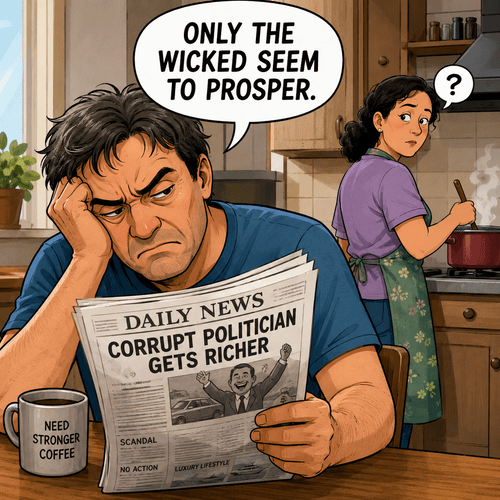
Psalm 137:9 is a prayer, not a command. A man who’d just watched Babylon’s army kill the children of Jerusalem asks God to give Babylon exactly what Babylon gave him. Verse 8 says so in plain words. God is love. God is also just. This verse is what justice sounds like when it is cried out from the bottom of a mass grave.
The verse nobody forgets
Most people who read the Bible from cover to cover stop dead at the end of Psalm 137. The psalm begins with one of the most beautiful lines in Scripture. It ends with one of the most terrible.
“O daughter of Babylon, doomed to be destroyed, blessed shall he be who repays you with what you have done to us! Blessed shall he be who takes your little ones and dashes them against the rock!” (Psalm 137:8–9)
Critics of Christianity quote this verse constantly. They say it proves the God of the Bible approves of killing babies. Many believers quietly agree the verse is indefensible, and simply skip it.
Both groups misread it. Not because the verse is soft—it’s not—but because they’ve read verse 9 without reading verse 8, and without knowing what had happened to the man who wrote it.
First, what had just happened to these people
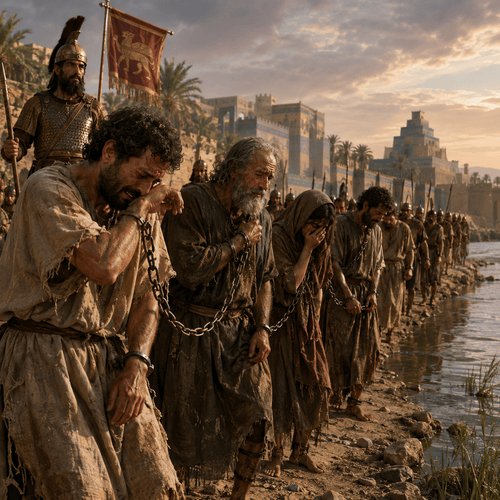
Psalm 137 was written by a survivor. In 586 BC the Babylonian army broke through the walls of Jerusalem after a siege that lasted around 18 months. A siege means an army surrounds a city and lets nobody in or out until the people inside starve.
The book of Lamentations was written about that same siege. It’s not comfortable reading.
WHAT BABYLON ACTUALLY DID TO JERUSALEM
Starvation of children—“The tongue of the nursing infant sticks to the roof of its mouth for thirst; the children beg for food, but no one gives to them” (Lamentations 4:4).
Mothers eating their own babies—“Should women eat the fruit of their womb, the children of their tender care?” (Lamentations 2:20). Lamentations 4:10 says it happened.
Children dying in the streets—“Your children faint for hunger at the head of every street” (Lamentations 2:19).
The city burned and the temple destroyed—Everything the people loved was reduced to rubble (2 Kings 25:9).
Survivors marched away in chains—Around 1,500 kilometres on foot, to a foreign land.
The man who wrote Psalm 137 saw all of this. He watched Babylonian soldiers do to Hebrew children exactly what verse 9 describes. This was standard practice in ancient warfare, and the Bible reports it as.
So when you read verse 9, we aren’t reading a wish for something new. We’re reading a survivor asking God to bring the same measure back on the men who invented it.
The shape of the psalm: three movements
Psalm 137 has nine verses and moves in three clear stages. Reading it as a whole changes how the ending sounds.
- Verses 1–3—Grief. The exiles sit by the canals of Babylon and weep. They hang their harps on the poplar trees. Their captors demand a cheerful song about Jerusalem for entertainment. This is mockery, and it’s cruel.
- Verses 4–6—A vow, with a curse attached to himself. The psalmist swears he will never forget Jerusalem, and calls down disaster on his own body if he does.
- Verses 7–9—A prayer for justice. He asks God to remember what Edom did, and what Babylon did.
Notice the order. The curse in the middle of the psalm falls on the writer himself. We will come back to that, because it matters more than most readers realise.
Verse 8 is the key that unlocks verse 9
Almost every argument about this psalm ignores verse 8. But verse 8 tells us exactly what verse 9 means:
“Blessed shall he be who repays you with what you have done to us” (Psalm 137:8).
The phrase “with what you have done to us” is the whole argument. Bible scholars call this principle lex talionis—a Latin term meaning “the law of like for like”. We may know it better as “an eye for an eye” (Exodus 21:24). It’s not licence for cruelty. It’s a limit on cruelty. It says the punishment may never be greater than the crime.
This means verse 9 isn’t an escalation. It’s a measurement. The psalmist isn’t asking God to invent a new horror for Babylon. He’s asking God to hand Babylon back its own bill—not a dollar more.
Table 1: Verse 9 mirrors the crime—it doesn’t exceed it
| WHAT BABYLON DID TO JUDAH | WHAT THE PSALM ASKS FOR | IS IT MORE, LESS OR EQUAL? |
|---|---|---|
| Killed the children of a conquered city | The same measure returned to Babylon | Equal |
| Burned the temple and the city | No request for Babylon’s temples | Less |
| Marched survivors into slavery | No request for Babylonian slaves | Less |
| Mocked the exiles’ God (verse 3) | No mockery requested in return | Less |
Read carefully, the psalm asks for less than it suffered, not more. That’s a strange kind of “bloodthirsty rage”.
This prayer wasn’t the psalmist’s own idea
Here’s the point that changes the whole discussion. God had already announced this judgment on Babylon, in writing, through His prophets—decades before Psalm 137 was written.
“Their infants will be dashed in pieces before their eyes” (Isaiah 13:16).
Isaiah 13 is a prophecy against Babylon. Isaiah 13:16 uses the same image as Psalm 137:9. Jeremiah 50 and 51 say the same thing at length: Babylon will be repaid for what it did to Zion (Jeremiah 51:24). Jeremiah even calls the coming conqueror God’s hammer and weapon of war (Jeremiah 51:20).
So the psalmist isn’t asking God for something new. He’s praying God’s own published word back to Him. He’s saying, in effect: “You said you’d do this. Please do it.”
John Day, who wrote a full doctoral study of these psalms titled Crying for Justice, argues exactly this. The cursing psalms aren’t private temper. They’re legal appeals, grounded in promises God had already made—above all in Genesis 12:3, where God tells Abraham He will curse those who curse His people.
O Palmer Robertson, in his study of how the Psalms are arranged, The Flow of the Psalms, notes Psalm 137 sits in the section of the Psalter shaped by the exile. Its placement is deliberate. The editors of the Psalter didn’t slip it in by mistake or leave it in by embarrassment. It’s there to be prayed by a people in ruins.
Table 2: Verse 9 uses standard ancient war language found throughout Scripture
| PASSAGE | WHO IS SPEAKING | WHAT IT DESCRIBES |
|---|---|---|
| 2 Kings 8:12 | The prophet Elisha, weeping | What Hazael of Syria will do to Israel |
| Hosea 10:14 | God, through Hosea | Judgement coming on Israel |
| Hosea 13:16 | God, through Hosea | Judgement on Samaria |
| Nahum 3:10 | God, through Nahum | What already happened to Thebes |
| Isaiah 13:16 | God, through Isaiah | Judgement coming on Babylon |
| Psalm 137:9 | A human survivor, praying | A request that Isaiah 13:16 be fulfilled |
Look at the last two lines of that table. God announced it. The psalmist asks for it.
He calls down a curse on himself first
“If I forget you, O Jerusalem, let my right hand forget its skill! Let my tongue stick to the roof of my mouth, if I do not remember you” (Psalm 137:5–6).
Before he asks God to judge anybody else, this man asks God to cripple him if he ever stops loving God’s city. He puts himself under the same knife.
This isn’t the psychology of a man drunk on hate. A man consumed by revenge exempts himself. This man does the opposite. He submits himself to judgement before he asks for it on others. Whatever else Psalm 137 is, it isn’t self-righteous.
A prayer isn’t a command
This is the single most important distinction in the whole discussion, and it’s very simple.
What Psalm 137:9 doesn’t contain
No command. Nobody in the Bible is ever told to do this. There’s no imperative addressed to any human being anywhere in the psalm.
No permission. The psalmist doesn’t give himself or anyone else the right to act.
No plan. He’s a prisoner in a foreign land, 1,500 kilometres from home, with no army and no weapon.
No action. Nothing happens in Psalm 137 except weeping, remembering and praying.
No divine reply. God doesn’t answer in the psalm. The prayer is simply left with Him.
The Bible contains many kinds of writing. Some of it is God commanding. Some of it is God describing. Some of it is people speaking to God. Confusing these is the most common mistake made about difficult passages.
Table 3: Different kinds of biblical text—and what each one obliges us to do
| KIND OF TEXT | EXAMPLE | WHAT IT MEANS FOR THE READER |
|---|---|---|
| A command from God | “You shall not murder” (Exodus 20:13) | Obey it |
| A record of what people said | “There is no God” (Psalm 14:1) | Recognise it as false speech, truly reported |
| A prayer offered to God | Psalm 137:8–9 | Learn how God’s people may speak to Him in agony |
| A prophecy of judgement | Isaiah 13:16 | Trust God will do what He said |
Psalm 137:9 belongs in row three. It’s God’s inspired record of how a crushed believer may bring his rage to God—honestly, and without acting on it.
Notice what he does not do: he doesn’t pick up a sword
This is the point most critics miss entirely. The psalmist takes no revenge. He hands the entire matter over to God and walks away from it.
“Beloved, never avenge yourselves, but leave it to the wrath of God, for it is written, ‘Vengeance is mine, I will repay, says the Lord’” (Romans 12:19).
Paul quotes Deuteronomy 32:35—a song that itself contains fierce language about God repaying his enemies. Paul doesn’t delete the idea of divine vengeance. He moves it out of our hands and into God’s. That’s precisely what Psalm 137 does.
Erich Zenger, a Catholic scholar whose short book A God of Vengeance? remains one of the most quoted studies of these psalms, made this point sharply. These are the prayers of people with no power whatsoever. They cannot take revenge even if they want to. So they give the matter to God—and in giving it away, they’re freed from having to carry it.
There are only three things a wounded person can do with rage this deep.
- He can bury it and pretend to be at peace
- He can act on it and become the thing he hates, or
- He can bring it to God and leave it there.
Psalm 137 is the third road, and God put it in the Bible so His people would have words for the worst days of their lives.
Jesus himself uses this psalm’s language
Many people assume the God of the Old Testament is harsh and the Jesus of the New Testament is gentle. Psalm 137 makes that assumption impossible to hold.
“They will not leave one stone upon another in you, and they will dash you to the ground, you and your children within you” (Luke 19:44).
This is Jesus, weeping over Jerusalem, days before His death. The Greek word translated “dash you to the ground” is edaphizo. It’s the very same word the Greek Old Testament uses in Psalm 137:9. Christ takes the vocabulary of Psalm 137 and applies it to the coming judgement on Jerusalem itself—and He says it in tears.
Jesus also warns anyone who harms a child would be better off drowned in the sea with a millstone round his neck (Matthew 18:6). That isn’t a gentle sentiment. It’s a statement that crimes against children deserve terrible judgment—which is exactly what Psalm 137 assumes.
The last book of the Bible prays the same prayer
If Psalm 137 were sub-Christian, the New Testament would quietly drop it. Instead it does the opposite.
- Revelation 6:10—Christian martyrs, already in heaven and already perfected, cry out: “O Sovereign Lord, holy and true, how long before you will judge and avenge our blood?” They aren’t rebuked. They’re given white robes and told to wait a little longer.
- Revelation 18:20—Heaven is commanded to rejoice over the fall of Babylon. Not merely to accept it. To rejoice.
- Revelation 18:21—A mighty angel throws a great millstone into the sea as a picture of Babylon’s destruction—stone imagery deliberately echoing the psalm.
- Revelation 19:1–3—Heaven answers with “Hallelujah!” as the smoke of Babylon goes up for ever.
James E Adams, in War Psalms of the Prince of Peace, argues these psalms belong first of all to Christ, and only then to us. Christ is the true righteous sufferer of the Psalter. When He returns as judge, every prayer for justice ever prayed by a wronged believer will be answered in Him. On this reading, Psalm 137 isn’t a leftover from a crude age. It’ a prayer still awaiting its answer.
The Bible doesn’t abolish the cry for justice. It fulfils it.
But what about the children?
This is the hardest part, and it deserves a straight answer rather than a clever one.
Two things need to be said, and both matter.
First: the psalm is asking for the end of an empire
Ancient nations thought of a city as a single person. That is why the psalm says “daughter of Babylon”. When an ancient conqueror destroyed a royal line, he ended the dynasty—its ability to rise again and repeat what it had done. Babylon had built its wealth on doing this to other nations for generations. The prayer asks that the machine be stopped permanently, in the only terms that ancient world understood.
This is not a comfortable explanation. It is not meant to be. The psalm intends to horrify you—because that is what empire does, and someone should be horrified.
Second: dead children are not a problem unique to this psalm
If your objection is that children died under God’s judgment, then your objection is far bigger than one verse. Children died in the Flood. Children died at Sodom. Children died in Egypt. If Psalm 137:9 troubles you, Genesis 7 should trouble you more.
So the question is really this: how can a loving God allow a child to die at all? Scripture answers in four ways.
Four biblical answers on children and the judgment of God
God alone has the right over life. “I kill and I make alive” (Deuteronomy 32:39). He gave life. It’s not theft when He takes it back.
Death is not the worst thing that can happen. To be born into Babylon and raised to become Babylon is worse. Scripture treats physical death as an enemy, but not as the final word.
The judge of all the earth will do right. Abraham’s question in Genesis 18:25 is answered in the asking. God is never careless with a single life.
There’s real hope for children who die young. The Westminster Confession of Faith (10.3) states infants dying in infancy are regenerated and saved by Christ. David expected to see his dead infant son again (2 Samuel 12:23).
That last point deserves emphasis, because it’s almost always missed in this debate. The historic confessional position isn’t that the children of Babylon went to hell. Judgement fell on an empire. The children, if anything, were carried out of it.
One question for the critic: where does your outrage come from?
When someone reads Psalm 137:9 and says “that’s monstrous”, something important has just happened. That person has assumed the killing of children is a real evil—not merely something he personally dislikes, but something genuinely wrong, everywhere, always.
Where does that assumption come from? If human beings are simply matter in motion, the destruction of Jerusalem and the destruction of Babylon are both just atoms rearranging. There’s no injustice in the universe, only events.
The very outrage the critic feels is borrowed from the Bible’s own view of the world: that people are made in God’s image, that atrocity is real, and that it demands an answer. Psalm 137 assumes all of this.
Three popular answers that don’t work
Christians often reach for one of three explanations. All three are well-meant, but none holds.
Table 4: Why the three common defences of Psalm 137:9 fail
| THE ANSWER | WHAT IT CLAIMS | WHY IT FAILS |
|---|---|---|
| “It’s just poetry” | The psalmist is exaggerating and doesn’t mean it literally | He does mean it. He had watched it happen. Calling real grief “exaggeration” insults the sufferer |
| “The psalmist was sinning” | God recorded His rage but disapproved of it. CS Lewis called such passages devilish | This makes Scripture merely a diary of human feeling. If the prayer is sin, why does Revelation pray it too? |
| “It means our sinful thoughts” | Augustine read the “little ones” as young sins to be crushed against Christ the Rock | A beautiful sermon, but not what the words mean. The historical meaning must come first |
CS Lewis was honest enough to tell us plainly the verse disturbed him. That’s better than pretending. But his solution costs too much: if the writers of Scripture were simply wrong when they prayed, we can no longer trust them when they praise.
Gordon J. Wenham, in The Psalter Reclaimed, offers a better path. He argues that when we sing or pray the psalms, we make their words our own—and that this includes learning to hate what God hates. A faith that can’t hate cruelty hasn’t understood love.
God answered this prayer—in His own way
Here’s something remarkable. God did answer Psalm 137. But not in the terms the psalmist specified.
Timeline: the rise and fall of Babylon
- 605 BC—Babylon defeats Egypt at Carchemish and becomes the dominant world power. The first exiles are taken from Jerusalem, including Daniel.
- 597 BC—A second deportation. King Jehoiachin and the leading citizens are carried away.
- 586 BC—Jerusalem falls after a long siege. The temple is burned. Psalm 137 comes out of this catastrophe.
- 539 BC—Cyrus of Persia takes Babylon. By the Persian record, the city is entered without a massacre. Babylon simply changes hands.
- 538 BC—Cyrus issues the decree allowing the Jews to go home and rebuild the temple (Ezra 1:1–4).
- Following centuries—Babylon slowly declines, is abandoned, and becomes the desolate ruin Isaiah 13 had foretold.
So Babylon fell, exactly as God had promised. Judah went home, exactly as God had promised. But God did it on his own timetable, with far less blood than the prayer had asked for.
This is the model for every prayer for justice. We bring God the desire. He decides the form. The psalmist asked for measure-for-measure. God gave something better: the fall of the empire, the freedom of the captives, and a road home.
Where this prayer finally lands
There’s one more thing to say. Every honest reader of Psalm 137 eventually asks the uncomfortable question: what about my sins? If God repays wrongdoing measure for measure, where does that leave me?
“Christ redeemed us from the curse of the law by becoming a curse for us” (Galatians 3:13).
At the cross, the full weight of “repay them for what they have done” fell on Jesus Christ. He was the innocent one, dashed against the rock of God’s justice, in the place of the guilty. The judgment Psalm 137 calls for is real, and it landed—on him—for everyone who trusts Him.
That’s why a Christian can hold both truths at once. God won’t let a single atrocity go unanswered. And God has already borne the answer Himself, so the guilty can go free. The cross isn’t God ignoring Psalm 137. The cross is God absorbing it.
Can a Christian pray Psalm 137 today?
Yes—but with care. John Calvin, commenting on the Psalms, warned these prayers must never be driven by private bitterness. They may only be prayed out of love for God’s justice, never out of personal spite.
Table 5: How to pray a psalm like this without sinning
| You may pray this | You may not pray this |
|---|---|
| “God, stop the traffickers and rescue the children” | “God, ruin my colleague who insulted me” |
| “God, bring the genocide to an end and judge those responsible” | “God, let me be the one who gets even” |
| “God, your kingdom come”—which is a prayer against every Babylon | “God, I will not forgive, and I want you to agree with me” |
| “God, judge them—or save them; either way, end the evil” (Psalm 83:16–18) | “God, I refuse to want their repentance” |
Jesus commands us to love our enemies and pray for those who persecute us (Matthew 5:44). That command stands. But loving an enemy has never meant pretending his crimes don’t matter. It means wanting his repentance more than his ruin—while still asking God to stop him.
Psalm 83:16–18 holds both together perfectly: judge them, and let that judgement bring them to seek your name.
The honest conclusion
Psalm 137:9 isn’t a stain on the Bible. Or on God. A comfortable religion would have edited this psalm out. A book invented by men trying to look respectable would never have kept it. But God kept it, because God knows His people are sometimes destroyed, and that destroyed people need somewhere to put what they’re feeling.
So He gave them a prayer. Not a sword—a prayer. He said: bring it to me. All of it. The part you’d never say aloud in church. Bring that too, and leave it with me, and I will deal with it justly.
Tough Questions, Honest Answers
Who wrote Psalm 137, and when was it written?
The psalm doesn’t name the author. The Hebrew text carries no title, which is unusual. Almost all scholars date it to the exile period or shortly after, because verse 1 describes the exiles sitting by the canals of Babylon as a present experience. The Jewish exile in Babylon ran from 586 BC to 538 BC, so the psalm most likely comes from that window or from the years just after the return, while the memory was still raw. Some believe it was written by a Levite singer, since verse 2 mentions harps and verse 4 speaks of singing the Lord’s song—the work of temple musicians.
What does “By the rivers of Babylon” mean, and why’s it a famous pop song?
The “rivers” were the great irrigation canals of the Babylonian empire, built off the Euphrates. Exiles were often settled in work colonies beside them. So the opening line is a picture of displaced people sitting beside a foreign waterway, remembering a homeland they may never see again. The song most people know was recorded by the group Boney M in 1978, based on an earlier Jamaican version, and it uses verses 1–4 almost word for word. It stops before verse 9, which is why millions of people can sing the psalm without ever having met its ending.
Which psalms are the cursing psalms, and how many are there?
Scholars use the term “imprecatory psalms”—imprecation simply means calling down judgment. There is no fixed list, but the ones most often named are Psalms 35, 55, 58, 59, 69, 79, 83, 109 and 137. Psalm 109 is generally regarded as the most severe of them. Shorter passages of the same kind appear inside many other psalms. Together they make up a significant part of the Psalter, which tells us something important: God expected his people to spend a good deal of their prayer life asking him to deal with evil.
Why do some churches leave out Psalm 137:7–9 in public worship?
After the Second Vatican Council, the Roman Catholic Liturgy of the Hours omitted Psalms 58, 83 and 109 entirely, and cut the closing verses from Psalm 137. The stated reason was pastoral difficulty for ordinary worshippers. Many Protestant hymn books have quietly done something similar for generations. The concern is understandable, but there’s a cost: when the church edits its prayer book, it teaches people some of their real experiences have no place before God. Those who’ve actually suffered atrocity are usually the last people to want these verses removed.
What actually happened to Babylon, and did God answer the prayer?
Babylon fell to Cyrus of Persia in 539 BC, less than 50 years after Jerusalem was destroyed. The Persian account describes the city being taken without a great slaughter. The Babylonian empire ended, its royal line ended, and the following year Cyrus allowed the Jewish exiles to go home (Ezra 1:1–4). Over the following centuries the city itself declined until it was abandoned ruins, just as Isaiah 13 had said. So the prayer was answered: Babylon was repaid and Judah was restored. But God chose the manner of it, which turned out to be far less bloody than the psalm had requested.
What does “How shall we sing the Lord’s song in a foreign land?” mean?
The exiles’ captors wanted entertainment: sing us one of those Zion songs (verse 3). The request was mockery, because the songs of Zion celebrated a city the Babylonians had just burned to the ground. The question in verse 4 is therefore not about music but about faith. How do you praise God for his promises when every visible sign of those promises has been destroyed? Every believer who has prayed through disaster knows that question. The psalm does not answer it cheaply—it simply refuses to let go of Jerusalem, which is another way of saying it refuses to let go of God’s promise.
Should churches read or sing Psalm 137 in public worship?
Yes, and preferably the whole of it. It’s part of Scripture, and Paul says all Scripture is profitable (2 Timothy 3:16). The wise approach is to read it with teaching attached, so nobody leaves confused. Congregations that include survivors of war, abuse or persecution often find this psalm to be one of the most liberating passages in the Bible, because it tells them their rage has already been anticipated by God and given a safe place to go. Skipping it doesn’t protect people. It simply leaves them alone with feelings they think God will not receive.
Related Reads
- Is The God of the Bible Cruel and Vindictive?
- Slaughter of the Canaanites: Would a Loving God Command It?
- Isaiah 45:7: Does God Indeed Create Evil?
- Evil: More Than the Absence of Good
- Why Do Animals Suffer If God Is Good?
- Called Home Early: Reformed Perspectives on Infant Death
- Not Home Yet: How Scripture’s Exile Theme Shapes Our Faith