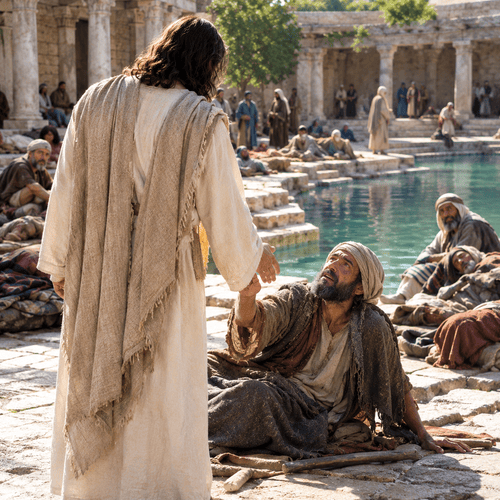
Jesus once walked into a place full of sick people—blind, lame and paralysed. He healed one man, and then, walked away.
That’s not a sceptic’s version. It’s in John chapter 5. And it may be the key to one of the most painful questions Christians ever ask.
Perhaps you’ve asked it yourself. You prayed for someone you love. You believed. But the healing didn’t come. Then you read the Gospels—the four books about Jesus’ life—and saw Him healing crowds of people. So you ask: If Jesus healed so many, why doesn’t God heal everyone today?
The Bible gives a clear and solid answer. Let’s see what it is.
Jesus Didn’t Heal Everyone Either
Some people think Jesus healed every sick person He met. He didn’t. At the pool of Bethesda in Jerusalem, crowds of sick people waited, hoping the water would heal them:
In these lay a multitude of invalids—blind, lame, and paralysed.
John 5:3, ESV
An invalid is a person made weak by illness. A multitude is a large crowd. Jesus healed one man there who had been ill for 38 years. The Bible mentions no one else.
Times when Jesus and His apostles did not heal everyone
| WHAT HAPPENED | BIBLE REFERENCE | WHAT IT SHOWS |
|---|---|---|
| Jesus heals one man out of a large crowd of sick people | John 5:1–9 | Jesus chose whom to heal |
| Jesus leaves a town while sick people are still looking for Him | Mark 1:35–39 | Preaching came first |
| Jesus does very few miracles in His home town | Mark 6:1–6 | Miracles were not shows for people who rejected Him |
| Paul leaves his friend Trophimus sick | 2 Timothy 4:20 | Even the apostles did not heal everyone |
(An apostle was one of the special messengers whom Jesus chose and sent out to start His church.)
Jesus Explained It Himself
In His home town of Nazareth, Jesus reminded the people of two prophets from long ago:
But in truth, I tell you, there were many widows in Israel in the days of Elijah… and Elijah was sent to none of them but only to Zarephath, in the land of Sidon, to a woman who was a widow. And there were many lepers in Israel in the time of the prophet Elisha, and none of them was cleansed, but only Naaman the Syrian.
Luke 4:25–27, ESV
Many hungry widows, but only one was helped. Many lepers (people with a terrible skin disease), but only one was healed—a foreigner! The crowd was so angry that they tried to throw Jesus off a cliff (Luke 4:28–29). God is free to choose whom He blesses.
True, on some evenings Jesus ‘healed all who were sick’ in a town (Matthew 8:16). But the next morning He moved on, while people were still looking for Him: ‘Let us go on to the next towns, that I may preach there also, for that is why I came out’ (Mark 1:38).
SO WHAT’S THE QUESTION?
God never healed everyone, not even when Jesus walked on earth. So the real question is not, ‘Why has God stopped healing everyone?’ It is: What were the miracles for?
Miracles Were Signs, Not a Hospital
John’s Gospel calls Jesus’ miracles signs.
KEY TERM: WHAT’S A ‘SIGN’?
A sign points beyond itself. A road sign saying ‘Delhi 50 km’ is not Delhi. It tells you where Delhi is. In the same way, Jesus’ miracles were not the main point. They pointed to who Jesus is.
When some friends lowered a paralysed man through a roof, Jesus first forgave his sins. People were shocked, because only God can forgive sins. So Jesus said:
But that you may know that the Son of Man has authority on earth to forgive sins—he said to the paralytic—‘I say to you, rise, pick up your bed, and go home.’
Mark 2:10–11, ESV
The healing was proof that Jesus can do something even greater than heal a body. The Bible gives three main purposes for His miracles:
- They showed who Jesus is. ‘These are written so that you may believe that Jesus is the Christ, the Son of God’ (John 20:31).
- They fulfilled prophecy. When John the Baptist doubted, Jesus pointed to the blind seeing and the lame walking (Matthew 11:4–5), just as Isaiah 35:5–6 had promised.
- They confirmed the apostles’ message. God ‘bore witness by signs and wonders’ to the first preachers of the gospel (Hebrews 2:4; see also 2 Corinthians 12:12).
Benjamin Breckinridge Warfield, a great Bible teacher at Princeton Seminary, explained why the apostles had special power to heal:
They were part of the credentials of the Apostles as the authoritative agents of God in founding the church.
BB Warfield, Counterfeit Miracles (1918)
Credentials are papers that prove who you are, like a passport. The miracles were God’s stamp of approval on His messengers. John Calvin, the sixteenth-century Bible teacher in Geneva, agreed. He wrote that the gift of healing, ‘like the rest of the miracles, which the Lord willed to be brought forth for a time, has vanished away’. Calvin did not mean that God never heals today. He meant that the apostles’ special gift had done its job.
Timeline: When Miracles Came in Bursts
Most of Bible history has very few miracles. They come mainly in three bursts, each at a turning point in God’s plan:
- 1400s BC—Moses and the Exodus: God rescues Israel from Egypt and gives them His law.
- 800s BC—Elijah and Elisha: God calls Israel back from worshipping idols.
- AD 30s–60s—Jesus and the apostles: God sends His Son and lays the foundation of His church.
Geerhardus Vos, a Dutch-American Bible scholar, showed that God’s great acts come with His words: when God does something new, He explains it and confirms it. Richard Gaffin of Westminster Seminary adds that the apostles were the foundation of the church (Ephesians 2:20). You lay a foundation only once.
What the Gospel miracles did, and what they did not promise
| THE MIRACLES DID… | THE MIRACLES DID NOT… |
|---|---|
| Prove that Jesus is the Son of God | Promise that every believer would be healed in this life |
| Show His power to forgive sins | Remove sickness and death from the world |
| Confirm the apostles’ message | Make faith a tool to force God’s hand |
Trailers of the Coming Kingdom
A film trailer shows a few real scenes, but not the whole film. It makes you long to see the rest. Jesus’ miracles were trailers of the kingdom of God—the time when God rules as King and puts everything right.
Herman Ridderbos, a Dutch New Testament scholar, showed that with Jesus the kingdom has truly come, but not yet in full. Bible teachers call this the already and not yet.
Already and not yet: what we have now, and what is still to come
| ALREADY (SINCE JESUS CAME) | NOT YET (WHEN JESUS RETURNS) |
|---|---|
| Our sins can be forgiven | We will never sin again |
| Satan is defeated at the cross | Satan will be gone for ever |
| God heals some people, as a preview | All of God’s people will be completely healed |
Here is a fact many people miss. Everyone Jesus healed became ill again one day, and died. Even Lazarus, whom Jesus raised from the dead, died a second time. The miracles were real, but they were not the final cure. That is still to come:
He will wipe away every tear from their eyes, and death shall be no more, neither shall there be mourning, nor crying, nor pain anymore, for the former things have passed away.
Revelation 21:4, ESV
The Cross Pays for It, the Resurrection Delivers It
Matthew links Jesus’ healings to something deeper:
This was to fulfil what was spoken by the prophet Isaiah: ‘He took our illnesses and bore our diseases.’
Matthew 8:17, ESV
Isaiah 53 describes the coming Saviour’s death. Sickness entered the world through sin (Romans 5:12), and on the cross Jesus dealt with sin, the root of it all. So full healing is part of what He paid for. But when do we receive it?
We ourselves, who have the firstfruits of the Spirit, groan inwardly as we wait eagerly for adoption as sons, the redemption of our bodies.
Romans 8:23, ESV
Redemption means being bought back and set free. Our bodies will be redeemed at the resurrection, when Jesus returns and raises His people with new bodies that can never perish (1 Corinthians 15:42–43).
Think of buying a house. You pay the full price and the house is truly yours, but you may have to wait before you move in. Jesus has paid for our healing. We are waiting to move in.
THE BIG IDEA
Believers are not denied healing. They are asked to wait for it—for bodies that will never be sick, grow old or die.
God’s Fatherly Hand
But why does God heal one person now and ask another to wait? The Bible points us to God’s providence—His loving care and control over everything that happens. Nothing happens by chance. The Heidelberg Catechism, a teaching guide written in Germany in 1563, says:
…leaf and blade, rain and drought, fruitful and lean years, food and drink, health and sickness, prosperity and poverty—all things, in fact, come to us not by chance but by his fatherly hand.
Heidelberg Catechism, Question 27
When a good father says ‘not now’, it is not because he lacks love. Look at Jesus:
Now Jesus loved Martha and her sister and Lazarus. So, when he heard that Lazarus was ill, he stayed two days longer in the place where he was.
John 11:5–6, ESV
Jesus loved them, so He waited. He let Lazarus die because He planned something greater—raising him from the dead ‘for the glory of God’ (John 11:4). So what good can God bring through sickness?
- He makes us like Jesus. God works all things for good, so that we may be ‘conformed to the image of his Son’ (Romans 8:28–29).
- He shows His strength in our weakness. He told Paul, ‘My grace is sufficient for you, for my power is made perfect in weakness’ (2 Corinthians 12:9).
- He reminds us that life is short. John Charles Ryle, a nineteenth-century Bishop of Liverpool, wrote that ‘Sickness helps to remind men of death.’
- He prepares future glory. Our ‘light momentary affliction’ is preparing ‘an eternal weight of glory’ (2 Corinthians 4:17).
Charles Haddon Spurgeon, the famous London preacher, suffered painful gout and deep sadness for much of his life. Yet he could say:
I have learned to kiss the wave that throws me against the Rock of Ages.
Charles Haddon Spurgeon
Answering the Sceptic
Some sceptics ask, ‘If God can heal and He is good, why doesn’t He heal everyone? Why does He never grow back a lost leg?’
THE SCEPTIC’S PROBLEM
- If the Gospel miracles never happened, there is no puzzle about why God healed some and not others. The question disappears.
- If the miracles did happen, God has great power—and He used it exactly as Jesus said He would: as chosen signs pointing to Himself.
Either way, the objection fails. Jesus’ choosing whom to heal fits His own explanation perfectly.
Now imagine a world where God healed every illness the moment anyone prayed:
- Miracles would stop being signs. Healing would become as normal as gravity. Nobody would see it as a message from God.
- Prayer would become a machine. We would use God like a cash machine, not trust Him as a Father.
- God’s patience would end too soon. Removing all sickness and death now would end the story before God has finished saving people. He is ‘patient toward you, not wishing that any should perish’ (2 Peter 3:9).
What about lost limbs? Jesus once restored a cut-off ear (Luke 22:50–51). And every believer who has lost a limb is promised something better: a whole new body at the resurrection. God is not short of power. He is working to His own timetable.
Answering ‘You Just Need More Faith’
Some preachers teach that God always wants to heal you now, so if you are not healed your faith must be too weak. This faith-healing or prosperity teaching is wrong—and it is cruel, because it adds guilt to pain.
Faith-healing claims compared with what the Bible shows
| WHAT SOME PREACHERS CLAIM | WHAT THE BIBLE ACTUALLY SHOWS |
|---|---|
| ‘God heals everyone who has enough faith.’ | Paul, a man of great faith, begged God three times to remove his ‘thorn’. God said no (2 Corinthians 12:8–9). |
| ‘If you are not healed, you lack faith.’ | Paul left his fellow worker Trophimus sick (2 Timothy 4:20). Nobody blamed Trophimus. |
| ‘Healing depends on the sick person’s faith.’ | The man at Bethesda did not even know who Jesus was (John 5:13). Lazarus was dead! |
| ‘It is always God’s will to heal you now.’ | We pray ‘according to his will’ (1 John 5:14). Even Jesus prayed, ‘not my will, but yours, be done’ (Luke 22:42). |
What about Nazareth, where Jesus ‘could do no mighty work’ (Mark 6:5)? The problem there was not weak faith but rejection. Jesus would not perform signs for people who refused Him (Matthew 12:39). Timothy Keller, a New York pastor, put it wisely:
God will either give us what we ask or give us what we would have asked if we knew everything he knows.
Timothy Keller, Prayer
Living With Unanswered Prayer
On the night before He died, Jesus Himself prayed:
Father, if you are willing, remove this cup from me. Nevertheless, not my will, but yours, be done.
Luke 22:42, ESV
The Father did not take the cup away. The one prayer of Jesus that received a ‘no’ is the reason our prayers can be heard at all. God did not stay far from our pain. He came right into it.
So be honest with God. The Bible is full of lament—crying out to God in sorrow: ‘How long, O LORD? Will you forget me forever?’ (Psalm 13:1). Joni Eareckson Tada, paralysed in a diving accident in 1967, has lived with her pain for decades. She has learned this:
Sometimes God allows what He hates to accomplish what He loves.
Joni Eareckson Tada
WHAT TO DO WHILE YOU WAIT
- Keep praying. God tells us to bring Him our requests (Philippians 4:6). He may say yes.
- Look at the cross. It proves God loves you, even when you cannot understand Him.
- Look to the finish line. One day every tear will be wiped away (Revelation 21:4).
So, Why Doesn’t God Heal Everyone?
Here is the answer in one sentence: Jesus did not come to empty the hospitals of Israel—He came to empty the grave.
His miracles were signs pointing to who He is, trailers of the coming kingdom and promises of full healing for all His people. He did not heal everyone. He did something far greater. He died for our sins and rose again, so that He could say:
I am the resurrection and the life.
John 11:25, ESV
Today God heals some. One day He will heal all His people. If you are sick and trusting in Christ, you have not been forgotten. You are simply waiting for the main event.
Tough Questions, Honest Answers
Does God still heal miraculously today?
Yes, God can and sometimes does heal in answer to prayer, both through medicine and beyond it. But the special gift of healing that the apostles had was given to confirm their message as the church was being founded. So no one today should claim to have the power to heal whenever they like. We should pray boldly for healing, thank God when He gives it, and test every healing claim carefully against the Bible.
Is sickness a punishment for sin?
All sickness exists because sin came into the world (Romans 5:12). But a particular illness is usually not a punishment for a particular sin. When the disciples asked who sinned to cause a man’s blindness, Jesus said: ‘It was not that this man sinned, or his parents, but that the works of God might be displayed in him’ (John 9:3). Sometimes God does discipline His people through illness (1 Corinthians 11:30), but we must never assume that this is why someone is sick. Job’s friends made that mistake, and God rebuked them.
What does ‘by his wounds you have been healed’ mean?
These words come from Isaiah 53:5 and 1 Peter 2:24. In both places the main subject is sin. Peter writes that Jesus ‘bore our sins in his body on the tree, that we might die to sin and live to righteousness’. So the first and greatest healing is spiritual—being forgiven and made right with God. Bodily healing is also part of what Jesus paid for, but we receive it fully at the resurrection. These verses do not promise that every believer will be healed now.
Is it wrong for Christians to see doctors and take medicine?
Not at all. Luke, who wrote one of the Gospels, was ‘the beloved physician’ (Colossians 4:14), and Paul told Timothy to use wine for his stomach problems (1 Timothy 5:23). God usually works through ordinary means, and doctors and medicine are gifts from His good hand. Using medicine is not a lack of faith, just as eating food is not a lack of faith in God’s care. We should pray and see the doctor, and thank God when either one helps.
Why pray for healing if God is sovereign?
Being sovereign means God is in full control of all things. But God has chosen to work through our prayers. The Bible says, ‘You do not have, because you do not ask’ (James 4:2). Prayer is not a way to change God’s mind against His will. It is how His children bring their needs to their Father, and it is one of the ways He carries out His plans. Prayer also changes us, as we learn to trust Him.
What does James 5 mean by anointing the sick with oil?
James writes: ‘Is anyone among you sick? Let him call for the elders of the church, and let them pray over him, anointing him with oil in the name of the Lord. And the prayer of faith will save the one who is sick, and the Lord will raise him up’ (James 5:14–15). The oil was probably a sign that the sick person was being placed into God’s care. It is not magic, and the power is in the Lord, not the oil. James is teaching that church leaders should visit the sick and pray for them with real trust in God. God answers those prayers in His wisdom, sometimes with healing now and always with full healing at the resurrection.
What was Paul’s ‘thorn in the flesh’?
Nobody knows for sure. Some think it was an eye disease (see Galatians 4:15), others a different illness, and others a group of enemies who troubled Paul. Paul calls it ‘a messenger of Satan to harass me’, given ‘to keep me from becoming conceited’ (2 Corinthians 12:7). Satan meant it for harm, but God used it for good. Perhaps God left it unnamed so that every suffering believer can apply Paul’s lesson to their own pain: God’s grace is enough.
Related Reads
- What Does the Bible Say About Exercise? More Than You Think
- Difficult Questions, Bible Answers: Why Won’t God Heal Amputees?
- Miracles In the Bible: What Purposes Do They Serve?
- The Miracles of Jesus: Why Sceptics Can’t Dismiss the Gospel Accounts
- What Was Paul’s Thorn in the Flesh? Four Leading Theories
- If God Is Sovereign, Why Bother Praying?
- Africa Statement on the Prosperity Gospel: 14 Articles Explained
- The Prosperity Gospel’s Lies and the True Cost of Discipleship
- Deeply Moved: Why Did Jesus Weep at Lazarus’s Tomb?
- Purpose in Pain: Why Trust Providence When His Plan Is Hidden?