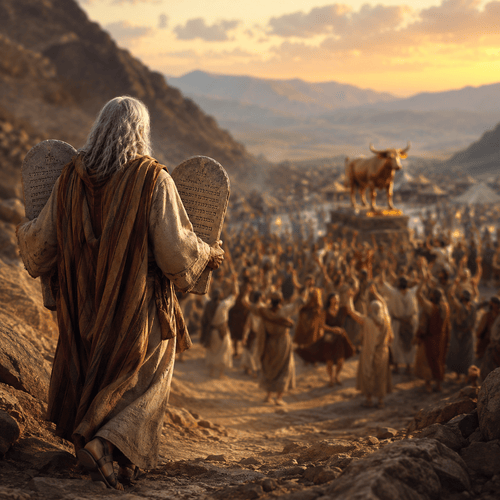
This is the longest of the 10 Commandments. God uses more words on rest than He uses on murder, adultery and theft combined.
“Remember the Sabbath day, to keep it holy. Six days you shall labour, and do all your work, but the seventh day is a Sabbath to the LORD your God. On it you shall not do any work, you, or your son, or your daughter, your male servant, or your female servant, or your livestock, or the sojourner who is within your gates.” (Exodus 20:8–10)
It is also the only one of the ten that the New Testament never repeats as a plain command—and the only one that sincere Christians still argue about.
So why does the most detailed commandment turn out to be the most disputed? And why did resting earn a place in a list that includes killing and stealing?
What the Words Actually Say
What does “Sabbath” mean?
The Hebrew word shabbat, and comes from a verb meaning to cease, to stop, to desist.
That isn’t quite the same as our word “rest”. English “rest” suggests recovery—a nap, a holiday, recharging so that you can work harder afterwards. Shabbat is simpler and more radical. It means stopping.
This matters, because it changes the purpose. A rest day exists for the sake of the working days. A Sabbath doesn’t. It’s a day that exists for its own sake. And for God’s.
Two other words are worth noticing.
“Holy.” The Hebrew is qadosh, meaning set apart. God had already set apart places and people. Here He sets apart a slice of time, which is a striking idea. You can’t see time, guard it, or put a fence around it. Yet God treats 1 day in 7 as belonging to Him in a way the others don’t.
“Or the sojourner within your gates.” Read the list again: son, daughter, male servant, female servant, livestock, foreigner. This is the only commandment among the 10 that has an explicit social reach built into it. It doesn’t merely tell us to stop; it forbids us to keep anyone else working while we do.
That detail was extraordinary in the ancient world. Douglas Stuart notes in his commentary on Exodus no other legal code from the period gives a guaranteed rest day to slaves, servants and resident foreigners. Israel’s neighbours had holy days for priests and festivals for the powerful. Israel had a weekly day when the household servant stopped at the same hour as the head of the house.
2 Reasons, and They Are Different
The commandment appears twice in Scripture, and each version gives a different reason for it. Far from being a problem, this is one of the richest features of the Decalogue.
| Category | Exodus 20:11 | Deuteronomy 5:15 |
|---|---|---|
| The reason given | God made everything in six days and rested on the seventh | You were a slave in Egypt, and the LORD brought you out |
| The truth it teaches | You’re a creature, not the Creator. The world doesn’t depend on us. | You’re free, not property. Your worth isn’t your output. |
| What it answers | “Everything will fall apart if I stop.” | “I am only worth what I produce.” |
Put them together and the Sabbath makes 2 claims about us every week. The first is that the world runs perfectly well without our effort—we stop, and the sun still rises. The second is that we aren’t machines, and God has no interest in owning one.
Christopher JH Wright observes in Deuteronomy the Sabbath is framed as an anti-slavery law. A nation that had been worked without limit is told to build a weekly limit into its own life. To extend it to everyone under its roof. People who’d once been slaves are commanded never to make anyone else one.
Why Does ‘Rest’ Earn a Place in the 10?
This is the question our series keeps asking, and here the answer is stronger than most people expect.
Because whoever owns our time owns us
Time is the one possession every human being has in the same quantity and cannot manufacture more of. We can earn more money and buy more land. We cannot make an 8th day for ourselves.
So a commandment about time isn’t a minor domestic regulation. It’s a claim of ownership. God is saying the calendar is His, and a life with no room in it for Him isn’t a full life running slightly late—it’s a life that has answered the first commandment in practice while denying it in theory.
Because stopping is a confession we make with our body
Most of our beliefs stay in our heads. This one cannot. To keep the Sabbath we must physically stop doing the thing that pays us, protects us and proves us.
Sinclair Ferguson has observed resting is one of the hardest forms of trust, because it’s the one that can’t be faked. Anyone can say they believe God provides. Only those who actually stop say it with their diary.
Because it protects people who can’t protect themselves
A weekly stop is a mercy to the person with power. It’s a rescue for the person without it.
The employee with no bargaining power, the domestic worker, the migrant labourer, the child in a family business—these are precisely the people who’ll be worked to exhaustion in any society that has no fixed limit. God didn’t leave the limit to the goodwill of employers. He wrote it into the constitution.
Because it began even before Israel existed
This is the argument that carries the most weight, and we shall return to it below.
The Sabbath doesn’t begin at Sinai. It begins on the 7th day of the world, before Israel, before the law, before sin. “So God blessed the seventh day and made it holy, because on it God rested from all his work” (Genesis 2:3). That’s roughly 2500 years before Moses.
Whatever the Sabbath is, it was given to humanity for our sake—which is exactly what Jesus said about it centuries later: “The Sabbath was made for man, not man for the Sabbath” (Mark 2:27).
The Hard Question: Is It Still Binding?
Now to the difficulty we’ve been promising to face.
Three passages give thoughtful Christians pause. Let’s read them before we draw any conclusion.
- Colossians 2:16–17. “Let no one pass judgement on you in questions of food and drink, or with regard to a festival or a new moon or a Sabbath. These are a shadow of the things to come, but the substance belongs to Christ.”
- Romans 14:5. “One person esteems one day as better than another, while another esteems all days alike. Each one should be fully convinced in his own mind.”
- Galatians 4:10–11. Paul is alarmed the Galatians are observing days and months and seasons and years.
Add to these the plain fact we noted at the start: 9 of the 10 commandments are restated as obligations in the New Testament letters. This one isn’t.
Christians answer this in 3 main ways, and each deserves to be stated as its own advocates would state it.
| VIEW | WHAT IT HOLDS | ITS STRONGEST ARGUMENT | ITS MAIN DIFFICULTY |
|---|---|---|---|
| Seventh day unchanged | The Sabbath remains the 7th day. Nothing in Scripture authorised a change. | Genesis 2 sets the 7th day, and no verse explicitly moves it. | The apostolic church plainly gathered on the first day, and Colossians 2 warns against judging on this very issue. |
| Fulfilled and expired | The Sabbath was a sign given to Israel, but fulfilled in Christ. Christians gather on Sunday by wisdom, not command. | Colossians 2:16–17 names the Sabbath as a shadow whose substance is Christ. | Genesis 2 predates Israel by millennia, and the command sits in the moral summary God spoke aloud and wrote in stone. |
| The Christian Sabbath | The commandment is moral and permanent; the day moved to the first day of the week in Christ. | A creation ordinance, placed in the Decalogue, with the apostles meeting on the first day. | No verse explicitly commands the change of day. The conclusion is drawn from practice, not from a direct statement. |
We should say plainly serious scholars hold each of these. The collection From Sabbath to Lord’s Day, edited by DA Carson, argues the second position with real care.
Our View, and Why
We hold the third position. Four things persuade us.
1. It’s a creation ordinance. God instituted three things before the fall: work, marriage and the Sabbath. Nobody argues marriage expired when Christ came, and the reasoning that would retire the Sabbath would retire marriage on the same grounds. What God builds into creation isn’t culturally local.
2. It is in the 10. As we argued in the introduction to this series, the Decalogue is the summary of the moral law—the only portion God spoke aloud to the whole nation, wrote Himself, and had placed in the ark. To treat 1 of the 10 as ceremonial while the other 9 are moral requires an argument, and we don’t think a sufficient one has been made.
3. Jesus said it was made for man. Not for Israel. Not for the era before the cross. For man—for human beings, because of how we are built.
4. The day moved, and the reason is beautiful. Christ rose on the first day of the week. The disciples gathered on the first day to break bread (Acts 20:7). Paul told the Corinthians to set money aside on the first day (1 Corinthians 16:2). John was in the Spirit on “the Lord’s day” (Revelation 1:10). And there’s a logic to the move that’s easy to miss.
Why the day moved to the front of the week
Under the old covenant, the week worked towards rest. Six days of labour, and then, rest. Rest was what you arrived at.
Under the new covenant, the week begins with rest. Christ finished His work and rose on the first day, and the church gathered there.
The difference is the whole gospel in a calendar. We no longer labour towards a rest we hope to earn. We start from a rest that has already been secured. And we work out of it.
On Colossians 2. The phrase “a festival or a new moon or a Sabbath” is a standard Old Testament expression for the whole Jewish calendar—yearly, monthly and weekly observances taken as a package (compare 1 Chronicles 23:31; Hosea 2:11). Paul is confronting people who were imposing that calendar as a requirement for acceptance with God. He isn’t repealing a commandment God wrote in stone; He’s forbidding the ceremonial year to be used as a badge of righteousness.
On Romans 14. Paul is dealing with disputable matters in a congregation of Jewish and Gentile believers, and telling them not to despise each other over them. Notice he refuses to legislate. That’s a strong hint these were the Jewish holy days, not the weekly creation ordinance—because Paul legislates confidently everywhere else in the Decalogue.
We’re aware of the weakness in our case: there’s no verse that says “the day has changed”. We’re reasoning from what the apostles did and from what the resurrection means. That’s legitimate reasoning, but it’s reasoning nonetheless, not Scripture.
What the Sabbath Isn’t
Much of the resistance to this commandment is really resistance to a caricature—and Jesus attacked that caricature harder than anyone.
He healed on the Sabbath, repeatedly and deliberately, in front of people He knew were watching. His disciples picked grain as they walked through a field. He told a healed man to carry his mat. Each time the objection came, and each time He answered it.
Notice carefully what He never did. He never broke the fourth commandment. He broke the fence that had been built around it—the accumulated human rules that had turned a gift into a trap. Jesus’ summary judgement is the sentence everything else hangs on: the Sabbath was made for man, not man for the Sabbath (Mark 2:27).
What Jesus showed was lawful on the Sabbath
Works of necessity. His disciples ate as they walked, and He defended them by citing David eating the bread of the Presence (Mark 2:23–28). Feeding ourselves on Sabbath day isn’t a violation of it.
Works of mercy. He healed a woman bent double for 18 years, and pointed out His critics untied their animals to water them on that day (Luke 13:10–17). If a thirsty ox counts, a suffering person certainly does, too.
Works of worship. The priests worked hardest of anyone on the Sabbath, and Jesus notes they were guiltless (Matthew 12:5). Serving God’s people on that day isn’t breaking it.
These aren’t loopholes. They’re the shape of the commandment, given by the One who wrote it.
What This Looks Like Now
We should be reluctant to hand out rule lists. John Frame’s caution is worth taking seriously here: the danger in this commandment has always been adding requirements God didn’t give, and then treating them as though He had. What follows are principles, not legislation.
- Gather with God’s people. This is the one non-negotiable. The day was set apart to the LORD, and Scripture knows nothing of a private Sabbath (Hebrews 10:25).
- Stop the earning. Whatever the work is that pays you, proves you or protects you—stop it. The point isn’t idleness but a deliberate refusal to be productive for one day.
- Stop the anxious productivity too. For many people the harder discipline isn’t the office but the phone: the inbox checked at midnight, the low hum of catching up. A Sabbath that leaves the anxiety running has stopped the wrong thing.
- Do good. Visit someone. Feed someone. Mercy isn’t an interruption of the day; Jesus treated it as an expression of it.
- Give rest to those who work for you. The social clause hasn’t lapsed. If your day of rest requires several other people to work, that’s worth thinking about honestly.
A word for those for whom Sunday is a working day
A great many of our readers live in places where Sunday is an ordinary working day. Or work in hospitals, transport, security, hospitality and family businesses where it can’t be free. Others work night shifts that cut across the whole idea of a day.
We would say three things. Works of necessity and mercy are lawful, on the authority of Jesus Himself—the nurse and the police officer aren’t sinning. Where the day cannot be Sunday, the principle of a fixed weekly stop still holds, and building one deliberately is far better than drifting without one. Even then, a Christian in that position should be praying and working towards a life where gathering with the church is possible, rather than settling permanently for an arrangement that makes it impossible.
What the Commandment Requires
Following the rule that governs this whole series: where a sin is forbidden, the opposite duty is commanded.
| WHAT IT FORBIDS | WHAT IT THEREFORE REQUIRES |
|---|---|
| Unbroken work with no fixed stop | A deliberate weekly rhythm of ceasing |
| Treating all time as ours to spend | Setting apart time that belongs to God |
| Keeping others working while we rest | Actively securing rest for employees, staff and dependants |
| Neglecting the gathering of God’s people | Public worship with the church |
| Turning the day into a burden of rules | Works of necessity, mercy and worship, freely done |
| Idleness dressed up as rest | Rest that restores the body and refreshes the soul |
The Rest the Sabbath Was Pointing To
There is a detail in the crucifixion account that’is easy to read past.
Jesus finished His work on the Friday and said, “It is finished.” Then His body lay in a tomb through the Sabbath. The Son of God kept the seventh day by resting from a completed work—and then rose on the first day of a new week, and a new creation.
Hebrews draws the thread together: “there remains a Sabbath rest for the people of God, for whoever has entered God’s rest has also rested from his works as God did from his” (Hebrews 4:9–10). The weekly day was never the destination. It was a signpost, planted at the seventh day of creation, pointing at a rest He would one day provide.
Which is why the warmest invitation in the Gospels sounds exactly like the fourth commandment: “Come to me, all who labour and are heavy laden, and I will give you rest” (Matthew 11:28).
How This Commandment Is Actually Kept
That question—where exactly is the line—is the question the Pharisees asked, and it produced a system Jesus dismantled. The better question is what’s the Sabbath day for.
- It’s for remembering the world is held together by someone else.
- It’s for proving to ourselves, with our own diaries, that our value isn’t our usefulness. And
- It’s for practising, 1 day in 7, the posture we will hold for ever: of receiving rather than achieving.
If we’ve never stopped, let’s start small. And start honestly. Most people discover very quickly how much of their identity was resting on their productivity, and that discovery is itself the commandment doing its work.
Next in this series: the fifth commandment—the hinge between the two tables, the first with a promise attached, and the one that raises the hardest question of all for anyone whose parents were not good ones.
Tough Questions, Honest Answers
Did Emperor Constantine change the Sabbath from Saturday to Sunday?
This claim is widespread and doesn’t fit the evidence. Constantine issued a civil law in AD 321 making Sunday a public day of rest across the empire, but he did not invent Christian Sunday worship—he recognised a practice that was already 250 years old. The New Testament itself records believers gathering on the first day of the week (Acts 20:7; 1 Corinthians 16:2), and John already calls it “the Lord’s day” (Revelation 1:10). Christian writers well before Constantine—including Ignatius early in the second century and Justin Martyr around AD 150—describe Sunday assemblies as normal. Whatever one concludes about which day is right, the history is clear: the church was meeting on the first day long before any emperor took an interest.
Is it wrong for a Christian to worship on Saturday?
No. Christians who keep the seventh day out of conviction are obeying what they understand Scripture to require, and Romans 14 is precisely the passage that forbids us to despise one another over such a matter. Our disagreement with seventh-day churches is real, and we have set out our reasons above. But it becomes a serious problem only where keeping Saturday is made a condition of salvation or a mark of the true church, because that turns a disputed day into a different gospel.
What should I do if my job requires me to work on Sundays?
First, remember necessary work isn’t sin. Jesus explicitly defended works of necessity and mercy on the Sabbath, and hospitals, transport, utilities, security and emergency services do not stop because a society rests. Second, where you have any freedom to arrange your hours, use it to make gathering with the church possible, even if that means a different service time or a real cost in pay or promotion. Third, where the arrangement is genuinely fixed, build a deliberate weekly stop into whatever day you do have, rather than living with no rhythm at all.
Is it wrong to shop, eat out or play sport on a Sunday?
Christians hold differing views here, and we’d rather give you the questions than a ruling. The strongest consideration isn’t personal enjoyment but the one the commandment itself raises: our rest should not require other people to work. Every restaurant meal and online order rests on someone else’s labour, and that’s worth weighing rather than ignoring. On sport and recreation, the older Puritan position forbade them outright, while most Reformed Christians today distinguish between what refreshes and what simply relocates the week’s striving. Our concern would be less with the activity than with the drift: a day that fills up with everything except worship has stopped being a Sabbath, whatever else is written in the diary.
Why was Sabbath-breaking punished by death in the Old Testament?
The case of the man gathering sticks in Numbers 15:32–36 troubles every honest reader. Three things help. Israel was a covenant nation under a specific arrangement in which certain offences carried civil penalties, and those penalties belonged to that nation and that era—the church isn’t a state and has no such authority. The offence itself wasn’t a moment of forgetfulness but public, deliberate defiance shortly after the law was given, in a passage that explicitly contrasts unintentional sin with sinning “with a high hand” (Numbers 15:30). And the severity tells us how seriously God took the sign of the covenant, which should make us slower, not quicker, to treat the commandment as trivial.
Does it have to be a particular day, or can I just pick one day a week?
The commandment isn’t about a slot in the calendar but about a day set apart to the Lord, and that has always included gathering with God’s people rather than resting privately. So “any day I choose” misses something important, because you cannot assemble with a church that’s not assembling. Our conviction is that the church gathers on the first day, and that a Christian should order life around that gathering wherever it’s possible. Where work genuinely prevents it, a deliberate personal rhythm on another day is far better than none—but it’s a concession to necessity, not the pattern to aim at.
What about the sabbath year and the Jubilee—do those still apply?
Israel was given a wider set of sabbath laws: the land rested every seventh year, and every 50th year debts were released, slaves freed and ancestral land returned (Leviticus 25). These were civil laws for a particular nation in a particular land, tied to a system of tribal inheritance that no longer exists. So they’re not binding on any modern state as written. But they were never merely economic housekeeping, and their principles carry over with real force: land isn’t to be exploited without limit, debt isn’t to become permanent bondage, and poverty isn’t to harden into a caste. Jesus opened His ministry by reading from Isaiah 61 and announcing the year of the Lord’s favour (Luke 4:18–19), which is Jubilee language—a strong hint about what the whole system had been pointing to.
CONTINUE THE SERIES: THE TEN COMMANDMENTS
This post is part of our series working through the Ten Commandments. It follows Why God Gave the 10 Commandments—And Why These 10?, The First Commandment: Why Does God Demand Exclusive Worship?, The Second Commandment: Why Does God Forbid Idols?, and The Third Commandment: What Does “Taking God’s Name in Vain” Mean?.
Related Reads
- Why God Gave the 10 Commandments—And Why These 10?
- The First Commandment: Why Does God Demand Exclusive Worship?
- The Second Commandment: Why Does God Forbid Idols?
- The Third Commandment: What Does “Taking God’s Name in Vain” Mean?
- The Christian Sabbath: Why Did Sunday Replace Saturday?
- Jesus and the Sabbath: Did He Break It or Fulfil It?