
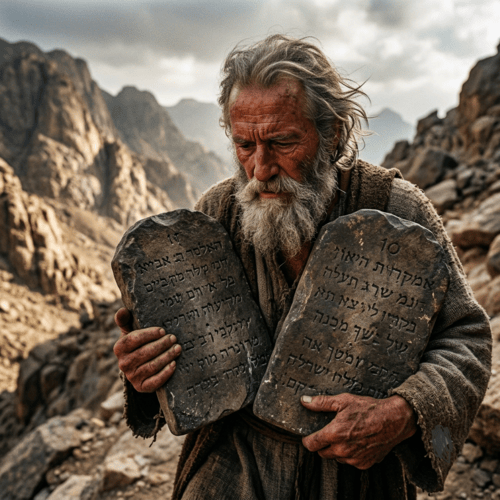
God could have started anywhere. He could have opened with murder, or theft, or lying—the sins almost everyone already agrees are wrong. Instead He opened with worship. Of all the things God could have put first, why this?
“You shall have no other gods before me.” (Exodus 20:3)
It’s a short sentence. 8 words in English, 4 in Hebrew. And yet everything else in the 10 Commandments rests on it.
For many readers today this feels like the least useful commandment of the 10. We’re not tempted to bow to statues. We don’t keep small carved figures on a shelf and bring them food. So it’s easy to nod at the first commandment, assume we’re keeping it, and move quickly to the ones that seem to bite—the ones about anger, money. And sex.
In reality, that’s exactly backwards. The first commandment is the one we break most often, most easily, and with the least awareness that we’re breaking it. And until we understand it, the other 9 won’t make sense.
What the Words Actually Say
2 phrases in this commandment are commonly misunderstood, and both are worth slowing down for.
“BEFORE ME”—WHAT DOES IT MEAN?
The Hebrew is al-panay, which literally means “before my face” or “in my presence”.
Many people read the English “before me” as though it meant “ahead of me in the queue”—as if God were saying, “You may have other gods, so long as I come first.” That reading is understandable, and it’s wrong.
The phrase means “in my presence”. And since God’s present everywhere, there’s no place where another god may be held. The commandment doesn’t ask God to be ranked highest on a list. It abolishes the list.
John Currid, in his commentary on Exodus, notes the expression carries the sense of confronting someone face to face. An idol isn’t a companion to God. It’s a rival standing in front of Him.
The second phrase is “other gods”. Does this admit other gods exist? We shall get to that question further down. For now, notice what the commandment is actually regulating. It doesn’t say “no other gods exist”. It says you shall have no other gods. It governs what we hold, treat and rely on as god—whether or not such a thing exists at all.
One more detail is easy to miss in English. The “you” in this commandment is singular in Hebrew. God’s speaking to a whole nation gathered at a mountain. Yet He addresses each person individually. Nobody could stand in that crowd and assume the command applied to someone else in the group. Philip Ryken observes in his work on Exodus this personal address runs through all ten commandments. Sure, they’re given to a people, but they land on a person. We cannot outsource this one to our church, our family or our culture.
That distinction matters enormously for how we apply this commandment today. A piece of carved wood is nothing. A person who trusts it has still broken the first commandment.
Why This One First?
4 reasons, and each one builds on the last.
1. Without it, no other commandment has any authority
Every commandment that follows assumes an authority behind it. Take that authority away and the other 9 become opinions—good opinions, perhaps, but opinions that a determined person can argue with.
Watch what happens to each one when God is no longer God.
| # | THE COMMANDMENT | WHAT IT BECOMES IF GOD ISN’T GOD |
|---|---|---|
| 2 | No images | a matter of artistic taste |
| 3 | Do not misuse His name | a rule about politeness |
| 4 | Keep the Sabbath | advice about work-life balance |
| 5 | Honour father and mother | a family custom, negotiable when inconvenient |
| 6 | Do not murder | a social contract that the powerful may rewrite |
| 7 | Do not commit adultery | a private arrangement between consenting adults |
| 8 | Do not steal | whatever the law currently permits |
| 9 | Do not bear false witness | a rule you keep when the risk of being caught is high |
| 10 | Do not covet | meaningless—nobody can police a desire |
This isn’t a scare tactic. It’s simply what the second table of the law looks like once the first table is removed. The commandments aren’t 10 separate rules standing side by side. They’re a structure, and the 1st commandment is the foundation stone.
2. It answered the most urgent danger Israel faced
It also helps to remember where this commandment was given, and to whom.
Israel had just left Egypt, one of the most god-saturated societies in the ancient world—a land with deities for the sun, the river, the harvest, childbirth, death and the king himself. Scripture says the plagues weren’t merely a display of power but a verdict: “on all the gods of Egypt I will execute judgments” (Exodus 12:12). Each plague struck at something an Egyptian would have regarded as divine.
And Israel was walking towards Canaan, where every hill had its shrine and every harvest had its ritual. They were leaving one crowded pantheon and marching into another.
So the 1st commandment wasn’t an abstract theological statement handed to people with no other options. It was the most practical possible instruction for a nation about to be surrounded on all sides. Douglas Stuart notes in his commentary on Exodus the surrounding cultures didn’t object to adding the God of Israel to their collection—what they couldn’t understand was a God who refused to be added to anything. Exclusivity was the scandal then, and it remains a scandal now.
3. It names the root of every other sin
Look behind any broken commandment and you’ll find a first-commandment problem.
- The thief didn’t simply want money. He trusted money would give him what only God can give.
- The adulterer didn’t simply want pleasure. He looked to another person for a life-giving joy that God alone can supply.
- The liar didn’t simply want to deceive. He wanted a reputation more than he wanted God’s approval.
Paul traces exactly this line in Romans 1. He says people exchanged the truth about God for a lie and worshipped created things rather than the Creator (Romans 1:25). Then he lists the moral collapse that followed. The worship problem came first, and the behaviour problem later.
John Calvin put it memorably in the Institutes: the human heart is, he said, a perpetual factory of idols. Not a museum of old ones. A factory, running constantly, producing new ones.
4. It’s the one commandment that can’t be kept on the outside
A person can avoid murder without loving his neighbour. A person can avoid theft while being consumed with greed. Outward obedience is possible for most of the 10. But nobody can appear to worship God alone. Worship is allegiance, and allegiance lives where no one else can see it.
That is why the 1st commandment and the 10th are 2 ends of the same rope. The 1st asks who has your heart. The 10th asks what your heart wants. Between them, they make the entire law inescapable.
Isn’t It Arrogant for God to Demand This?
This is an oft-heard objection, and it deserves an answer. If a human being demanded exclusive devotion from everyone around him, we’d call him a tyrant. Or a megalomaniac, perhaps. Why’s it different when God does it?
There are three answers, and together we think they close the case.
Because it is true
The demand for exclusive worship would be monstrous if God were one being among many. But if there is only one God—one uncreated source of everything that exists—worship directed anywhere else isn’t merely disloyal. It’s false. It’s a statement about reality that’s simply not accurate.
Think of it this way. If a man insists a stranger call him “father”, that’s madness. If your actual father asks you to call him father, he is asking you to acknowledge what’s true. God isn’t asking for a status He doesn’t have. He’s asking us to stop pretending.
There’s a second layer to this. We rightly dislike self-promotion in people, because a person who points to himself is pointing us towards something small and flawed. But if God is the greatest and best reality there is, pointing us anywhere else would be an act of unkindness. He’d be recommending a lesser satisfaction while knowing better. God’s insistence on His own glory and His kindness to us aren’t therefore in tension. They’re the same act.
Because it is love
The very next verses use a word that startles modern readers: God describes Himself as jealous (Exodus 20:5). We hear that word and think of insecurity, suspicion, and small-mindedness.
THE WORD “JEALOUS” IN THE BIBLE
The Hebrew word is qanna. English has one word where the Bible’s idea needs 2.
Envy is wanting what belongs to somebody else. That’s always wrong, and the 10th commandment forbids it.
Jealousy, in this sense, is refusing to share what rightly belongs to you. A husband who feels nothing when his wife is unfaithful doesn’t love her more than a jealous husband. He loves her less.
God’s jealousy is of the second kind. It’s not the anxiety of a rival. It’s the seriousness of a covenant partner who won’t treat the marriage as optional. Check out our post: Why Is God Jealous? Does That Make Him Evil?
Exclusivity is what love looks like in a covenant. Nobody thinks it’s arrogant for a wife to expect her husband to have no other wives. The demand isn’t a limit on love; it’s the shape of it.
Because it is good for us
The third answer is the one people find hardest to believe: this commandment is for our benefit.
Psalm 115 describes idols with a kind of grim humour—mouths that cannot speak, eyes that cannot see, ears that cannot hear—and then delivers the hammer blow: those who make them become like them (Psalm 115:8). GK Beale developed this whole theme in his book We Become What We Worship. Worship isn’t a neutral activity. It shapes the worshipper into the likeness of whatever is worshipped.
So the choice is never between worshipping God and being free. It’s between being shaped by the living God and being shaped by something smaller than yourself. Worship money and you’ll slowly become calculating. Worship approval and you’ll become a performer. Worship comfort and you’ll become a coward. Idols don’t merely disappoint. They shrink their worshippers.
So What Counts as “Another God” Today?
Here’s where the commandment stops being ancient history.
Timothy Keller argued in Counterfeit Gods an idol is usually not a bad thing at all. It’s a good thing that has been made into an ultimate thing—something we treat as essential to our life having meaning. Family is good. Work is good. Security is good. Any of them can become a god.
That makes idolatry much harder to spot, because we cannot identify it by looking at the object. We have to look at the weight the object is carrying.
FIVE QUESTIONS THAT EXPOSE AN IDOL
These are diagnostic, not condemning. Ask them slowly.
What do I think about when nothing demands my attention? The mind returns to what it treasures.
What could I not bear to lose? Not “what would upset me”, but “what would make life feel pointless”.
Where does my money go when nobody is watching? Budgets are honest in a way that words aren’t.
What do I get angry or panicky about? Strong emotion usually means something we treat as ultimate is being threatened.
What do I turn to for comfort when life goes wrong? Whatever that is, it’s masquerading as a saviour.
One clarification prevents this from becoming a torment. Loving something deeply isn’t the same as worshipping it. God gave us families, work, food, music and friendship, and He expects us to enjoy them warmly. The line isn’t crossed when a good thing is loved much, but when a good thing is asked to do a God-sized job—to make life meaningful, to prove we matter, to guarantee that we will be safe. A gift becomes an idol the moment we start needing it to save us.
Run those questions honestly and most of us will find something. That isn’t a reason for despair. It’s the first commandment doing its work as a mirror, which is precisely one of the uses of the law we described in the introduction to this series.
Do Other Gods Actually Exist?
This question troubles careful readers, because the Bible seems to speak in 2 ways.
- Scripture is emphatic there’s only one God. “The LORD our God, the LORD is one” (Deuteronomy 6:4). Isaiah has God saying repeatedly there’s no other, and that He knows of none (Isaiah 44:8). Paul says an idol has no real existence (1 Corinthians 8:4).
- The Bible speaks of real spiritual beings behind pagan worship. Israel is said to have sacrificed to demons rather than to God (Deuteronomy 32:17), and Paul says the same about pagan sacrifice in his own day (1 Corinthians 10:20).
The Reformed answer holds both together without strain.
| THE QUESTION | THE ANSWER |
|---|---|
| Is there more than one God? | No. There’s one uncreated, self-existent God. Everything else that exists was made by Him and depends on Him. |
| Is the statue itself a god? | No. It’s wood, stone or metal. It has no power at all. |
| Then is idolatry harmless? | No. Behind false worship there are real created spiritual beings who’re content to receive what belongs to God. |
| Are those beings rivals to God? | Not in any real sense. They’re creatures. They aren’t another species of deity, and they’ve already been defeated (Colossians 2:15). |
So the commandment isn’t conceding a crowded heaven. It’s saying the human heart will always find something to serve, and that everything it finds apart from God is either nothing at all or something dangerous. Neither is a good option.
What the Commandment Requires, Not Just Forbids
In the introduction to this series we set out the rule that governs all 10 articles: where a sin is forbidden, the opposite duty is required. The first commandment is stated negatively, but it commands a great deal.
| WHAT IT FORBIDS | WHAT IT THEREFORE REQUIRES |
|---|---|
| Trusting anything else for what only God can give | Trusting God—resting our security, identity and hope in Him |
| Fearing any power more than we fear God | Fearing God—a reverence that makes other fears smaller |
| Loving anything more than God | Loving God with heart, soul, mind and strength |
| Ignorance of God, or indifference to knowing Him | Knowing God—we can’t worship a God we’re not bothered to learn about |
| Prayer, thanks and hope directed elsewhere | Calling on God, thanking Him, and waiting for Him |
| Living as though God weren’t there | Acknowledging Him in ordinary decisions, not only in religious ones |
Notice the 4th row especially. JI Packer built an entire book, Knowing God, on the point that we can’t either love God or obey Him if we haven’t taken the trouble to know Him. Ignorance about God isn’t spiritually neutral. It’s a first-commandment failure, because it leaves the mind free to invent a more convenient god in His place.
Jesus and the First Commandment
Two things must be said here, and the second is more surprising than the first.
First, Jesus kept this commandment where Israel failed. In the wilderness, hungry and alone, He was offered every kingdom of the world for one act of worship. His answer was a quotation from Deuteronomy: worship the Lord your God, and serve Him only (Matthew 4:10). Israel had failed at a mountain with a golden calf within weeks of hearing the commandment spoken aloud. Jesus succeeded in a desert with nothing to eat.
Second, the New Testament worships Jesus without breaking the commandment. This is remarkable when you think about it. The first Christians were Jews, formed by “the LORD is one”, who would rather die than worship a creature. And yet they sang to Jesus, prayed to Him, and applied to Him a passage from Isaiah where every knee bows to the LORD alone (Philippians 2:10–11; compare Isaiah 45:23).
They weren’t adding a second god. They were confessing Jesus belongs on the divine side of the line. The first commandment isn’t a problem for faith in Christ. It’s one of the strongest arguments for His deity, because the people best trained to guard it worshipped Him anyway.
How Anyone Actually Keeps This Commandment
Thomas Chalmers, preaching in Scotland 2 centuries ago, gave the classic Reformed answer in a sermon with a memorable title: “The Expulsive Power of a New Affection”. His argument was simple. We can’t empty the heart by force. Tell someone to stop loving something and we achieve nothing. The heart lets go of a lesser love only when it’s gripped by a greater one.
That’s why this article has spent so much time on who God is rather than on how hard you should try. Idols aren’t defeated by willpower. They are displaced—crowded out by a God who turns out to be better than the thing you were clinging to.
The first commandment is therefore not a demand to manufacture devotion. It’s an invitation to look long enough at God to find Him worth it.
Next in this series: the second commandment—if the first tells us whom to worship, the second tells us how. And the difference between the two isn’t as small as it looks.
Tough Questions, Honest Answers
What exactly is the difference between the 1st and 2nd commandments?
The 1st commandment tells us whom to worship; the 2nd tells us how. The 1st forbids worshipping a false god. The 2nd forbids worshipping the true God in a false way—by means of images we’ve made. That’s why the golden calf incident is so instructive: Israel wasn’t renouncing the LORD, since Aaron announced a feast to the LORD the very next day (Exodus 32:5). They were trying to worship the right God by the wrong method, and that was still a serious breach. Keeping the 2 commandments distinct guards a real danger, which is that a person may be entirely sincere about the God of the Bible while worshipping a version of Him they’ve constructed.
Do Christians and Muslims worship the same God?
This question needs a careful answer rather than a slogan, because “the same” can mean two different things. Historically and referentially, Islam intends to worship the God of Abraham, and is not pointing at some other deity in a crowded pantheon. But the God being described is decisively different: Islam denies that God is Father, Son and Holy Spirit, and denies that Jesus is God the Son who died and rose. The Reformed answer is that a God who is not triune is not the God who actually exists, however sincerely He is sought. Jesus Himself set the test plainly when He said that whoever does not honour the Son does not honour the Father who sent Him (John 5:23). This should be said with sorrow and courtesy, never with contempt.
Is asking Mary or the saints to pray for me a breach of the first commandment?
Reformed churches have historically answered yes, though with care to state the objection accurately. Roman Catholic teaching distinguishes worship given to God alone from the honour and requests directed to saints, and sincere Catholics don’t intend to treat Mary as a god. Our concern is more basic than intention. Prayer directed to any being requires the being can hear countless requests at once, in every language, everywhere—and that’s an attribute belonging only to God. Scripture also gives us one mediator between God and men, the man Christ Jesus (1 Timothy 2:5), and offers no example of anyone praying to a departed believer. We’d rather commend the extraordinary access we already have than criticise those who seek it elsewhere.
Are horoscopes, astrology and tarot cards really that serious?
Yes, and Scripture treats them as more than harmless entertainment. Israel was forbidden to consult mediums, fortune-tellers and those who read omens, and the reason given is striking: the LORD your God hasn’t allowed you to do this, and you shall be blameless before Him (Deuteronomy 18:9–14). The problem isn’t that the stars are powerful. It’s that these practices seek guidance and security from a source other than God, which is the essence of the first commandment. Many people who’d never call themselves religious check a horoscope out of habit, which is a good illustration of how naturally the human heart looks for a god. The pastoral answer isn’t fear but replacement: God has spoken sufficiently in His word and governs the future Himself.
Can a Christian break the 1st commandment and still be a Christian?
Yes—and every Christian does break it, which is precisely why this commandment is so uncomfortable. The difference between a believer and an unbeliever is not that one has no idols and the other does; it is what happens next. A believer, shown an idol, grieves over it, confesses it, and turns back to Christ, however slowly and however often. That pattern of return is itself evidence of a heart that belongs to God. Assurance does not rest on having achieved undivided devotion but on Christ, who gave it perfectly on our behalf.
Is it wrong to attend a wedding, funeral or festival at another religion’s place of worship?
Christians of good conscience differ here, and the distinction we would draw is between presence and participation. Being physically present to honour a colleague, neighbour or family member is not itself worship, and withdrawing from all such occasions can damage the relationships through which the gospel travels. Actively taking part in a rite—bowing to an image, receiving a blessing from another god, joining in a prayer addressed elsewhere—is a different matter, and there the answer is no, however awkward the moment. Paul’s handling of food offered to idols in 1 Corinthians 8 to 10 works along exactly these lines: liberty is real, but it stops where the act becomes an act of worship. Deciding in advance what you will and will not do, and saying so kindly and early, prevents most of the difficulty.
If an atheist worships nothing, can he break the 1st commandment?
The Bible doesn’t really recognise the category of a person who worships nothing. Everyone builds life on something they treat as ultimate—whether reason, progress, the nation, family, freedom or the self—and whatever occupies that place is functioning as a god, whether or not it receives prayers. Paul’s argument in Romans 1 isn’t that unbelievers fail to worship, but that they redirect worship towards created things. So the first commandment addresses the atheist as directly as anyone else, though the idol has no altar and no name. It’s worth saying gently this isn’t an accusation of stupidity; it’s a claim about how human beings are made.
CONTINUE THE SERIES: THE TEN COMMANDMENTS
This post is Part 2 of our series working through the Ten Commandments. It follows the series introduction, Why God Gave the Ten Commandments—And Why These Ten?, and is followed by the Second Commandment: Why Does God Forbid Idols?
Related Reads
- Why God Gave the 10 Commandments—And Why These 10?
- The Second Commandment: Why Does God Forbid Idols?
- Why Is God Jealous? Does That Make Him Evil?
- Is Jehovah a Copy of Other Ancient Gods?
- The Euthyphro Dilemma: Did God Invent Morality or Discover It?
- The Third Commandment: What Does “Taking God’s Name in Vain” Mean?
- The Fourth Commandment: Why Did God Command a Day of Rest?
- The Fifth Commandment: Why Must We Honour Our Parents?
- The Sixth Commandment: Why Does God Forbid Murder?
- The Seventh Commandment: Why Does God Care About Adultery?
- The Eighth Commandment: Why Does God Forbid Stealing?
- The Ninth Commandment: Why Does God Care About Truth?
- The Tenth Commandment: Why Does God Care About What We Desire?
- Mount Carmel in the Bible: Elijah’s Fire and the Cross of Christ