
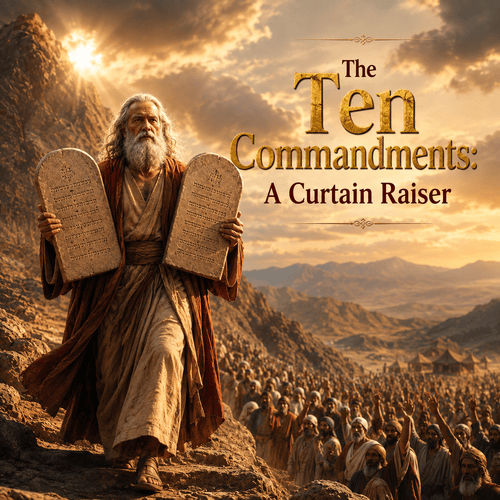
God gave Israel hundreds of laws. So why did these 10 receive a place of special prominence? Of all the things God could have commanded, why these?
That question is where this series begins. Over the next 10 posts, we shall take each commandment on its own and ask what it means, what it forbids, what it requires, and how it touches ordinary life today.
But before we can do that well, we need to understand the list itself—where it came from, how it’s built, and why it’s shaped the way it is.
The 10 Commandments aren’t 10 random rules. They’re a carefully built structure, and every part of it is deliberate. Once we see the design, the list stops looking arbitrary. And starts looking inevitable.
Rescue Comes Before Rules
Here’s the first surprise. The 10 Commandments don’t begin with a commandment.
“And God spoke all these words, saying, ‘I am the LORD your God, who brought you out of the land of Egypt, out of the house of slavery.’” (Exodus 20:1–2)
Read that again. Before God says do or do not, He says who He is and what He has already done. Israel wasn’t standing at Mount Sinai hoping to earn freedom. They were already free. The chains were already off. God had already carried them out on eagles’ wings, as He describes it a chapter earlier.
Think of it this way. A family adopts a child out of a terrible situation. On the first evening in the new house, the parents explain how things work here: we tell the truth, we don’t take what’s not ours, we’re kind to each other. Those rules aren’t a test the child must pass to stay. The child is already home. The rules describe what life in this family looks like.
This changes how we read the list that follows. The 10 aren’t entrance requirements. They’re house rules for children who’ve already been brought home.
FIRST: WHAT GOD HAS DONE. THEN: WHAT WE MUST DO
Theologians describe the pattern using two words borrowed from grammar.
The indicative is a statement about what’s true. “I am the LORD your God, who brought you out.”
The imperative is a command. “You shall have no other gods before me.”
In the Bible, the indicative almost always comes first. God tells us what He has done. And then He tells us how we’re to live in light of it. Reverse the order and we have religion as a ladder—obey enough and maybe God will rescue you. Keep the order and we get the gospel.
The 10 Commandments aren’t the enemy of grace. Alec Motyer pointed out Exodus tells the story in the only order that works: God saves His people first, and only then does He tell them how the saved are to live. Michael Horton has made the same point in his writing on the covenant. Kevin DeYoung opens his study of the commandments by insisting they were given to a people God had already redeemed, not to a people trying to earn redemption.
Forget the preface, and the 10 become a burden. Remember it, and they become a description of freedom.
Why 10? And Why Carved in Stone?
Jewish tradition counts 613 commands in the first five books of the Bible. Laws about food, farming, festivals, clothing, courts, priests, land, and much more. Of all that material, 10 are singled out and given a status nothing else receives.
4 things set these 10 apart, and each one is stated plainly in the text.
WHAT MAKES THE 10 DIFFERENT
God spoke them out loud to everyone. The rest of the law came through Moses in private. These 10 were heard by the whole nation at the mountain.
God said no more after them. “These words the LORD spoke to all your assembly at the mountain… and He added no more” (Deuteronomy 5:22). The list was complete as it stood.
God wrote them Himself. “And he gave to Moses… the two tablets of the testimony, tablets of stone, written with the finger of God” (Exodus 31:18). No other part of Scripture is described this way.
God had them stored in the ark. The tablets went inside the ark of the covenant, in the most sacred space Israel had (Deuteronomy 10:5). Nothing else was kept there.
So the 10 aren’t simply 10 favourites culled from a longer list. They’re set apart by God’s own action at every stage: they were spoken, finished, written, and stored differently from everything else.
A constitution, not a rulebook
The most helpful way to picture the relationship is this. The 10 Commandments are the constitution. The other 603 laws are the case law that applies it.
A country’s constitution says something short and broad, such as “no one may be deprived of property unlawfully”. It doesn’t tell you what to do when the neighbour’s cow falls into a pit you dug. That’s what the detailed statutes are for. Exodus 21 and 22 do exactly this: they take “you shall not steal” and work it out in dozens of specific situations.
Scholars have a pair of terms for these two kinds of law, and they’re worth knowing because they show up throughout the series.
| TERM | WHAT IT MEANS | EXAMPLE |
|---|---|---|
| Apodictic law | A short, direct, unconditional command. No “if”. It simply states what must or mustn’t be done. This is the form of the Ten Commandments. | “You shall not steal.” (Exodus 20:15) |
| Casuistic law | A case-by-case rule. It begins with “if” or “when” and gives a ruling for a specific situation. This is the form of most of the rest of the law. | “If a man steals an ox… he shall repay five oxen for an ox.” (Exodus 22:1) |
Douglas Stuart notes in his commentary on Exodus this distinction matters practically: the apodictic commands set the principle, and the casuistic laws show a judge how to apply it. Lose the 10 and the rest of the law becomes a pile of unconnected rulings. Keep the 10 and the whole system has a spine.
But why 10 precisely? Partly because the number is teachable. 10 fits on 2 hands. A child can learn it. A shepherd who cannot read can carry it. Every catechism in church history has used the 10 Commandments as a teaching frame for exactly this reason. God gave a moral summary an entire nation, most of whom couldn’t read, could hold in memory.
Why These 10? The Logic Behind the List
Now to the heart of the matter.
Our answer is this: the 10 Commandments aren’t 10 random sins. They’re 10 spheres of life in which the image of God in a human being is either honoured or attacked. Take away any one of them, and covenant life collapses at precisely that point.
Look at what each actually guards, and what would happen to a community that removed it.
| # | THE COMMANDMENT, IN SHORT | WHAT IT GUARDS | REMOVE IT, AND… |
|---|---|---|---|
| 1 | No other gods | Who God is—the one true object of worship | There’s no covenant at all, only religion in general |
| 2 | No images | How God is represented—worship on His terms, not ours | God is quietly remade in our own image |
| 3 | Do not misuse His name | God’s name and reputation among people | every oath, prayer and witness becomes empty noise |
| 4 | Keep the Sabbath | The rhythm of time—work bounded by rest | we become our own providers, and work becomes slavery again |
| 5 | Honour father and mother | Authority, and the passing on of faith to the next generation | nothing survives a single generation |
| 6 | Do not murder | Human life itself | there is no society at all, only survival |
| 7 | Do not commit adultery | The marriage covenant | no family is safe and no child is secure |
| 8 | Do not steal | Property and honest labour | stewardship, work and generosity all become meaningless |
| 9 | Do not bear false witness | Truth, and a neighbour’s good name | justice dies, because every court runs on testimony |
| 10 | Do not covet | The heart, where every other sin begins | the other 9 shrink into mere behaviour management |
Read the table downwards and a pattern appears. The 10 cover the whole of what a person is and has. God Himself. Time. Authority. Life. Marriage. Property. Reputation. And finally the inner life of desire that lies behind all of it.
Why the list isn’t arbitrary
First, the 10 are the conditions that make every other command possible. Every later law in Scripture assumes them. None of the 10 assumes a later law. We can’t have laws about honest weights unless stealing is already wrong. We can’t have laws about court procedure unless false testimony is already wrong. The 10 sit underneath everything.
Second, they cover everything a neighbour has that can be taken from him. Consider the second table of the law: his life, his marriage, his possessions, his good name. That’s the complete list of what one human being can destroy in another. And then the 10th commandment closes the circle by forbidding the wanting itself.
John Frame built his entire system of Christian ethics around the 10, arguing the 10 headings are broad enough to organise the whole moral teaching of Scripture. That’s a tall claim, but it’s hard to dispute once you try it. Take any moral question you like—dishonest business, cruelty to workers, pornography, gossip, neglect of the elderly, environmental waste—and you’ll find it sits naturally under one of the 10.
There’s one more thing worth noticing about the order. The first commandment doesn’t merely rank God first. It determines everything after it. GK Beale summed up a whole biblical theme in the title of his book on idolatry: We Become What We Worship. What we treat as ultimate will shape how we treat time, parents, life, marriage, property and truth. The first 4 commandments aren’t a separate religious department. They’re the root for the last 6.
What God Didn’t Command—and Why That Matters
One of the best ways to understand a list is to notice what’s missing from it. And the gaps in the 10 are striking.
- There’s nothing about what kind of government a nation should have.
- There’s nothing about economic systems, taxation, or trade.
- There’s nothing about food, clothing, or ritual purity—though the rest of the Torah has a great deal to say about all 3.
- There’s nothing about how often to pray, or where.
- There’s nothing about how a congregation should be organised or led.
- There’s not even a command that says “you shall love”—although Jesus later says the whole law hangs on love (Matthew 22:37–40).
Why the silence?
Because the 10 are constitutional, not exhaustive. They address what binds every human being in every culture in every century. Forms of government change. Economies change. Diets and clothing and languages change. What doesn’t change is that God is God, that human life is sacred, that marriage is a covenant, that property belongs to someone, that words either build or destroy, and the heart is where it all begins.
Christopher JH Wright has argued that Israel’s law functions as a paradigm—a working model we study in order to apply, rather than a complete code we copy line by line. The 10 Commandments are the clearest example. They’re deliberately broad because they were always meant to travel.
And the missing command to love? It isn’t missing at all. It’s simply everywhere. The first table is what love for God looks like when it becomes concrete. The second table is what love for neighbour looks like when it stops being a feeling and starts being a practice. The tenth commandment then reaches into the heart, which is exactly where love either lives or doesn’t.
The Order Isn’t Random Either
The commandments fall into 2 groups, and Jesus Himself named them. When asked for the greatest commandment, He gave 2: love God with everything you are, and love your neighbour as yourself. Then He added the whole law hangs on those 2 (Matthew 22:37–40). That’s the Decalogue in miniature. Commandments 1 to 4 are vertical—they’re linked to God. Commandments 5 to 10 are horizontal—they’re linked to those around us
Within the 2 groups the movement is deliberate.
- The first table narrows inwards. It moves from the object of worship (no other gods), to the manner of worship (no images), to the name by which God is invoked, to the time set apart for Him. Who, how, by what name, and when.
- The second table moves outwards. It begins with the authority nearest to us—father and mother—and then widens: life, marriage, property, speech. From the household to the whole community.
- Then the tenth turns inwards again. After 9 commandments about what we do, the last one is about what we want.
That final turn is the hinge of the entire 10. 9 commandments could, in theory, be kept by a careful hypocrite. You can avoid killing, stealing and lying with clenched teeth and a bitter heart. The 10th makes that impossible. It moves the law from the hands to the appetite.
This is precisely why the apostle Paul, describing how the law exposed him, singles out this one commandment: “if it had not been for the law, I would not have known sin. For I would not have known what it is to covet if the law had not said, ‘You shall not covet’” (Romans 7:7). Paul could keep the outward nine. The 10th found him out.
WHY 2 STONE TABLETS?
Most people picture Moses holding 2 tablets because the commandments were split—4 on one stone, 6 on the other. It’s a natural guess, but the Bible never says it.
Meredith Kline argued the 2 tablets were most likely 2 identical copies of the same document. That was the standard practice in the ancient world when a covenant was made: each party received a full copy, and both were stored in a sanctuary.
Here the twist is that God is one party and Israel is the other, and both copies were placed in the ark. God kept His copy and Israel’s copy in the same holy place—a quiet picture of how closely He had bound Himself to them.
A Treaty, Not Just a List
Here’s one of the most striking discoveries of the last century of Old Testament study, and it strengthens the case that the Decalogue is a carefully designed document rather than a loose collection.
Archaeologists recovered a large number of ancient treaties from the Hittite empire in the 2nd millennium BC. These were agreements between a great king—the technical term is a suzerain—and a smaller nation under his protection, called a vassal. The treaties follow a fixed shape. And Exodus 20 follows the same shape, point for point.
| STANDARD PART OF THE TREATY | WHAT IT DID | WHERE IT APPEARS IN EXODUS 20 |
|---|---|---|
| Preamble | Named the great king making the treaty | “I am the LORD your God” (v. 2a) |
| Historical prologue | Recalled what the king had already done for the vassal | “who brought you out of the land of Egypt, out of the house of slavery” (v. 2b) |
| Stipulations | Listed the obligations of the vassal | The ten commandments themselves (vv. 3–17) |
| Blessings and sanctions | Promised benefit for loyalty and consequence for betrayal | “showing steadfast love to thousands”; “visiting the iniquity” (vv. 5–6); the promise attached to the fifth commandment (v. 12) |
| Deposit and public reading | The text was stored in a temple and read aloud regularly | The tablets placed in the ark (Deuteronomy 10:5); the law read publicly (Deuteronomy 31:10–13) |
George Mendenhall first drew serious attention to these parallels. Meredith Kline then developed them theologically, arguing the whole book of Deuteronomy is structured as a covenant document of this kind. Kenneth Kitchen has argued the specific form matches 2nd-millennium treaties rather than later ones. This fits the traditional date of the exodus rather than the much later dates some scholars propose.
Why does this matter for our question? Because it shows the Decalogue was never meant to be read as a moral checklist. It’s the stipulation section of a relationship. The commandments describe what loyalty to this particular King looks like, from a people He has already rescued. That’s a very different thing from a list of rules for getting into heaven.
2 Versions of the Same 10
The 10 Commandments appear twice in the Bible: Exodus 20:1–17 and Deuteronomy 5:6–21. Read them side by side, and you’ll notice they’re not word for word identical, and the differences are worth understanding rather than hiding.
| POINT OF DIFFERENCE | EXODUS 20 | DEUTERONOMY 5 |
|---|---|---|
| The Sabbath command opens with | “Remember the Sabbath day” | “Observe the Sabbath day” |
| The reason given for the Sabbath | Creation—God made everything in six days and rested on the seventh | Redemption—“you were a slave in the land of Egypt, and the LORD your God brought you out” |
| Setting | God speaking directly at Mount Sinai to the generation that left Egypt | Moses preaching forty years later to their children, on the edge of the promised land |
This isn’t a contradiction. Neither is it carelessness. Moses is preaching. He is taking the same 10 words and applying them to a new generation with a different pressing need. The parents needed to hear rest is built into creation itself. The children, about to become landowners with servants of their own, needed to hear they came from a house of slavery and must never build one.
There’s a lesson here for the whole series. The 10 commandments are fixed, but faithful teaching applies them. That’s what we intend to do in the 10 articles that follow, and Deuteronomy 5 gives us the warrant for it.
Why Do Churches Number Them Differently?
If you’ve ever compared a Roman Catholic list of the commandments with a Protestant one, you’ll have noticed they don’t match. This confuses many.
The confusion has a simple cause. The Hebrew text doesn’t print numbers. It gives us a preface and a body of material, and 3 different traditions have divided that material three different ways.
| COMMANDMENT | JEWISH TRADITION | ROMAN CATHOLIC AND LUTHERAN | REFORMED, ANGLICAN AND ORTHODOX |
|---|---|---|---|
| First | “I am the LORD your God, who brought you out” | No other gods, and no images (joined together) | No other gods |
| Second | No other gods, and no images | Do not misuse God’s name | No images |
| Third to Ninth | Shifted up by one throughout | Shifted down by one throughout | Follows the text in sequence |
| Ninth and Tenth | Coveting is one commandment | Coveting split in two: your neighbour’s wife, then his goods | Coveting is one commandment |
3 things should be said clearly about this.
- The content is identical in every scheme. Nobody has added or removed anything. The same words of Exodus 20 appear in all three lists. Only the numbering differs.
- The divisions are ancient, not modern inventions. The Jewish division is very old. The threefold split used by Reformed and Orthodox churches is found in Philo and Josephus in the first century. The division followed by Catholics and Lutherans comes from Augustine in the 4th and 5th centuries.
- The disagreement does have consequences. Where the commandment about images is a separate, numbered commandment, it tends to be taught and remembered as one. Where it’s a clause inside the first, it can slip out of view. We hold the Reformed division, and we shall explain why when we reach the 2nd commandment.
Do They Still Apply to Christians?
This is the objection that stops many readers before the series even begins. If we’re saved by grace and not by law, why study a list of commands at all? Were they not nailed to the cross?
Our answer, in short: yes, they still apply—but not as a way of getting saved. 4 points make the case.
They didn’t begin at Sinai. Murder was wrong before Moses. Cain knew it. Adultery was wrong in Egypt before any tablet existed; Joseph knew it, and called it sin against God. Paul says that Gentiles who never received the law still show its work written on their hearts (Romans 2:14–15). Sinai didn’t invent the moral law. Sinai published it.
Jesus made them heavier, not lighter. He said plainly He came not to abolish the Law but to fulfil it, and that not a stroke would pass away (Matthew 5:17–20). Then He showed what He meant. Murder reaches as far as contempt. Adultery reaches as far as the look. Whatever “fulfil” means, it clearly does not mean “cancel”.
The New Testament keeps quoting them. 9 of the 10 are repeated as binding in the letters of the apostles, sometimes several times over. Paul quotes the 5th commandment to children in Ephesus, and strings together the 6th, 7th, 8th and 10th in Romans 13.
The Sabbath is the genuinely hard case. Sincere Christians who love Scripture disagree about how the 4th commandment applies now that Christ has come. We will give that question a full and honest hearing when we reach it, rather than a sentence in passing.
The 3 uses of the law
Reformed teaching has long described 3 ways God uses His law. Distinguishing them prevents a great deal of confusion.
As a mirror. It shows us what we’re really like. It doesn’t clean the face; it shows the dirt, and drives us to Christ.
As a restraint. Even people who don’t believe are held back by it. Societies shaped by these commandments are safer places to live, whether or not they credit the source.
As a guide. For those already forgiven, it shows what a life of gratitude looks like.
Sinclair Ferguson has written helpfully about the twin dangers here. Legalism treats the law as the way to earn God’s favour. Antinomianism—literally “against law”—treats grace as though it made obedience optional. Both errors share the same root: they can’t imagine a God who commands because He loves. Get the preface right—“I am the LORD your God, who brought you out”—and both errors lose their grip.
How We Will Read Each Commandment
Ten short commandments will fill ten long posts. That may seem odd, so here’s the method we will use, and why.
A prohibition is a fence, not a cage. 8 of the 10 begin with “you shall not”. That negative form is a mercy. A negative command marks a boundary and leaves an enormous open field inside it. “Do not steal” leaves you free to earn, give, trade, invent, save and share in a thousand ways. A positive command that tried to specify every right use of property would need to be endless—and it really would be a cage.
Where a sin is forbidden, the opposite duty is required. This is the oldest rule of Christian teaching on the commandments, and it is the engine of this whole series. If murder is forbidden, then protecting life is commanded. If false witness is forbidden, then defending a neighbour’s good name is commanded. If stealing is forbidden, then honest work and open-handed giving are commanded. 10 prohibitions unfold into a complete way of life.
Every commandment has a root as well as a fruit. Each one names the outward act, but it indicts the inward disposition that produced it. The 6th commandment names murder and reaches down to hatred. The 8th names theft and reaches down to greed. This isn’t us reading things in; it’s how Jesus Himself handled the commandments in the Sermon on the Mount.
J Douma’s study of the Decalogue is a good model here: he treats each commandment as a heading under which a whole cluster of modern questions can be addressed honestly. That’s our aim too. We’re not writing 10 definitions. We’re asking what these 10 words demand of people living now.
The One Who Kept What We Broke
There’s a reason a series on the 10 Commandments must end where it does.
Read them slowly and honestly and they’ll not leave you feeling accomplished. That’s not a design fault. The law was never given as a scoring system for the confident. It was given to a rescued people to show them the shape of the life they’d been rescued into—and to show them how far they still were from it.
Only one man ever kept these 10 words perfectly. He kept them in the wilderness when He was starving, in the garden when He was terrified, and on the cross when He was mocked. And the promise of the new covenant isn’t a shorter list. It’s the same law moved to a different place: “I will put my law within them, and I will write it on their hearts” (Jeremiah 31:33, quoted again in Hebrews 8:10).
Stone was never the point. The heart was always the point. That’s why we can study the 10 without fear. And studying them carefully isn’t a return to slavery but a description of freedom.
Tough Questions, Honest Answers
Who actually wrote the 10 Commandments—God or Moses?
The Bible says God wrote them. Exodus 31:18 describes the tablets as “written with the finger of God”, and Exodus 32:16 says the writing was God’s own writing engraved on the tablets. Moses carried them and later carved the replacement stones after breaking the first set, but even then Exodus 34:1 has God saying He will write the words on them. The phrase “finger of God” is picture language for direct divine action, not a claim that God has fingers. The point is that these ten words did not come through a human editor. Every other part of the law reached Israel through Moses; this part did not.
Why did Moses smash the first tablets, and what happened afterwards?
Moses came down the mountain and found Israel worshipping a golden calf—breaking the first two commandments within weeks of hearing them spoken aloud. He threw the tablets down at the foot of the mountain and shattered them (Exodus 32:19). This was not a loss of temper so much as a public verdict: the covenant document was broken because the covenant had been broken. God then commanded a second set, and this time Moses cut the stones while God again wrote the words (Exodus 34:1–4). The second set was placed in the ark, and the whole episode is a compressed picture of the Bible’s storyline—the covenant broken by us, and restored only because God renews it.
Were the 10 Commandments copied from the Code of Hammurabi?
This is a common claim, and it does not survive comparison. Hammurabi’s code, from Babylon around the eighteenth century BC, is casuistic law—hundreds of “if a man does X, then Y” rulings about property, injury, and commerce. The Decalogue is apodictic: short, absolute, unconditional commands with no penalties attached. Hammurabi’s laws are also explicitly graded by social class, giving different penalties for the same offence depending on the status of the victim, while the Decalogue addresses every Israelite in the same voice. Most importantly, Hammurabi’s code has no equivalent to the first table at all—nothing about exclusive worship, images, or the divine name. Shared moral ground between ancient cultures is exactly what we would expect if all people are made in God’s image; it is not evidence of copying.
Are the 10 Commandments actually repeated in the New Testament?
Yes, and repeatedly. Jesus lists several to the rich young ruler (Mark 10:19). Paul quotes the fifth commandment when instructing children in Ephesians 6:2–3, and gathers the sixth, seventh, eighth and tenth together in Romans 13:9 before summing them up as love of neighbour. James cites the sixth and seventh in James 2:11. Jesus expounds the sixth and seventh at length in the Sermon on the Mount. The only commandment not restated as a direct obligation in the epistles is the fourth, which is precisely why the Sabbath question needs its own careful treatment rather than a quick answer.
Do Judaism and Islam recognise the same 10 Commandments?
Judaism recognises exactly the same text, since Exodus and Deuteronomy are shared Scripture, though the numbering differs as explained above. Islam is a different case. The Qur’an does not contain the Decalogue as a list, though it refers to tablets given to Moses and includes passages—notably in Surah 17—that overlap in content, forbidding idolatry, killing, theft and dishonesty while commanding kindness to parents. So there is real moral overlap, but not a shared text. The deeper difference is the preface: the Decalogue is grounded in a specific rescue from Egypt and a covenant with a particular people, and that framing is not carried across.
Should the 10 Commandments be displayed in schools and courtrooms?
Christians who agree on the commandments themselves disagree sharply here, and the disagreement is worth understanding rather than settling in a sentence. One view holds that public display honours the historic moral foundation of Western law and is a legitimate act of a self-governing people. Another view holds that a display without a preacher is nearly useless, and that a text ripped from its covenant setting becomes a vague appeal to civic morality rather than a call to worship the God who spoke it. Our own concern is more basic: the commandments were given to a redeemed people, and a nation that hangs them on a wall while ignoring the God who gave them has kept the frame and thrown away the picture. Neither posting them nor removing them changes a single heart—only the gospel does that.
What is the “second Decalogue” in Exodus 34, and does it contradict Exodus 20?
Some scholars point to Exodus 34:11–26—a passage about festivals, firstborn offerings, and not boiling a young goat in its mother’s milk—and call it a rival “ritual Decalogue”, arguing that Israel originally had a ceremonial list which was later replaced by the moral one. The text itself does not support this. Exodus 34:1 states plainly that God will write on the new tablets “the words that were on the first tablets”, and verse 28 says the ten words were written there. The intervening material is covenant renewal instruction given to Moses, not the content of the tablets. The apparent problem comes from assuming that everything in the chapter must be the tablet text, which the chapter never claims.
CONTINUE THE SERIES: THE TEN COMMANDMENTS
This post opens our new series working through the Ten Commandments, one at a time. Next up is The First Commandment: Why Does God Demand Exclusive Worship?, followed by The Second Commandment: Why Does God Forbid Idols?
Related Reads
- The First Commandment: Why Does God Demand Exclusive Worship?
- The Second Commandment: Why Does God Forbid Idols?
- Which Old Testament Laws Must Christians Keep?
- The Three Uses of the Law: Do the Saved Still Need Them?
- Was Mount Sinai a Volcano?
- The Euthyphro Dilemma: Did God Invent Morality or Discover It?
- The Third Commandment: What Does “Taking God’s Name in Vain” Mean?
- The Fourth Commandment: Why Did God Command a Day of Rest?
- The Fifth Commandment: Why Must We Honour Our Parents?
- The Sixth Commandment: Why Does God Forbid Murder?
- The Seventh Commandment: Why Does God Care About Adultery?
- The Eighth Commandment: Why Does God Forbid Stealing?
- The Ninth Commandment: Why Does God Care About Truth?
- The Tenth Commandment: Why Does God Care About What We Desire?