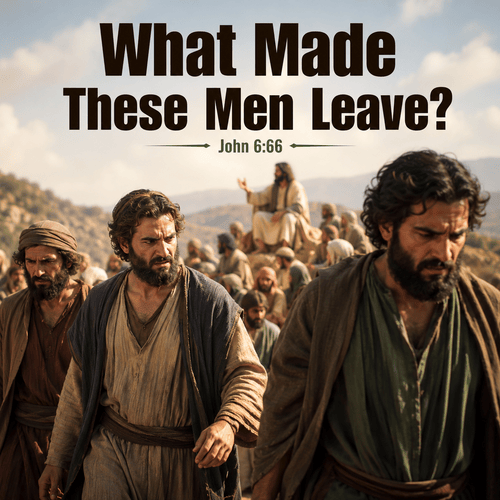

The verse often appears on our social media feed—usually with a caption such as “the Calvinism killer”. The verse is Jeremiah 19:5.
The verse has God speaking about child sacrifice. Parents in Judah were burning their own children alive as gifts to a false god. And God says something startling. He says the idea never came into His mind.
The argument presented looks strong. If God planned everything that happens, this horror was indeed part of His plan. But God says it never entered his mind. So God didn’t plan everything. Calvinism is finished.
Yet, when you look closely at the words, at the passage, and at the rest of Jeremiah, something surprising happens. The verse doesn’t wound the doctrine at all. In fact, Jeremiah 19, the chapter that contains its twin sentence turns out to be one of the strongest chapters in the whole Old Testament on God’s complete control.
Two Words You Need First
Almost the whole debate turns on two simple terms. Learn them now and the rest of this article will fall into place.
THE TWO WILLS OF GOD — A PLAIN DEFINITION
Precept—what God tells us to do. His commands, his law, his rules for living. This is the will of God we can read in our Bibles. We’re meant to obey it.
Decree—what God has planned to happen. His eternal purpose for history. This includes events he hates and forbids, such as the murder of his own Son.
The two—God’s preceptive will and His decretive will aren’t the same thing. God commands, “You shall not murder” (Exodus 20:13). That’s His preceptive will. Yet He planned the crucifixion of Jesus—which is murder. That’s His decretive will.
The Objection, Stated Fairly
Here’s the objection in its strongest form.
THE OBJECTION IN THREE STEPS
1. God swears He never commanded child sacrifice, and that it never came into His mind. He says it three times (Jeremiah 7:31; 19:5; 32:35).
2. Calvinism teaches God decreed everything that ever happens. So child sacrifice was in God’s mind and in His plan from eternity past.
3. Therefore Calvinism contradicts the plain words of God Himself.
This is no fringe argument. Richard Coords presses it hard on his site Examining Calvinism. Leighton Flowers has argued it in public debate with Chris Date. And these writers are sharp enough to see the standard reply coming. Coords even answers this reply before it’s made. When Calvinists point out that reading the verse this way would also destroy God’s knowledge of the future, Coords calls that a scarecrow—a fake threat, put up to scare readers away from the plain meaning of the text.
So we won’t begin there. We shall begin with the words themselves.
What Was Actually Happening at Topheth
Jeremiah 19 isn’t a lecture. It’s street theatre. God tells Jeremiah to buy a clay jar, take the city elders and senior priests out to the Valley of the Son of Hinnom, preach there, and then smash the jar in front of them. The message is brutal and simple: this is what God will do to Jerusalem.
Inside that valley was a place called Topheth. There, people burned children. They did it for Baal and for Molech, gods of the surrounding nations. God describes the valley as filled “with the blood of innocents” (Jeremiah 19:4).
Here’s the detail most readers rush past. These weren’t simply pagans who’d walked away from Israel’s God and forgotten him. They appear to have believed they were doing something religious and acceptable. Look at the vocabulary God quotes back at them:
- “High places”—platforms built for worship, the standard word for a shrine.
- “Burnt offerings”—a technical term straight out of Israel’s own law for a sacrifice that goes up whole to God.
- A sacred site—just outside the holy city, not in some distant foreign land.
They were using the language of true worship to dress up a false and murderous act. That’s what God is answering. He’s not answering a philosophy seminar about eternal decrees. He’s answering a claim of authorisation. The claim was: God asked for this. And God replies in the strongest words available: I never asked for this. The wish for it never once rose up inside me.
Three Verses, One Sentence
The same sentence appears three times in Jeremiah. Put them side by side, because the third one finishes the thought.
| VERSE | WHAT GOD SAYS (ESV) |
|---|---|
| Jeremiah 7:31 | “which I did not command, nor did it come into my mind” |
| Jeremiah 19:5 | “which I did not command or decree, nor did it come into my mind” |
| Jeremiah 32:35 | “though I did not command them, nor did it enter into my mind, that they should do this abomination” |
Notice the shape of the sentence. It has two halves, and they’re joined together. “I did not command” comes first. “Nor did it come into my mind” comes second. In Hebrew writing, a second line like this normally repeats and strengthens the first. It doesn’t suddenly introduce a completely different idea.
Now look hard at Jeremiah 32:35. It’s the fullest version, and it tells us what the mind of God is being denied: “nor did it enter into my mind, that they should do this abomination.” The content being denied is the requirement, the instruction, the demand. Not the information.
What “It Did Not Come Into My Heart” Means in Hebrew
The Hebrew phrase is lo alethah al-libbi. Word for word it means: “it did not come up upon my heart.”
In the Bible, the “heart” isn’t mainly about feelings. It’s the whole inner person—thinking, wanting and deciding together. And this particular expression, “come up upon the heart”, has a settled meaning right across the Old Testament. It’s about wanting, planning, resolving, or paying attention to something. It’s never about simply knowing that a thing exists.
Here are the parallels. Read the right-hand column and the pattern is unmistakable.
| PASSAGE | THE PHRASE USED | THE PLAIN MEANING |
|---|---|---|
| Acts 7:23 | “it came into his heart to visit his brothers” | Moses decided to go |
| 2 Kings 12:4 | money that “comes into a man’s heart to bring” | What a man chooses to give |
| Ezekiel 38:10 | “thoughts will come into your mind” | Gog forms an evil plan |
| Isaiah 65:17 | old troubles “shall not come into mind” | God will not bring them up again |
| Jeremiah 3:16 | the ark “shall not come to mind” | Nobody will long for it |
| Jeremiah 44:21 | “did it not come into his mind?” | God took their sin to heart |
Look especially at Jeremiah 44:21. There the very same expression is used about things God obviously knew all about. It can’t possibly mean “knowledge”. It means He gave the matter His attention.
So the sense of Jeremiah 19:5 is this: I never desired this. I never resolved on it. The wish for it never rose up inside me.
Several modern translations simply say so outright. The New Living Translation says it never even crossed God’s mind “to command such a thing”. The Christian Standard Bible reads, “I never entertained the thought.”
WHAT THE VERSE DOES AND DOESN’T DENY
What God is saying: I never commanded this. I never approved it. I never wanted it. It never came from me. You can’t claim I ordered it.
What God isn’t saying: I didn’t know this would happen. I was taken by surprise. History escaped my control.
A Serious Problem for the Other Side
Now the objection runs straight into a wall.
If “it never came into my mind” means God had no knowledge of the event, God didn’t know it was coming. That’s not an argument against Calvinism. That’s an argument against God knowing the future at all.
Two writers, Gregory Boyd and John Sanders, are at least consistent here. They belong to a movement called open theism—the view that God doesn’t know the whole future, because the future isn’t yet settled. They use these exact verses, and on their reading the words mean what they appear to mean: Topheth caught God off guard.
But almost nobody who shares the meme believes that. Richard Coords doesn’t. Neither does Leighton Flowers. They insist God knows everything that will ever happen. And the moment they say that, they’ve already stopped reading the phrase “literally”. They’ve already agreed it’s a figure of speech about something other than knowledge.
THE DILEMMA NOBODY ESCAPES
If “never came into my mind” is about knowledge → God doesn’t know the future → open theism, which almost every church in history has rejected.
If it’s about desire, purpose or command → the verse is about God’s precept → Calvinism is left completely untouched.
There’s no third option. Once you agree it’s a figure of speech, the only remaining question is which kind of willing is being denied. And the verse answers that itself: commanding.
Coords himself makes the decisive concession. He grants God isn’t claiming ignorance, and says God is instead disowning any divine origin for the act. But that’s precisely what the confessions have always insisted on. Where does sin come from? James answers directly: “Let no one say when he is tempted, ‘I am being tempted by God,’ for God cannot be tempted with evil, and he himself tempts no one. But each person is tempted when he is lured and enticed by his own desire” (James 1:13-14).
The source of sin is the sinner’s own heart. Which is exactly what Jeremiah 19:5 says. It didn’t come up out of God’s heart. It came up out of theirs.
What Calvinism Actually Claims—and What It Denies
Much of this argument survives on a misunderstanding of what the doctrine even teaches. So here’s a straight comparison. The left column lists possible claims. The middle column asks whether Jeremiah 19:5 rules it out. The right column asks whether Calvinism holds it.
| THE CLAIM | DOES JEREMIAH 19:5 RULE IT OUT? | DOES CALVINISM HOLD IT? |
|---|---|---|
| God commanded child sacrifice | Yes | No — denied |
| God approved of it | Yes | No — denied |
| God desired it for its own sake | Yes | No — denied |
| God tempted anyone to do it | Yes | No — denied |
| God is the author of the sin | Yes | No — denied |
| God knew it would happen | Not addressed | Yes — affirmed |
| God ordained that it would happen, for holy ends | Not addressed | Yes — affirmed |
Every single thing the verse denies, the doctrine also denies. The Westminster Confession of Faith, written in the 1640s, states it without flinching. God did “freely and unchangeably ordain whatsoever comes to pass; yet so, as thereby neither is God the author of sin” (3.1). It goes on to say of sinful acts that “the sinfulness thereof proceedeth only from the creature, and not from God, who being most holy and righteous, neither is nor can be the author or approver of sin” (5.4).
Read Jeremiah 19:5 again, then read that sentence again. They’re making the same point.
The Chapter That Settles the Argument
Now for the strongest part of the case, and it’s almost too neat to be true.
The twin of our verse is Jeremiah 32:35. If any chapter in the Bible should demolish the doctrine of God’s decree, it ought to be that one. Instead, Jeremiah 32 is one of the great chapters on God’s total control. Look at what stands around verse 35.
- Jeremiah 32:27—God’s unlimited power.
- Jeremiah 32:28—God ordains a national catastrophe.
- Jeremiah 32:35—God denies commanding child sacrifice. The verse used against us.
- Jeremiah 32:39-40: God changes hearts so they cannot fall away.
Read verse 40 slowly. God doesn’t say He will offer to help people fear Him only if they first decide to. He says He will put the fear of Himself inside them, so they won’t turn away. That’s God working directly on the human will to guarantee the outcome. It’s one of the clearest statements of unstoppable grace anywhere in the Old Testament.
So the person quoting verse 35 against God’s sovereignty has some explaining to do. Why does the same chapter, from the same mouth, in the same breath, insist nothing’s too hard for God? That God personally hands the city over to its enemies? And that God secures His people’s loyalty from the inside?
Jeremiah Already Knew How to Hold Both Truths
Lamentations comes out of the same disaster and the same theology. And there, only five verses apart, both truths sit happily side by side.
“For He does not willingly afflict or grieve the children of men.” (Lamentations 3:33)
“Who has spoken and it came to pass, unless the Lord has commanded it? Is it not from the mouth of the Most High that good and bad come?” (Lamentations 3:37-38)
The word translated “willingly” in verse 33 is literally “from His heart”—the same family of expression as our verse in Jeremiah 19. God doesn’t send suffering out of any delight in it. And yet nothing at all happens, good or bad, unless He has spoken it.
The writer saw no contradiction between the two sentences. Neither should we.
Scripture Makes This Very Distinction
Some people object the difference between precept and decree is a clever invention of theologians. It’s not. Ezekiel states it, and states it about this exact sin.
“I gave them over to worthless decrees and regulations that would not lead to life. I let them pollute themselves with the very gifts I had given them, and I allowed them to give their firstborn children as offerings to their gods—so I might devastate them and remind them that I alone am the Lord.”
Ezekiel 20:25-26 (NLT)
This is a hard passage and worth reading twice. God is describing judgement. Because Israel rejected His good law, He handed them over to a ruinous religion—the very fire offerings that Jeremiah condemns. He didn’t approve of it. He used it as punishment. It’s the same movement Paul describes when he writes three times that “God gave them up” to what they already craved (Romans 1:24, 26, 28).
Put prophets Jeremiah and Ezekiel beside each other: and we see the difference we began with isn’t a Calvinist invention at all. It’s sitting right there in the text.
| Passage | What it says God did | Which will of God is in view |
|---|---|---|
| Ezekiel 20:25-26 | God ordained that they would offer their children by fire, as an act of judgement | His decretive will—what He brings about in history |
| Jeremiah 19:5 | God never commanded them to offer their children, and never wanted it | His preceptive will—what He requires of us |
Why Does God Speak Like This At All?
There’s one more thing to say about the wording. John Calvin argued God constantly speaks to us in a way our small minds can bear. In the Institutes of the Christian Religion he says God “lisps” with us, in the way a nurse babbles at an infant. He doesn’t use baby talk because the truth is childish. He uses it because we are.
“It never came into my mind” is God stooping to speak in human terms. That doesn’t make the statement less true. It makes the horror land. A farmer in Judah didn’t need a lecture on the divine attributes. He needed to hear, in words he could feel in his stomach, that the God of Israel never ordered his children to be put in the fire.
The Cross Settles the Principle
Suppose someone still insists God can’t possibly ordain what He forbids. The New Testament answers with a single event.
The killing of Jesus was the worst crime ever committed. And Scripture says twice, in the plainest possible terms, that God planned it.
- Acts 2:23—”this Jesus, delivered up according to the definite plan and foreknowledge of God, you crucified and killed by the hands of lawless men.”
- Acts 4:27-28—Herod, Pontius Pilate, Gentiles and Israel gathered “to do whatever your hand and your plan had predestined to take place.”
Read that again. Their hands were lawless. God’s plan was holy. Both statements sit inside the same sentence.
How can that be? Genesis 50:20 gives us the mechanism, and a child can follow it. Joseph tells the brothers who sold him into slavery: “As for you, you meant evil against me, but God meant it for good.” One event. Two intentions. Two completely different moral verdicts. The brothers are guilty because their aim was wicked. God is blameless because his aim was to save lives.
Isaiah 10 shows the same pattern on a national scale. God calls the Assyrian empire “the rod of my anger” and uses it to punish Israel. Then He punishes Assyria, because “he does not so intend” (Isaiah 10:7). Assyria did exactly what God had ordained, and Assyria was guilty, because Assyria’s own heart was full of pride and greed.
THE POINT TO HOLD ON TO
Anyone who believes Acts 4:28 already agrees God can ordain what He forbids. So Jeremiah 19:5 can’t be used to deny it. Whatever the verse means, it can’t mean something the New Testament plainly asserts about Calvary.
From Topheth to Golgotha
Look one more time at where all this took place. The Valley of the Son of Hinnom. In Greek the name became Gehenna—and in the New Testament, Gehenna is the word Jesus uses for hell (Mark 9:47-48). The rubbish valley where children burned became the very picture of final judgement. Then look at what God did.
He never once asked a father in Judah to give up his son. He forbade it, he was sickened by it, and he swore on His own name that it never rose up in His heart. And then He gave His own Son. “He who did not spare his own Son but gave him up for us all, how will he not also with him graciously give us all things?” (Romans 8:32). Outside the city wall, not far from that valley, the one sacrifice God really did decree was the one He Himself supplied.
That’s not a God caught by surprise at human wickedness. That’s a God who is never surprised, never complicit, and never—even for one moment—anything less than good.
Jeremiah 19:5 doesn’t disprove Calvinism. It states, with chilling clarity, exactly what Calvinism confesses: God commands no sin, approves no sin and desires no sin—and still reigns over every moment of a broken world, bending even Topheth towards a cross.
Tough Questions, Honest Answers
Doesn’t a hidden will that contradicts the revealed will mean you can believe anything?
That’s a fair worry, and it has been raised sharply in online debates. If God’s secret plan can contradict His stated commands, what stops anyone claiming a private divine warrant for anything at all? The answer: the two wills aren’t about the same thing, so they never actually clash. The precept tells us what we ought to do. The decree tells what will in fact be. God never says both “do this” and “do not do this” to the same person at the same moment. Deuteronomy 29:29 draws the line for us: “The secret things belong to the LORD our God, but the things that are revealed belong to us and to our children for ever, that we may do all the words of this law.” The decree isn’t a rule for living. We’re never told to consult it—we couldn’t if we tried. We obey the commands we can read.
Is God then angry at His own decree?
The older writers answered this by separating two different things: wanting a thing in itself, and wanting it as part of a larger whole. A surgeon doesn’t enjoy cutting. He wills the cut for the sake of the healing. God hates child sacrifice with a perfect hatred, and still permits history to contain it inside a plan whose end is glorious. Augustine of Hippo put it in a famous and startling sentence: in a wonderful and unspeakable way, what’s done against God’s will isn’t done without His will. Jonathan Edwards used the sun as a picture. The sun produces light and warmth by shining. It produces cold and darkness not by doing anything, but by withdrawing. God is the direct and active source of every good thing. He isn’t the source of evil in the same way at all. His relation to the two is genuinely different, and the difference is the whole answer.
It’s also worth noticing this problem doesn’t belong to Calvinists alone. If God knew with certainty Topheth would happen, and had the power to prevent it, and created the world anyway, the event was certain from the moment He chose to create. Every Christian who believes God knows the future has to give some account of that. The verse hands nobody an escape route.
If God hates child sacrifice so much, why did He tell Abraham to offer Isaac in Genesis 22?
Because God never intended Isaac to die, and the text tells us so. Genesis 22:1 says plainly this was a test, and God stopped Abraham’s hand and provided a ram instead (22:12-13). Abraham lived long before the law that forbade this, and in a world where such offerings were common, so God took a familiar horror and used it to reveal that He does not want it. Hebrews 11:19 adds Abraham believed God could raise Isaac from the dead. Read this way, Genesis 22 isn’t an exception to Jeremiah 19:5 but a preview of Calvary: a father, a beloved son, a hill, and a substitute. God stopped Abraham. He didn’t stop Himself (Genesis 22:7-8).
If God never changes His mind, what about Genesis 6:6 and Jonah 3:10?
The Bible uses two kinds of language, and both are true. Genesis 6:6 says the LORD “regretted” making man, and Jonah 3:10 says God “relented” over Nineveh. But Numbers 23:19 says God “is not man, that He should lie, or a son of man, that He should change His mind”, and 1 Samuel 15:29 repeats it. The first kind of language is God speaking in human terms so we can feel what He feels about sin and mercy. The second tells us what’s actually going on behind the curtain. God’s eternal purpose never shifts. What changes is the situation and the way He deals with it—and in Jonah’s case, the warning itself was the means God used to bring about the repentance He had always intended to honour.
Is there any archaeological evidence that people really burned children?
Yes, and quite a lot of it. Excavations at Carthage, a Phoenician colony in North Africa, uncovered large burial precincts—modern scholars often call them tophets, after the biblical name—containing thousands of urns holding the burnt remains of infants and small children, together with dedication stones to the gods Baal Hammon and Tanit. Scholars argue over how many of these were sacrifices rather than burials after natural death, but the practice itself is described in Phoenician inscriptions and by Greek and Roman writers. Similar sites are known from Sicily and Sardinia. Inside Israel, the Bible itself reports it repeatedly (2 Kings 16:3; 21:6; Psalm 106:37-38). Jeremiah wasn’t using shocking language for effect. He was describing what was happening a short walk from the temple.
What does it mean God “hardened Pharaoh’s heart”?
Exodus says both things without embarrassment. God hardens Pharaoh’s heart (Exodus 4:21; 9:12), and Pharaoh hardens his own heart (Exodus 8:15, 32). This isn’t God forcing a good man to turn wicked. Pharaoh was already a tyrant who had enslaved a nation and ordered the drowning of its babies. God’s hardening confirms him in what he already loved and hands him over to it, and God states his purpose openly: “that my name may be proclaimed in all the earth” (Exodus 9:16, quoted in Romans 9:17). The structure is identical to Jeremiah 19:5. God commands Pharaoh to let the people go, and God ordains that Pharaoh will refuse. Precept and decree, once again.
What other verses are commonly used to argue against Calvinism?
The usual list includes 1 Timothy 2:4, where God “desires all people to be saved”; 2 Peter 3:9, where God is “not wishing that any should perish”; Ezekiel 33:11, “I have no pleasure in the death of the wicked”; and Matthew 23:37, “how often would I have gathered your children together”. Each deserves its own careful study, and there are real differences among Christians about how to read them. But the same distinction we used for Jeremiah 19:5 does most of the work. These verses describe what God commands, invites and delights in—His revealed will. They don’t describe what He has decreed to bring about. God can sincerely command and desire something He hasn’t decreed, just as He sincerely commanded Judah not to burn their children.
If God ordains everything, are our choices real?
Compatibilism is the view that God’s complete control and genuine human choice fit together rather than cancel one another out. On this view you’re free when you act according to your own desires, without anyone forcing you—and that’s precisely what Joseph’s brothers, Pharaoh, and the men who crucified Jesus all did. Nobody dragged them. They did exactly what they most wanted to do, which is why Scripture holds them guilty for it. The Westminster Confession states it carefully: God ordains everything, yet “no violence” is offered to the will of his creatures, and the liberty of second causes is not taken away but rather established. In the Bible, divine control and human responsibility are not rivals. They usually turn up in the same verse.