At the Last Supper, hours before His arrest, Jesus says something that seems confusing to first-time readers. “For the Son of Man goes as it has been determined, but woe to that man by whom He is betrayed!” (Luke 22:22). One sentence, two halves. If God had already settled, determined the betrayal—how can the betrayer be held guilty for it?
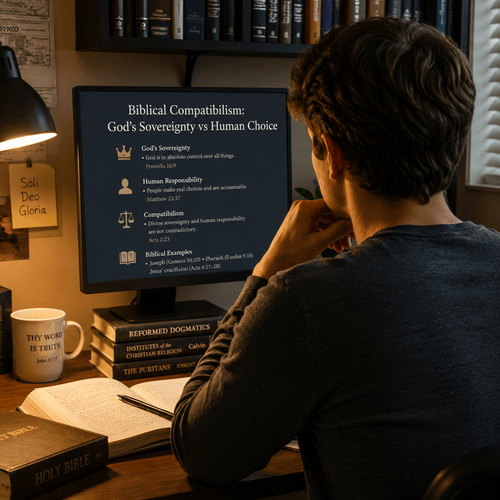
Welcome to biblical compatibilism—the conviction that both halves—God’s sovereignty and human free will—are true and that neither cancels the other. God’s sovereignty and our choice aren’t rivals dividing a fixed quantity of control between them. They belong to different orders of causation altogether—and that’s precisely why both can stand at full strength.
What Biblical Compatibilism Actually Claims
Strip away the philosophy and the claim reduces to two sentences, both asserted across Scripture without hedging.
- God ordains everything that comes to pass. Not merely foresees it, or permits it, or improvises once it has happened. He plans it. “My counsel shall stand, and I will accomplish all my purpose” (Isaiah 46:10).
- Human beings choose, and are justly held accountable for what they choose. Judas was no puppet. Pharaoh was no machine. When Scripture assigns guilt it never softens the verdict by appealing to the decree.
Compatibilism says these are compatible: both true of the same act, at the same moment. Not that God is mostly in control and we hold the remainder; not that freedom is an illusion. The claim is even stranger—God’s rule is total, human agency is real, and the second rests on the first.
The Verses Where Both Stand in One Breath
This doctrine isn’t deduced from a system and imposed on Scripture. It arises from passages where God’s sovereign action and human responsibility are presented together in the same event, often in the same sentence.
- Genesis 50:20—one act, two intentions. “As for you, you meant evil against me, but God meant it for good.” Joseph’s brothers sold him into slavery with wicked motives. Yet God intended that very same event to save many lives during the famine. Scripture doesn’t describe two separate events, but one event with two different intentions—human evil and divine good. The brothers remain guilty because of what they intended, while God remains perfectly good in what He intended.
- Acts 2:23—the sermon that explains and indicts. Jesus was “delivered up according to the definite plan and foreknowledge of God,” yet Peter immediately adds, “you crucified and killed” Him. The cross was not an accident or a failure of God’s plan; it happened exactly as God had ordained. Yet those who demanded Christ’s death were still fully responsible for what they freely chose to do.
- Acts 4:27–28—predestination on its knees. The early church prays that Herod, Pontius Pilate, the Gentiles and the people of Israel did “whatever your hand and your plan had predestined to take place.” Remarkably, these words occur not in a theological lecture but in a prayer. For the first Christians, God’s sovereignty over evil was a source of courage and comfort long before it became a point of theological debate.
- Isaiah 10:5–15—the rod that gets punished. God calls Assyria “the rod of my anger” because He uses its army to discipline Israel. Yet Assyria attacks out of pride and a desire to conquer, not because it wants to obey God. After using Assyria for His purposes, God judges its king for his arrogance. God’s sovereign use of a nation does not remove that nation’s moral responsibility.
- 2 Samuel 24:1 and 1 Chronicles 21:1—three agents, one census. One passage says the LORD incited David to take a census; the other says Satan did. David himself carried it out and was held accountable for his sin. Scripture sees no contradiction: God sovereignly ordained the event, Satan maliciously tempted, and David willingly acted. Each was involved, but each in a different way.
Philippians 2:12–13—the little word that carries the doctrine. Paul tells believers to “work out your own salvation with fear and trembling, for it is God who works in you, both to will and to work.” That little word for explains why Christians can obey: God’s work within us is the reason our obedience is possible. His action doesn’t replace ours; it enables it. We truly act because God is already at work in us.
God Is Not a Competitor With His Creation
The contradiction objection assumes God and human beings must compete for control. If God does more, we must do less. If He determines an event, our choices can’t be real.
But the Bible presents God differently. He isn’t one cause among many within the world. He’s the Creator who gives existence and power to every created cause.
A simple illustration helps. William Shakespeare determines every syllable Macbeth utters, yet Macbeth murders Duncan freely, and no reader has thought to hold the playwright accountable. Sure the comparison is imperfect, but it makes one important point: causes at different levels don’t compete with each other.
The classical name for this is concurrence. God works in and through every action of His creatures. Every act is wholly God’s as the First Cause and wholly the creature’s as the secondary cause. As Herman Bavinck put it, God is not a competitor with His creation.
The Westminster Confession of Faith expresses this with remarkable precision. God ordains everything that happens, “yet so as thereby neither is God the author of sin, nor is violence offered to the will of the creatures, nor is the liberty or contingency of second causes taken away, but rather established” (3.1).
Notice that last phrase: God’s sovereignty does not undermine human freedom. It establishes it.
What “Free” Actually Means
The apparent contradiction arises because many people assume a definition of freedom the Bible never uses. Two different ideas of freedom are possible.
- Liberty of indifference: Here, we’re free only if, at the moment of choice, we could have chosen either option equally. Nothing about our character or desires determines our decision.
- Liberty of spontaneity. In this view, we’re free when we act willingly, according to our own desires, without being forced by someone else.
The Reformers—Martin Luther, John Calvin and Francis Turretin—affirmed the second view. They argued freedom means acting voluntarily, not acting independently of our own nature.
In fact, the first definition weakens responsibility rather than strengthening it. If our choices were completely disconnected from our character and desires, they’d not really be our choices. As Jonathan Edwards argued in Freedom of the Will (1754), a self-determining will either leads to an endless regress or ends in sheer chance.
Now apply the Bible’s definition consistently.
- God cannot lie or sin, yet no one is more free than God.
- Christ, in His humanity, could not sin, yet His obedience was perfectly free.
- Believers in heaven will no longer be able to sin, and yet they will enjoy their greatest freedom.
The Bible therefore presents true freedom not as the ability to choose evil, but as the ability to delight in what is good.
This also explains the distinction between natural ability and moral inability. Sinners possess the mind, will and body needed to come to Christ. What they lack is the desire to do so. Jesus says, “You refuse to come to me” (John 5:40), yet also, “No one can come to me unless the Father draws him” (John 6:44). Their inability is moral, not physical. They cannot because they don’t want to.
Grace, then, isn’t coercion. The Synod of Dort taught that God does not force the human will but renews and heals it, so that sinners willingly come to Christ. No one raised from spiritual death complains God has violated his freedom.
Not Fatalism, Not Hard Determinism, Not Molinism
Compatibilism is often confused with other views, but it’s different from each of them.
- Fatalism says the outcome will happen no matter what we do, so our actions make no difference. The Bible teaches the opposite. God ordains both the end and the means. In Acts 27, God promised Paul everyone on board the ship would survive. Yet Paul also warned, “Unless these men stay in the ship, they cannot be saved” (Acts 27:31). God’s promise included the actions by which it would be fulfilled. History is governed not by blind fate, but by a wise and loving Father.
- Hard determinism says every human action is determined and therefore no one is truly responsible. Compatibilism agrees that God sovereignly ordains all things but rejects the conclusion that responsibility disappears. Scripture repeatedly holds both truths together. In Acts 2:23, Christ’s crucifixion was God’s definite plan, yet those who carried it out were fully guilty.
- Molinism, developed by the 16th-century Jesuit Luis de Molina, argues God knows what every person would freely choose in every possible situation and then creates the world that best fulfils His purposes. This preserves libertarian freedom, but it still leaves God choosing a world whose entire history He knows in advance. It also raises a deeper question: if these hypothetical choices are true before God decrees anything, where do those truths come from? Compatibilism avoids that problem by locating the whole course of history within God’s sovereign decree.
| Fatalism | Hard determinism | Molinism | Biblical compatibilism | |
|---|---|---|---|---|
| Is the future certain? | Yes | Yes | Yes | Yes |
| What makes it certain? | Impersonal fate | Prior physical causes | God’s choice among possible worlds | God’s free, wise decree |
| What is freedom? | Irrelevant | An illusion | Liberty of indifference | Acting from your own desires, uncompelled |
| Do the means matter? | No | Yes | Yes | Yes |
| Is anyone responsible? | No | No | Yes | Yes |
How the Church Arrived Here
Compatibilism wasn’t invented during the Reformation. It emerged over many centuries as Christians sought to explain everything the Bible says about God’s sovereignty and human responsibility.
Augustine of Hippo (5th century). Opposing Pelagius, Augustine taught that fallen people choose freely according to their desires, yet those desires are enslaved by sin. Grace frees the will instead of forcing it.
Martin Luther (1525). In The Bondage of the Will, Luther argued our choices are necessary because they flow from our nature, not because we are coerced.
John Calvin (1559). Calvin described God’s providence as the loving rule of a heavenly Father, not of blind fate.
The Synod of Dort and the Westminster Confession of Faith. Both taught God’s grace renews the will rather than forcing it, and that God’s decree establishes rather than removes human action.
Francis Turretin and Jonathan Edwards. They argued true freedom means acting according to one’s desires, and that sinners are morally unable—not physically unable—to come to God.
Modern discussion. Some scholars debate whether compatibilism is the best label for this historic teaching. Whatever the terminology, the biblical truths themselves remain unchanged.
The Cross Settles It
If we want to know whether God can ordain an evil act without becoming sinful Himself, we must begin at the cross.
The crucifixion was the greatest evil ever committed, yet it was also God’s eternal plan to save sinners. As Acts 4 says, Herod, Pilate and the crowds did “whatever your hand and your plan had predestined to take place.” God ordained the event; those who carried it out remained fully guilty.
Without compatibilism, the cross becomes either an accident or a gamble. With it, we see that God sovereignly accomplished salvation through the freely chosen evil of sinful men.
Does This Make God the Author of Sin?
This is the most important objection, and Scripture answers it carefully.
First, distinguish between the act and the sinfulness of the act. God gives His creatures life, strength and the ability to act. But the evil within the act comes from the sinner’s own heart, not from God. As Augustine illustrated, when a rider urges a lame horse forward, the movement comes from the rider, but the limp comes from the horse.
Second, distinguish between God’s decree and His command. God may ordain what He forbids. Joseph’s brothers sinned by selling him into slavery, even though God had ordained that event for good. God’s secret plan and His revealed commands aren’t the same. As Deuteronomy 29:29 reminds us, “The secret things belong to the LORD our God.”
Finally, mystery isn’t the same as contradiction. Scripture teaches both that God ordains all things and that human beings are accountable for their sins. The contradiction arises only if we add an extra assumption—that no one can be responsible for an act God has ordained. But Acts 2:23 teaches exactly the opposite.
Every Christian view must explain why God created a world in which He knew evil would certainly occur. Compatibilism’s answer: God permitted evil for wise and holy purposes that ultimately display His justice, mercy and glory.
Why This Is Pastoral, Not Abstract
This doctrine isn’t merely for theological debate. It strengthens everyday Christian living.
- In suffering. Genesis 50:20 reminds us God can intend good through the very events others intend for evil. No suffering in the believer’s life is ultimately meaningless.
- In prayer. We pray not to change God’s mind, but because He has chosen to accomplish His purposes through our prayers.
- In evangelism. God told Paul, “I have many in this city who are my people” (Acts 18:9–10). Election isn’t a reason to remain silent; it’s the reason we can preach with confidence.
- In holiness. We pursue obedience because God is already at work within us. His grace empowers our perseverance.
- In personal responsibility. God’s sovereignty is never an excuse for sin. Adam tried to blame both Eve and God for his disobedience, and God rejected the excuse.
Jesus Himself brings these truths together. “The Son of Man goes as it has been determined, but woe to that man by whom he is betrayed” (Luke 22:22). God’s sovereign plan and human responsibility stand side by side. Scripture does not ask us to explain away either truth, but to believe them both and live in the light of them.
Tough Questions, Honest Answers
If God ordains my choices, am I not just a puppet?
A puppet has no desires, no deliberation, no motives of its own. We have all three. Nobody drags us to our sins; we go gladly, for reasons entirely our own. That’s what makes us guilty. The objection assumes a determined choice cannot be a willing one. Judas wanted the silver.
Why pray if everything is already decreed?
Because prayer is among the things decreed. God ordains ends and means together, appointing prayer as a real cause of real outcomes. “You do not have, because you do not ask” (James 4:2). If the decree made prayer pointless, it would make eating pointless too.
Why evangelise if the elect will be saved anyway?
They will be saved through the preaching of the gospel, which is the ordained means. Paul reasons in the opposite direction: because God has many people in Corinth, keep speaking (Acts 18:9–10). Election does not make evangelism unnecessary. It guarantees that it will not fail.
Is “compatibilism” even a biblical word?
No—and neither is “Trinity”. The term is borrowed from philosophy and must be stripped of some baggage before it is safe to use. But the two propositions it names are stated plainly in Genesis 50:20 and Acts 2:23. Argue about the label; the substance is on the page.
What about Pharaoh—did God force him to sin?
Exodus uses three formulae, all true: God hardened Pharaoh’s heart, Pharaoh hardened his own heart, and Pharaoh’s heart was hardened. God implanted no desire foreign to Pharaoh. He gave him over to desires he already had, withdrew restraint, and confirmed him in a course he had freely chosen. Nobody at the Red Sea thought Pharaoh had been wronged.
Is this just fatalism with a Christian accent?
Fatalism says the outcome arrives whatever you do. Compatibilism says it arrives through what you do. That is not a subtle difference; it is the opposite claim. Fatalism paralyses. The decree guarantees that faithful means reach their appointed ends.
If I cannot come to Christ without grace, how can I be blamed for not coming?
Because the inability is moral, not natural. You have every faculty required; what you lack is the will. Scripture treats the bondage as culpable precisely because it is a bondage of the affections: “the light has come into the world, and people loved the darkness rather than the light” (John 3:19). Not could not come. Would not.
Related Reads
- Does Calvinism Make God the Author of Sin?
- Calvinism and Free Will: What Reformed Theology Actually Teaches
- What Is Hyper-Calvinism—and Why Do Calvinists Reject It?
- What Is Provisionism? A Reformed Response to the Flowers Challenge
- Calvinism vs Molinism: A Deep Dive into the Debate
- The Calvinist-Arminian Debate: The Strongest Objections to Calvinism Answered
- Romans 9 Calvinism and Arminianism: The Whole-Chapter Debate
- Kinds of God’s Will: Secret, Revealed, and How to Discern Them
- Does Jeremiah 19:5 Disprove Calvinism?
- Free Will vs Free Agency: Is "Agency" the Better Word?
- Who Incited David’s Census: God or Satan?