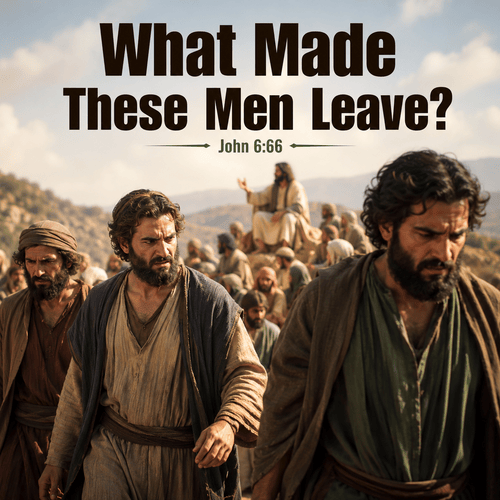
Something strange happens at the end of John 6. Jesus preaches a sermon, and some in the congregation walk out. After this many of His disciples turned back and no longer walked with Him (John 6:66). Not enemies. Disciples. People who’d chased Him around a lake the day before.
Any preacher today would call that an afternoon to forget. Whatever Jesus said in the synagogue at Capernaum, it emptied the room.
So what did He say that upset people? He told a hungry crowd He himself was the bread they needed. Then He explained why some people come to Him while others don’t. Christians have been arguing about that explanation ever since.
It’s a question worth asking. Calvinism is usually summed up by the word TULIP—five letters standing for five claims about salvation, also known as the doctrines of grace:
- That we cannot save ourselves
- That God chooses whom He will save
- That Christ actually secures their salvation
- That His call succeeds, and
- That not one of them is finally lost.
When Jesus accounted for faith and unbelief that afternoon, did He make any of these claims? And what is it He said that upset people?
Let’s read the sermon and judge for ourselves.
The crowd that wanted lunch
The day before, Jesus had fed more than 5000 people from 5 loaves and 2 fish. The crowd wanted Him to do it again. Jesus refused to comply: you are seeking me, not because you saw signs, but because you ate your fill of the loaves (John 6:26).
Then they asked for a sign. Some helpfully even suggested one: Moses gave our ancestors manna in the wilderness (John 6:31). Do that. It’s just the kind of request to expect from people who’d eaten a miracle the previous evening.
Jesus turns down the request. He says the bread God is now giving isn’t a substance but a person: I am the bread of life; whoever comes to me shall not hunger, and whoever believes in me shall never thirst (John 6:35).
In other words, Jesus tells them, “I am that sign you seek. It’s a request the Father answered—even before you asked.”
Notice how John 6:35 is built. Two phrases, saying one thing twice:
- whoever comes to me
- whoever believes in me
Coming and believing are the same act, described from two angles. Coming isn’t walking across a room. It’s trusting.
Remember that, because everything in the next four verses hinges on it.
Jesus repeats the point in John 6:40, where the person who receives eternal life is the one who looks on the Son and believes in him.
“You have seen me and yet do not believe”
Then comes the diagnosis: But I said to you that you have seen me and yet do not believe (John 6:36).
Stop and feel the weight of that. These people had watched bread appear out of, well, nothing. They’d crossed a lake to find the man who performed the miracle. The evidence could hardly have been stronger. Yet, it produced nothing.
How does Jesus respond? Not by offering better proof. He doesn’t perform another miracle to tip them over the edge. Instead He explains unbelief by pointing away from the evidence altogether, and away from the people in front of Him. He points instead to what the Father is doing.
John makes the same observation later in his Gospel: Though He had done so many signs before them, they still did not believe in Him (John 12:37). Something deeper than a shortage of information is at work in human unbelief. That’s the problem John 6:37 answers.
Four words that settle a lot
All that the Father gives me will come to me, and whoever comes to me I will never cast out (John 6:37).
That verse is one of the most important sentences in the Gospels that answer the question our title poses. And its power lies in the direction it runs.
Notice Jesus doesn’t say the Father gives Him the people who come. He says the people the Father gives Him will come. The giving happens first. The coming follows, and follows certainly.
What the wording will not allow
- All that the Father gives me—in the original Greek this is a singular collective, something like “the whole of what the Father gives.” The Father hands over a people, viewed as one single gift.
- gives—present tense. This is a giving worked out over the course of history, resting on a decision made before it, as Jesus makes explicit in His high priestly prayer: yours they were, and you gave them to me ( John 17:6).
- will come—a plain statement of fact about the future. Not “may come.” Not “are invited to come.” Not “will come if they cooperate.” Will come.
- The logic only works one way. Reverse it—make the coming the reason for the giving—and Jesus is left saying the Father gives Him the people the Father gives Him.
Also, notice what the verse clearly excludes: the Father’s giving doesn’t follow our decision to come. Instead, we come because the Father first gives us to the Son.
DA Carson, in his commentary on John, draws attention to that collective wording and to the way Jesus then narrows down to the individual in the second half of the verse: the whole is given, and not one part of the whole is lost. Herman Ridderbos makes a similar point: the Father’s giving is the hidden foundation under everything the Gospel says about believing.
This is what older writers called effectual calling: when God calls a person to Christ, the call does not merely invite. It’s a call those invited simply do not resist.
The widest welcome ever offered
Then, in the same breath, the second half of John 6: 37 reads: and whoever comes to me I will never cast out.
The Greek here is emphatic in a way English struggles to reproduce. Leon Morris notes Jesus uses the strongest form of denial the language has available. Not simply “I will not”. Instead, what He says is closer to “I most certainly never will, under any circumstances whatsoever.”
And notice the verb. Cast out means to throw somebody outside, to expel. Two chapters later, the man born blind is thrown out of the synagogue for confessing Christ, and Jesus immediately goes and finds him (John 9:34-35). Religion expels people. Christ never has.
This deserves emphasis, because the doctrine we’re examining is often accused of shrinking the gospel invitation down to a select few. Look at where Jesus puts the two truths. In one sentence, joined by the word and:
| Half of the verse | What it says |
|---|---|
| All that the Father gives me will come to me | God’s choice stands behind every conversion |
| whoever comes to me I will never cast out | Nobody who comes is ever turned away |
Charles Spurgeon returned to that second half of the verse again and again in his preaching. And for good reason. It’s the widest welcome in Scripture. No preacher needs to know who has been given to the Son before offering Christ to a room full of strangers. The promise is made to whoever comes. That’s a sentence we can say to any human being alive.
Why Christ cannot fail
John 6:38-39 explains why the welcome is unbreakable.
For I have come down from heaven, not to do my own will but the will of him who sent me. And this is the will of him who sent me, that I should lose nothing of all that he has given me, but raise it up on the last day.
The argument here is watertight, and it’s worth laying out step by step.
The four steps
- Jesus came to do the Father’s will, not His own (John 6:38).
- The Father’s will is that Jesus should lose nothing of what He was given (John 6:39).
- Jesus finished the work the Father gave him to do: It is finished (John 17:4; John 19:30).
- Therefore not one of those given to Him can be lost.
There’s no gap in that chain. If a single person given by the Father to the Son were finally lost, Jesus would have failed to do the Father’s will. And the Gospel of John would collapse.
Two details in John 6:39 tighten it further. The word translated lose is the same root as should not perish in John 3:16, and it reappears in the promise that no one will snatch them out of my hand (10:28) and in Jesus’ report to the Father that not one of them has been lost (17:12). And the tense of has given shifts to describe a completed act with lasting effect. The handing over is settled business.
So the passage is sealed at both ends. John 6:37 says everyone the Father gives will come in. And John 6:39 says nobody, having come, ever goes out. Nobody enters except by the Father’s gift, and nobody leaves at all. Some writers call this the golden chain of John 6, and its shape is the same as Paul’s chain in Romans 8:29-30.
The drumbeat of the last day
Read John 6:39, 40, 44 and 54 in a row and you hear the same phrase four times: I will raise him up on the last day.
That repetition matters. The security Jesus promises isn’t vague spiritual comfort. It ends in a body coming out of a grave. Being kept by Christ isn’t merely being kept believing; it’s being raised.
It also has a sharp consequence for how we read John 6:44, which is where the sermon goes next.
The rest of the sermon says the same thing
If John 6:35-39 were all we had, someone might argue we’d over-read a single sentence. But Jesus keeps going, and each time He returns to the subject He says something stronger.
John 6:44—No one can come to me unless the Father who sent me draws him. And I will raise him up on the last day.
Two things here. First, no one can. Not “no one will,” which would describe stubbornness. Can describes inability. Left to ourselves, we’re not merely unwilling to come to Christ; we’re unable. Jonathan Edwards drew the helpful distinction long ago: nothing physical prevents anyone from believing, but our wants and loves are bent away from God, and we never choose against what we most want.
Second, look at what’s attached to the drawing. Everyone the Father draws, Jesus raises on the last day. So the drawing cannot be a general influence that some accept and others shrug off—otherwise Jesus has just promised to raise unbelievers to eternal life.
John 6:45—Everyone who has heard and learned from the Father comes to me. Paraphrasing Isaiah 54:13, Jesus says the Father’s teaching always arrives at the same destination. Everyone taught, comes.
John 6:64-65—But there are some of you who do not believe… This is why I told you that no one can come to me unless it is granted him by the Father.
This is the plainest statement in the chapter, and it’s Jesus’ own explanation of the unbelief in front of him. Why do some of you not believe? Because the ability to come is a gift, and it hasn’t been given you. Not the opportunity. The ability itself. Luke says the same thing about a woman in Philippi: the Lord opened her heart to pay attention (Acts 16:14).
And then John 6:66. They leave. The sermon proves its own point in real time: preaching sovereign grace sifts a crowd rather than swelling it.
All five points, in one sermon
Set the whole passage out and the pattern is hard to miss.
| The teaching | Classic name | Where Jesus says it |
|---|---|---|
| We cannot come to Christ on our own | Total Depravity | John 6:36, 44 (no one can), John 6: 63, 65 |
| God chooses and gives a people to His Son | Unconditional Election | John 6:37, 39 (all that he has given me) |
| Christ secures precisely those given to Him | Definite or Limited Atonement | John 6:39, with John 10:11, 15 |
| God’s call doesn’t merely invite; it works | Effectual Calling (also called Irresistible Grace) | John 6:37 (will come), John 6:44, 45 |
| Not one of them is ever lost | Perseverance of the saints | John 6:37, 39-40 |
Four of the five are stated outright inside five verses. The other, Definite or Limited Atonement, follows from verse 39 and is said plainly three chapters later, where, we’re told the Good Shepherd lays down His life for the sheep (John 10:11, 15).
But what about human responsibility?
Three objections come up quickly, and the text answers all three.
- “This makes people machines.” John 6:36 blames them: you have seen me and yet do not believe. Jesus holds these people responsible in the same paragraph in which He says nobody can come unless drawn. Carson has argued at length the Bible everywhere assumes both, without embarrassment and without apology, and that John’s Gospel is the clearest example of it in Scripture. Our discomfort isn’t the text’s problem.
- “John 6:40 makes it conditional on believing.” Read John 6:39-40. Both verses begin by naming the will of my Father. Verse 39 gives the outcome God guarantees; verse 40 gives the means by which He brings it about—faith in His Son. A guaranteed end and an appointed means aren’t rivals. Nobody is saved apart from believing. And nobody believes apart from being given.
- “What about Judas?” He was chosen as an apostle (John 6:70) but he wasn’t one of the given. Jesus keeps the categories apart Himself: I have guarded them, and not one of them has been lost except the son of destruction (John 17:12). The exception is named as an exception, and Jesus tells us He knew this all along (John 6:64).
Where this leaves us
It’s worth noticing what kind of pastoral care this passage is designed to give.
Jesus isn’t handing His hearers a puzzle about who’s in and who’s out. He’s telling frightened, hungry, half-convinced people where their safety comes from. Not from the firmness of their grip on Him. But rather, from the Father’s decision to give them, and the Son’s refusal to lose them.
Craig Keener, who’s no Calvinist, observes the Gospel of John is thoroughly at home with divine initiative in salvation; the emphasis isn’t smuggled in by later interpreters. Andreas Köstenberger notes how the whole discourse turns on the Father’s action: believing is merely the response it produces rather than the cause it depends on.
So: did Jesus teach Calvinism? The label is 16th-century and the acronym is later still. But the teaching clearly isn’t. Centuries before Geneva, and before the Synod of Dort met in 1619 to write any of it down, a Saviour stood in a synagogue in Capernaum and said everyone the Father gives Him will come, that He will lose not one of them, and that He will throw out nobody who comes.
The crowd found that unbearable and left.
So why do the “disciples” walk away? What exactly put them off?
They tell us themselves: This is a hard saying; who can listen to it? (John 6:60). On the surface the offence was Jesus’ language about eating His flesh and drinking His blood (John 6:53-56)—shocking to any Jewish ear, since the Law forbade the drinking of blood outright (Leviticus 17:10-14). Two other offences had been stacking up before that. Jesus claimed to have come down from heaven, which the locals thought absurd coming from a man whose parents they knew (John 6:41-42); and He offered them a body given and blood shed, when what they wanted was the bread-king they’d tried to crown by force the day before (John 6:15).
But notice Jesus doesn’t diagnose the problem the way we would. He never says they’ve misunderstood a metaphor. He says there are some of you who do not believe, and then gives the reason: no one can come to me unless it is granted him by the Father (John 6:64-65). That is the deepest offence, and it comes last for a reason. A crowd will happily hear God helps those who make an effort. Being told we cannot come at all unless God grants us the ability takes salvation out of our hands completely, and religious pride cannot survive it. Back in John 6:28 they’d asked, What must we do, to be doing the works of God? The whole sermon was Jesus’ answer: nothing you can do—everything the Father gives.
Which makes verse 66 the most remarkable confirmation of the sermon imaginable. Jesus says only those given by the Father can come. And at once, those who weren’t ‘given’ get up and go. Their exit doesn’t disprove the doctrine; it performs it. John’s wording is careful too—these were disciples in the loose sense of followers and hangers-on, not the Twelve, which is why Jesus turns immediately to the Twelve in John 6:67. Sovereign grace gathers, but it also sifts, and John applies the same test in his letter: They went out from us, but they were not of us (1 John 2:19).
Tough Questions, Honest Answers
Was Jesus a Calvinist then?
^Strictly speaking the question is back to front, since Calvin was born 15 centuries too late to have influenced anybody in Capernaum—the right question is whether John Calvin was a good reader of Jesus’s teachings. Calvin himself would have been horrified by the label; he wanted no movement named after him and insisted he was simply passing on what the apostles wrote. It’s also worth remembering “Calvinism” is a nickname coined largely by Calvin’s opponents, and that TULIP as an acronym is younger still, dating from the 20th century rather than the 16th. What the label usefully names is a set of convictions about grace, and those convictions have to be tested against Scripture rather than against a reputation. So the fair verdict is this: no Jesus wasn’t a Calvinist. But Calvinism is a serious attempt to say back to God what Jesus said in John 6. If the reading offered above holds, the system isn’t the source of the doctrine—it’s the echo.
Does John 6:37 mean I can stop believing and still be saved?
No, and the passage rules that out rather than allowing it. John 6:40 makes eternal life belong to the one who looks on the Son and believes—a continuing posture, not a single moment in the past. What John 6:39 promises is God will not let His own people finally fall away, which is a very different claim from saying a person who abandons Christ altogether was secretly safe. Herman Ridderbos and others rightly stress that being kept by God and continuing to believe are two sides of one reality, not alternatives. Ongoing faith is the evidence of God’s keeping, not a substitute for it. So the doctrine gives no comfort at all to someone using it as permission.
Isn’t John 6 really about the Lord’s Supper rather than election?
The eating and drinking language of John 6:53-58 has certainly been read that way, but the discourse defines its own terms before it gets there. In John 6:35 coming and believing are set in parallel, and in John 6:47 eternal life belongs to whoever believes. John Calvin argued the passage teaches the feeding on Christ that faith performs, which the Supper then signifies and strengthens—not the other way round. On that reading the sacrament illustrates the sermon; the sermon isn’t about the sacrament. Either way, the argument of John 6:37-45 stands on its own feet.
Did anyone read John 6 this way before Augustine?
Earlier writers quote the chapter freely, and the emphasis on God’s initiative in drawing sinners appears well before the 5th century, though nobody had yet worked it into a system. What Augustine did, in the course of a long argument about grace, was press the two hardest sentences—no one can come to me unless the Father draws him and unless it is granted him—and refuse to soften them. That’s not invention. That’s exegesis catching up with a text nobody had fully reckoned with. The doctrine doesn’t depend on Augustine being first, in any case; it depends on Jesus having said it.
Doesn’t John 12:32, “I will draw all people to myself,” cancel John 6:44?
The same verb appears in both places, which is exactly why the context has to decide the sense. John 12 is spoken immediately after Greeks come looking for Jesus (John 12:20-22), and John adds Jesus was speaking about the manner of His death. The point is that the cross would gather people from every nation, not merely from Israel—all people in the sense of all kinds. Reading it as every individual without exception would prove too much even for those who use it, since not everyone is in fact saved. John 6:44 remains what it plainly is.
Does God force people to come against their will?
No, and this is where the doctrine is most often misunderstood. God doesn’t drag unwilling people to Christ; He changes what they want. Jonathan Edwards distinguished between what a person is physically able to do and what a person’s desires will actually permit, and argued grace works on the second. Nobody who comes to Christ experiences it as coercion. They experience it as finally seeing something they’d overlooked—which is precisely the movement from John 6:36 to John 6:37.
How does this fit with God desiring all to be saved?
Scripture says both things and the tradition under discussion has never pretended otherwise. God takes no pleasure in the death of the wicked (Ezekiel 33:11), and He commands the gospel to be preached to everybody without distinction or qualification. Older writers spoke of God’s revealed will—what He commands and delights in—and His secret purpose, which He alone knows and which He hasn’t put us in charge of. We’re given the first and told to act on it. The mystery in the second is real, and Jesus doesn’t resolve it in John 6; He simply says both parts and leaves them standing together.
Related Reads
- What Is TULIP Calvinism? The Five Points Explained
- Total Depravity: The Doctrine That Makes Grace Make Sense
- Unconditional Election: Why God’s Choice Is Entirely His Own
- Limited Atonement: The Biblical Case for Particular Redemption
- Irresistible Grace: How God’s Call Actually Works
- Perseverance of the Saints: Why True Believers Cannot Finally Fall Away
- The Synod of Dort: The Debate That Gave Us TULIP
- Why Does God Choose Some for Salvation and Not Others?
- God Helps Those Who Help Themselves: Is It in the Bible?
- Does Colossians 1:20 Teach Universal Reconciliation?