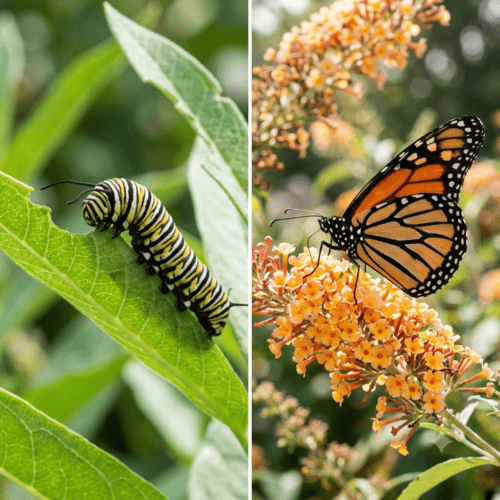
A caterpillar is a soft tube with a mouth. It crawls. It chews leaves all day. Has no wings, no long tongue. And no interest in flowers.
A butterfly flies. It drinks nectar through a tube like a drinking straw. Its wings carry colours that no paint can copy.
Now here’s the strange part. The two creatures are the same animal. The caterpillar doesn’t grow into the butterfly the way a puppy grows into a dog. It takes itself apart. Then it puts itself back together as something else.
We call this metamorphosis. The word simply means a complete change of form. Scientists have a longer name for the full version of it: holometaboly, which means an insect passes through four separate stages, with a resting stage in the middle where the rebuilding happens.
Almost everyone finds this beautiful. But only a few notice it’s also a very serious problem for the theory that all living things arrive by slow, small, accidental steps. This isn’t a problem creationists invented.
What Actually Happens Inside the Chrysalis
Before we can weigh the arguments, let’s be clear about what actually happens inside the chrysalis—the hard, shell-like case around the caterpillar.
The butterfly passes through 4 stages. Each is a different way of being alive.
| STAGE | WHAT IT LOOKS LIKE | WHAT IT DOES | WHAT IT CANNOT DO |
|---|---|---|---|
| Egg | A dot, often smaller than a pinhead | Holds the complete instructions for every later stage | Move or feed |
| Larva (caterpillar) | A soft, legged, crawling tube | Eats constantly and grows, sometimes 1,000 times heavier | Fly, drink nectar, or reproduce |
| Pupa (chrysalis) | A sealed, still, protective case | Dissolves the old body and builds a new one inside | Eat, move, or defend itself |
| Adult (imago) | A winged, scaled, nectar-drinking insect | Flies, navigates, mates and lays eggs | Grow any larger or chew a leaf |
The middle stage is the one that matters most. Inside the chrysalis, the caterpillar’s body is broken down. Special chemicals called enzymes dissolve most of its old tissues. Cells switch on a programme of self-destruction. If you cut open a chrysalis at the right moment, much of what pours out is a thick liquid.
But it isn’t simply soup. Something is directing the rebuild. And what’s directing it was placed there long before it was needed.
The Blueprints That Wait in the Dark
Hidden inside every caterpillar are small pockets of cells called imaginal discs. The name comes from the old word imago, which is what scientists call the adult insect.
AN IMAGINAL DISC? WHAT’S THAT?
It’s a tiny, folded packet of cells that’s set aside very early in the insect’s life. And left alone.
It does nothing at all while the caterpillar feeds and grows. It has no job in the caterpillar’s world.
That’s until it wakes up and grows into one specific adult part: a wing, a leg, an eye, and the coiled feeding tube.
Remove a disc in the laboratory and the matching adult part never forms. The disc isn’t a spare. It’s the plan.
The discs are key to the whole puzzle. Here’s why.
They’re set aside while the animal is still an egg. They sit quietly through the caterpillar’s entire life, doing nothing useful. They don’t help the caterpillar eat, move, or hide from birds. They’re simply carried around, fed and protected, for weeks.
Then, when the caterpillar seals itself inside the chrysalis, the sleeping discs wake up. They multiply rapidly. One disc becomes a wing. Another a leg. Another the long coiled tongue the caterpillar never had and never needed. Around them, the dissolved tissue of the old body is used as raw material.
Let that sink in: The instructions for building a butterfly are present inside a creature that’s not a butterfly, has no use for wings, and that will never fly unless it first destroys itself.
Biologist Gary Parker, who taught evolutionary biology before he became a creationist, has pressed exactly this point: a system that’s useless now, and only pays off after a total rebuild, is the opposite of what step-by-step survival is supposed to produce. Nature doesn’t save up for later. It keeps what works today.
The Chemical Switch That Must Never Fail
The rebuild also needs a timer. And the timer must be perfect.
Two chemicals control the whole process. Chemicals of this kind are called hormones, which are simply chemical messages that travel around the body and tell cells what to do.
- Ecdysone (the moulting hormone) gives the order to shed the old skin. Without it, the insect stays as it is and eventually dies inside a skin it has outgrown.
- Juvenile hormone (the identity hormone) decides what kind of creature comes out of the skin. High levels say “stay a caterpillar”. Falling levels say “become a chrysalis”. Near-zero levels say “become an adult”.
- The two must agree on both the amount and the moment. The same hormone at the wrong level, or at the right level on the wrong day, produces a monster that can’t feed or a rebuild that never completes.
Get the timing wrong and the animal dies. Not injured. Not slower. Dead.
Beneath the 2 hormones sits a second layer of control: a set of genes that switch each other on and off in a fixed order. Scientists know several of them by name, including Broad-Complex, E93 and Chinmo.
James Truman and Lynn Riddiford, 2 leading researchers in this field, have spent decades untangling how the signals fit together. And the picture that has emerged isn’t simple. It’s a control system with many parts that must all agree.
Biochemist Michael Behe gave a useful name to this kind of arrangement: irreducible complexity. He means a system made of several parts working together, where taking away any one part doesn’t make it work a bit worse. It makes it stop working altogether.
Why Small Steps Don’t Get Us There
Evolution by natural selection needs a long chain of small changes. Each link in the chain must produce a creature that survives and has young. If any link produces a creature that dies, the chain snaps and the whole path is closed.
So let’s try to imagine the chain that leads to metamorphosis.
Start with an insect whose young look like small adults. Grasshoppers work this way. The young hatch, look roughly like their parents, and simply grow bigger. Scientists call this partial change, or hemimetaboly.
Now we need to reach the butterfly pattern. Somewhere along the way, a creature must appear that dissolves its own body and rebuilds it. What did the first, partial version of that look like?
THE HALFWAY CREATURE PROBLEM
An insect that dissolves its gut but has no new gut ready to replace it doesn’t become a butterfly. It starves inside its own skin.
An insect that grows sleeping wing-discs but never completes the rebuild has simply wasted energy carrying useless lumps around for weeks.
An insect that starts the self-destruct programme with only half the instructions for the rebuild isn’t a transitional form. It’s a corpse.
Natural selection can’t reward a half-finished demolition, because a half-finished demolition leaves nothing alive to reward.
That’s the heart of the matter. The chrysalis isn’t a gentle slope a species can climb one step at a time. It’s a gap. On one side is a living caterpillar. On the other side is a living butterfly. In between is a stage where the animal is neither, and can’t survive unless the entire rebuilding system is already present and already working.
Biologist Paul Nelson argues this is the deepest difficulty of all. It isn’t that we lack the details of how metamorphosis evolved. It’s that the halfway states we’d need appear to be states in which nothing can live.
A Hundred Years of Guessing
If you think we’re overstating this, listen to what mainstream science says about itself.
Two main theories have been on the table for over a century, and neither has won.
| THEORY | WHAT IT CLAIMS | WHY IT HAS NOT SETTLED THE MATTER |
|---|---|---|
| Berlese (1913): the early-hatching embryo | The caterpillar is really an unfinished embryo that left the egg too soon. The chrysalis is where it finishes developing. | It does not explain how an embryo could survive outside the egg, feeding and growing, before the rebuilding system existed. |
| Hinton: the modified final stage | The caterpillar matches the ordinary young stage of other insects. The chrysalis is just the last of those stages, heavily changed. | It does not explain why that final stage would begin dissolving the whole body, a step that is fatal unless it is complete. |
Antonio Berlese, an Italian scientist, proposed in 1913 the caterpillar is really an embryo that hatched early. On this view, the young insect leaves the egg before it has finished developing, and the chrysalis is where it finally completes the job it should have done inside the shell.
Howard Hinton, a British entomologist, disagreed. He argued the caterpillar matches the ordinary young stage of other insects, and that the chrysalis is simply the last of those stages, heavily modified.
Modern research has looked at the genes involved and found evidence that fits both theories. That sounds like progress. It’s not. When new evidence supports 3 opposing explanations equally well, what we have isn’t an answer. We have a deeper puzzle.
Review articles published in 2026 still describe the origin of complete metamorphosis as one of the great unsolved mysteries of insect biology, unexplained since the days of Aristotle. That isn’t a creationist claim. That’s the honest verdict of researchers themselves, printed in their own journals.
What the Fossils Show
What about the fossils? If metamorphosis assembled itself slowly, the rocks should show us the assembly. They don’t.
A timeline of what has actually been found
- The oldest layers with insects contain creatures with no metamorphosis at all. The young are simply small adults.
- Then, abruptly, complete metamorphosis appears. The oldest widely accepted example, Westphalomerope maryvonneae from northern France, arrives already fully formed, with no line of ancestors leading up to it.
- Shortly after, in the same rock system, a fossil larva named Srokalarva berthei turns up in North America. The pattern is already established and already varied.
- From then until now, nothing changes. Butterflies and moths preserved in amber, some of them extraordinarily detailed, look like the ones in our gardens.
- What’s missing throughout is any graded series showing the rebuilding system being assembled piece by piece.
We find the same pattern across the fossil record. Again and again. Creatures appear suddenly, fully formed, doing what they still do. Then they stay the same. Palaeontologist Kurt Wise, who studied under Stephen Jay Gould at Harvard before writing as a creationist, has long argued sudden appearance followed by long sameness is the actual shape of the fossil record, whatever framework we bring to it.
We must be fair about one objection. Caterpillars are soft. Soft things rarely fossilise. So the absence of a long series of in-between forms is exactly what an evolutionist would expect anyway. That’s a reasonable reply, and we mustn’t pretend otherwise. But notice what it costs. The explanation now rests on evidence that’s missing rather than evidence that’s present. And that’s a weak place for any theory to stand.
The Moth That Remembered
We often hear it said the caterpillar becomes a formless soup, and that the butterfly is built from nothing. That isn’t quite true, and the truth is far more interesting.
In 2008, three scientists at Georgetown University in the US asked a simple question: can a moth remember something it learned as a caterpillar?
Douglas Blackiston, Elena Silva Casey and Martha Weiss trained caterpillars of the tobacco hornworm moth to hate a particular smell. They paired the smell with a small electric shock. The caterpillars learned to avoid it. Then the caterpillars turned into moths.
The moths still avoided the smell.
The team checked carefully that the smell hadn’t simply stuck to the outside of the chrysalis. It hadn’t. The memory itself had survived the rebuild.
WHY THIS MAKES THE DESIGN ARGUMENT STRONGER, NOT WEAKER
If the caterpillar truly melted into shapeless liquid, we’d only have to explain how matter is rearranged.
What actually happens is a controlled demolition. Enough of the nervous system is held together, through all the dissolving, that a learned lesson comes out the other side intact.
That means the process knows what to destroy and what to protect, and it makes that judgement thousands of times without a single supervisor and without a second attempt.
Think about what that tells us. Something continuous runs through the middle of the transformation. Enough of the nervous system holds together, through all that dissolving and rebuilding, that a learned lesson comes out the other side intact.
This is a better argument than the soup story, not a worse one. Anyone can imagine matter being melted down. What we actually find is a controlled demolition that carefully preserves the parts worth keeping, carried out by a system with no supervisor, no plan visible to the animal itself, and no second chances.
Wings, Colour and a Map No One Taught Them
Once you start looking, the butterfly doesn’t stop giving.
- Colour without paint. The wings are covered in tiny scales, and in many species the colour is no pigment at all. The scales are shaped into microscopic ridges that bend light. The blue of a Morpho butterfly isn’t paint. It’s architecture.
- A tongue that assembles itself. The feeding tube is built from two separate halves that zip together after the butterfly emerges, forming one sealed straw.
- A map nobody taught them. Monarch butterflies fly thousands of kilometres to a small group of forests in Mexico. No single butterfly makes the whole round trip. The ones that arrive are the great-grandchildren of the ones that left.
That last point deserves a moment. The monarchs that reach Mexico have never seen the destination. No parent taught them the way; their parents died on the journey. They carry a clock in their antennae, they read the position of the sun and correct for the time of day, and they arrive.
Information that no individual learned, carried by a creature that never met the one who made the journey before, isn’t the kind of thing that accidents produce. It’s the kind of thing that gets written down in advance.
The Honest Question
Let’s be honest about where we’ve landed.
We haven’t proved evolution is impossible. We’ve shown something narrower and, we think, more useful. The people best qualified to explain how metamorphosis arose say openly they cannot yet do so. The halfway creatures the theory requires look like creatures that couldn’t have lived. The blueprints for the butterfly sit inside the caterpillar long before there’s any use for them. And the whole process runs on a chemical timer that fails fatally if any part of it is missing.
Given all that, the question isn’t whether the butterfly is amazing. Everybody agrees it is. The question is what kind of cause is big enough to account for it.
“The heavens declare the glory of God, and the sky above proclaims his handiwork” (Psalm 19:1). So, in its own small and silent way, does the thing on the rose in our garden.
Tough Questions, Honest Answers
Are butterflies mentioned anywhere in the Bible?
No, they’re not. Several websites claim Psalm 78:39 and Job 27:18 refer to butterflies, but this is simply a mistake. Psalm 78:39 speaks of a wind that passes and does not return, and Job 27:18 compares a rich man’s house to the fragile shelter built by a moth. We should be glad to say so plainly. Scripture is sufficient for what it was given to teach, and it doesn’t need our help. Inventing verses that aren’t there weakens our credibility and dishonours the Word we claim to defend. The butterfly still teaches us something. It teaches it as part of general revelation, the truth God makes known through the things He has made (Romans 1:20), not as a proof text.
Were butterflies created on Day 5 or Day 6?
Christians who hold to a straightforward reading of Genesis 1 disagree about this, and the disagreement is an honest one. Day 5 covers the creatures of the water and “every winged bird” (Genesis 1:21), which some take to include all flying creatures. Day 6 covers the land animals and “everything that creeps on the ground” (Genesis 1:25), which others take to include insects.
The text doesn’t settle it, and we mustn’t pretend that it does. Genesis was written to tell us who made the world and in what order the great categories appeared, not to provide a modern taxonomy. What Genesis does settle is that butterflies were made by God, within the ordinary week of creation, and were pronounced good. That’s the point on which everything else depends.
If the caterpillar dies inside the chrysalis, does that mean there was death before the Fall?
This question rests on a misunderstanding of what happens. The caterpillar doesn’t die. Its tissues are broken down and rebuilt, but the animal continues, which is exactly what the memory experiments show: the creature that comes out remembers what the creature that went in had learned. It’s one life, not two.
Even if it were otherwise, Scripture connects the entry of death to man’s sin in a particular way. Romans 5:12 speaks of death coming to men, and Romans 8:20-22 of a whole creation subjected to futility. Insects aren’t described in Scripture as having the breath of life in the way that man and the higher animals are. Careful writers have long distinguished between the death of a creature and the mere breakdown of cells or plant matter. So the chrysalis raises no difficulty here. It’s a rebuilding, not a burial.
Why would a good God allow wasps to lay their eggs inside living caterpillars?
Charles Darwin raised this exact objection in a letter to botanist Asa Gray. Parasitic wasps do lay eggs in caterpillars, and the larvae do eat them alive. The Bible doesn’t describe the world as it now stands as the world God originally pronounced good. Creation was subjected to futility because of sin, and it groans (Romans 8:20-22). What we observe includes real corruption, and we should not explain it away.
We should also be careful not to read our feelings into God’s judgement. He answered Job out of the whirlwind by pointing him to creatures Job couldn’t understand, and Job’s response was worship rather than an explanation.
The Christian answer is not that suffering in nature is fine. It’s that it’s temporary, that it has a cause, and that God has committed Himself to undoing it.
Is seeing a butterfly a sign from God, or a message from someone who has died?
We want to answer this gently, because it is usually asked by people who’re grieving. No, it’s not. Scripture is clear the dead don’t send us messages, and it warns us firmly against seeking contact with them (Deuteronomy 18:10-12). God doesn’t speak to us today through omens or through creatures that cross our path. He has spoken finally in His Son (Hebrews 1:1-2), and He speaks to us now through His Word.
That isn’t a cold answer. It’s a far more certain one. A butterfly may or may not appear on the day you need comfort. The promises of God are there every day, and they don’t depend on the weather. There’s nothing wrong with being moved by a butterfly, or thanking God for it. The danger is only in treating it as a message it wasn’t sent to carry.
Are moths and butterflies the same created kind?
Almost certainly they’re not one single kind, and the boundary isn’t where most people assume. Butterflies and moths together form a huge group with well over 150,000 known species, far too many to have come from one pair on the Ark.
The biblical category is the “kind” of Genesis 1, which is a group whose members can produce young together. It usually sits somewhere near what biologists call the family or genus, not at the level of butterflies as a whole.
This also means a great deal of variation within kinds has occurred since creation, and that’s exactly what we’d expect. Variation within a kind isn’t in dispute. What’s in dispute is whether one kind can become another.
Insects were also not on the Ark in the way land animals were, since Genesis 7:15 speaks of creatures with the breath of life. Many likely survived the Flood on floating vegetation.
Do insects preserved in amber support a young earth and the Flood?
They fit it well. Amber is hardened tree resin, and resin only preserves an insect if it flows heavily and buries the creature very quickly. Large amber deposits therefore point to enormous quantities of resin produced under stress, over a short period, and then buried fast. A global flood provides exactly those conditions: damaged forests bleeding resin, huge floating mats of logs, and rapid burial in sediment.
What the amber insects themselves show is just as striking. They’re not primitive. Their wings, scales and mouthparts match living species closely enough that specialists can often identify the family at a glance. If very great ages had passed, we’d expect visible change. What we find instead is a butterfly that wouldn’t look out of place on an English garden path.