
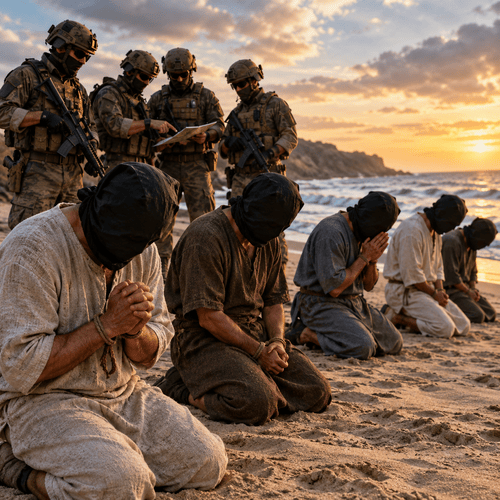
7 of the Beatitudes describe something a person is or does. Poor in spirit. Mourning. Meek. Hungry. Merciful. Pure. Peacemaking. Each one describes a condition or an action that belongs to the person Jesus calls blessed.
The eighth is different. It describes something done to a person.
And this is probably the Beatitude people claim most often when someone simply disagrees with them—and the one least often claimed by people who’re actually being persecuted.
So any serious look at “Blessed are those who are persecuted” has to face both facts. Jesus really does call the person on the receiving end of hostility blessed. But He also puts three crucial words in the middle of the sentence that rule out most of the ways we like to apply it.
The Only Beatitude in the Passive Voice
The shift in grammar is easy to miss. Every previous blessing rests on something true of the person: he has recognised his poverty, he grieves, he has surrendered self-defence, he hungers, he shows mercy, his heart is undivided, he makes peace. Each is an active description.
Here the subject does nothing. He’s persecuted—acted upon by others, with the initiative entirely theirs. Matthew even uses a form of the verb that suggests a settled state rather than a single episode, though the point doesn’t rest on the grammar and it would be a mistake to build much on it.
There’s a further consequence of the passive. Every other beatitude can, at least in principle, be counterfeited—a person can perform meekness, simulate mercy, adopt the vocabulary of spiritual poverty. This one can’t be produced at will, because it requires the cooperation of an opponent. Nobody can arrange to be persecuted for righteousness by deciding to be; it has to be conferred by someone who has taken an objection to something real.
The significance is theological rather than technical. This beatitude doesn’t bless a spiritual achievement. It blesses a circumstance, and specifically a circumstance nobody would choose. That places it in an odd position at the end of a list otherwise composed of character marks. And the position turns out to be deliberate.
Where the List Ends Is Where It Began
Compare the 2 promises:
Blessed are the poor in spirit, for theirs is the kingdom of heaven (5:3). Blessed are those who’re persecuted for righteousness’ sake, for theirs is the kingdom of heaven (5:10). Identical. Of the 8 parallel beatitudes, these are the only 2 that promise the same thing, and the only 2 that promise it in the present tense. The remaining 6 all use the future—they shall be comforted, they shall inherit, they shall be satisfied, they shall receive mercy, they shall see God, they shall be called sons of God.
The effect is a bracket. The list opens and closes on the same possession, which means the journey it describes doesn’t accumulate anything. The persecuted disciple at the end of the progression holds exactly what the spiritual beggar held at the beginning, and holds it on exactly the same terms.
Donald Carson and others pointed out the 8 beatitudes are best read as a single portrait rather than a ladder, and this bracket is the strongest internal evidence for that. A ladder has a top. A portrait has features, and no feature is nearer the goal than another.
That’s worth sitting with, because it cuts against the natural reading of a list. We expect a sequence like this to build toward something—as though the mature believer at position 8 had earned an upgrade on the one who entered at position 1. He hasn’t. He has the kingdom, which is what he was given the moment he arrived empty-handed, and which persecution has been unable to take from him.
THE BRACKET
Matthew 5:3 and Matthew 5:10 are the only 2 beatitudes promising the kingdom of heaven, and the only 2 using the present tense. The list accumulates nothing—the persecuted disciple holds exactly what the beggar was given.
3 Words That Do the Filtering
For righteousness’ sake. Everything hangs on that qualifier, and removing it changes the verse into something Jesus didn’t say.
Strip the qualifier out and the verse becomes a blessing on suffering as such, which Scripture doesn’t offer. Pain isn’t sanctifying by itself, and the Bible contains a great deal of suffering it doesn’t commend—including suffering brought on by folly or by sin.
Righteousness in Matthew’s vocabulary means conduct that conforms to God’s will—the word he uses 7 times across his Gospel, consistently describing a manner of life rather than a legal standing. So persecution for righteousness’ sake is opposition provoked by living the way the preceding 7 beatitudes describe.
That connection is the key to the whole verse. Persecution isn’t a separate topic bolted onto the end of the list. It’s the predictable consequence of the list. A person who has stopped defending himself, refuses to retaliate, tells the truth in conflicts, gives mercy to people who have not earned it and organises his life around one loyalty will, in a world arranged differently, generate friction. The eighth beatitude is simply describing what happens next.
It’s worth noting where Matthew takes the qualifier next. In verse 10 the cause of the hostility is stated abstractly—righteousness, a standard. One verse later Jesus changes it to something personal: on my account. The abstraction narrows to a person, and the third-person description becomes direct address. That transition is the subject of the next beatitude, and it is the point at which this sermon stops describing a category of people and starts speaking to the ones in front of Him.
Peter, who watched it happen, states the same qualifier twice. “But even if you should suffer for righteousness’ sake, you will be blessed” (1 Peter 3:14). And more precisely: “For what credit is it if, when you sin and are beaten for it, you endure? But if when you do good and suffer for it you endure, this is a gracious thing in the sight of God” (1 Peter 2:20). The cause of the suffering, not its severity, is what the blessing attaches to.
Persecution and Consequences Aren’t the Same
Peter draws the line more bluntly than most modern preaching does, and his list of disqualifications is instructive: “But let none of you suffer as a murderer or a thief or an evildoer or as a meddler” (1 Peter 4:15). Three of those are crimes. The fourth is not.
The word rendered meddler describes someone who interferes in matters that aren’t his concern. Peter puts it in the same sentence as theft and murder, which is startling until you notice what he’s doing: he’s naming the specific way a Christian is most likely to generate hostility while believing himself persecuted. Not by wickedness. By being tiresome.
That distinction deserves to be made, because 2 errors follow.
The first is inflation. A believer experiences social awkwardness, criticism of a poorly made argument, or the ordinary friction of holding a minority view, and reaches for the language of persecution. This isn’t merely inaccurate. It’s an insult to the church in places where the word means arrest, confiscation and violence, and it teaches congregations to interpret every disagreement as an attack.
Inflation also has a practical cost that’s rarely counted. A congregation trained to read every criticism as an attack loses the ability to receive correction, since all correction now arrives pre-classified as hostility.
The second is dismissal. Reacting against inflation, some conclude nothing short of imprisonment counts, and that Christians facing real professional or social cost should stop complaining. Scripture doesn’t support that either. The New Testament describes persecution as a spectrum running from mockery to execution, and it blesses the whole range.
Two Kinds of Trouble
| Aspect | PERSECUTION | CONSEQUENCE |
|---|---|---|
| Cause | Righteousness — living as Christ requires | Behaviour — rudeness, meddling, poor judgement |
| Whose initiative | Theirs | Ours |
| What provokes it | The character the beatitudes describe | The manner in which we conducted ourselves |
| Scripture’s verdict | Blessed; theirs is the kingdom | No credit in it (1 Peter 2:20) |
| The right response | Endure, rejoice, do not retaliate | Apologise and change |
Why This Beatitude Follows Peacemaking
The ordering isn’t arbitrary. The blessing on peacemakers comes immediately before the blessing on the persecuted, and the sequence describes a mechanism.
A peacemaker refuses to take sides. He establishes what actually happened rather than what each party would prefer, tells them the truth, and declines to be recruited as an ally by either. The predictable result is that both come to regard him as unreliable, and he’s attacked from 2 directions at once by people who agree on nothing except that he has let them down.
This isn’t a hypothetical pattern. It’s a fair summary of what happened to the prophets, and to the person delivering this sermon. Jesus wasn’t executed for being disagreeable. He was executed for refusing to be the kind of Messiah either the religious authorities or the crowd wanted, while telling both exactly what was wrong with them.
The prophets supply the precedent, and the record is grim in its consistency.
- Jeremiah was lowered into a cistern and left in the mud.
- Micaiah was imprisoned on bread and water for declining to tell a king what 400 colleagues had already told him.
- Elijah was hunted by a queen.
- Amos was ordered out of the country and told to prophesy elsewhere.
- Zechariah was stoned in the temple courtyard, an episode Jesus Himself refers to later in this Gospel.
In none of these cases was the offence bad manners. The offence was accuracy.
Jesus makes the connection explicit later: “If the world hates you, know that it has hated me before it hated you… A servant is not greater than his master. If they persecuted me, they will also persecute you” (John 15:18–20). The logic is one of resemblance. Opposition arrives because something recognisable has shown up.
‘All Who Desire to Live a Godly Life’
Paul makes a claim most readers in comfortable countries quietly set aside: “Indeed, all who desire to live a godly life in Christ Jesus will be persecuted” (2 Timothy 3:12). 2 temptations present themselves here. 1 is to inflate ordinary friction until the verse appears satisfied. The other is to treat it as hyperbole, or as a description of the first century that no longer applies.
The more honest reading takes the breadth of the New Testament vocabulary seriously. The word covers a wide range—from being spoken against and excluded, through economic and professional cost, to imprisonment and death—and Paul’s ‘all’ is a statement about direction rather than degree. Godliness attracts opposition wherever it appears, and the form the opposition takes depends entirely on what the surrounding culture has available.
For most of church history and for a great many Christians today, the available forms have been severe. Tertullian, writing while it was happening around him, made the observation the blood of Christians functions as seed—that killing them produced more of them. Believers in much of the world read Matthew 5:10 without requiring any explanation of it.
Paul wrote that sentence to Timothy, a young pastor, as pastoral preparation rather than as rhetoric—the surrounding paragraphs are about what Timothy should expect and how he should conduct himself when it arrives.
For readers whose cost is measured in awkwardness rather than danger, the appropriate response is neither to manufacture a persecution narrative nor to conclude that the verse has nothing to say. It’s to notice the cost has been low, to be honest about why, and to be genuinely unsurprised if that changes.
What the Persecuted Already Have
Return to the tense. Theirs is the kingdom of heaven—present, not future.
This isn’t a promise of eventual compensation. Jesus isn’t saying those who suffer now will be repaid later, though other passages do say something like that. He’s saying they possess the kingdom during the persecution, which is a considerably stronger claim.
The implication is that persecution cannot reach the thing that matters. Whatever else may be taken—employment, liberty, reputation, family, life—the possession named here isn’t among the assets available for confiscation. Paul reached the same conclusion when he listed persecution among the things unable to separate believers from the love of Christ (Romans 8:35).
It’s important not to hear this as a claim that the losses are unreal. Scripture doesn’t pretend confiscation, imprisonment or bereavement are trivial, or describe the martyrs as having felt nothing. What’s claimed is narrower and sturdier: the central possession is untouchable, and that everything else, however painful its loss, is peripheral to it by comparison.
This also explains the otherwise baffling reaction of the apostles after being flogged by the Sanhedrin: they left rejoicing they’d been counted worthy to suffer dishonour for the name (Acts 5:41). That isn’t stoicism or a performance of piety. It’s the response of people who understood nothing they valued had actually been touched.
Paul goes further still, describing suffering for Christ as something granted—a gift given alongside faith rather than a price extracted for it (Philippians 1:29). That vocabulary is difficult to absorb from a position of safety. And it isn’t the sort of thing one Christian should press on another. But it’s what the New Testament says, and the people who wrote it weren’t speaking theoretically.
Blessed Are The Persecuted: The Bracket Closes
The beatitudes begin with a beggar and end with a defendant. And both are handed the same thing: the kingdom of heaven.
That’s the argument of the eighth beatitude in a sentence. Nothing has been added along the way, because nothing needed to be added; the kingdom was given in full on arrival empty-handed. And the whole progression since has been a description of what that gift does to a person rather than a schedule of what he earns.
That’s why the persecution at the end isn’t a setback in the story. It’s evidence the story is real. Opposition arrives because something has become visible—the marks Jesus has spent 8 verses describing, showing up in a person clearly enough for other people to object to.
There’s an implication here for anyone who has never faced anything of the kind. The absence of opposition isn’t by itself evidence of failure—circumstances differ, and some believers live in places and periods where obedience genuinely costs little. But it’s worth asking occasionally whether the absence is circumstantial or whether the marks the first 7 beatitudes describe have simply not become visible enough for anyone to notice.
Notice, finally, what the verse doesn’t promise. Not vindication, not relief, not an end to hostility. Only that the kingdom belongs to them, which the apostles evidently regarded as sufficient.
Tough Questions, Honest Answers
What do the words “for righteousness’ sake” actually exclude?
They exclude suffering caused by our own conduct rather than by our obedience. Peter is unusually blunt about this, listing the meddler alongside the thief and the murderer as someone whose suffering carries no credit (1 Peter 4:15). The word describes a person who interferes in matters that are not his business, which is precisely the way Christians most often generate hostility while believing themselves persecuted. The relevant question is never how much the episode hurt, but where a fair observer would locate its cause.
Is being criticised or unpopular the same as persecution?
Usually not, though the New Testament vocabulary is broader than the extreme cases and does include being spoken against and excluded. The distinction is causal rather than one of severity. Criticism of a badly made argument is not persecution; neither is the discomfort of holding a minority view among people entitled to disagree. Where the hostility is genuinely provoked by obedience rather than by manner, it belongs in this category however mild it is.
Does 2 Timothy 3:12 mean every Christian will be persecuted?
Paul’s statement is about direction rather than degree. Godliness attracts opposition wherever it appears, and the form that opposition takes depends on what the surrounding culture makes available—ranging from exclusion and professional cost through to imprisonment and violence. The verse should not be inflated to make ordinary awkwardness satisfy it, and it should not be dismissed as first-century hyperbole either. A believer whose cost has been low should be honest about that rather than resolving the tension in either direction.
Is it persecution if I lose a job or a friendship over my beliefs?
It can be, and the test is the same. If the cost came because of obedience to Christ, it falls inside this beatitude regardless of how modest it looks beside imprisonment elsewhere. If it came because of the manner in which a position was expressed—needlessly combative, poorly informed, or delivered where it was not asked for—then Peter’s category of suffering that carries no credit applies. Both are common, and self-assessment here is notoriously unreliable, which is a good reason to ask someone honest.
Should Christians seek out persecution or try to avoid it?
Avoid it, within the limits of obedience. Jesus told His disciples that when persecuted in one town they should flee to the next (Matthew 10:23), and Paul repeatedly used legal protections available to him. Nothing in Scripture commends courting hostility or treating suffering as a spiritual accomplishment. The blessing attaches to persecution endured because obedience allowed no other course, not to persecution engineered.
Why does this beatitude repeat the promise of the first one?
Because the repetition is the point. Matthew 5:3 and 5:10 are the only two beatitudes that promise the kingdom of heaven, and the only two that use the present tense, forming a bracket around the whole set. The effect is to show that the progression accumulates nothing: the persecuted believer at the end holds precisely what the spiritually bankrupt one held at the beginning. The kingdom was given in full at the start, and everything since has described what that gift produces rather than what it costs.
How should Christians in safe countries relate to this verse?
Without either manufacturing a persecution narrative or concluding the verse is irrelevant to them. The honest position is to acknowledge that the cost has been low, to understand why, and to remain genuinely unsurprised if circumstances change. It is also worth letting the verse redirect attention outward: the church in a great many places reads Matthew 5:10 as straightforward description, and the most useful response available to comfortable believers is usually practical support rather than rhetorical solidarity.
Related Reads
- The 9 Beatitudes Meaning: The 9 Marks of Those Jesus Calls Blessed
- Blessed Are the Poor in Spirit: Meaning of Matthew 5:3
- Matthew 5:4: What ‘Blessed Are Those Who Mourn’ Truly Means
- Blessed Are the Meek: Meaning of Matthew 5:5
- ‘Hunger and Thirst for Righteousness’: What Matthew 5:6 Means
- Matthew 5:7: What Does ‘Blessed Are the Merciful’ Mean?
- ‘Blessed Are the Pure in Heart’: Meaning of Matthew 5:8
- Blessed Are the Peacemakers: Meaning of Matthew 5:9
- ‘Blessed Are You When People Revile You’: What Does Jesus Mean?