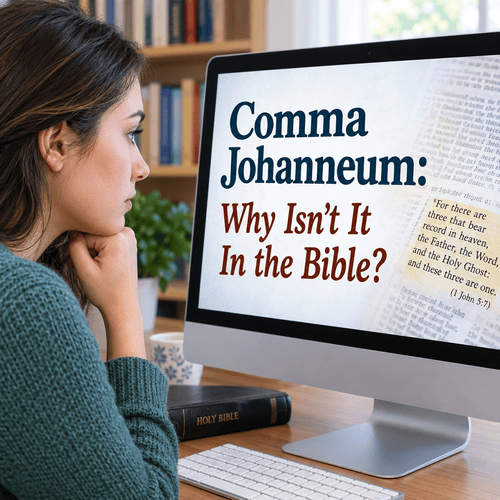
Open a King James Bible at 1 John 5:7. You’ll find the clearest statement of the Trinity in the whole Bible. Three Persons. One God. One sentence. Nothing else in Scripture says it so plainly.
Now open an ESV, an NIV or a NASB. The sentence has been edited out.
So somebody is wrong, and badly wrong. Either modern translators have cut a verse out of the Word of God, or human hands added those words long ago and nobody removed them for a 1000 years. There’s no gentle middle option here.
This post walks you through the evidence in plain language.
First, what is the “Johannine Comma”?
The name sounds technical. It’s not.
- “Johannine” simply means “belonging to John”. It refers to John, the apostle who wrote this letter.
- “Comma” here has nothing to do with punctuation. It comes from the Greek word komma, which means a short piece of a sentence—a clause.
So “the Johannine Comma” just means “the short clause in John’s letter”. Scholars also call it the Comma Johanneum. Both names mean the same thing.
Here’s what’s actually in dispute.
| TRANSLATION | WHAT 1 JOHN 5:7-8 SAYS |
|---|---|
| King James Version (1611) | For there are three that bear record in heaven, the Father, the Word, and the Holy Ghost: and these three are one. And there are three that bear witness in earth, the Spirit, and the water, and the blood: and these three agree in one. |
| English Standard Version | For there are three that testify: the Spirit and the water and the blood; and these three agree. |
The disputed words are the ones about the three witnesses in heaven. Everything else in the passage is agreed by everybody. The argument is about roughly 24 Greek words.
3 simple facts before we start
To weigh the evidence we need 3 facts about how the Bible has reached us.
- We don’t have the originals. The sheets John wrote on decayed long ago. What God gave us instead is an enormous number of hand-written copies. This is how He has preserved His Word.
- John wrote in Greek. So Greek copies are the primary witnesses. Latin copies are translations, one step further from the author.
- The early pastors quoted the Bible constantly. If a verse was in their Bibles, they quoted it—especially when it helped them win an argument. Keep this third point in mind. It’s the hinge of the whole case.
Evidence 1: 13 centuries of Greek silence
About 500 hand-written Greek copies of 1 John have survived. Roughly 9 of them contain the Comma.
9 out of 500 is striking enough. The detail is far worse than the number.
- No Greek copy before the 1300s has the words in the text. Not 1. The 2 great complete Bibles from the 300s, Codex Sinaiticus and Codex Vaticanus, don’t have them. Neither does Codex Alexandrinus. Neither does any papyrus.
- 4 of the 9 don’t really count. In the manuscripts numbered 88, 221, 429 and 636, the words aren’t in the text at all. Somebody has written them in the margin, in handwriting from the 1500s. That’s a reader’s note added later, not Scripture copied from an older book.
- The earliest Greek copy with the words in the text is manuscript 629, from the 1300s. It’s a 2-language book, Latin down 1 column and Greek down the other, and its Greek has been quietly adjusted to match the Latin.
- 1 of the others, Codex Montfortianus, was written around 1520. That’s after the printing press and after Columbus crossed the Atlantic. We’ll meet it again shortly.
Now widen the search. Within a few centuries the New Testament was translated for the churches of Syria, Egypt, Armenia, Georgia and Ethiopia. Each translation is an independent witness to what the Greek said at the time.
| WITNESS TO THE TEXT | DOES IT CONTAIN THE COMMA? |
|---|---|
| Greek manuscripts before AD 1300 | No—none at all |
| Syriac (Peshitta and Harklean) | No |
| Coptic, in both Egyptian dialects | No |
| Armenian, Georgian, Ethiopic, Arabic, Slavonic | No |
| Earliest Latin copies (before about AD 600) | No |
| Later Latin copies (from about AD 800 onwards) | Yes, increasingly |
| Greek manuscripts after AD 1300 | 9 of about 500 |
Read down the right-hand column. The word “yes” appears only in Latin, and only late. That single pattern is the shape of the whole problem.
Evidence 2: The silence that shouts
This is the argument that settles the matter, and it’s one most readers have never heard.
In about AD 318, a preacher in Egypt named Arius began teaching that the Son of God was a created being—the highest of all creatures, but still a creature, and not God in the full sense. The church was thrown into a century of conflict. Councils met at Nicaea in 325 and at Constantinople in 381. Pastors were exiled. Emperors changed sides. It was the fiercest doctrinal war the church has ever fought.
The men who defended the deity of Christ wrote in Greek: Athanasius of Alexandria, Basil of Caesarea, Gregory of Nazianzus, Gregory of Nyssa, Cyril of Alexandria, John Chrysostom. They ransacked the Scriptures for every verse that would serve, arguing over single word and single letter.
Not 1 of them ever quotes the Johannine Comma. Not once, in a 100 years of writing. The councils never quote it. The creeds never quote it. Greek writers even quote 1 John 5:8—the very next line—and stop precisely where the Comma would begin.
THE QUESTION WITH NO GOOD ANSWER
If the words “the Father, the Word, and the Holy Spirit: and these three are one” stood in every Greek Bible of the fourth century, then during the greatest battle ever fought over the Trinity, every defender of the Trinity forgot to use the one verse that would have ended the argument on the first page.
There are only 2 ways to explain this.
Either the whole Greek-speaking church somehow mislaid its single most useful verse and nobody complained—or the verse was never there.
Silence is often weak evidence. This isn’t ordinary silence. It’s silence from the men who needed the verse most, at the moment they needed it, in the language it was supposedly written in.
Evidence 3: We can watch the words being born
If the Comma was added, an obvious question follows: added by whom? And how? Here the trail is unusually clear, and it leads to the Latin-speaking churches of North Africa and Spain.
Latin preachers loved to find hidden pictures in the text. In 1 John 5:8 the apostle says three things testify: the Spirit, the water and the blood. So they said: three witnesses, and they’re one—there is a picture of the Trinity.
How the clause entered the Bible: a timeline
- About AD 200-250—Tertullian and Cyprian. Both read verse 8 as a symbol of the Trinity. Cyprian writes it’s written of the Father, Son and Holy Spirit, “and these 3 are one”. This is the strongest card the other side holds. But he’s not quoting the heavenly witnesses. He’s quoting the symbolic reading of the earthly ones.
- About AD 380—Priscillian. The first person to quote the words clearly as Scripture. He was a Spanish bishop later executed for heresy, and his wording sits in a different order from ours.
- About AD 400—Augustine. The decisive moment. Augustine writes a long book against an Arian bishop named Maximinus. He needs Trinity texts desperately. He turns to 1 John 5, and argues from the symbolic reading of spirit, water and blood. Had the Comma been in his Bible he had every reason to quote it. He didn’t, because it wasn’t there.
- AD 484—Carthage. African bishops, under pressure from Arian rulers, place the words in a written confession of faith. From here they begin to look official.
- AD 546 and about AD 700—Fuldensis and Amiatinus. The 2 finest early copies of Jerome’s Latin Vulgate still lack the Comma. Fuldensis is remarkable: it carries a preface accusing careless translators of dropping the heavenly witnesses, then prints the passage without them.
- AD 800-1200—the words settle in. Latin copies increasingly include them, until by the 13th century every Latin Bible in Europe has them and nobody recalls a time when they were absent.
HOW A SERMON ILLUSTRATION BECOMES A VERSE
Scribes copied by hand, and margins were working space. A preacher wrote his explanation of verse 8 in the margin. A later scribe, copying that book, couldn’t tell whether the marginal words were a note or a line accidentally left out. Wanting to be faithful, he put them into the text.
This wasn’t fraud. It was reverence making a mistake. And because the mistake made the Trinity clearer, nobody in the Latin West wanted to question it.
Evidence 4: Erasmus, and a story you’ve probably been told wrongly
In 1516, Dutch scholar Desiderius Erasmus published the first printed Greek New Testament. He left the Comma out, for the simple reason none of his Greek manuscripts contained it.
The storm was immediate. He was accused of reviving the heresy of Arius. In his third edition of 1522 he printed the words, after being shown the Codex Montfortianus mentioned above. Erasmus suspected the manuscript had been produced specifically to answer him.
Legend has it that Erasmus made a rash promise, swearing to print the verse if 1 Greek manuscript could be produced. It makes a wonderful story. Historian Henk Jan de Jonge, however, examined the sources and found no evidence of any such promise. It’s a legend, and we should not use arguments that are untrue even when they help our case.
From Erasmus the words passed into the editions of Robert Stephanus and Theodore Beza, and from those into the Greek text used by the King James translators in 1611. Nothing was concealed along the way. The men of that era knew the reading was contested. They simply had very little material with which to test it.
“But the Greek grammar needs it!”—the best objection, answered
Greek words have a gender. Every noun is either masculine, feminine or neuter—a bit like calling something “he”, “she” or “it”.
Now look at verse 8. The 3 earthly witnesses are the spirit, the water and the blood. In Greek, all 3 of those words are neuter. They’re “its”. But when John introduces them, he doesn’t use the “it” form. He writes “three that testify” using the masculine form, as though he were pointing at 3 men.
That’s odd. So defenders of the Comma say: this oddness is a wound. Something masculine has been cut out of the sentence, and we know exactly what—”the Father” and “the Word”. It’s a clever argument. But it doesn’t survive a close look.
- Greek writers personify things constantly. When things act like persons, they’re spoken of like persons. The 3 are witnesses in a courtroom, and witnesses are people. The masculine form fits the picture.
- John himself breaks the supposed rule 2 verses earlier. In verse 6 he speaks of the Spirit using the neuter. So he’s plainly not bound by any fixed pattern in this passage.
- The decisive answer: the mismatch appears everywhere. Verse 8 reads this way in every manuscript we possess, including the hundreds that never contained the Comma. A feature found in all copies is the author’s style, not a scar left by missing words.
- And it doesn’t even solve the problem. Print the Comma, and verse 8 still uses the masculine for the earthly 3. The supposed cure leaves the supposed disease exactly where it was.
There’s a second problem, and it’s about meaning rather than grammar. Read the passage as a whole:
This is he who came by water and blood—Jesus Christ; not by the water only but by the water and the blood. And the Spirit is the one who bears witness, because the Spirit is the truth. (1 John 5:6, ESV)
John is answering false teachers who denied Jesus Christ truly came in the flesh, in water and in blood. His whole argument is about the testimony borne to Jesus. 3 heavenly Persons testifying about their own unity doesn’t advance that argument. It interrupts it. The passage runs better without the clause, not worse.
What our own forefathers said
Here we must be careful, because the history doesn’t run entirely in our favour.
- John Calvin accepted the clause, but visibly uneasily. In his commentary he observes the Greek copies don’t agree, and says he dare not assert anything about it. He kept it mainly because he thought the sentence read more smoothly with it.
- Theodore Beza printed it in his Greek editions, which shaped the English Bible for centuries.
- Francis Turretin defended its genuineness in his great work of theology.
Should that settle the question? No—and the reason why is important.
Calvin died in 1564. Codex Sinaiticus wasn’t discovered until 1844, and the Syriac, Coptic and Armenian evidence was unavailable to him. He had a handful of late copies and a Latin tradition a 1000 years deep. Given that, his hesitation was remarkably honest.
More importantly, their own principle leads us where we now stand. Rome defended the Comma by pointing to the Latin Vulgate and the authority of the church. The Reformers answered: go back to the original languages, and let the text be judged by the witnesses God has preserved. That’s exactly what we’re doing, with the evidence they longed to have.
The direction of travel in our own tradition is clear. Charles Hodge and BB Warfield defended the full inspiration of Scripture as vigorously as anyone ever has, and both rejected the Comma. Warfield saw no tension. If you believe God gave His very words, you should want those words alone, and no others.
Does this break “kept pure in all ages”?
For many readers this is the real question. The Westminster Confession of Faith says the Scriptures in Hebrew and Greek were “immediately inspired by God, and by His singular care and providence kept pure in all ages”. The same words appear in the Baptist Confession of 1689.
Some argue this must mean the printed Greek text of the Reformation era is flawless, so the Comma must be genuine; remove it, and the Confession falls. Read the sentence again slowly. It doesn’t say what that argument needs it to say.
| WHAT THE CONFESSION PROMISES | WHAT IT DOESN’T PROMISE |
|---|---|
| That God has preserved His Word in Hebrew and Greek, the original languages | That any one printed edition is perfect in every letter |
| That the church has always had the authentic text available to it | That no copy ever contains a slip or an addition |
| That no doctrine has been lost or corrupted in transmission | That we may never compare copies and correct a reading |
| That Scripture, not the church, is the final authority | That a decision made in 1611 can never be revisited |
The Confession makes a promise about God’s care over the whole stream of copies. It never names Erasmus, Stephanus or Beza, and it never declares a printing house infallible.
3 points make this plain.
- The men who wrote the Confession knew about variant readings. The Stephanus edition of 1550, sitting on their desks, printed a margin listing Greek copies that lacked this very verse. They knew, and they didn’t conclude purity had failed.
- Historian Richard Muller has shown 17th-century theologians never claimed one printed edition was flawless. They spoke of the text preserved in the copies taken together—a body of evidence, not one book on one shelf.
- If one printed edition were perfect, which one? Those editions differ from each other in hundreds of places, and several don’t contain this verse at all. We must still choose—and choosing between copies is the very activity the objection was meant to forbid.
Preservation promises that God keeps His Word safe for His church. It doesn’t promise He does so through one printer in one century.
The doctrine doesn’t need the verse
Now to the heart of it. Many believers fear losing 1 John 5:7 weakens the Trinity. It doesn’t weaken it by a gram.
| WHAT SCRIPTURE TEACHES | WHERE IT SAYS SO | THE WORDS THEMSELVES |
|---|---|---|
| Three Persons named together as one divine name | Matthew 28:19 | baptising them in the name of the Father and of the Son and of the Holy Spirit |
| Three Persons in one blessing | 2 Corinthians 13:14 | The grace of the Lord Jesus Christ and the love of God and the fellowship of the Holy Spirit be with you all |
| The Son is God, and is distinct from the Father | John 1:1 | the Word was with God, and the Word was God |
| The Son and the Father are one | John 10:30 | I and the Father are one |
| The Holy Spirit is God | Acts 5:3-4 | You have not lied to man but to God |
| One God, in three, across the life of the church | Ephesians 4:4-6 | one Spirit… one Lord… one God and Father of all |
All quotations are from the ESV. Remove 1 John 5:7 and every line of this table stands untouched.
Then there’s the historical argument, which is the strongest of all. The Nicene Creed was written by men who’d never seen the Johannine Comma. The doctrine of the Trinity was defined and secured in Greek, by pastors reading Greek Bibles without this clause, in the middle of the most savage doctrinal conflict in Christian history. They won without it.
THE POINT TO REMEMBER
A verse that played no part whatever in winning the battle for the Trinity cannot possibly be the foundation of the Trinity.
The doctrine doesn’t rest on one sentence. It rests on the entire weight of Scripture, pressing in from Genesis to Revelation. That’s why it survived the loss of a verse it never had.
So why is this argument back in the news?
Because two quite different revivals of interest are happening at once, and they’re often confused with each other.
In the universities
Grantley McDonald’s study Biblical Criticism in Early Modern Europe (Cambridge University Press, 2016) traced the whole social and political history of this clause—Erasmus, Luther, Calvin, Isaac Newton and the rest. Meanwhile a vast new critical edition of the Greek letters has given this generation more information about the text of 1 John than any before it. The academic verdict hasn’t softened. It has only hardened.
In the churches
A movement often called Confessional Bibliology argues the churches of the Reformation received a particular Greek text, and that our doctrine of preservation obliges us to keep it. Around it have grown conferences and books: “Kept Pure in All Ages” in Wisconsin in 2022, the ongoing Text and Translation conferences, the Reformation Bible Society conference of 2024, the essay collection Why I Preach from the Received Text edited by Jeffrey Riddle and Christian McShaffrey (2022), and Taylor DeSoto’s The Received Text: A Field Guide (2024).
These aren’t the old, angry King James Only fundamentalism, and it is unfair to treat them as though they were. They’re confessional men, often faithful pastors, making a theological argument about providence. They deserve a serious answer. Here’s that answer, in a single observation.
30 YEARS OF ARGUMENT, AND NOT ONE MANUSCRIPT
Through all this renewed activity, no new Greek witness to the Comma has been discovered. Not one. The number of pre-1300 Greek manuscripts containing these words is exactly what it was a century ago: zero.
The case has therefore moved off the evidence and onto the doctrine of preservation. That move is itself a key testimony in the whole debate about where the evidence stands.
Note too the pushback isn’t coming from unbelieving scholars. In 2026 Timothy Decker, a Baptist pastor who holds the 1689 Confession, published a detailed series arguing against the Comma and engaging the confessional case directly. This is a conversation inside the family, and it should be conducted that way.
The other reason for renewed interest is simply public exposure. Since textual criticism reached mainstream audiences in 2025, ordinary Christians have begun asking about manuscripts, and the Johannine Comma is almost always their first question. We should be ready with a clear answer.
So, should 1 John 5:7 be in our Bibles?
No. And that answer costs us nothing we should want to keep.
- Nothing is lost. Every doctrine remains. The Trinity stands on dozens of passages, and always did.
- Something is gained. Adding to God’s Word is as serious as taking from it. Moses warned Israel not to add to what God commanded (Deuteronomy 4:2), and the warning closing Revelation cuts both ways. Keeping words God never gave isn’t reverence. It’s presumption dressed as piety.
- Our witness is strengthened. When a Muslim, a sceptic or a cult member says “you Christians invented a Trinity verse”, we no longer have to defend the indefensible. We can say: yes, some Latin Christians added a sentence in about the fourth century; Christian scholars detected it, and Christian publishers removed it. Our doctrine never rested on it for a day.
The scribe who first wrote those words in a margin was trying to help. He believed the Trinity, and he wanted his reader to see it in the text. We can honour his intention and still correct his mistake.
God didn’t need an added sentence to tell us who He is. He told us on every page.
Tough Questions, Honest Answers
Why is it called a “comma” if it isn’t punctuation?
The word comes from the Greek komma, which means a short section of a sentence—what we would call a clause. Ancient writers used it as a unit of measurement for prose, rather like a line of poetry. So “the Johannine Comma” means nothing more dramatic than “that short clause in John”. You will also see it written as the Comma Johanneum, which is the same phrase in Latin. It is an unfortunate name, because it makes a straightforward question sound like something only specialists may discuss. Any Christian can weigh this evidence.
Did Isaac Newton really write about this verse?
He did. In 1690 Newton sent a long and careful letter to philosopher John Locke, later published as An Historical Account of Two Notable Corruptions of Scripture. He argued that 1 John 5:7 and a reading in 1 Timothy 3:16 had been altered over time. His textual work was genuinely excellent, and his conclusion on this verse has been confirmed by everything discovered since. But we must be honest about the man: Newton privately rejected the Trinity, and he had a motive we don’t share. This is a useful lesson in careful thinking. We don’t accept his theology because his manuscript work was good, and we don’t reject his manuscript work because his theology was bad. Evidence and motive are separate questions.
Is 1 John 5:7 in Catholic Bibles today?
Generally not. The old Douay-Rheims Bible contains it, and in 1897 an office in Rome ruled its genuineness couldn’t safely be denied—a ruling quietly set aside in 1927. When Rome produced its revised official Latin Bible, the Nova Vulgata of 1979, the clause was omitted. Modern Catholic translations omit it too. This is worth knowing because it removes a misunderstanding: this is not a Protestant-versus-Catholic argument, and it is not a liberal-versus-conservative argument. Scholars across every tradition have reached the same conclusion from the same evidence.
Should I throw away my King James Bible?
Certainly not. The King James Version is a magnificent translation, made by devout and learned men, and it shaped the English language itself. Its translators did outstanding work with the manuscripts available in 1611. The issue is not the translators but the small number of late copies underlying a handful of passages. Simply learn where those passages are; a good study Bible marks them in the footnotes. If English isn’t your first language, a modern translation will usually serve you better for daily reading, because the English of 1611 is now four centuries old. No Bible in your house is dangerous, and nobody should be made to feel their Bible has failed them.
How should I answer someone who says Christians invented a Trinity verse?
Agree with the part that’s true, then show why it proves the opposite of what they think. Say plainly: yes, a clause was added to 1 John in Latin-speaking churches around the 4th century, and here’s roughly how and when it happened. Then ask the obvious question—who found the addition and removed it? Christians did. Christian scholars identified it, Christian translators took it out, and Christian publishers print Bibles today with it gone. A religion that was inventing evidence would not spend centuries auditing its own text and publishing the results. Then bring the conversation back to where it belongs: the deity of Christ rests on John 1, John 20:28, Colossians 2:9, Titus 2:13 and Hebrews 1, and not one of those is in any doubt.
Are there other passages like this one?
A few, and you should know them rather than be surprised by them later. The main ones are the last 12 verses of Mark, the account of the woman caught in adultery in John 7:53 to 8:11, the Ethiopian official’s confession in Acts 8:37, and a one-letter difference in 1 Timothy 3:16. Each has its own evidence and its own strength of case, and none of them is as clear-cut as the Johannine Comma, which is by far the weakest attested of the group. Notice something encouraging: these passages are not hidden. They are printed in the footnotes of nearly every modern Bible, which is exactly what honest publishing looks like. And no article of the Christian faith depends on any of them.
How many verses are “missing” from modern Bibles compared with the King James Version?
Around 16 whole verses appear in the King James Version as numbered verses but appear only in footnotes in most modern translations. The wording of the question, though, contains the mistake. Nothing was removed. Verse numbers were only invented in 1551, by the printer Robert Estienne, and he numbered the text that was in front of him. When later evidence showed that certain lines were not in the earliest copies, translators left the numbering alone so that every Bible reference in every commentary and sermon would still work. That is why you sometimes see a number jump. The gap is not a hole in Scripture. It is the honest scar of a correction, left visible on purpose.
Related Reads
- The Comma Johanneum: Does It Undermine Bible Reliability?
- The Allure of KJV Onlyism: Why Does It Persist?
- Solo, Prima and Sola Scriptura: Which Do We Affirm and Why?
- Do Textual Variants Undermine Bible Reliability?
- Why Are Some Bible Verses “Missing”? The Truth Behind Those 16 Absent Passages
- New Testament Reliability: Debunking Myths and Lies